The prophecy is more than seeing into the future. For the prophecy sees without the element of time. For the prophecy sees things as they were, as they are, and as they always shall be.
When Iraq’s prime minister, Haider al-Abadi,
failed again this week to replace his corrupt cabinet with a new breed
of reformists, the impact reverberated far beyond Baghdad.
A hundred miles south, in Najaf, ayatollah Ali Sistani seethed with
anger. The 86-year-old cleric, the most revered figure among Iraq’s
majority Shia sect, has staked his name on Abadi establishing some form
of control over the country’s political class and the powerful presence
of its neighbour Iran.
Across the border, in the Iranian shrine city of Qom, the failure was
also noted, though not with the same concern. For more than 13 years,
Iran has been an essential stakeholder in Baghdad. But in the past three
years in particular, it has had more role shaping political outcomes
than many of Iraq’s most influential players.
After Abadi’s second capitulation in a fortnight, senior officials
close to Sistani say he is fast losing hope that the leader he helped appoint in late 2014
can deliver reforms he believes are essential to the survival of the
state of Iraq. Worse still, perhaps nobody else can either.
In the decade-plus since the ruthless order of Saddam Hussein’s dictatorship was overthrown, Iraq is being torn apart by a convergence of crises that many observers say make it all but ungovernable.
Rampant corruption by a political class, appointed on sectarian
lines, has seen the country plundered of enormous wealth that record
pumping of oil can’t come close to making up for – especially with oil prices 70% lower than the heady highs of three years ago.
Add to that a withering war with Islamic State, which has shredded
Iraq’s military, sacked some of its cities, imperilled its borders and
exposed the fragility of post-Saddam authority, and there seems little
hope that Iraq can secure a sovereign footing.
This concern is central to Sistani’s angst. Najaf has long been his
power base, and a centre of gravity for Shia Iraqi nationalists, whom
Sistani overwhelmingly leads. Qom, meanwhile, especially since the
Islamic Revolution of 1979, has become a symbol of Iran’s theological
and political projection.
Since 2003, the two centres of Shia learning have been rival power
bases, but never more so than now. Sistani, apolitical throughout his
life, now finds himself pitched against Iran’s Shia leader, ayatollah
Ali Khamenei, in a tussle to define Iraq’s national character.
“This is something that has underpinned every administration over the
last decade or so, but it has become more acute, more pointed since
2010,” said Ali Khedery, a former adviser to US ambassadors to Iraq and
military chiefs.
“Sistani is now very aware that the extent of Iranian influence has
reached new levels. This is about power and influence. This is about
taking control of what remains of the state.”
As Abadi has struggled to impose his will, the leader he replaced in
late 2014, Nouri al-Maliki, has been steadily reaccumulating power. The
Shia militias, who have been organised under the banner of the Popular
Mobilisation Front (PMF), report to him, and he is especially close to
Iran
“He has been set up by Iran like a scarecrow for Abadi,” the former
vice-president Iyad Allawi told the Guardian earlier this year. “There
is not much that he can do about him.”
The PMF continues to play a dominant role in many of the clashes
against Isis across much of Iraq, often having primacy over the Iraqi
army. Nearly all of the PMF’s factions are led by men who are proxies of
the Iranian Revolutionary Guards.
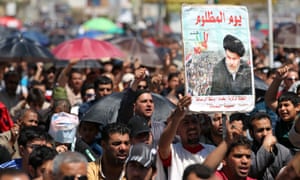
A picture
of Moqtada al-Sadr is held up at a protest against corruption in Sadr
City, Baghdad. Photograph: Ahmad Al-Rubaye/AFP/Getty Images
Abadi’s latest attempt to appoint a cabinet of technocrats,
supposedly at arm’s length from the sectarian quota system that has led
to ministries being used as personal fiefdoms, and wealth being hoovered
up by a rigid patronage system, came after Sadr set up a protest camp inside Baghdad’s green zone.
Abadi, meanwhile, who Sistani had believed could somehow turn it all
around, seems less likely than ever to deliver. Iraq’s political class
remains vested in a sectarian system that has enriched it, and Abadi has
next to no room to manoeuvre.
“What that means for Sistani is that his command of the street, which
has remained unquestioned throughout all this, could be tested for the
first time,” said one senior Iraqi official who refused to be named.
“He gave the fatwa to raise the militias in June 2014 and in doing
so, he gave Iran cover. He now knows what that meant. It was an
invitation for them to take over in many ways. If Abadi stays, it is bad
for Sistani and for Iraq, but if he goes, it could be much worse.”