
Showing posts with label ten. Show all posts

Friday, June 29, 2018

Canada Will Become a Nuclear Horn (Daniel 7:7)

Hmmm... what if Canada wants nuclear weapons?

Jazz ShawPosted at 1:01 pm on June 16, 2018

Did you happen to catch this tweet from the editors at the Ottawa Citizen, the largest daily newspaper in Ottawa, Canada?
That certainly caught the attention of a number of people. Was it satire? Some hint regarding a change in official Canadian policy toward nuclear arms? Reading the full editorial it sounds like neither, but they’re raising a provocative question. What if Canada, having become so distressed by the election of President Trump, fired up their own nuclear weapons program? They certainly have most of the required technical capability if they decided to do it.
As U.S. president Donald Trump thumps Canada with an out-of-the-blue trade war, he is simultaneously cozying up to a nuclear-armed North Korea: Saluting their generals, flattering their dictator and even making them fake movie trailers.
For Canadians watching all this is, a natural question is: What if we got some nuclear weapons, too?
“Your world would change,” said Mitchell Reiss, a former director of policy planning at the United States Department of State.
The action would be so needlessly provocative that it would likely result in Canada’s immediate ejection from NATO.
This was clearly dreamed up as a creative way to insult the American president and draw some clicks. The editors note at the top that they spoke to a number of sources in both countries and each and every one of them thought, “a Canadian nuclear bomb is an unbelievably terrible idea that is bad for everyone in almost every way.”
But since one of their leading newspapers decided to bring it up, let’s bat that idea around for a moment. They’ve got plenty of uranium to spare and nuclear engineers. (They have one of the largest nuclear power plants in the world.) They’ve made reactors in the past capable of producing weapons-grade plutonium. And it seems unlikely that they couldn’t find somebody up there who knows how to design a bomb. (Or they could import some talent.) All the really hard work is already done. They’re not that many steps away from a bomb if they really want one.
But would they? Bombastic editorials aside, if the Canadians decided to force their way into the nuclear clubhouse they would immediately become a player on that part of the stage. One of the reasons that Canada has had such an easy ride on the military front for the past seventy years or more is that they live next door to the United States. Nobody in the world would dream of attacking them so they haven’t needed to invest all that much in their military. When you live next door to and are best buddies with the heavyweight champion you don’t worry about getting into too many fights.
I’m sure Canada would like to maintain the status quo in that regard rather than taking on the cost and responsibility of maintaining a full, nuclear-capable military infrastructure. Right, Canada? I mean, you wouldn’t want anything to happen to our special relationship, would you? Instead of an exit question we’ll just have an exit tweet.

Monday, June 18, 2018

The Canadian Nuclear Horn (Daniel 7:7)

NOTE: Just to be clear, all sources quoted in this story think a Canadian nuclear bomb is an unbelievably terrible idea that is bad for everyone in almost every way. 
As U.S. president Donald Trump thumps Canada with an out-of-the-blue trade war, he is simultaneously cozying up to a nuclear-armed North Korea: Saluting their generals, flattering their dictator and even making them fake movie trailers.
For Canadians watching all this is, a natural question is: What if we got some nuclear weapons, too?
“Your world would change,” said Mitchell Reiss, a former director of policy planning at the United States Department of State.
The action would be so needlessly provocative that it would likely result in Canada’s immediate ejection from NATO.
A Canadian A-bomb would also violate a whole host of international agreements. As soon as word got out about a Canadian effort to build nuclear weapons, Ottawa could expect to see the evaporation of whole webs of alliances and trading partnerships.
A nuclear-armed Great White North “would change the national character and how the world views Canada,” said Reiss.
However, a Canadian bomb is indeed possible. Canada is among an elite fraternity of countries that do not possess nuclear weapons, but could build them relatively easily if they wanted to.
This has been true since at least the 1950s. Canada was a critical partner in the Manhattan Project, the U.S. effort to build an atomic bomb during the Second World War.
Canadian technology was also key to another country’s development of a nuclear bomb. In 1974, India detonated their first nuclear weapon using plutonium that was clandestinely made in a donated Canadian research reactor.
Nevertheless, Canada has a long history of eschewing atomic weapons for itself. The country has never tested an atomic bomb, nor considered acquiring a nuclear arsenal.
In a 1978 speech to the United Nations, then-Prime Minister Pierre Trudeau referred to Canada as the “first country in the world with the capability to produce nuclear weapons that chose not to do so.”
This isn’t to say that Canada hasn’t dabbled with nuclear weaponry. For a 20-year period during the Cold War, up to 200 U.S.-controlled warheads were stored at Canadian military bases for use in an all-out war with the Soviet Union.
However, the country has been entirely nuclear-free since 1984, when Canada returned the last batch of Genie nuclear-tipped missiles to the Americans. Ever since, Canada has pursued a policy of increasingly strict non-proliferation.
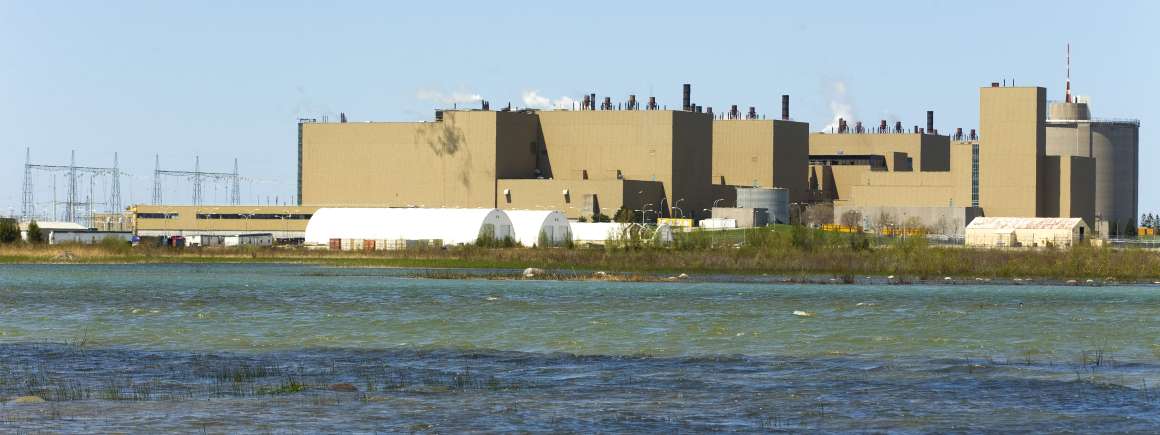
On the face of it, Canada has all the ingredients to become a nuclear-armed state: Ample uranium, plenty of engineering talent and a robust nuclear power sector. Ontario’s Bruce Nuclear Generating Station, in fact, is the world’s largest nuclear power plant.
What’s missing, though, are the facilities needed to make weapons-grade nuclear fuel, be that plutonium or enriched uranium.
The Bruce nuclear plant. Nuclear, nuclear everywhere, but not a drop that’s weapons-grade.Mike Hensen/The London Free Press/Postmedia Network
John Luxat is the director of the Hamilton-based Centre for Advanced Nuclear Systems. He estimated that it would take “years” for Canada to develop the capability to build its own nuclear weapons.
“The knowledge Canada has acquired over the decades posy-WWII, while substantial, has always been focused on the commercial nuclear power arena, and really does not give us an advantage with respect to the resources and time required to establish nuclear weapons complexes,” he wrote in an email.
To enrich uranium, Canada would need to build extremely costly complexes of centrifuges requiring specialized materials, such as high-strength aluminum. By the mere act of purchasing such materials, Canada would immediately tip off the international community that it was up to something.
The F-104 Starfighter, the Canadian jet that would have carried U.S. nuclear missiles in the event of nuclear war.Perry Mah/Edmonton Sun/QMI Agency
Rogue nations like North Korea or Iran have evaded this problem by simply acquiring materials illegally — and sealing off their borders to nuclear inspectors. Even then, said Luxat, “establishing such a facility takes many years.”
Canada would also have the option of building a facility to separate plutonium from its vast stores of spent nuclear fuel.
“Only 1% of the spent fuel is plutonium. So tons of spent fuel would have to be processed to get enough plutonium for a weapon,” said Leonard Spector with the Washington, DC-based James Martin Center for Nonproliferation Studies.
This too takes time, and it would similarly be hard to keep it a secret. As Spector noted, all spent nuclear fuel is monitored by the International Atomic Energy Agency.
In short, the only way Canada could develop a bomb in secret would be to somehow acquire rogue nuclear technology and operate it in secret. While this might be relatively simple for an isolated authoritarian state, it’s next to impossible for a democracy with extremely close defence ties to the United States.
The U.S. has historically frowned upon all foreign nuclear proliferation, even from allies. In the 1960s, for instance, U.S. pressure was key in shutting down the Swedish effort to build an atomic bomb.
As a result, it’s entirely likely that the mere act of trying to go nuclear would attract waves of punitive U.S. trade barriers.
There’s also the problem of delivery systems. The Canadian military is unable to perform plenty of conventional tasks, not to mention the considerable logistical challenge of launching a nuclear war.
A Russian submarine tests a nuclear-capable missile on May 22, 2018. Canada can’t do anything like this.AP Photo/Russian Defense Ministry Press Service
Any development of a Canadian nuclear bomb would be delayed by the fact that it would need to be small enough to fit aboard a CF-18. Canada has no dedicated bombers, long-range missiles or nuclear weapons-capable submarines.
However, Reiss noted that delivery systems might be a moot point if Canada’s ultimate adversary was his home country.
“You could put it on an oxcart and push it across the border,” he said.

Thursday, August 31, 2017

The Canadian Nuclear Horn (Daniel 7:7)


Dolgert: Here’s why Canada should get nuclear weapons

Protest At Nuclear Research Lab Marks Anniversary Of Hiroshima And Nagasaki LIVERMORE, CA - AUGUST 09: Protesters stage a die-in during a demonstration against nuclear weapons outside of the Lawrence Livermore National Laboratory on August 9, 2017 in Livermore, California. Dozens of protesters staged a demonstration at the Lawrence Livermore National Laboratory to mark the 72nd anniversary of the atomic attack on Hiroshima and Nagasaki. An estimated 50 protesters were arrested by Lawrence Livermore Laboratory police for illegal assembly in front of the laboratory. (Photo by Justin Sullivan/Getty Images) Justin Sullivan, Getty Images
Dozens of protesters staged a demonstration at the Lawrence Livermore National Laboratory to mark the 72nd anniversary of the atomic attack on Hiroshima and Nagasaki. Justin Sullivan, Getty Images JUSTIN SULLIVAN / GETTY IMAGES
Dear Prime Minister Trudeau,
Please consider inaugurating a nuclear armament program. Please begin this process now.
I never imagined writing something like this. American by birth, but now also a Canadian citizen, I’ve always regarded the bombing of Hiroshima and Nagasaki as a stain on my birth nation’s honour. But the time has come to face reality, and the foreign minister’s June speech reasserting Canadian sovereignty is only the beginning of the reckoning.
We are in many ways living through a replay of the 1930s: a world struggling in the wake of economic cataclysm, fascists rising across Europe and an authoritarian in power (this time in the United States) cultivates support from the radical right.
Tyranny is on the march, and there is no clear end-point in sight. We can no longer assume that our country’s safety is assured, and even proposals for anti-missile defence don’t go far enough because they assume a democratic U.S. – the very thing that is now in question.
Alarmist? Maybe. But the consequences of a misstep now — the 21st-century equivalent of 1933, the year of Hitler’s ascendance — are dire, and we can’t regain later the time that we lose now. Nuclear programs take time to initiate, and in order to be prepared for our version of 1939 (the start of the Second World War), we cannot allow these to be “the locust years,” as Winston Churchill described the time wasted between 1933 and 1939.
So this is 1933. Start the countdown.
America is on a quest to demonize Muslims, round up Mexican immigrants, restrict trade, break up NATO and help Vladimir Putin divvy up the world. If you want to understand Donald Trump’s foreign policy, think “Mafia Protection Racket.” Just change the little shop-owners, forced to pay up, into little nations across the globe.
Canada is a small shopkeeper not so well-positioned to resist this new racket.
To understand what it’s like being beside a bully in today’s world, look at Ukraine. Perhaps the greatest mistake that country made after the breakup of the USSR was to get rid of its nuclear weapons. The consequences? Russia seizes Crimea and effectively invades eastern Ukraine by arming Russian secessionists there. This could also happen to Latvia and the Baltic states.
Could it happen here? For more than a century, Canadian policy could assume that, while the U.S. might be an 800-lbs gorilla on our doorstep, at least the gorilla played by the rules. But Trump has said the old rules won’t apply, and his selection of white nationalists and conspiracy theorists to powerful roles in his administration indicates he is not kidding.
Most troublingly, recent Congressional Republican capitulation on “L’Affaire Russe” shows us that the famed “checks and balances” of the U.S. Constitution mean little, and that the path to American authoritarianism is wide open.
To plan for the day when the U.S. is more like Putin’s aggressive bear, Canada must be able to protect itself without anyone’s assistance. A conventional military buildup is nonsensical, given the size disparity between the U.S., Russia, and ourselves.
But as Israel, Pakistan and North Korea have shown, nuclear arms are a pragmatic deterrent for small nations adjacent to populous neighbours of uncertain motives.
Yes, this might provoke the ire of Trump or Putin, and hasten the conflict it means to stave off. That risk must be carefully weighed. But what do you think Ukraine would do, given the chance to go back and keep its nukes?
Was Ukrainian disarmament rewarded with Russian pacifism? Who, other than Putin, is Trump’s model for strong leadership? And, speaking of Putin, who is looking to contest Canada’s future Arctic claims? If you think Trump will support us against Russia’s coming provocations, think again.
Rather than trigger a crisis, I expect this strategy would preserve the peace, by forcing potential aggressors to acknowledge a far more potent Canadian response.
To be clear, I am not suggesting that America is our enemy. Canada just needs to prepare to ensure its own security in an uncertain world, which requires having the resources to face any potential future conflict.
Starting a nuclear program is not easy. It takes time and research to determine the most practical options for Canada. It will also require withdrawing from the nuclear non-proliferation treaty, a step with major ramifications that requires careful consideration.
Importantly, however, we should not think that such a program would be inherently “un-Canadian.” For two decades, during the Cold War, we had up to 450 nuclear warheads permanently stationed on Canadian bases (though these were not under exclusive Canadian control). We need to trust in ourselves even more now, and stop relying on others to protect us.
Maybe I’m being alarmist. Maybe. But at what point does alarmism become prudence? Not when an aggressor makes the first overt threats – by then it’s too late. If 1933 (i.e. now) is too soon, then when? At some point we must be ready to start the discussion about protecting ourselves, and three years’ grace is about the best we can hope for.
After that we have to rely on the United Kingdom or United States to bail us out … Oh, wait.
Stefan Dolgert is an associate professor in the department of Political Science at Brock University in St. Catharines, and can be found on Twitter @PosthumanProf.

Wednesday, March 1, 2017

An Unprecedented Alliance (Daniel 7:7)

By John Irish and Andrea Shalal | MUNICH
Saudi Arabia and Israel both called on Sunday for a new push against Iran, signaling a growing alignment in their interests, while U.S. lawmakers promised to seek new sanctions on the Shi'ite Muslim power.
Turkey also joined the de facto united front against Tehran as Saudi and Israeli ministers rejected an appeal from Iranian Foreign Minister Mohammad Javad Zarif for Sunni Gulf Arab states to work with Tehran to reduce violence across the region.
While Saudi Arabia remains historically at odds with Israel, their ministers demanded at the Munich Security Conference that Tehran be punished for propping up the Syrian government, developing ballistic missiles and funding separatists in Yemen.
International sanctions on Iran were lifted a year ago under a nuclear deal with world powers, but Republican senators said at the conference they would press for new U.S. measures over the missiles issue and Tehran's actions to "destabilize" the Middle East.
He sidestepped a question about Israel's call for concerted action with Sunni Arab states amid growing speculation that the two countries could normalize relations and join forces to oppose Tehran, much as Turkey has done.
The six Arab members of the Gulf Cooperation Council (GCC), especially Saudi Arabia, accuse Iran of using sectarianism to interfere in Arab countries and build its own sphere of influence in the Middle East. Iran denies the accusations.
"Iran remains the single main sponsor of terrorism in the world," Adel al-Jubeir told delegates at the conference. "It's determined to upend the order in the Middle East ... (and) until and unless Iran changes its behavior it would be very difficult to deal with a country like this."
Al-Jubeir said Iran was propping up the government of President Bashar al-Assad in the Syrian civil war, funding the Houthi movement in Yemen and fomenting violence across the region.
The international community needed to set clear "red lines" to halt Iran's actions, he said, calling for banking, travel and trade restrictions aimed at changing Tehran's behavior.
"The real division is not Jews, Muslims ... but moderate people versus radical people," Lieberman told delegates.
Turkish Foreign Minister Mevlut Cavusoglu also criticized what he called an Iranian "sectarian policy" aimed at undermining Bahrain and Saudi Arabia.
"Turkey is very much against any kind of division, religious or sectarian," he said. "It's good that we are now normalizing our relations with Israel."
Zarif opened Sunday's session with the call for dialogue to address "anxieties" in the region. This followed a visit by Iranian President Hassan Rouhani to Oman and Kuwait last week to try to improve ties, his first visit to the Gulf states since taking power in 2013.
Asked if Iran's envisioned regional dialogue could include Israel, Zarif said Tehran was looking at a more "modest" approach. "I'm focusing on the Persian Gulf. We have enough problems in this region so we want to start a dialogue with countries we call brothers in Islam," he said.
Zarif dismissed any suggestions his country would ever seek to develop nuclear weapons. When asked about the new U.S. administration's tough rhetoric on Iran's role in the region and calls to review the nuclear deal, he said Tehran did not respond well to threats or sanctions.
U.S. Senator Lindsey Graham, a South Carolina Republican, said he and other senators were preparing legislation to further sanction Iran for violating U.N. Security Council resolutions with its missile development program and other actions.
Senator Christopher Murphy, a Democrat and member of the Senate Foreign Relations Committee, said Washington needed to decide whether to take a broader role in the regional conflict.
"We have to make a decision whether we are going to get involved in the emerging proxy war in a bigger way than we are today, between Iran and Saudi Arabia," he said.
(Additional reporting by Vladimir Soldatkin; editing by David Stamp)