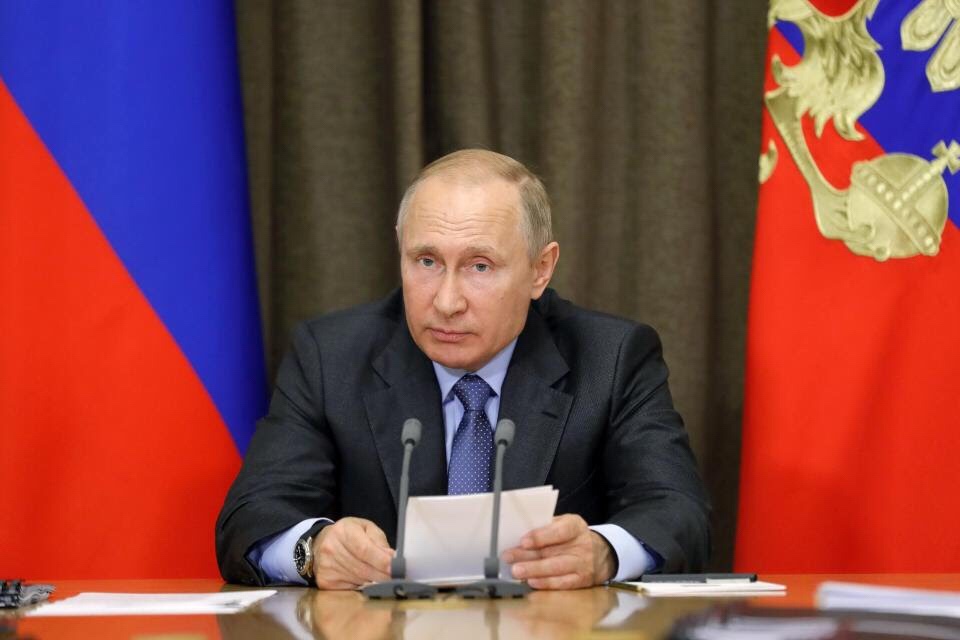
Network 54A Russian submarine.
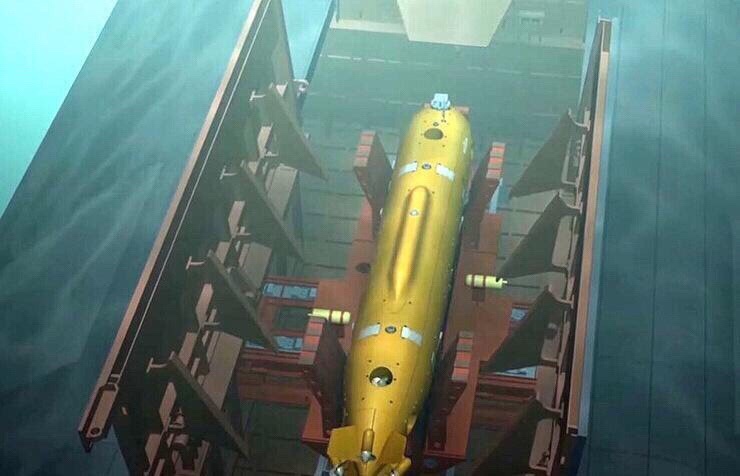
Russia is building a drone
submarine to deliver large-scale nuclear weapons against U.S. harbors
and coastal cities, according to Pentagon officials.
The developmental unmanned
underwater vehicle, or UUV, when deployed, will be equipped with
megaton-class warheads capable of blowing up key ports used by U.S.
nuclear missile submarines, such as Kings Bay, Ga., and Puget Sound in
Washington state.
Details of the secret Russian nuclear UUV program remain closely held within the U.S. government.
The Pentagon, however, has code-named the drone “Kanyon,” an indication that the weapon is a structured Russian arms program.
The nuclear drone submarine is further evidence of what officials say
is an aggressive strategic nuclear forces modernization under President
Vladimir Putin. The building is taking place as the Obama
administration has sought to reduce the role of nuclear arms in U.S.
defenses and to rely on a smaller nuclear force for deterrence.
Officials familiar with details of the Kanyon program said the weapon
is envisioned as an autonomous submarine strike vehicle armed with a
nuclear warhead ranging in size to “tens” of megatons in yield. A blast
created by a nuclear weapon that size would create massive damage over
wide areas.
A megaton is the equivalent of 1 million tons of TNT.
On missiles, megaton warheads are called “city busters” designed to destroy entire metropolitan areas or to blast buried targets.
An underwater megaton-class drone weapon would be used to knock out
harbors and coastal regions, the officials said, declining to be named
due to the sensitivity of the information.
“This is an unmanned sub that will have a high-speed and
long-distance capability,” said one official, who noted that the drone
development is years away from a prototype and testing.
Russian nuclear buildup
 Desmond Boylan/ReutersA
deactivated Soviet-era SS-4 medium range nuclear capable ballistic
missile displayed at La Cabana fortress in Havana, on Oct. 13, 2012.
The Kanyon appears to be part
of a Russian strategic modernization effort that seeks to give Moscow
the ability to coerce the United States.
Desmond Boylan/ReutersA
deactivated Soviet-era SS-4 medium range nuclear capable ballistic
missile displayed at La Cabana fortress in Havana, on Oct. 13, 2012.
The Kanyon appears to be part
of a Russian strategic modernization effort that seeks to give Moscow
the ability to coerce the United States. It is also expected to
complicate the Obama administration’s attempts to seek further
reductions in U.S. and Russian nuclear forces after the 2010 New START
arms treaty.
New arms cuts were derailed after Russia’s military annexation of
Crimea and continuing destabilization of eastern Ukraine, as well as by
Moscow’s failure to return to compliance with the 1987
Intermediate-Range Nuclear Forces Treaty.
“It’s very difficult to consider Russia a responsible party when it’s developing something like this,” the official said.
Another official familiar with the program said that the Kanyon will
be a large nuclear-powered autonomous submarine. This official said the
size of its nuclear warhead is not clear.
Russian leaders announced a new maritime strategy in July that
provided hints about the new drone sub. The doctrine calls for
developing innovative technologies, including unmanned underwater
vehicles, IHS Jane’s 360
reported last month.
The new underwater nuclear weapon is also raising concerns among
Pentagon strategic planners. The Navy, in particular, is worried about
the Kanyon.
Navy forces are charged with conducting underwater warfare operations, including countering enemy submarines.
 Flickr/US NavyUS Navy’s USS Rhode Island returns to Naval Submarine Base Kings Bay after three months at sea.
Lt. Col. Michelle Baldanza, a Pentagon spokeswoman, declined to comment on the nuclear-armed underwater drone.
Flickr/US NavyUS Navy’s USS Rhode Island returns to Naval Submarine Base Kings Bay after three months at sea.
Lt. Col. Michelle Baldanza, a Pentagon spokeswoman, declined to comment on the nuclear-armed underwater drone.
The Pentagon said last week that it is closely watching a Russian
military research ship that sailed along the east coast of the United
States. The ship, a research vessel called the Yantar, was engaged in
underwater reconnaissance, gathering intelligence that could be used to
support a weapon system like the nuclear UUV.
While the United States
currently has no similar plans for a megaton-class underwater nuclear
strike vehicle, the Navy is developing a range of UUVs, including a
weapons-carrying drone.
The Pentagon is in the process of retiring all of its megaton
weapons. The stockpile of 9-megaton B53 bunker-buster bombs were
dismantled several years ago, and the 1.2 megaton-B83 will be retired
after the upgraded B61 bomb is deployed.
Russia’s arsenal of megaton warheads and bombs includes an estimated
five SS-18s armed with 20-megaton warheads and previously deployed
5-megaton warheads on SS-19s. Moscow once built the largest nuclear
weapon, the 150-megaton bomb called the
Tsar Bomba, or “Tsar of bombs.”
China uses megaton warheads on its DF-5A missiles. The two-dozen DF-5As are said to be armed with 5-megaton warheads.
Goal: causing catastrophic damage
 Stringer/REUTERSThe Russian navy.
“The Kanyon represents another example of Russia’s aggressive and
innovative approach to the development of military capabilities against
U.S. and Western interests,” said Jack Caravelli, a former CIA analyst
who specialized in Soviet and Russian affairs.
“The possible yield of the
warhead, in the megaton class, clearly is an attempt to inflict
catastrophic damage against U.S. or European naval facilities or coastal
cities,” he added. “Nations vote with their resources, and the
Kanyon, along with an expanding number of other military modernization
programs, indicates the priority Vladimir Putin places on military
preparedness against the West.”
 Kanyon UUV/Artist’s rendering
Mark Schneider, a former Pentagon nuclear policymaker, said Russian state-run media have announced plans for UUV development.
“In 2014, Putin stated that there were undisclosed strategic nuclear
modernization programs that would be made public at the appropriate
time,” Schneider said.
A Russian weapons engineer told the state-run RIA Novosti news agency in June that UUVs are being
developed.
“Our institute already concluded a number of new developments in the
sphere of command systems automation… [including] remotely-operated,
unmanned sea-based underwater vehicles. We hope that these developments
will be applied for designing of a new destroyer vessel,” said Lev
Klyachko, director of the Russian Central Research Institute.
Moscow nuclear threats worrying
 Shutterstock
Robert Kehler, who retired two years ago as commander of the U.S. Strategic Command, said
development
of a robot underwater nuclear strike vehicle could be part of what he
termed a “troubling” Russian strategic nuclear buildup.
“Overall, we were watching the Russian nuclear modernization effort
very carefully,” Kehler said in an interview. “And that effort was
finally starting to put forces in the field.”
Kehler said he was not “particularly bothered” by the Russian nuclear
buildup as long as Moscow stays within the limits of the New START arms
treaty. The treaty limits the United States and Russia to 700 strategic
missiles and bombers and a total of 1,550 deployed strategic warheads.
The retired four-star Air Force general said he was unaware of the
Kanyon drone program.
However, recent threats and
belligerent statements by Russian leaders about using nuclear weapons
are compounding concerns about Moscow’s arms buildup.
“That was disturbing as well, their rhetoric,” Kehler said. “Again,
that said something about how nuclear weapons fit in their national
security. From their perspective, they’re saying, ‘We still need these
weapons.’”
 REUTERS/Sergei KarpukhinRussian
S-400 Triumph medium-range and long-range surface-to-air missile
systems drive during the Victory Day parade at Red Square in Moscow,
Russia, May 9, 2015.
REUTERS/Sergei KarpukhinRussian
S-400 Triumph medium-range and long-range surface-to-air missile
systems drive during the Victory Day parade at Red Square in Moscow,
Russia, May 9, 2015.
Putin has stated publicly that he is willing to use Russia’s nuclear
forces in response to Western opposition to the military annexation of
Ukraine’s Crimea.
Pavel Felgenhauer, a Russian military analyst, said he has not heard
about the Kanyon program. “But such things could have easily been
developed during the Cold War and may be still being developed or
modernized,” he said.
Felgenhauer said a nuclear drone submarine would involve launch from a
mother sub and would require getting close to a target, something he
said would result in a “semi-suicidal” bombing run.
Russia has researched exotic nuclear weapons concepts in the past,
including underwater blasts aimed at creating massive tsunamis, like
those caused by undersea earthquakes, he said.
However, Felgenhauer said he does not believe the underwater nuclear
drone would be a mainstream weapons development program for Moscow.
Based on Soviet nuclear torpedo
 Wikimedia CommonsA
MK-32 Mod 15 Surface Vessel Torpedo Tube (SVTT) fires a MK-46 Mod 5
lightweight torpedo from the starboard side of the recently commissioned
guided missile destroyer USS Preble (DDG 88), during a Combat Systems
Ship Qualification Test (CSSQT).
Wikimedia CommonsA
MK-32 Mod 15 Surface Vessel Torpedo Tube (SVTT) fires a MK-46 Mod 5
lightweight torpedo from the starboard side of the recently commissioned
guided missile destroyer USS Preble (DDG 88), during a Combat Systems
Ship Qualification Test (CSSQT).
Norman Polmar, a naval analyst and author, said the Kanyon could be
based on a Soviet-era nuclear torpedo disclosed in his 2003 book,
Cold War Submarines.
Both the Russian navy and its predecessor, the Soviet navy, have been
innovators of undersea systems and weapons. “These efforts have
included the world’s most advanced torpedoes,” Polmar said. “Early in
the nuclear age, the Soviets began development of a massive torpedo for
attacking coastal cities and ports.”
The T-15 torpedo was about 75
feet long and was capable of carrying a high-yield thermonuclear warhead
some 15 miles underwater, something Polmar called “a truly innovative
concept.”
The Navy is developing UUVs as well, including some capable of
conducting strike operations. No details of the Navy’s underwater drone
program could be learned.
A 2004 Navy study on the subject lists nine functions for underwater
drones, ranging from intelligence gathering to anti-mine warfare to
special operations delivery and “time critical strike.”
“Warfighters need the ability to strike time critical targets at
precisely the right moment in battle,” the Navy study said. “UUVs can
perform some of the necessary functions for [time critical strike], for
example, clandestine weapon delivery or remote launch.”
 US Navy via FlickrThe US Navy tests a UUV.
“Stealth and long-standoff distance and duration allow a UUV to be an
effective weapon platform or weapon cache delivery vehicle for TCS
missions.”
The UUV is part of a major nuclear modernization by Russia that
includes a new class of ballistic missile submarine called the
Borey-class, and a new submarine-launched missile, the Bulava.
Two new intercontinental ballistic missiles are being deployed as well, along with development of three more new ICBMs,
including a replacement for the SS-18 and a new rail-mobile missile. A
new strategic bomber is also under development, and there are reported
plans to restart production of the Tu-160 Blackjack bomber.
Russia is also developing a new
long-range, air-launched nuclear-tipped cruise missile, the KH-101,
which will be capable of hitting targets in the United States from
launch areas within Russian airspace.
Navy seeking UUVs
 US NavyUS Navy UUV.
Navy Secretary Ray Maybus said in a speech in April that unmanned systems are a high priority for future Navy weapons.
“While unmanned technology itself is not new, the potential impact
these systems will have on the way we operate is almost incalculable,”
Maybus said.
The submarine warfare division of the chief of naval operations
stated on its website that the future submarine force will include UUVs.
“UUVs allow an [attack submarine] to safely
gain access to denied areas with revolutionary sensors and weapons,” the
website stated. “UUVs provide unique capabilities and extend the
‘reach’ of our platforms while reducing the risk to an [attack
submarine]” and its crew.
The site made no mention of a future UUV strike weapon, only intelligence and reconnaissance, mine warfare, and mapping.
“UUVs are key elements in maintaining submarines’ future undersea dominance against any threat.”
 Putin unveils underwater Poseidon nuclear drone that can trigger 300ft tsunamis to wipe out Russia’s enemy naval bases