Showing posts with label drug. Show all posts

Saturday, August 4, 2018

How Pharma Supported the Antichrist


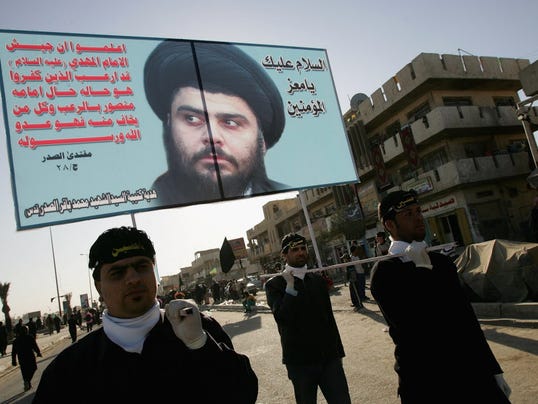
Shiite Muslims protest close to an image of anti-US cleric Moqtada al-Sadr during a protest following Friday noon prayers in the impoverished Sadr City neighborhood of eastern Baghdad in 2008. AFP PHOTO
US probes pharma firms accused of aiding Iraqi militia that killed Americans
The lawsuit argues firms knowingly provided drugs sold on by the Mahdi Army to fund attacks on US troops
Michael Chand was working in south-east Iraq as a civilian contractor for American reconstruction efforts when his convoy was attacked in 2007 by forces believed to be loyal to then firebrand Shia cleric Moqtada Al Sadr.
At first, his family were told he was shot and killed. They later learned he was being held hostage at a time when militant attacks on American forces were at their bloodiest.
His body was returned three years later, bearing the hallmarks of torture.
Now his widow is one of the dozens of bereaved relatives who accuse big international pharmaceutical companies of helping bankroll the Mahdi Army in its campaign of violence through kickbacks of medicine and supplies given to the Iraqi ministry of health which was then under Mr Al Sadr’s control.
For Washington, Mr Al Sadr has been the most vocal opponent of the American war. His militias were blamed for deadly attacks on a US-backed political opponent and soldiers, triggering an arrest warrant for murder that was never executed. But in recent years he has moved away from his openly anti-US stance and the position in Washington has softened.
The five pharmaceutical companies deny the allegations but this week it emerged that the US Department of Justice had launched an investigation.
In a regulatory filing, AstraZeneca, the UK pharmaceutical giant, said it “has received an inquiry from the US Department of Justice in connection with an anti-corruption investigation relating to activities in Iraq, including interactions with the Iraqi government and certain of the same matters alleged in the lawsuit.”
The suit, filed in federal court in the District of Columbia on behalf of 112 victims, seeks to hold five companies responsible for the deaths of hundreds of American soldiers from 2005 to 2009.
The defendants are household names: General Electric, Johnson & Johnson, Pfizer and Roche as well as AstraZeneca.

Thursday, August 2, 2018

How Pharma Has Funded the Next War


AstraZeneca is one of five companies named in a lawsuit filed last year on behalf of members of the American military who were injured or killed in attacks in Iraq from 2005 to 2009.Christopher Furlong/Getty Images
Justice Dept. Investigating Claims That Drug Companies Funded Terrorism in Iraq
July 31, 2018
WASHINGTON — The Justice Department is investigating claims that major drug and medical device companies doing business in Iraq knew that the free medicines and supplies they gave the government to win business there would be used to underwrite terrorist attacks on American troops.
In a regulatory filing last week, AstraZeneca, a drugmaker based in Britain, disclosed that it had “received an inquiry from the U.S. Department of Justice in connection with an anti-corruption investigation relating to activities in Iraq.”
The filing said the inquiry was related to a lawsuit filed last year in federal court that accused five companies of winning contracts to sell their products to the Iraqi Ministry of Health with the understanding that they also provide additional medical supplies and medicines for free. The five companies are General Electric, Johnson & Johnson, Pfizer, Roche Holding A.G. and AstraZeneca.
The lawsuit was filed on behalf of members of the American military who were injured or killed in attacks from 2005 to 2009, at the height of the Iraq war.

Tuesday, November 7, 2017

How the US Funded the Antichrist

Updated 8 hours ago
I remember when Johnson & Johnson was a nice, big American company selling warm-hearted products like baby powder.
Now the company, along with several of the other largest U.S. and European medical companies — including Pfizer and GE Healthcare — is targeted in a federal lawsuit. Families of dozens of U.S. troops killed or injured in Iraq allege that J&J and the other companies knowingly financed the anti-American Mahdi Army militia.
The lawsuit “claims the companies regularly paid kickbacks to officials in Iraq's Ministry of Health through their local agents,” reports USA Today correspondent Aamer Madhani, previously a White House and Baghdad correspondent for that newspaper.
“Officials at the ministry in turn used the proceeds to help fund the militia that carried out attacks against U.S. troops in Iraq, the suit alleges,” Madhani says.
Following months of debate about Iraq's alleged weapons of mass destruction, the invasion of Iraq began in March 2003 with U.S. and British forces entering southern Iraq and other land, air and sea assaults.
“In the aftermath of the 2003 invasion, Iraq's health care spending surged,” reports Madhani, “and the Health Ministry's budget ballooned from $16 million during Saddam Hussein's final year in power to about $1 billion in 2004.”
Western companies seeking entry into the expanding Iraq market “were willing to pay kickbacks — billed as ‘commissions' or ‘free goods' — that amounted to as much as 20 percent of the value of a contract to ministry officials, the lawsuit alleges.”
The defendants also supposedly made illegal payments by promising after-sales support and services funded by giving money to their “local agents.”
The lawsuit says: “In reality, such services were illusory and functioned merely to create a slush fund the local agents could use to pass on ‘commissions to corrupt ministry officials.'”
The plaintiffs claim the companies' financial transactions aided and abetted the militants and thus violated U.S. anti-terrorism law.
The lawsuit claims the defendants “did not intend for the ‘free goods' provided” to the health ministry “to serve any legitimate charitable or medicinal purpose.
“It was widely understood in Iraq that the (ministry) operated more like a terrorist organization than a legitimate health entity,” the lawsuit says.
In 2007, Madhani writes, global intelligence firm Stratfor, which provided briefings to several of the companies named as defendants, reported that “U.S.-led forces in Iraq had arrested the then-deputy health minister for ‘selling health services and equipment in return for millions of dollars that he later funneled to Shiite militias.'”
Ralph R. Reiland is associate professor of economics emeritus at Robert Morris University and a local restaurateur (rrreiland@aol.com).

Tuesday, October 31, 2017

British Pharma Funds the Antichrist

The Cambridge-based pharmaceuticals giant is one of several firms being dragged into a US court over allegations it bribed health officials who were aligned with Jaysh al-Mahdi, one of the most violent insurgent groups in Iraq.
Lawyers representing the families of US soldiers killed and wounded in the Iraq war claim Astra paid cash to win lucrative drug contracts. However, the money was then used to buy weapons and explosives that were deployed against British and US troops. The claims, filed in a federal court in Washington, relate only to US troops but could pave the way for similar litigation in the UK.
Accusations: Astrazeneca is one of several firms hit by allegations it bribed health officials who were aligned with Jaysh al-Mahdi, one of the most violent insurgent groups in Iraq
Ryan Sparacino, of Washington law firm Sparacino & Andreson, told the Mail: ‘Many coalition lives were destroyed because Astrazeneca made corrupt payments to Jaysh al-Mahdi terrorists in order to boost profits.’
Astra is named along with parent companies and subsidiaries of General Electric, Johnson & Johnson, Pfizer and Roche Holding. They deny any wrongdoing.
The civil lawsuit accuses the companies of violating the US Anti-Terrorism Act and seeks damages. It is not expected that either side will present arguments in court for at least a year.
Claims brought by the families of US soldiers cover the deaths and injuries inflicted by Jaysh al-Mahdi between 2005 and 2009.
Bribes paid by Astra and other drug companies to Iraq’s health ministry helped fund the militia’s activities, court papers claim.
The ministry was effectively controlled by Jaysh al-Mahdi, they say. Goods allegedly sold to Iraq include an anti-psychotic drug, hospital equipment, a birth control injection and a breast cancer drug.
An Astrazeneca spokesman said: ‘We are focused on bringing life-saving medicines to patients, and are disheartened anyone would suggest we have any connection to terrorism-related activity.
‘We take all allegations of bribery extremely seriously, and we intend to vigorously defend against them.’

Saturday, October 21, 2017

US Companies Fund Antichrist’s Terrorism

Federal lawsuit alleges Big Pharma firms funded Iraq terrorist organizations

[JURIST] US veterans filed a lawsuit [complaint, PDF] in federal court on Tuesday against five big pharmaceutical firms for funding terrorist organizations in Iraq.
The suit was brought by more than 100 US veterans and their families for injuries sustained in combating terrorist forces in Iraq. The lawsuit, filed in the US District Court for the District of Columbia [official website], accuses defendants AstraZeneca, GE Healthcare, Johnson & Johnson, Pfizer and Roche of violating several provisions of the federal Anti-Terrorism Act and intentionally inflicting emotional distress by giving medicine, medical devices and the like to Sadrists to sell in Iraq through the corrupt Iraqi Ministry of Health (MOH).
The MOH was led by the Mahdi Army, a group known for attacking US soldiers and working with known terrorist group Hezbolla [WP report]. According to the plaintiffs, the "Iraqi healthcare system offered the Sadrists several advantages, including the ability to raise funds for terrorism through the medical-goods contracting process," which the defendants are deemed principal parties to. The plaintiffs describe this process in part as:
Defendants' corrupt transactions with MOH also aided and abetted terrorism by supplying Jaysh al-Mahdi with the means to pay its rank-and-file terrorist fighters. Some U.S. government personnel in Iraq called Jaysh al-Mahdi "The Pill Army," because Sadr and his Jaysh al-Mahdi commanders were notorious for paying their terrorist fighters in diverted pharmaceuticals, rather than cash. Those fighters—most of whom were poor, uneducated, young Shi'a men—accepted such payment because they could re-sell the free drugs on the street or could consume the pills themselves as a form of intoxication.
In the 203-page complaint, the plaintiffs present findings on the financial impact the defendants allegedly had on the healthcare market. For instance, the MOH procurement budget "skyrocketed from $16 million per year under Saddam to an average of well more than $1 billion after 2004, when the Sadrists controlled MOH. As a result, the market for Defendants' products in Iraq increased substantially, providing an additional motive for Defendants to engage in corrupt transactions with MOH."
The plaintiffs alleged these pharmaceutical companies violated the Anti-Terrorism Act because although they did not engage in terrorism through actual harmful force, they are accused of aiding terrorist organizations, which also violates the Act.

Friday, October 20, 2017

Big Pharma Supported the Antichrist


Followers of Shiite cleric Moqtada al-Sadr chant anti-government slogans and waved Iraqi flags during a protest in Basra on March 19, 2012. (Nabil al-Jurani/AP)
 
In the first years following the defeat of Saddam Hussein, there were few dark corners of battle-scarred Iraq less hospitable to Americans than the country’s ministry of health.
The walls of the ministry, headquartered in a dilapidated high-rise in eastern Baghdad, were covered with hundreds of photos of scowling Shiite clerics. Banners proclaimed “Death to America and Israel” and “we must destroy the occupiers.” Death squads commandeered the ministry’s ambulances for missions to hunt Sunnis. Assault rifles were stacked in offices. The morgues were used for torture. Everywhere flapped the flag of the Jaysh al-Mahdim, also known as the Mahdi Army, the Shiite militia controlled by the radical anti-American cleric Moqtada al-Sadr.
The government office was so thoroughly infested that in 2007 Gen. David Petraeus, then in command of U.S. forces in Iraq, admitted Sadrists had “effectively hijacked the Ministry of Health.”
And yet at the same time, American and international pharmaceutical companies were regularly doing business with it.
A lawsuit that has just hit the federal court system claims that these drug giants were not only filling purchasing orders but offering substantial kickbacks and free medication, all while knowing they were in business with a group of terrorists engaged in violence against U.S. interests and Americans. Such payments, the lawsuit claims, were violations of the Anti-Terrorism Act.
The 203-page suit, filed in the U.S. District Court for the District of Columbia on behalf of 108 plaintiffs, seeks to hold the corporations responsible for the deaths and injuries of U.S. service members between 2005 and 2009.
The corporate defendants include subsidiaries of the largest medical brands in the world: AstraZeneca, General Electric, Johnson & Johnson, Pfizer and Roche. The businesses “obtained lucrative contracts from that ministry by making corrupt payments to the terrorists who ran it,” the complaint argues. “Those payments aided and abetted terrorism in Iraq by directly financing an Iran-backed, Hezbollah-trained militia that killed or injured thousands of Americans.”
The complaint is heading into uncharted legal territory. Last year, Congress expanded the provisions of the Anti-Terrorism Act to allow for such suits. The updated statute specifies that the violence must have been committed by a group specifically designated by the secretary of state as a “foreign terrorist organization.” The Mahdi Army was not so designated, but Hezbollah was and still is.
The lawsuit claims a corrupt relationship between Big Pharma and Iraq stretches back to Saddam Hussein’s iron rule.
The fall of the Hussein regime created a scramble within the country between sects vying for a foothold in the new government. By early 2004, Sadrists had grabbed key positions in the ministry’s bureaucracy. “Sunnis and secular technocrats alike were purged in what one percipient witness describes as a widespread ‘occupational cleansing,'” the lawsuit says. “Doctors who exhibited insufficient loyalty to the Sadrists were killed or forced to flee.”
One Iraqi hospital worker told CBS News in 2006 that more than 80 percent of the original health care staff in one Iraqi hospital had been removed and replaced with Sadr loyalists.
“It’s going to get worse because there is no control and no accountability,” the worker told the network. “No one can stop them.”
A year later, Kenneth Katzman, a Middle East expert, testified at a congressional hearing that Sadrists were attempting to segregate the health care system by gender, “with doctors treating only patients of the same gender.”
At the same time, there was a great amount of money at stake in the post-Hussein Iraq for companies. The lawsuit points to one study showing that between 2006 to 2011, the “Iraqi pharmaceutical market experience a 17 % compound annual growth rate — making it the fastest-growing market in Eastern Europe, the Middle East, and Africa.”
In 2004, the ministry’s Sadrist leaders “implemented a requirement that medical goods suppliers seeking” contracts with the ministry pay a religious tax “worth at least one-fifth the contract’s value.” One way companies paid the tax, according to the lawsuit, was by offering the ministry “free goods,” or “additional batches of in-kind drugs and equipment, free of charge, on top of the quantities for which MOH had actually paid.”
These extras, in turn, were sold by Sadrists on Iraq’s black market at a considerable markup. The Mahdi Army, in fact, became known among U.S. government personnel as the “Pill Army.” The cleric often paid his fighters in medical supplies and pharmaceuticals, which they either resold or ingested as intoxicants, the lawsuit says. These included antipsychotic drugs, birth control medication and cancer drugs.
Both the bribes and resales provided a cash flow feeding “directly into Jaysh al-Mahdi’s coffers and helped the militia buy weapons, training, and logistical support for its terrorist attacks,” the lawsuit claims, attacks that “likely killed more than 500 Americans and wounded thousands more.”
In 2011, Johnson & Johnson entered into an agreement with the Department of Justice to pay $70 million to resolve allegations of unlawful payments in a number of countries, including Iraq. General Electric resolved allegations leveled by the Securities and Exchange Commission involving Iraq kickbacks with a $23 million payment in 2010.
Johnson & Johnson, AstraZeneca and Roche have yet to publicly comment on the lawsuit. A spokesperson with General Electric told the Financial Times the company was reviewing the lawsuit. A Pfizer representative denied any wrongdoing to the Times as well.

Wednesday, October 18, 2017

America Uses Slush Funds to Support the Antichrist

The families of dozens of U.S. troops killed or injured during the war in Iraq filed a federal lawsuit Tuesday against several U.S. and European pharmaceutical and medical supply companies, alleging that the corporations knowingly financed the anti-American militia Mahdi Army through bribes and kickbacks to officials at a government ministry controlled by the group.
The lawsuit in U.S. District Court in Washington, D.C., against some of the biggest names in the industry — including GE Healthcare, Johnson & Johnson, Pfizer, AstraZeneca and Roche Holdings — claims that the companies regularly paid kickbacks to officials in Iraq’s Ministry of Health through their local agents.
In the aftermath of the 2003 invasion, Iraq’s health care spending surged, and the Health Ministry’s budget ballooned from $16 million during Saddam Hussein’s final year in power to about $1 billion in 2004.
Western companies looking to break into the Iraq market were willing to pay kickbacks — billed as “commissions” or “free goods” — that amounted to as much as 20% of the value of a contract to ministry officials, the lawsuit alleges.
Another way the defendants allegedly made the illegal payments was by including language in the contracts promising after-sales support and other services related to the product they sold and funded those services by giving money to their local agents.
"In reality, such services were illusory and functioned merely to create a slush fund the local agents could use to pass on 'commissions to corrupt (ministry) officials,'" the lawsuit alleges.
The plaintiffs charge that through the transactions the companies aided and abetted the militants, violating the U.S. anti-terrorism act.
Pfizer responded to the lawsuit in a statement, saying the company "categorically denies any wrongdoing,” while GE said in a statement it was "thoroughly reviewing the allegations.” A spokeswoman for Roche said the company had not yet been served with the lawsuit and declined comment.
Representatives from AstraZeneca and Johnson & Johnson did not respond to requests for comment.
“Defendants did not intend for the ‘free goods’ provided to Kadima (health ministry’s pharmaceutical importing agency) to serve any legitimate charitable or medicinal purpose,” the lawsuit alleges. “It was widely understood in Iraq that MOH (Ministry of Health) operated more like a terrorist organization than a legitimate health entity, and no rational company would have viewed MOH as a suitable object for charity.”
U.S. officials in Iraq expressed concern that the Health Ministry was beset by corruption and had become a Sadr fiefdom. News reports about pharmaceuticals flooding the black market suggested that Sadr backers were using the ministry to bankroll the Mahdi Army.
By late August 2007, a draft of an alarming U.S Embassy Baghdad report had become public that accused the ministry of “operating a pharmaceutical diversion scheme” and of being “openly under the control of the Mahdi Army.”
Months before the embassy report, the global intelligence company Stratfor — which provided advisory reports to senior executives at several of the companies named as defendants in the suit — noted in a briefing for its subscribers that U.S.-led forces in Iraq had arrested the then-deputy health minister for “selling health services and equipment in return for millions of dollars that he later funneled to Shiite militias.”
The Iraq war victims' lawsuit comes amid greater scrutiny of global brands' efforts to win favor with politicians and policymakers.
In August, Lee Jae-yong, the third-generation heir to the Samsung empire, was sentenced to five years in prison for paying nearly $8 million in bribes to win the support of South Korean President Park Geun-hye for a complex corporate deal. Wal-Mart is still dealing with the fallout of a 2012 New York Times report that it paid millions of dollars in suspect payments to government officials in Mexico to help speed up construction of stores there.
Last month, a federal judge in Arkansas ruled that a class-action lawsuit brought by a Michigan pension fund alleging that shareholders were defrauded by company executives could move forward. The City of Pontiac Employees’ Retirement System argues that Wal-Mart officials failed to properly investigate bribery claims that they were first reportedly made aware of in 2005.
Attorneys for the plaintiffs from the Washington, D.C.-based law firms of Sparacino & Andreson and Kellogg, Hansen, Todd, Figel & Frederick said they spent thousands of hours investigating and analyzed hundreds of transactions between the defendants and Health Ministry between 2004 and 2013.
Ami Neiberger-Miller,  a plaintiff whose 22-year-old brother, Army Spc. Christopher Neiberger, was killed in a roadside bombing allegedly carried out by the Mahdi Army in Baghdad in August 2007, said her family wants the companies to be held accountable.
"I had always pictured by brother's killers as faceless," said Neiberger-Miller, who recalled her younger brother as funny and a good friend. "I wouldn't have thought U.S. companies would have anything to do with his death. Those funds went directly from those companies to terrorists who had a mission to kill U.S. troops like my brother. They should be held accountable. Companies should know what is done in their name.
The plaintiffs’ attorneys said the alleged bribery scheme was a continuation of how some of the companies and their affiliates named in the suit conducted business during the final years of Saddam’s rule.
Hundreds of multinational companies are alleged to have funneled more than $1.7 billion into Saddam’s regime, skirting sanctions by abusing the U.N. Oil-for-Food program that was designed to soften the impact on the Iraqi people by allowing the supervised sale of some Iraqi oil for food, medicine and other necessities.
In 2010, GE resolved a Foreign Corrupt Practices Act charge brought by the U.S. Securities and Exchange Commission by paying almost $23 million in fines. Two GE subsidiaries were alleged to have obtained at least four medical-goods contracts between 2000 and 2003 by agreeing to “pay illegal kickbacks in the form of computer equipment, medical supplies and services” to the Kimadia, the Health Ministry’s purchasing agency, the lawsuit notes.
AstraZeneca AB, the pharmaceutical behemoth’s UK-affiliate, paid at least $162,000 in kickbacks as part of the sale of $1.7 million of drugs under the sanctions relief program, according to the Volcker Committee, the panel that investigated the alleged corruption in the Oil-for-Food program.
“We believe that the evidence will show that when Jaysh al-Mahdi seized the Iraqi Health Ministry, the defendants continued paying the same bribes they provided under Saddam — except in far greater amounts," said Ryan Sparacino, one of the attorneys representing plaintiffs in the lawsuit.

Wednesday, September 23, 2015

The Facade Of The Scarlet Woman (Revelation 17)


Hillary Clinton proposes $250 monthly cap on prescription drug costs

22 Sep, 2015, 1648 hrs IST, Reuters

On Monday, Clinton vowed during a campaign stop in Little Rock, Arkansas that, “It is time to deal with sky-rocketing out-of-pocket costs.”

LITTLE ROCK, ARKANSAS: Democratic presidential candidate Hillary Clinton on Tuesday will propose a $250 monthly cap on prescription drugs for patients with chronic or serious medical conditions in a drive against what she calls “excessive profiteering” by pharmaceutical companies.
At a campaign stop in Iowa, Clinton will outline a plan to encourage the development and use of generic drugs and also would end drug companies’ ability to write off consumer-directed advertising as a business expense.

Under Clinton’s plan the monthly cap would limit what insurance companies could ask patients to pay for drugs.

On Monday, Clinton vowed during a campaign stop in Little Rock, Arkansas that, “It is time to deal with sky-rocketing out-of-pocket costs.”

Shares of biotech companies such as Immunogen and Gilead Sciences on Monday dropped after Clinton tweeted that steep prices for specialty drugs wereoutrageous.”

Critics of marketing drugs to consumers say it encourages the use of costly brand names over generics and can be confusing or misleading. A series of court decisions has determined the practice cannot be banned outright because it is a form of commercial speech protected by the U.S. Constitution.

Clinton says the government could save billions of dollars by no longer allowing pharmaceu
tical companies to deduct what they spend marketing drugs to consumers and those funds could be redirected into encouraging research and development.

The largest pharmaceutical companies are collectively earning $80 billion to $90 billion per year at higher margins than other industries, while average Americans struggle to pay for medicine, Clinton’s campaign said.

While Clinton has maintained her front-runner status, she has been under pressure to take more populist stances to widen her lead over U.S. Senator Bernie Sanders, her second-place rival for the Democratic nomination.

Clinton’s plan would encourage the development and use of generic drugs. Her plan would redirect funds to a U.S. Food and Drug Administration office with a backlog of generic drugs awaiting approval.

She would also prohibit what the campaign called “pay-for-delay agreements,” in which the company of a brand-name drug pays a generic competitor to keep its product off the market for a period of time, usually as part of a litigation settlement.

Clinton wants Medicare, the U.S. government’s health insurance program for the elderly, to be able to negotiate with pharmaceutical companies over drug prices and require more generous rebates, driving down overall costs.

Consumers would also be allowed to purchase drugs from other countries, where medicine is often less expensive, so long as there are sufficient safety standards in place, Clinton’s campaign said.