Showing posts with label Ahmadinejad. Show all posts

Friday, June 11, 2021

The Iranian Horn Attacks Babylon the Great Again: Daniel 8

Rockets hit near U.S. forces and contractors in Iraq in separate attacks -officials

Reuters

Rockets hit near U.S. forces and contractors in Iraq on Wednesday, including an air base north of Baghdad and a military base at Baghdad International Airport, the Iraqi army and security officials said.

The army reported at least three rockets hit Balad air base, where U.S. contractors are based.

Security officials told Reuters at least one rocket hit shortly afterwards near the airport at a base which U.S. military aircraft use.

Thursday, June 10, 2021

A hard-line stance on Iran endangers Christians. There’s a better way.

(Open Doors) — Western countries can insist that Iran drop charges against Christian converts facing prosecution.

An Iranian woman holds a portrait of Iranian Supreme Leader Ayatollah Ali Khamenei during a rally marking the 42nd anniversary of the 1979 Islamic Revolution, in Tehran, Iran, Feb. 10, 2021. (AP Photo/Ebrahim Noroozi)

June 1, 2021By 

(Open Doors) — The quickest way to know if Iran is serious about either nuclear compliance or religious freedom is to tie the two issues together.  

During the 2016 campaign, then-candidate Donald Trump promised to take a hard-line stance on Iran to curb its nuclear ambitions. This was a response to the Obama administration’s loosening of sanctions, seemingly rewarding Iran with a massive cash payment and a path to rejoining the world’s financial system in hope the rogue nation would respond with nuclear compliance.

Just days after his inauguration, President Trump’s top officials came out swinging, “officially putting Iran on notice” and launching a campaign of “maximum pressure” that included the reimposition of financial sanctions against the theocratic regime. Within the Iranian government, emboldened fundamentalist factions waged a war of persecution against Christians throughout the country.

Rather than focus on inflicting maximum pain or looking the other way, a successful renegotiation of the Iran nuclear deal should target the heart of the regime’s nuclear ambitions: religious extremism.

As one of the world’s few remaining theocracies, Iran has nuclear ambitions that are not simply a matter of national pride or homeland security. The regime wants to safeguard its religious authority to promote a radical definition of the Muslim faith on the world stage.

The government makes sure that Islam is preeminent at home. Raids of home churches are common, forcing many people of faith to flee the country or face prosecution. Muslims who convert to Christianity are especially at risk of arrest and long-term imprisonment for “crimes against national security.” Government officials use smartphone location data and digital footprints to find those who defy fundamentalist Islamic practices.

Iran, red, on a world map. Map courtesy of Creative Commons

Iran’s foreign policy is also driven by religious concerns. Many have decried Iran’s bankrolling of Hamas for its role in exacerbating the Israeli-Palestinian conflict, but few have acknowledged the faith-based agenda of an Iran-Hamas alliance.

Perhaps the most concerning threat is the direct link between radical Islamic extremism and the meteoric rise in violent attacks throughout sub-Saharan Africa. Religiously motivated terrorist groups are organizing throughout the region, and Iran’s status as a well-funded expression of an extremist state could be a key asset to the small but loyal factions spreading throughout the continent. A new caliphate is on the rise, and the world cannot afford to equip it with nuclear weapons. 

The American approach to Iran has been experimental at best for the past two decades. President George W. Bush used Iraq to counter Iran’s influence in the Middle East, with mixed results. President Barack Obama’s 2015 deal, focused on nuclear site monitoring and international accountability, has received mixed reviews from foreign policy experts. In 2018, Trump withdrew the United States from the agreement, reinstating strict economic sanctions and forcing government officials into retaliation.

The radical Islamic regime has outlasted all these measures, even as the will of its population has become the biggest threat to its power. Some Iranians are calling for an end to the Islamic republic in the upcoming election, citing widespread rejection of theocratic ideals. As the Khamenei regime’s authority grows more fragile, religious diversity is increasing. The Roman Catholic Church has managed to slowly expand its presence, even recently installing an archbishop of Tehran with a commission to “offer the light of the Gospel.” 

All of this amounts to a diplomatic opportunity. If the regime expects to preserve its power in upcoming elections, it must prove its ability to provide both economic opportunity and religious freedom protections.

Fortunately, Iran can accomplish both in one deal. Western countries have the bargaining power to insist that Iran drop charges against more than two dozen Christian converts currently facing prosecution in the country. The White House can protect religious minorities by targeting Iranian officials who abuse them with asset freezes and visa sanctions while pressuring the government to lift religious freedom restrictions. In doing so the regime will curry favor with its electorate and preserve its sovereignty.

Meanwhile, the Biden administration can reopen admissions for Iranian religious refugees via the Lautenberg Program, which allows religious minorities in oppressive countries to relocate to the United States. Though the administration’s recent lifting of a historically low admissions ceiling is a promising first step, this additional measure can help provide safe harbor to those fleeing Iran on the basis of faith.

Now is the opportunity to bring greater freedom to the people of Iran, and to help them reenter the international community of nations. 

Iran can quickly prove it’s serious about diplomatic accountability by complying with international standards of human rights — including but not limited to the free practice of faith. President Joe Biden has the rare opportunity to learn from the promises and pitfalls of his predecessors’ approach on Iran. The path forward runs through religious freedom.

Monday, June 7, 2021

IAEA chief admits Iran is a Nuclear Horn: Daniel 8

Iran’s nuclear enrichment program at ‘bomb-making levels’: IAEA chief

Updated 26 May 2021 

Arab News 

May 26, 2021 06:00

LONDON: Iran is enriching uranium at purity levels that “only countries making bombs are reaching,” the UN’s nuclear watchdog chief warned.

Rafael Grossi, director general of the International Atomic Energy Agency (IAEA), said Tehran’s enrichment program was “very concerning” and cautioned that it requires a “vigilant eye” in an interview published by the Financial Times on Wednesday.

“A country enriching at 60 percent is a very serious thing — only countries making bombs are reaching this level,” Grossi told the newspaper. “60 percent is almost weapons grade. Commercial enrichment is two or three (percent).”

While most measures the regime has taken to this point are easily reversible, the level of research and development that had taken place was an “issue,” Grossi said.

“You cannot put the genie back into the bottle. Once you know how to do stuff, you know, and the only way to check this is through verification,” he said.

“The Iranian program has grown, become more sophisticated so the linear return to 2015 is no longer possible. What you can do is keep their activities below the parameters of 2015.”

World powers are currently in Vienna to negotiate with Iran on a return to full compliance with the Joint Comprehensive Plan of Action (JCPOA) nuclear deal signed in 2015, which the US withdrew from in 2018.

Since the American withdrawal, Iran has consistently overstepped on limits set out in the deal. Which has prompted fears Tehran is developing a nuclear weapon, a charge it has denied.

Grossi said a return to the original JCPOA was not a “feasible” option and pointed to the need for a more nuanced agreement considering the knowledge the Iranian program had accumulated since 2015.

“It is not possible,” he said. “Iran has accumulated knowledge, has accumulated centrifuges and has accumulated material. They have many options. They can dismantle, they can destroy, they can put in a cupboard. What we need to be able to do is to verify in a credible and timely manner.

Grossi says Iran has already extended research and development that was not allowed by the original JCPOA.

“It has happened and now the issue is how to deal with the results,” he said. “What you absolutely need is a way to verify that if they have that knowledge it is not being used to make bombs.”

Grossi also said Iran’s failure to provide explanations for traces of uranium found at two of its undeclared sites was “a big problem.”

Inspectors have been prevented from carrying out full monitoring on Iran’s program since Tehran imposed restrictions on IAEA in February, but a compromise agreement extension into June has allowed some monitoring to take place.

Grossi said the extension period was a “bridge,” but that the arrangement would ultimately be “unsustainable,” the Guardian newspaper reported.

“We are entering a phase where we have to take . . . one week at a time, and see how the other process (the Vienna negotiations) evolves,” he said. “It is obvious that a program with the degree of ambition, sophistication that Iran has, you need a very robust, very strong verification system . . . otherwise it becomes very fragile.”

Grossi said he has warned Iran about how restricting access will affect its credibility in negotiations, but that it is not his role to reprimand Tehran directly.

“They know they have to provide explanations. We are asking them to come clean with all these things because it can only help them,” he said.

“My responsibility is the credibility and integrity of the nonproliferation regime, I could say ‘do not say anything,’ but then five years down the line something happens, and then it is a dereliction of duty on our part.”

Grossi, who was in London on Tuesday, discussed challenges to the global nuclear non-proliferation regime and the need to monitor Iran’s activity with British foreign secretary Dominic Raab.

“We discussed how to ensure safe and peaceful uses of nuclear technology and prevent its misuse,” Raab said. “We also spoke about UK support for IAEA’s monitoring and verification in Iran and North Korea.”

Biden and the Iranian Nuclear Horn’s Game Plan

Ahmadinejad,The Prophecy,War,america,Andrew the Prophet,states,Russia,biden,Saudi Arabia,Iran,Nuclear,red line,terrorism,andrewtheprophet,Iran deal,Iraq,Military

Biden and the Ayatollah’s Game Plan

by Amir Taher

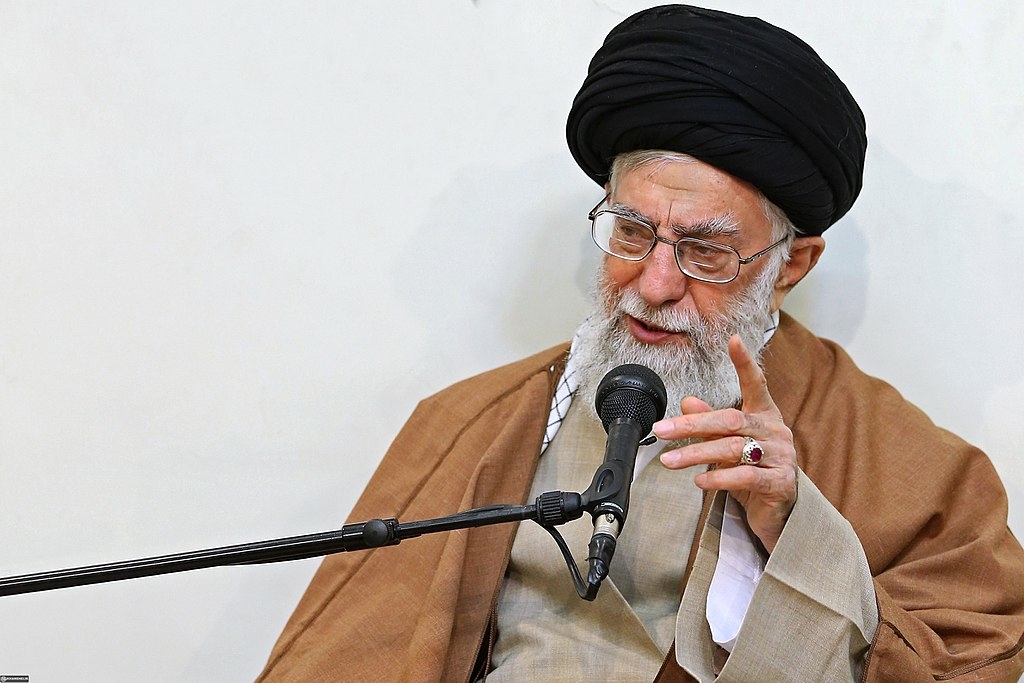
No sooner had President Biden’s appeasement squad been deployed than Ayatollah Ali Khamenei, the cleric heading Iran’s regime, ended almost four years of relative self-restraint by trying to revive the embers of several conflicts into blazing flames. Pictured: Iran’s “Supreme Guide,” Ayatollah Ali Khamenei. (Image source: khameni.ir/Wikimedia Commons)

Last February, when the new Biden administration launched its promised bid for a revival of the Obama “nuclear deal” with the Islamic Republic, apologists described it as an attempt at preventing another Middle Eastern war. This echoed the old mantra that in dealing with the Khomeinist regime, the choice is between appeasement and full-scale war.

Adepts of that mantra have failed to understand that in dealing with the mullahs it is appeasement that encourages war.

Thus, no sooner had President Biden’s appeasement squad been deployed than Ayatollah Ali Khamenei, the cleric heading the Khomeinist regime, ended almost four years of relative self-restraint by trying to revive the embers of several conflicts into blazing flames.

He started with Yemen, where he had withdrawn his embassy, military mission and religious propagandists, transferring them to Oman on a “temporary basis”, by sending one of his generals as the new ambassador with the mission to upgrade the Houthis’ ramshackle war machine. The next move was to speed up the supply of new rockets and missiles to his Hezbollah units in Lebanon. That was followed by a massive cash handout to Hamas and Islamic Jihad in Gaza in exchange for launching a new round of missile and rockets attacks on Israel. In between he also ordered a military build upon Iran’s borders with Azerbaijan and Armenia, to signal the end of the low profile he had been forced to adopt during the Trump administration.

But that was not all. Believing that the new US administration may help him solve his cash flow problem, the ayatollah re-wrote the official national budget, prepared by outgoing President Hassan Rouhani, to dramatically increase his military’s share. The revised budget, rushed through the ersatz parliament like a knife in butter, includes a 62 percent raise in the Islamic Revolutionary Guard Corps’ share. The Quds (Jerusalem) Force, which is in charge of exporting revolution and keeping the pot boiling in Yemen, Iraq, Syria, Lebanon and Gaza, sees its budget increased by almost 40 percent. Some estimates put the total increase of Iran’s military budget since 2019 at around 150 percent.

The message going to surrogates in the region and beyond is that Tehran expects to be able to end the budget cuts it had been forced to introduce during the Trump tenure as the US, with a wink and a nod, allows some allies, notably South Korea and Japan, to release part of the money they owe for oil imports.

In theological terms, Khamenei and his associates see the expected deal with Biden as “relief after constraint” which is promised to believers who go through a period of suffering without losing faith.

The ayatollah seems determined to use this “window of opportunity” for changing gears in domestic politics also. The seven-man list of “approved candidates” he has launched for the forthcoming presidential election shows that he intends to install a war cabinet of radicals totally loyal to his person.

Does all that mean that the “Supreme Guide” is preparing for war?

Not all, if by war we mean a full-scale classical clash of military forces on land, in air and at sea. Khamenei knows that his disorganized military, divided into countless corps and commands with conflicting cultures and interests and often saddled with antiquarian materiel, is in no position to fight a classical war against a serious enemy. None of his 13 highest ranking generals, all at retirement age and deeply involved in their own business activities, has the profile of a putative conqueror.

Khamenei implicitly admits that by repeating his “neither compromise, nor war” slogan.

As far as diplomacy is concerned, he will play the game that Tehran started almost 30 years ago, negotiating accords on the “nuclear issue”. The new US Secretary of State, Antony Blinken, says the aim is to persuade Tehran to reduce its nuclear activities so that it is always no less than a year away from building a bomb. Khamenei, who has no intention of building a bomb at this time, is ready to offer the Americans the candy that they crave.

Last month he said: If we decide to build the bomb, neither they (the Biden team) nor those greater than them could stop us!

Using the “nuclear deal”, a non-sequitur worthy of the Man of the Mancha, as a diversion the ayatollah hopes to get the sanctions lifted so that he can pursue his kind of war with greater vigor.

His kind of war is labelled in many different ways: proxy, asymmetric, low-intensity, low-cost, cottage industry war. Aware that few Iranians are prepared to fight his kind of war, he pursues it through surrogates and mercenaries recruited in Pakistan, Afghanistan, Iraq, Lebanon, Gaza and Yemen. The use of mercenaries in such wars has a long history. The Abbasid Caliphs used the Turkish Mameluke slaves and the Ottomans had the Bashi-Bazouks while the Safavids used the Qizil-Bash and the Kurdish Peshmerga. The British in India employed the Nepalese Gurkha (Tomb-seekers) and the French did their dirty work through Alawite recruits known as “auxiliaires” or ” helpers”.

According to best estimates, the Islamic Republic has spent around $20 billion in its various low-cost wars since 2000, a relatively modest sum compared to the huge cost of a full-scale war. According to Iranian Foreign Minister Muhammad Javad Zarif, the regime needs a minimum of $60 billion a year to cover its basic costs and survive while continuing its decades-long campaign to destabilize the Middle East in the hope of what Kayhan, a mouthpiece for Khamenei, describes as “the inevitable tsunami of Islamic revolution” that would establish a new base for the eventual conquest of the world by “faith and justice” by the Iranian-led Resistance Front.

Blinken talks of his hopes for a “breakthrough” in the currently stalled “nuclear” talks. Khamenei, too, wants a breakthrough based in a promise to enrich the uranium he does not want or need at a lower grade in exchange for the cash flow he does need to reactivate his momentarily interrupted special kind of war against the US and its regional allies, indeed against what is often known as ” the world order”.

Fear of an illusory war may lead to a deal which would allow a real war to continue behind the façade of an illusory peace.

Amir Taheri was the executive editor-in-chief of the daily Kayhan in Iran from 1972 to 1979. He has worked at or written for innumerable publications, published eleven books, and has been a columnist forAsharq Al-Awsat since 1987.

This article was originally published by Asharq al-Awsat and is reprinted by kind permission of the author.

Saturday, June 5, 2021

Iranian Horn has been Nuking up under the Obama Deal: Daniel 8

Iran fails to explain uranium traces found at several sites – IAEA report

ByReutersJune 2, 2021

Iran has failed to explain traces of uranium found at several undeclared sites, a report by the UN nuclear watchdog showed on Monday (31 May), possibly setting up a fresh diplomatic clash between Tehran and the West that could derail wider nuclear talkswrites Francois Murphy.

Three months ago Britain, France and Germany scrapped a US-backed planfor the International Atomic Energy Agency’s 35-nation Board of Governors to criticize Iran for failing to fully explain the origin of the particles; the three backed off as IAEA chief Rafael Grossi announced fresh talks with Iran.

“After many months, Iran has not provided the necessary explanation for the presence of the nuclear material particles at any of the three locations where the Agency has conducted complementary accesses (inspections),” a report by Grossi to member states seen by Reuters said.

It will now be up to the three European powers to decide whether to revive their push for a resolution criticising Iran, which could undermine wider negotiations to revive the 2015 Iran nuclear deal at talks currently under way in Vienna. Grossi had hoped to report progress before the board meets again next week.

“The Director General is concerned that the technical discussions between the Agency and Iran have not yielded the expected results,” the report said.

“The lack of progress in clarifying the Agency’s questions concerning the correctness and completeness of Iran’s safeguards declarations seriously affects the ability of the Agency to provide assurance of the peaceful nature of Iran’s nuclear programme,” it added.

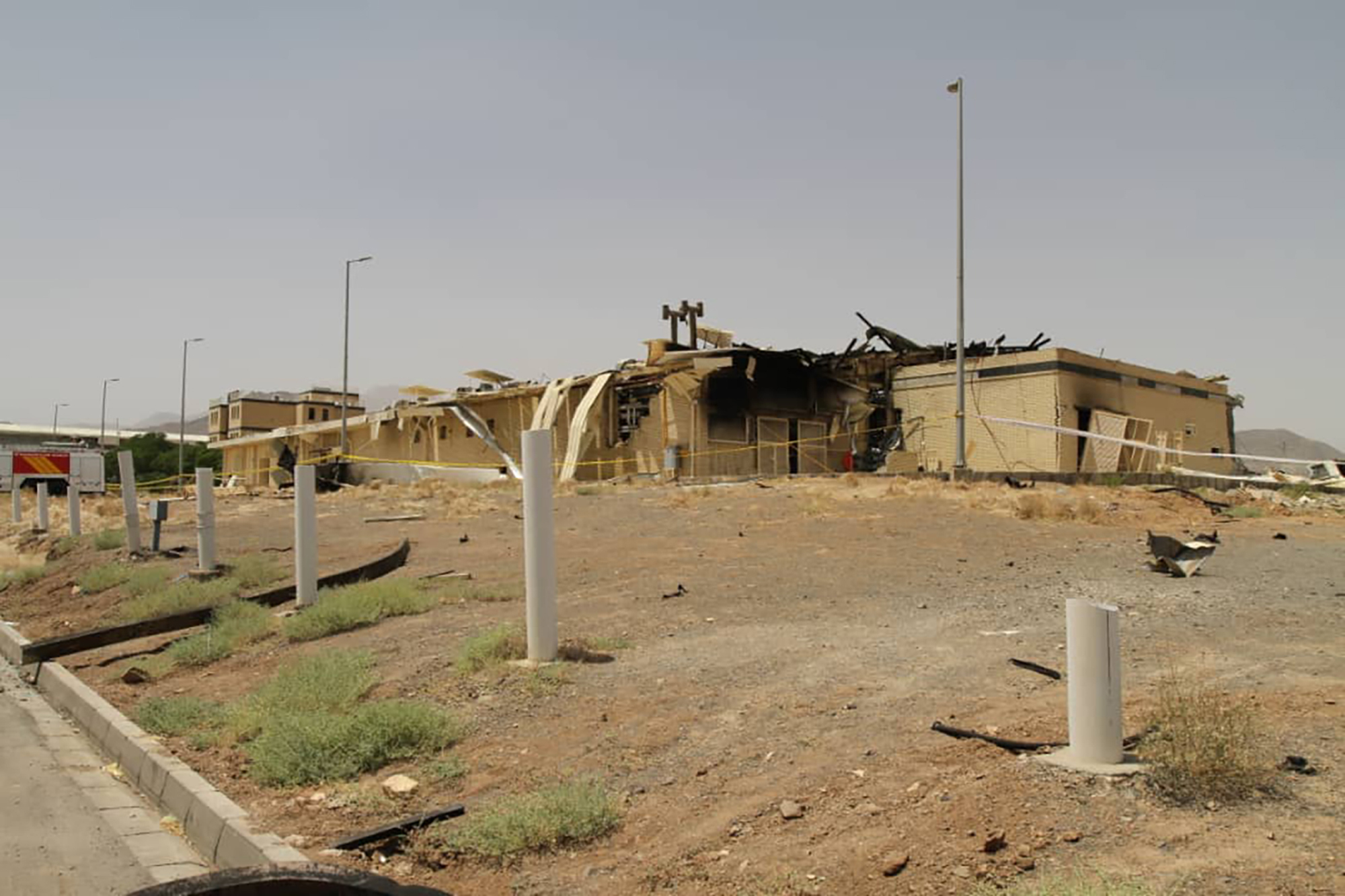
In a separate quarterly report also sent to member states on Monday and seen by Reuters, the agency gave an indication of the damage done to Iran’s production of enriched uranium by an explosion and power cut at its Natanz site last month that Tehran has blamed on Israel.

Iran’s quarterly increase in its stock of enriched uranium was the lowest since August 2019 at just 273 kg, bringing the total to 3,241 kg, according to an IAEA estimate. It was not able to fully verify the stock because Iran has downgraded cooperation.

That total is many times the 202.8 kg limit set by the nuclear deal, but still well below the more than six tonnes Iran possessed before the deal.

At Iran’s main enrichment plant, which is underground at Natanz, the agency verified on May 24 that 20 cascades, or clusters, of different types of centrifuges were being fed with uranium hexafluoride feedstock for enrichment. A senior diplomat said that before the explosion that figure was 35-37.

After Washington pulled out of the nuclear deal in 2018 under President Donald Trump and re-imposed crippling economic sanctions against Tehran, Iran began breaching the deal’s restrictions on its nuclear activities as of 2019.

One of its more recent breaches, enriching uranium to 60%, a big step towards weapons-grade from the 20% it had previously reached and the deal’s 3.67% limit, continued. The IAEA estimated that Iran had produced 2.4 kg of uranium enriched to that level and 62.8 kg of uranium enriched to up to 20%.

Iran’s production of experimental quantities of uranium metal, which is prohibited under the deal and has prompted protests by Western powers because of its potential use in the core of nuclear weapons, also continued. Iran produced 2.42 kg, the IAEA reported, up from 3.6 grams three months ago.

The Iranian authorities have attempted to cover up evidence regarding the scale of the 1988 massacre. Persons who are familiar with the incident have estimated that the overall death toll was around 30,000, mainly activists of the People’s Mojahedin Organization of Iran (MEK), the main Iranian opposition movement.  The identities and final resting places may never be known for some of these victims, as the Iranian regime has already completed plans at other sites much like those which are now pending in Khavaran. The activists involved in the Thursday gathering were relatives of the MEK victims in the 1988 massacre.

Thursday, June 3, 2021

The Iranian Horn ends UN nuclear monitoring: Daniel 8

Iran ends UN nuclear monitoring after failing to account for tracuranium

Iranian President Hassan Rouhani, right, and the head of Atomic Energy Organization of Iran Ali Akbar Salehi inspect the nuclear technology on the occasion of Iran National Nuclear Technology Day in Tehran in 2019. EPA

Iran on Monday said it would not renew its inspection agreement with the UN nuclear watchdog but would continue to record data for one more month.

The decision was made public after an accusation earlier in the day by the International Atomic Energy Agency that Tehran had failed to account for uranium traces.

“We have done our best to co-operate with the [IAEA] and provide all clarifications,” said Ali Akbar Salehi, head of the Iranian Atomic Energy Organisation.

Mr Salehi said the decision to extend maintaining data for another month was aimed at making progress and concluding “technical talks” between the two agencies.

Iran’s failure to explain traces of processed uranium found at several undeclared sites was revealed in the IAEA’s quarterly report, released on Monday.

Three months ago Britain, France and Germany scrapped a US-backed plan for the International Atomic Energy Agency’s 35-nation board of governors to criticise Iran for not fully explaining the origin of the particles.

The three countries relented when IAEA chief Rafael Grossi announced new talks with Tehran.

Mr Grossi hoped to report progress in the talks before the board meets next week and as negotiations to revive the 2015 Iran nuclear deal continue in Vienna, Austria.

“After many months, Iran has not provided the necessary explanation for the presence of the nuclear material particles at any of the three locations where the agency has conducted complementary accesses,” he said in a report to member states.

In another report, the agency said Iran’s stockpile of enriched uranium was about 16 times the limit allowed in the 2015 deal with world powers, which tried to limit Iran’s ability to develop nuclear weapons.

It gave an estimate of a stockpile of 3,241 kilograms but said it could not verify the total.

Iran began increasing production after president Donald Trump withdrew the US from the deal in 2018. 

Under the pact, the IAEA placed about 2,000 tamper-proof seals on nuclear material and equipment. Those seals communicated electronically with inspectors.

Automated measuring devices also provided real-time data from Iran’s nuclear programme.

But the IAEA’s report said it had not been able to access monitoring data since late February, when Iran started restricting international inspections of its plants.

The IAEA said it has “not had access to the data from its online enrichment monitors and electronic seals, or had access to the measurement recordings registered by its installed measurement devices” since February 23.

While Iran and the UN watchdog earlier acknowledged that the restrictions limited access to surveillance cameras at Iranian centres, the latest report indicated they were tougher.

The IAEA said it could only provide an estimate of Iran’s nuclear stockpile as the country enriches uranium at a much higher level.

The IAEA’s latest report leaves Britain, France and Germany with a decision on whether to revive their push for a re

Iranian Nuclear Horn ducking questions about uranium: Daniel 8

Iran ducking questions about uranium at undeclared sites, UN watchdog says

IAEA head ‘concerned’ that Tehran refusing to allow clarify presence of uranium at three sites; separate report says uranium stockpile at 16 times allowed limit

By AFP and TOI staff1 Jun 2021, 4:01 am

The UN nuclear watchdog Monday voiced concern that Iran had not clarified queries over possible undeclared nuclear activity after trace amounts of uranium were detected at three sites.

The IAEA said in the report that the results of its inspection work have established “a clear indication that nuclear material and/or equipment contaminated by nuclear material has been present” at three undeclared locations, with most of the activity in question dating back to the early 2000s.

The agency also said Iran has failed to answer questions regarding a fourth site where natural uranium may have been present between 2002 and 2003 in the form of a metal disc.

The report said IAEA director general Rafael Grossi was “concerned that the technical discussions between the agency and Iran have not yielded the expected results,” referring to exchanges on the sites where undeclared nuclear activity may have occurred.

“The lack of progress in clarifying the Agency’s questions concerning the correctness and completeness of Iran’s safeguards declarations seriously affects the ability of the Agency to provide assurance of the peaceful nature of Iran’s nuclear program,” the report read.

Get The Times of Israel’s Daily Edition by email and never miss our top stories Free Sign Up

The conclusion comes despite a “proactive and focused effort” launched by the IAEA in April “to break the impasse” over the sites.

In February, the atomic watchdog said it was “deeply concerned” by the possible presence of nuclear material at an undeclared site that had been flagged by Prime Minister Benjamin Netanyahu as a “secret atomic warehouse.”

“The agency is deeply concerned that undeclared nuclear material may have been present at this undeclared location and that such nuclear material remains unreported by Iran under its safeguards agreement,” a report at the time said.

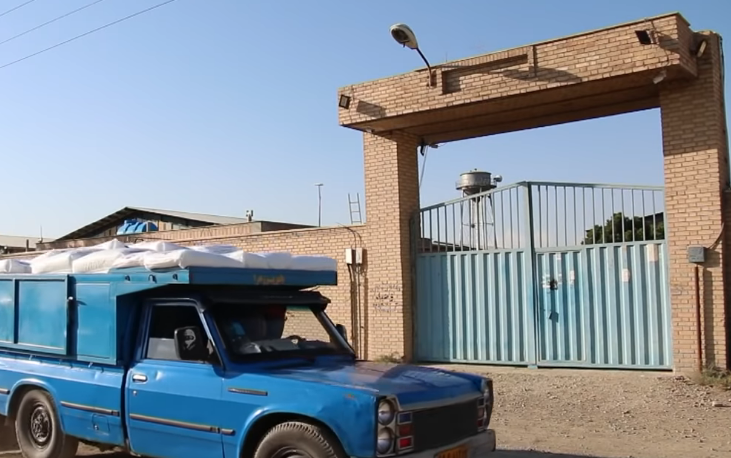
The site in question is in the Turquzabad district of Tehran, previously identified by Israel as an alleged site of secret atomic activity.

Inspectors from the International Atomic Energy Agency visited the site several times after Netanyahu identified it in a 2018 address to the UN General Assembly, took soil samples, and later definitively concluded that there were “traces of radioactive material” there, Israel’s Channel 13 news reported in 2019.

Sources told AFP in February that there is no indication the site has been used for processing uranium, but that it could have been used for storing it as late as the end of 2018.

In a separate report, the IAEA said Iran’s stockpile of enriched uranium is around 16 times the limit laid down in the 2015 deal with world powers.

However, the rate of production of enriched uranium has slowed since the last quarterly report from the IAEA in February, possibly as a result of sabotage which Iran has blamed on Israel.

In April, Iran said a “small explosion” had hit its Natanz nuclear facility.

The reports came as the IAEA has sought to negotiate with Iran to resume some inspections cut off in February.

Last week the IAEA said it had extended a temporary agreement with Iran until June 24 which has allowed many inspections to continue.

The latest reports will be presented to the IAEA’s board of governors next week.

Iran and world powers are engaged in talks in Vienna to rescue the 2015 nuclear deal after former US president Donald Trump walked away from it in 2018 and reimposed crippling sanctions on Tehran.

Trump’s successor Joe Biden has signaled his willingness to revive the plan.

For this to happen, the US would need to return to the accord and lift the sanctions reinstated by Trump while Tehran would have to re-commit to full compliance with nuclear obligations it progressively withdrew from since 2019.

Wednesday, June 2, 2021

Iran truly is a nuclear power: Daniel 8

Iran enriched uranium stockpile 16 times over deal limit: IAEA

3:19AM June 1, 2021

The UN nuclear watchdog said in a report on Monday that Iran’s stockpile of enriched uranium is around 16 times the limit laid down in the 2015 deal with world powers.

The limit laid down in the deal was 300 kilogrammes of uranium in a particular compound form, the equivalent of 202.8 kilogrammes of uranium. jsk/dl

Despite Obama Iran has been Nuking up all along: Daniel 8

Iran fails to explain uranium traces found at several sites -IAEA report

May 31, 202112:47 PM MDT

Iran has failed to explain traces of uranium found at several undeclared sites, a report by the U.N. nuclear watchdog showed on Monday, possibly setting up a fresh diplomatic clash between Tehran and the West that could derail wider nuclear talks.

Three months ago Britain, France and Germany scrapped a U.S.-backed planfor the International Atomic Energy Agency’s 35-nation Board of Governors to criticise Iran for failing to fully explain the origin of the particles; the three backed off as IAEA chief Rafael Grossi announced fresh talks with Iran. 

“After many months, Iran has not provided the necessary explanation for the presence of the nuclear material particles at any of the three locations where the Agency has conducted complementary accesses (inspections),” a report by Grossi to member states seen by Reuters said.

It will now be up to the three European powers to decide whether to revive their push for a resolution criticising Iran, which could undermine wider negotiations to revive the 2015 Iran nuclear deal at talks currently underwayin Vienna. Grossi had hoped to report progress before the board meets again next week. 

“The Director General is concerned that the technical discussions between the Agency and Iran have not yielded the expected results,” the report said.

“The lack of progress in clarifying the Agency’s questions concerning the correctness and completeness of Iran’s safeguards declarations seriously affects the ability of the Agency to provide assurance of the peaceful nature of Iran’s nuclear programme,” it added.

In a separate quarterly report also sent to member states on Monday and seen by Reuters, the agency gave an indication of the damage done to Iran’s production of enriched uranium by an explosion and power cut at its Natanz site last month that Tehran has blamed on Israel. 

Iran’s quarterly increase in its stock of enriched uranium was the lowest since August 2019 at just 273 kg, bringing the total to 3,241 kg, according to an IAEA estimate. It was not able to fully verify the stock because Iran has downgraded cooperation.

That total is many times the 202.8 kg limit set by the nuclear deal, but still well below the more than six tonnes Iran possessed before the deal.

DAMAGE TO NATANZ

At Iran’s main enrichment plant, which is underground at Natanz, the agency verified on May 24 that 20 cascades, or clusters, of different types of centrifuges were being fed with uranium hexafluoride feedstock for enrichment. A senior diplomat said that before the explosion that figure was 35-37.

After Washington pulled out of the nuclear deal in 2018 under President Donald Trump and re-imposed crippling economic sanctions against Tehran, Iran began breaching the deal’s restrictions on its nuclear activities as of 2019.

One of its more recent breaches, enriching uranium to 60%, a big step towards weapons-grade from the 20% it had previously reached and the deal’s 3.67% limit, continued. The IAEA estimated that Iran had produced 2.4 kg of uranium enriched to that level and 62.8 kg of uranium enriched to up to 20%.

Iran’s production of experimental quantities of uranium metal, which is prohibited under the deal and has prompted protests by Western powers because of its potential use in the core of nuclear weapons, also continued. Iran produced 2.42 kg, the IAEA reported, up from 3.6 grams three months ago.

Our Standards: The Thomson Reuters Trust Principles.

Tuesday, June 1, 2021

The Iranian Horn Extends Towards Babylon the Great: Daniel 8:4

US Officials Suspect Iran May Send Warships To Venezuela Amid Talks

Iran Spokesman Says ‘There Should Be No Rush’ In Vienna Nuclear Talks

Monday, 31 May 2021 11:56 

Iran’s foreign ministry said on Monday that “there should be no rush in Vienna talks”, as the fifth round of multilateral negotiations kicked off to find a compromise between the United States and Iran to revive the 2015 nuclear agreement known as the Joint Comprehensive Plan of Action, JCPOA.

In his weekly press briefing on Monday, foreign ministry’s spokesman Saeed Khatibzadeh said that “We are pursuing these talks with the necessary focus and attention to detail.” He added that the talks are not at an impasse and “considerable progress” has been made by the three working groups. “Negotiations have reached a key stage,” he added, but said that important issues remain to be resolved.

Following a decision by the Biden Administration to begin talks with Iran to pave the way for a revival of the JCPOA, negotiations began on April 6, with European powers acting as conduit between Washington and Tehran.

The two main issues are Iran’s return to the limits set by the agreement in terms of its nuclear activities and for Washington to lift sanctions imposed by the Trump administration after it left the JCPOA in May 2018.

It is not clear if the sides will reach an agreement before Iran’s presidential election on June 18, or the talks will go on until a new president takes office in Tehran.

Khatibzadeh also spoke about talks with Saudi Arabia that began in Iraq in April to reduce tensions between the two regional rivals. These talks are continuing in an “appropriate atmosphere”, he said.

The Iranian Horn Continues to Build Nukes: Revelation 8

Iran Continues 60-Percent Uranium Enrichment

By Pejman Amiri–  30th May 2021

Iran presses ahead with uranium enrichment technology

On Monday, May 24, the Atomic Energy Organization of Iran (AEOI) head Ali Akbar Salehi acknowledged Tehran still breaches the 2015 Iran nuclear deal, formally known as the Joint Comprehensive Plan of Action (JCPOA). “The accumulation of our uranium reserves with 20-percent fossil purity is more than 90kg,” he said.

Three months ago, Tehran signed an accord with UN nuclear watchdog chief Rafael Grossi allowing inspectors of the International Atomic EnergyAgency (IAEA) to continue their activities. According to the accord, Iranian officials were supposed to prevent IAEA from further inspections and collect and wipe all cameras.

In recent weeks, Iran’s pressure campaign had compelled U.S. and European negotiators to attempt to revive the JCPOA before May 21—the accord’s deadline. However, Tehran was eventually forced to extend the accord’s period to another month contrary to claims and threats that had previously raised by the ayatollahs and their lobbies in the U.S. and Europe.

To downplay this withdrawal, Salehi bragged about the continuation of uranium enrichment up to 60-percent purity. According to the JCPOA, Tehran was permitted to enrich uranium up to 3.67 percent and accumulate 202kg alone, which is used for scientific research. However, 60-percent uranium enrichment is unlikely to be used for scientific purposes, and it is considered a critical step toward weaponizing the projects.

“The 60-percent, 20-percent, and five-percent enrichment still continue, and the accumulation of our 20-percent enriched uranium has surpassed 90kg. According to the Majlis [Parliament] law, it should have reached 120kg in a year. Currently and after around four months, it has reached 90kg,” Salehi added.

Moreover, Fars news agency, affiliated with the Islamic Revolutionary Guard Corps (IRGC), reported Tehran has stockpiled tons of five-percent enriched uranium and kilos of 60-percent enriched uranium. “The accumulation of our 60-percent and five-percent uranium is over 2.5kg and five tons, respectively. Our nuclear activities still continue,” Fars quoted Salehi as saying on the same day.

Also, during the inauguration ceremony of four petrochemical plans on April 15, President Hassan Rouhani threatened the West with enriching uranium up to weapons-grade levels of 90 percent purity. “Today, we can easily achieve 90-percent enriched uranium if we decided,” he said.

Earlier, on January 7, AEOI spokesperson Behrouz Kamalvandi said, “Our progress is so great that we can easily enrich uranium in various percentages up to 90 percent.”

U.S. and European negotiators intentionally neglect Tehran’s potential for weaponizing its nuclear programs. However, they cannot bury their head in sand, analysts said.

The Iranian opposition National Council of Resistance of Iran (NCRI) provided a roundup over military aspects of the government’s nuclear programs. The NCRI explained how the ayatollahs did their best  to acquire five nuclear warheads, which failed thanks to the opposition’s revelation campaign began back in 2002.

Since then, Tehran never put aside its targets, according to dissidents. “When our team was in the midst of the JCPOA negotiations… Not only did we avoid destroying the bridges that we had built, but we also built new bridges that would enable us to go back faster if needed,” Salehi said in an interview with the state-run Channel Four TV on January 22, 2019.

“They would have told us to pour cement into those tubes as well. Now we have the same tubes,” the AEOI head explained how his government circumvented the verification process and breached the JCPOA.

Saturday, May 29, 2021

The Iranian nuclear genie is already out of the bottle: Daniel 8

The Iranian nuclear genie is already out of the bottle

Iran in the grip of the extremist camp will assuredly increase aid to Hezbollah and bolster relations with Hamas and other terrorist groups in Gaza. It will not cease striving for a nuclear bomb, even in the presence of a strict oversight regime.

The head of the International Atomic Energy Agency, Rafael Grossi, is a brave man. In an interview with the Financial Times published on Wednesday, he said what none of his predecessors have dared say: A country that enriches uranium to 60% purity is a country striving toward a nuclear weapon.

His comments make finding a smoking gun unnecessary. Grossi’s conclusion regarding Iran’s intentions resonates more and is far more credible than Ayatollah Ali Khamenei’s alleged religious decree, which no one has ever seen, whereby Iran is not pursuing an atomic bomb.

The only ray of light emanating from Grossi’s remarks was that the situation is still reversible and that the enrichment restrictions imposed by the 2015 nuclear deal can be reinstated, alongside the reimplementation of a robust oversight regime.

Indeed, backtracking Iran in terms of its enrichment activities and redeploying nuclear inspectors are some of the issues currently being discussed by Iran and world powers in Vienna. Gaps still remain, but both sides are expressing optimism and believe a deal will soon be reached. As a gesture, the Iranians even agreed to extend by a month international oversight of their nuclear facilities, “until after the Iranian presidential election next month.”

Iran’s consent to extend the oversight until after the election is not coincidental, and can also be seen as an indication of Khamenei’s desire to “drag feet” and take his time before signing a new nuclear deal with the global powers prior to the June 18 election. The reason: Khamenei doesn’t want the credit for a new nuclear deal, which would lift several of the heavier sanctions imposed on Iran, to go to current President Hassan Rouhani of the moderate and reformist camp, rather to the next president, Ebrahim Raisi, his close confidante and a member of the regime’s conservative faction.

Khamenei is doing all in his power to ensure Raisi is elected, including disqualifying most of the moderate candidates in advance. If Raisi, who is currently Iran’s chief justice, is elected, the entire hard-line camp will get a boost. The removal of sanctions under Raisi’s watch, Khamenei believes, will also diminish the prospect of a popular uprising by the millions of Iranians who have fallen beneath the poverty line due to the sanctions and government corruption.

Israel, naturally, views things differently and conveyed as much to US Secretary of State Antony Blinken during his recent visit. The extreme hardliners in Iran already control the parliament, justice system, and of course the Islamic Revolutionary Guard Corps and military. The election of a hard-line president, who is also tabbed as Khamenei’s successor, will give this camp full control of Iran and stymie the more moderate and liberal factions.

Iran in the grip of the extremist camp will assuredly increase aid to Hezbollah and bolster relations with Hamas and other terrorist groups in Gaza. It will not cease striving for a nuclear bomb, even in the presence of strict oversight. Even Grossi concedes that “it’s impossible” to erase the technological knowledge the Iranians have accrued over the pas

Thursday, May 27, 2021

The Iranian Horn Strikes Babylon the Great Again

Rocket Strike On Iraqi Base Marks Latest Attack On U.S. Interests

At least three rockets were fired last Monday towards the Iraqi military air base in Balad, just north of Baghdad, Iraqi security officials told AFP news agency. The base houses American company Sallyport, which maintains F-16 Iraqi aircraft purchased from the US. There were no casualties, the Pentagon said in a statement, although one foreign contractor working for Sallyport was injured. The attack comes less than 24 hours after two rockets targeted Iraq’s Baghdad airport base hosting US-led coalition troops. While no group has claimed responsibility for either attack, similar assaults have been perpetrated by Iranian-backed militia in the past, Reuters reports. 

The strike marks the latest of over 30 rocket or bomb attacks on US interests in Iraq since President Joe Biden took office in January, adding to the dozens of similar attacks that were carried out during the Trump administration, according to a report from Al Jazeera. The targets of these attacks have ranged from US troops, Iraqi supply convoys, and the US embassy, resulting in the deaths of two foreign contractors, one Iraqi contractor, and eight Iraqi civilians this year alone. Although Washington has often blamed Iran-backed military factions based in Iraq for such attacks, they have yet to publicly identify whom they believe is responsible for the most recent rocket strikes. “We’re going to respect that,” said US Pentagon Press Secretary John Kirby of the responsibility of the Iraqi authorities to investigate the matter independently.

Failure to deter or condemn such acts of violence sets a dangerous precedent. However, the attacks come at a delicate time for President Biden as he seeks to restart diplomatic negotiations with Tehran about re-entering the 2015 Iran nuclear agreement from which former President Donald Trump unilaterally withdrew as part of his “maximum pressure” campaign. The possibility of Iranian involvement in the continued rocket strikes raises questions about whether escalating tensions between the US and Iran may threaten the Biden administration’s agenda. According to a report from US News in March, Iran has rejected the prospect of a new deal until Biden lifts the crippling economic sanctions which Trump put in place upon pulling back from the accord. Meanwhile, Iran has continued to pursue uranium enrichment at levels which the State Department says clearly indicate the development of nuclear weapons.  

Relations between the US and Iran have been especially strained since Trump ordered the drone strike in January 2020 that killed Iranian General Qassem Soleimani, who had been responsible for coordinating the militias in Iraq, as well as a prominent Iraqi commander of those forces. Revenge for the assassinations has fuelled the continued attacks on US interests in Iraq, though Biden’s response has been more conciliatory than his predecessor’s. A retaliatory airstrike in February by US forces on an Iranian-backed militia position in Syria was seen as a calculated attempt to deter the attacks without escalating tensions with Iran, notably taking place outside Iraq so as to avoid provoking the pro-Iranian militia there, US News reports. 

Still, there have been calls from Iraqi lawmakers for the removal of US troops from the region. In a statement made after a similar rocket strike in March, the commander in chief of Iraq’s security forces stressed the importance of Iraq distancing itself from regional and international competitions for power. However, Iraq is in a particularly vulnerable position because of its joint dependence on the United States for support in its fight against ISIS and on Iran as its largest neighbour and trading partner. Although a non-binding resolution passed by the Iraqi Parliament in 2020 urged the expulsion of all foreign troops from Iraq, over 2,500 US troops remain in the country even after strategic talks between Baghdad and Washington over US military presence.    

Escalating tensions between the US and Iran, then, not only place the likelihood of a nuclear agreement in jeopardy, but also pose a threat to security in Iraq, who has borne the brunt of the violence and damage caused by the Iranian attacks. It is critical that Biden’s attempts to move forward diplomatically involve Iraq and that talks with the Iraqi government over the removal of US troops continue alongside the push for revived negotiations with Iran if peace in the region is to be anything but a zero-sum game.

The Iranian Horn Prepares for Nuclear War

Iran says still enriching uranium at 60-pct purity: media

TEHRAN, May 24 (Xinhua) — Iran is still enriching uranium at the purity of 60, 20 and 5 percent, and it has already accumulated over 90 kg of 20-percent enriched uranium, head of the Atomic Energy Organization of Iran (AEOI) Ali Akbar Salehi said on Monday.

The official made the statement after a telephone conversation held around noon with Rafael Grossi, director general of the International Atomic Energy Agency (IAEA), Iranian official IRNA News Agency reported.

In the conversation, Salehi reportedly informed Grossi of Tehran’s decision to extend a temporary agreement regarding the IAEA’s monitoring of Iranian nuclear activities for one month until June 24.

According to a law passed by Iran’s parliament in December, the AEOI is required to accumulate 120 kg of 20-percent enriched uranium every year, Salehi noted.

Nevertheless, Iran is obliged under the 2015 nuclear agreement to limit its uranium enrichment to a 3.67 percent purity and to stockpile no more than 300 kg of the material.

Iran started gradually reducing its commitments to the agreement one year after former U.S. President Donald Trump unilaterally took his country out of the deal in May 2018 and reimposed sanctions on Tehran.

Iran’s reserves of 60-percent enriched uranium have by now exceeded 2.5 kg, and the 5-percent enriched uranium reserves are over 5 tonnes, Salehi added.

The three-month agreement between Iran and the UN nuclear watchdog was reached right before a law passed in December 2020 by Iran’s parliament came into effect, which mandates Iran’s executive branch to stop implementing the IAEA’s Additional Protocol if sanctions on Iran that should be lifted under the 2015 nuclear agreement continue to be in place by Feb. 23.

Representatives from China, France, Germany, Russia, Britain and Iran are expected to meet later this week in Vienna to continue negotiations aiming at reviving the 2015 nuclear deal. Enditem

Wednesday, May 26, 2021

Iran Continues to Nuke Up: Daniel 8

Nuclear Chief Says Iran Will Continue Enriching Uranium At 60 Percent

Iran Spokesman Optimistic Over Nuclear Talks, Top Negotiator More Cautious

Tuesday, 25 May 2021 19:28 

 Iranian government spokesman Ali Rabiei Tuesday reiterated earlier remarks by President Hassan Rouhani, saying he was optimistic over Tehran reaching an agreement soon at talks with world powers to revive a 2015 nuclear deal. However, Iran’s top negotiator has cautioned that serious issues remained.

Iran and global powers have held talks since April in Vienna, working on steps that Tehran and Washington must take on sanctions and nuclear activities to return to full compliance with the nuclear pact.

“General agreements have been reached on major disputes. On the lifting of sanctions, the remaining cases are very minor, and given the negotiation process, we are optimistic about resolving the remaining minor and practical cases,” Rabiei told an online news conference.

Iran’s top negotiator, Abbas Araghchi (Araqchi) struck a more cautious stance in comments to state TV.

“There are still serious and important issues that need to be resolved,” he said. “Today we will start the negotiations again and we hope that during the few days of talks, God willing, we will be able to reach the final solutions.”

On his way to the talks, US Special Envoy for Iran Robert Malley said on Twitter: “The latest round of talks was constructive and saw meaningful progress. But much work still needs to be done.”

Washington withdrew from the deal in 2018, prompting Iran to steadily overstep the accord’s limits on its nuclear program.

Last week, Iranian President Hassan Rouhani said sanctions on oil, shipping, petrochemicals, insurance and the central bank had been dealt with in the talks, though European diplomats said success was not guaranteed and very difficult issues remained.

Reporting by Reuters