The prophecy is more than seeing into the future. For the prophecy sees without the element of time. For the prophecy sees things as they were, as they are, and as they always shall be.
On
April 4, 2004, the 2-5 battalion of the 1st Cavalry Division was just
taking over responsibility for Sadr City, a large Baghdad slum with a
population of 2 million. A platoon of 18 soldiers and their interpreter
was returning to its base from the most routine of missions, providing
security for sewage trucks, when it suddenly came under fire.
Within
minutes, a gunner, Sgt. Eddie Chen, was fatally injured. Others were
wounded and two of the platoon’s four Humvees were disabled. Lt. Shane
Aguero, the platoon leader, directed the team down an alleyway, where
the soldiers took cover in a house.
Back at the battalion’s base,
Camp War Eagle, located just outside Sadr City, the new commander, Lt.
Col. Gary Volesky, was taking over command as radio reports came in from
the platoon detailing the increasing intensity of the fight. Then
reports arrived of enemy fighters seizing the local police stations in
the neighborhood. Volesky and rescue teams from the battalion’s Charlie
and Alpha Company raced into the city, facing an onslaught of gun fire,
rocket propelled grenades (RPGs) and pipe bombs.
By the end of the
night, eight soldiers would be dead and more than 60 wounded -- the
largest casualty count in one day for the First Cavalry Division since
Vietnam.
Here’s more about the ambush that would be known as Black Sunday:
Back at the house in the alley, with
an Iraqi family still inside, soldiers from the platoon took up
positions on the roof. Sgt. 1st Class Jerry Swope stayed down in the
alley in one of the remaining Humvees. As enemy fighters continuously
assaulted the platoon, Swope was on the Humvee’s radio for the entire
fight, the only point of contact with rescue teams struggling to get to
them.
Up on the roof, the soldiers were frantically trying to
signal their location, using smoke grenades, electronic signaling
equipment, even ripping off the sleeves of their uniforms to start a
fire.
Out on the streets of Sadr City, the multiple rescue teams
attempting to reach the pinned down platoon came under fierce attack and
incurred heavy casualties.
“It was multiple rounds constantly,”
Capt. Troy Denomy, the commander of Charlie Company, recalled. “I
remember looking at the street, you’d see the rounds that were missing,
you could see the impact on the street, and it kind of looked like rain
when it hits puddles.”
Charlie Company passed by the alleyway, but
with the antennas shot off the lead Bradley fighting vehicles, the
Bradleys were unable to hear the radio calls to stop.
Eventually, a
tank company came up the adjoining road. Watching the tanks rolling by,
SFC Swope frantically called into the radio for them to stop. The
platoon leader, Lt. Aguero, in a last-ditch effort, ran down the alley
waving his flashlight in the dark. The tank company commander saw the
light, and stopped, bringing the power and might needed to push back the
enemy fighters and get the platoon out.
What was the toll?
In addition to Sgt. Eddie Chen, the gunner
with the pinned-down platoon, seven other soldiers were killed that
evening: Spc. Robert Arsiaga, Spc. Ahmed Cason, Spc. Israel Garza, Spc.
Stephen Hiller, Cpl. Forest Jostes, Sgt. Michael Mitchell and Spc. Casey
Sheehan. Most of them were in their 20s. More than 60 others were
wounded.
Why did it matter?
The fight to rescue the team in the alley was
just the beginning. Within hours, many of the soldiers involved were
back battling on the streets of Sadr City
to retake the police stations that had been seized. They would go on to
fight this new insurgency for 80 straight days, and then after a brief
respite, would endure another 60.
Who are the heroes?
As Volesky put it, “Uncommon valor was common
that day.” Sgt. 1st Class Swope would be awarded a Silver Star for
staying in the Humvee in the alley and remaining on the radio for the
entire battle. Staff Sgt. Robert Miltenberger was also awarded the
third-highest medal for valor because of his actions that night. As part
of a rescue mission, he and more than a dozen other soldiers were in
the rear of an open-bed LMTV truck. Exposed to the enemy like the
proverbial fish in a barrel, Miltenberger was credited with saving the
lives of three soldiers while treating many other wounded.
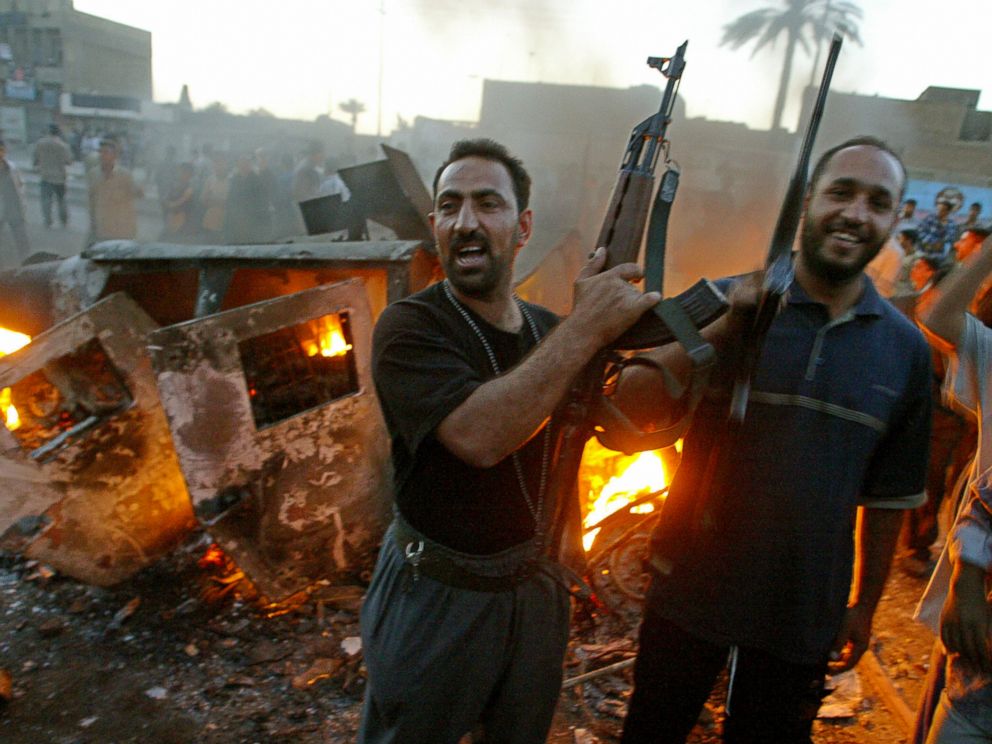
Wathiq Khuzaie/Getty Images
U.S. troops patrol the deserted streets of the sprawling Shia slum of Sadr City at
sunset after a day of tense clashes across the country with supporters
of controversial Shia cleric Moqtada al-Sadr, April 4, 2004, in Sadr
City, Iraq. more +For soldiers of the 2-5 battalion, it was moment that would define the days to follow.“I
don’t think the bonds that they’ve made here with their fellow soldiers
will ever break,” Volesky said. “I understand now what it means when
you go to a veterans’ ceremony and you see the old veterans get together
and hug and cry and you never really understood it. I understand it
now.”
By Conor Finnegan
The U.S.’s ranks of diplomats are losing key leaders at a
“dizzying speed” as the State Department struggles to recruit talent
amid a hiring freeze and sinking morale in the Trump administration,
according to a new letter from a top ambassador.
Sixty percent of
the agency’s career ambassadors, the highest rank for diplomats, have
retired or quit since January. Nearly half of career ministers — the
next level down and equivalent to the military’s three-star generals —
are gone too, down to 19 from 33. The next-level minister counselors
have seen their numbers drop by 62 diplomats since Labor Day alone “and
are still falling,” writes Ambassador Barbara Stephenson, the president
of the American Foreign Service Association union.
Without
these leaders, the U.S. could face a diminished role on the world
stage, unable to keep up with the increasingly aggressive foreign
policies of rising countries like China, she argues.
“There is
simply no denying the warning signs that point to mounting threats to
our institution — and to the global leadership that depends on us. There
is no denying that our leadership ranks are being depleted at a
dizzying speed,” Stephenson, who has headed the AFSA since 2015, writes
in a new essay in the group’s monthly publication.
AFSA rarely makes forays into political issues, making Stephenson’s letter that much more surprising.
There
has been a sharp impact on the next generation as well, AFSA reports. A
department-wide hiring freeze prevents new employees from coming
onboard and limits current employees’ ability to take on new roles,
unless granted special permission. After 366 new foreign service
officers were admitted in 2016, only about 100 will join in 2018,
according to AFSA.
What’s worse, they say, is that interest in
joining the foreign service is plummeting now because of these policies.
More than 17,000 people applied to take the foreign service test last
year, but fewer than half that number have taken it so far this year.
The
implications of that trend could be felt long term, with a new crop of
talented diplomats missing and unable to take the helm in a couple of
decades, Stephenson argues.
“The talent being shown the door now
is not only our top talent but also talent that cannot be replicated
overnight,” she writes.
While the union and many outside the
government as well are raising alarms about the situation, the president
has made clear that he does not see the need to fill many of the roles
or build talent.
“The one that matters is me. I’m the only one
that matters because, when it comes to it, that’s what the policy is
going to be,” he said in a Fox News interview last week.
Secretary of State Rex Tillerson
has said he is revamping the State Department to be more efficient and
sustainable — calling the project “the most important thing I want to do
during the time I have.”
That “redesign” began with an employee
survey and hundreds of employee interviews, led by an outside consulting
firm, to hone the department’s focus and mission, Tillerson’s team has
said. Until it is complete, he has implemented that hiring freeze and
left several top roles vacant or filled by staff in an acting capacity.
AP
In this June 5, 2017, file photo, U.S.
Secretary of State Rex Tillerson, right, and U.S. Secretary of Defense
Jim Mattis participate in talks at Government House in Sydney.more +Tillerson
has said he has the “utmost respect for the foreign service officer
corps here, and they’re vital ... and critical to the country’s ability
to carry out its foreign policy,” telling the New York Times magazine he doesn’t understand the backlash to the redesign. “I’m mystified by it. I’m perplexed by it.”But
to foreign policy hands, he is depleting the nation’s diplomats, which
will diminish America’s role on the world stage — or lead to a heavier
reliance on the Pentagon at a time when the military is already
stretched thin by two wars in Afghanistan and Iraq and Syria, as well as other hotspots around the world.
“The
rapid loss of so many senior officers has a serious, immediate and
tangible effect on the capacity of the United States to shape world
events,” Stephenson writes. “Were the U.S. military to face such a
decapitation of its leadership ranks, I would expect a public outcry.”
Military leaders have often called for robust funding of the State Department. Secretary of Defense James Mattis
is often quoted from his 2013 Congressional testimony, when he told the
Senate Armed Services Committee, “If you don’t fund the State
Department fully, then I need to buy more ammunition.”
Tillerson
and Mattis have worked closely in the Trump administration, with Mattis
pointing out at every turn that Tillerson and diplomacy are at the helm
on their North Korea strategy.
It’s not just the loss of personnel or lack of hiring. There have been complaints about mismanaging talent as well.
Politico
reported Monday that the State Department has assigned “several
hundred” employees to process public information requests, often known
as FOIAs, because of a backlog that has built up over more than a
decade.
While the State Department would not confirm that number,
an official told ABC News, “The current processing system just wasn’t
working,” citing over 13,000 requests outstanding since 2006.
“The
Secretary is taking an approach of calling on many capable hands to
step in, as part of a surge, to clear the backlog,” the official added.
“This is about accountability and efficiently getting these outstanding
FOIA requests down.”
Despite the criticism, the personnel moves seem to have satisfied Tillerson’s boss.
“It’s
called cost-saving. There’s nothing wrong with cost-saving. Rex is in
there working hard. He’s doing his best,” Trump told Fox News last week.
If
Trump does seem to have any concern about staffing at the State
Department, it’s that there are not enough of “his” people in the agency
to implement in the “America First” vision he promised — agreeing with
conservative commentator Laura Ingraham on this point in that Fox News
interview.
The Associated Press
FILE - In this Aug. 7, 2008 file
photo, then-US ambassador to Tanzania Mark Green is seen at the US
embassy in Tanzania. Green is a rare bird in Washington these days: A
nominee of President Donald Trump enjoying broad bipartisan support. But
there’smore +So
far, the Trump administration has only seven high-level political
appointees confirmed by the Senate and working in the department —
outside of Tillerson but including USAID Administrator Mark Green and
Deputy Secretary of State John Sullivan. An additional eight nominees
are working their way through the confirmation process now, with the
Senate either awaiting their paperwork or the nominees awaiting a Senate
hearing or vote.But in the absence of Trump nominees, there
are 30 senior roles filled by career diplomats in acting capacities.
Although there is someone doing the work, they do not enjoy the full
legal authority of their role or the image of speaking on the
administration’s behalf to the world.
There are 39 other senior
roles that are vacant, but Tillerson has said he plans to eliminate 18
of those and fold their responsibilities into other jobs. The Trump
administration has named a nominee for one of the 39 roles — the chief
of protocol — who is awaiting confirmation.
Nearly three dozen
ambassadorships remain vacant as well, with the embassies’ No. 2, called
the charge d’affaires, leading those U.S. missions.
 Ahmad Al-Rubaye/AFP/Getty Images
 Wathiq Khuzaie/Getty Images
 AP
AP
 The Associated Press

No comments:
Post a Comment