Showing posts with label armament. Show all posts

Wednesday, December 26, 2018

More Rioting Outside the Temple Walls (Revelation 11:2)


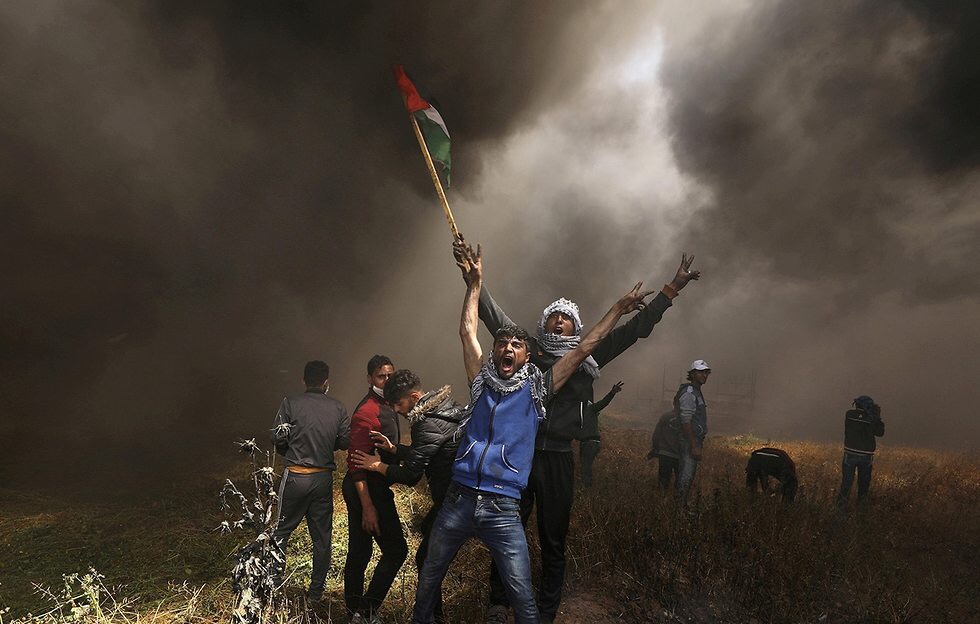
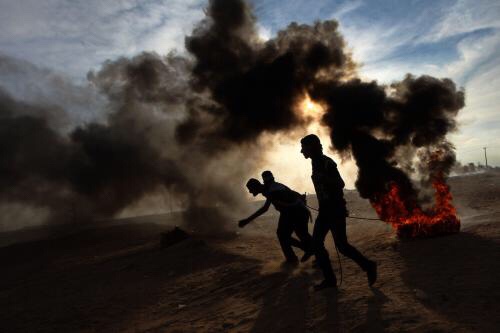
Arab rioters on the Gaza-Israel border in Rafah, Gaza on Oct. 12. (Abed Rahim Khatib/Flash90)
Gazans Riot on Land and at Sea
By Dov Benovadiaי"ז טבת תשע"ט
YERUSHALAYIM -
Thousands of Gaza Arabs rioted Monday night at several points along the border fence, as dozens of boats attempted to breach the Israeli naval blockade of Gaza. Riots occurred near Zikim, adjacent to the eastern border of Gaza just a few kilometers from Ashkelon, and at the Erez crossing.
Israeli forces responded to rock throwing and numerous attacks using firebombs with anti-riot measures. Gaza sources said that 14 rioters were injured.
Israel was redoubling its forces in the south, after Hamas and Islamic Jihad said that this coming Friday would be “a day of great testing for the enemy.” On the weekend, the terror groups threatened to increase attacks against Israel, after four rioters died Friday after attacking Israeli soldiers. The IDF is concerned that Hamas could stage riots even before Friday, hence the buildup of forces in the south.
Israeli sources told Channel 20 that if the terror groups once again began shooting missiles at Israel, the IDF’s response would be “harsh and powerful. We will not allow a repeat of the recent events” in which Gaza terrorists shot nearly 500 missiles at Israel withing several days. “The response will not be ‘measured’ this time, but will be a harsh strike at Hamas.”
On Tuesday, security officials arrested seven Arab residents of Yerushalayim for throwing firebombs at civilians and security personnel. The seven were all youths between 15 and 20 years of age. Besides firebombs, the gang threw firecrackers and other dangerous explosives at Israeli vehicles and at the light rail. Police plan to ask for an extension of their remand.
Overnight Monday, security officials said they arrested 5 wanted security suspects in other areas in Yehudah and Shomron. The suspects were wanted for participating in rioting and throwing stones and firebombs that endangered Israeli civilians and IDF soldiers. Several of the suspects were also charged with belonging to Hamas. All were being questioned on their activities by security forces.

Tuesday, December 25, 2018

Protests to Continue Outside the Temple Walls (Revelation 11:2)


Great March of Return protests to continue until end of Gaza siege: Hamas
Sun Dec 23, 2018 10:19PM [Updated: Mon Dec 24, 2018 02:34AM ]
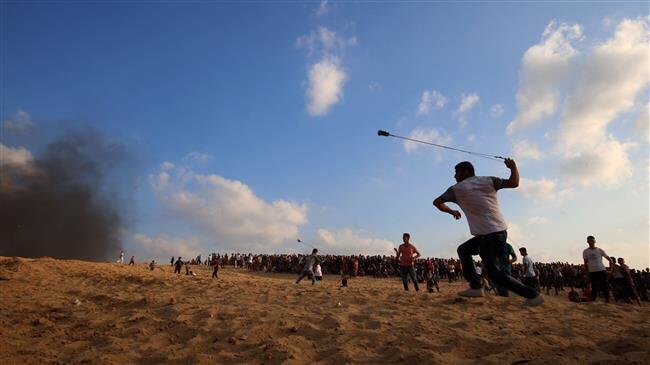
Palestinian protesters use slingshots in a demonstration on the beach near the maritime border with occupied territories, in the northern Gaza Strip, on October 8, 2018. (Photo by AFP)
A senior official of the Islamic resistance movement, Hamas, says Palestinians will continue the Great March of Return rallies until the end of the Israeli siege on the Gaza Strip.
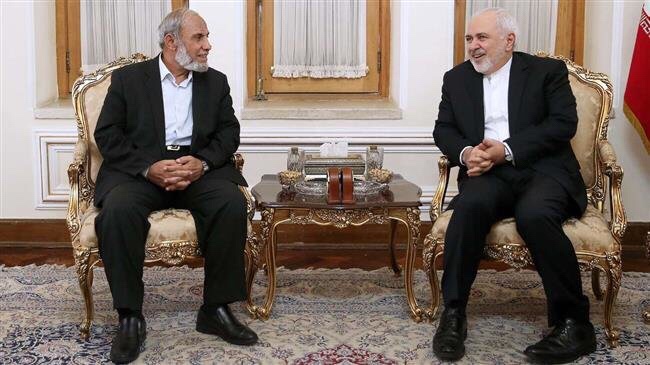
Mahmoud al-Zahar, a co-founder of Hamas and a member of its leadership in the Gaza Strip, made the remarks in a Sunday interview with Iran’s Al-Alam News Network in Tehran.
He said the anti-occupation rallies, known as the “Great March of Return," have produced important results, and will not be stopped before the Israeli regime’s siege on the enclave is lifted.
Tensions have been running high near the fence separating Gaza from the occupied territories since March 30, which marked the start of the protests.
Palestinian protesters demand the right to return for those driven out of their homeland.
The clashes in Gaza reached their peak on May 14, the eve of the 70th anniversary of Nakba Day, or the Day of Catastrophe, which coincided this year with Washington's relocation of the US embassy from Tel Aviv to occupied Jerusalem al-Quds.
More than 220 Palestinians have so far been killed and over 20,000 others wounded in the renewed Gaza clashes, according to the latest figures released by the Gaza Health Ministry.
Gaza has been under Israeli siege since June 2007, causing a decline in living standards as well as unprecedented unemployment and poverty.

PressTV-‘54 Palestinian children killed by Israeli forces since Jan.’
A report shows the Israeli regime’s forces have killed 54 Palestinian children and arrested over 900 during this year.
Friday to be decisive day for Israel
The military wings of Hamas warned in a joint statement on Sunday that the coming Friday will be “decisive” in determining their response to the killing of four people during recent border protests.
The groups declared they had prepared retaliation steps, and that their use will be dependent upon Israel’s policy.
It will be “a decisive day in examining the Zionist enemy’s behavior and intentions toward our people in the March of Return,” the Sunday statement said.
The deaths were “a total crime and clear recklessness by the Zionist enemy,” which has “crossed red lines,” they continued, as reported by Israeli media.
“Regarding these crimes, the resistance will not act lightly with the enemy and stand by idly,” the statement warned.
The statement came after several Palestinians, including a teenage, were shot dead by Israeli fire and nearly fifty others sustained injuries during the latest Great March of Return protests in Gaza.

PressTV-Israeli forces shoot dead three, wound dozens in Gaza
Over 220 Palestinians have been killed since they began weekly border protests on March 30.
Iran main backer of Palestinians
In his interview with Al-Alam, al-Zahar further described Iran as the main supporter of Palestinians, and said Hamas does not do anything without consulting with Iran over the issue.
Al-Zahar made the remarks during his visit to Tehran at the head of a delegation of the Hamas faction in the Palestinian Parliament.
He earlier held talks with Iranian Foreign Minister Mohammad Javad Zarif, Secretary of Supreme National Security Council Ali Shamkhani, Parliament Speaker Ali Larijani as well as Ali Akbar Velayati a senior advisor to the Leader of the Islamic Revolution Ayatollah Seyyed Ali Khamenei.
In the meeting with al-Zahar, Zarif once again reiterated the Islamic Republic's principled policy to support Palestine, urging all countries in the Muslim world to boost their unity to defend the Palestinian cause.
"We hope that some Muslim countries that have pinned their hopes on the support of the Zionists and the US will return to the Muslim world and realize that Zionists are not a trustworthy friend or partner for anybody," Zarif said.
The Iranian foreign minister added that efforts to counter the Palestinian resistance are unfortunately being made from inside the Muslim world, saying that all countries and Islamic movements are also under such pressure.

PressTV-Support for Palestine, Iran's principled policy: Zarif
Iran's Foreign Minister Zarif says support for Palestine is among the Islamic Republic's principled policies.
For his part, Zahar hailed Iran's real support for Palestine and expressed hope that the Palestinian people's resistance and the Muslim world's support would put an end to the Zionist project as soon as possible.
Back in May, Ayatollah Khamenei said resistance is the sole way to save the oppressed Palestinian nation.
Ayatollah Khamenei reaffirmed Iran’s unwavering support for Palestine and Palestinian fighters, noting that strengthening the resistance front in the Muslim world and intensifying the fight against the occupying regime of Israel and its supporters were the solution to the Palestinian issue.

Monday, December 24, 2018

Hamas Threatens New Violence Outside the Temple Walls

IDF chief urges caution in Gaza as Hamas threatens new violence
Outgoing IDF Chief of Staff Gadi Eisenkot on Sunday urged caution over the violence in the Gaza Strip, saying that a decision on launching a wide-scale Israeli military operation in the coastal enclave should be made based on “informed decisions,” rather than emotions. Meanwhile, the terror groups in Gaza vowed Sunday to avenge the deaths of four Palestinian protesters killed in weekend clashes with the IDF, which some fear will spark another escalation on the southern border.
On Friday, four Palestinian protesters, including a teenager, were fatally shot by IDF troops during the March of Return demonstrations along the border fence, prompting the Gaza factions to issue a statement threatening to respond to “Israel’s stupidity and its crimes against our people.”
Eizenkot said that Israel had a range of options open to it for dealing with Gaza.
“The question is whether to launch a major military operation, or choose a different option … For now, we’ve decided to go with a different option that would bring us the best results. We are not afraid to use force but it has to be done intelligently,” said the chief of staff.
“The use of force in Gaza will subsequently lead to questions whether it can ever be rehabilitated,” Eisenkot continued. “Although the Strip is ruled by a terrorist organization with murderous ideology that seeks to destroy Israel, it’s responsible for two million people living there.”
For the past month there has been relative quiet on the Gaza border as Israel and Hamas observed an Egypt and UN-brokered ceasefire following the biggest round of fighting between the two sides since 2014 Operation Protective Edge.
“Hamas is relatively deterred and has been in distress due to a series of decisions made by the Palestinian Authority, which has backed them into a corner. This led them to organize the border protests with the goals of easing the blockade, gaining international legitimacy and inciting violence in the West Bank—all of which they failed to achieve,” Eisenkot said.
The IDF chief also hit back at the criticism aimed at him by both former defense minister Avigdor Lieberman and Education Minister Naftali Bennett, for allowing $90 million of Qatari aid earmarked for Hamas civil servants and welfare to enter the Strip, despite the unstable security situation on the border.

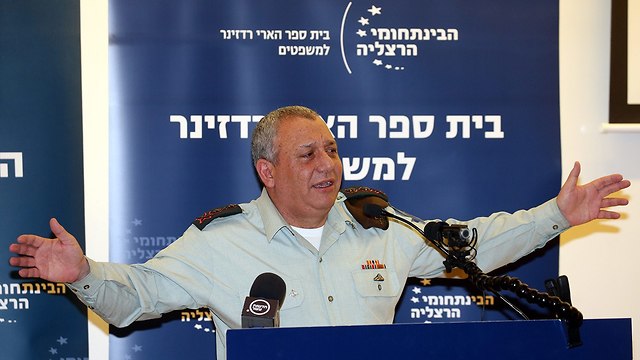
IDF’s outgoing Chief of Staff Gadi Eisenkot (Photo: Yariv Katz)
"I am aware that we have not been able to provide a good sense of security over the past three years to the residents of the Gaza border communities due to the primitive fighting methods developed by the enemy,” he said.
Eisenkot also added that although he doesn't agree with the notion that Israel has lost its deterrence, he admits that the situation in Gaza is “complex.”
“States and organizations can not be deterred from conventional expansion … We are doing a great deal to prevent the smuggling of advanced weapons into the Gaza Strip.” he said.

Sunday, December 23, 2018

Four Palestinians Killed Outside the Temple Walls (Revelation 11:2)


A wounded Palestinian is evacuated during a protest near the Israel-Gaza border fence, in the southern Gaza Strip December 21, 2018.REUTERS/Ibraheem Abu Mustafa
Four Palestinians Killed in Border Protests, Gaza Authorities Say
Jack Khoury22.12.2018 | 15:40
The latest fatality, an 18-year-old Palestinian who was hit by a bullet to his stomach during Friday's demonstration, succumbed to his wounds on Saturday
An 18-year-old Palestinian identified as Iman Munir Shubir succumbed to his wounds on Saturday after he was wounded gravely by a bullet that hit him in the stomach during protests at the border between Israel and Gaza, Gaza's Health Ministry said.
Shubir, who hails from the city of Deir al-Balah, was hurt while participating in a demonstration east of the Palestinian refugee camp of al-Bureij in the center of the Strip.
His death brings the death toll from Friday's Gaza demonstrations to four.
The three other fatalities from Friday's clashes between Gazan protesters and Israeli security forces are the 16-year-old Mohammad al-Jahjuh, who was shot east of Gaza City; the 40-year-old Maher Yasin, who was shot east of al-Bureij and the 28-year-old Abed al-Aziz Sharia, who was shot east of Gaza.
According to Gaza authorities, Yasin suffered from mental and cognitive disablities.
At least 40 other people were wounded by live Israeli fire, and three were injured from tear gas inhalation.
The Israeli militarty said around 8,000 Palestinians gathered near the border fence on Friday: Most kept their distance, while some burned tires and tried to throw an explosive device into Israel, though unsuccessfully.
"Troops responded with riot dispersal means and fired in accordance with standard operating procedures," an Israeli military spokeswoman said.
Since the Gaza border protests began in March, around 240 Palestinians died in confrontations with the Israeli military.
Ramallah's Health Ministry reported last week that an 18-year-old resident of the refugee camp Jalazone was killed by live Israeli fire during altercations between the Israeli military and Palestinians in the West Bank.
According to the health ministry, two other Palestinians were wounded by live fire and were evacuated to a hospital in the West Bank to receive medical care.
Reuters contributed to this report.

Three More Palestinians Die Outside the Temple Walls (Revelation 11:2)


The Gaza Health Ministry said more than 208 Palestinians have been killed in protests at the Gaza-Israel border since weekly protests began March 30. File Photo by Ismael Mohamad/UPI | License Photo
Three Palestinians dead in clashes at Gaza border with Israel
Danielle Haynes
Dec. 21 (UPI) -- Three Palestinians died during violence Friday marking nine months of weekly protests at the Gaza-Israel border, the Gaza Ministry of Health said.
Palestinian news agency WAFA identified the dead Mohammad Mo'een Jahjouh, 16, Abdul-Aziz Abu Shari'a, 28, and Maher Yasin, 40. Health officials said another 27 people sustained injuries, including journalists and medical workers.

Saturday, December 22, 2018

Humanitarian Crisis Outside the Temple Walls (Revelation 11:2)


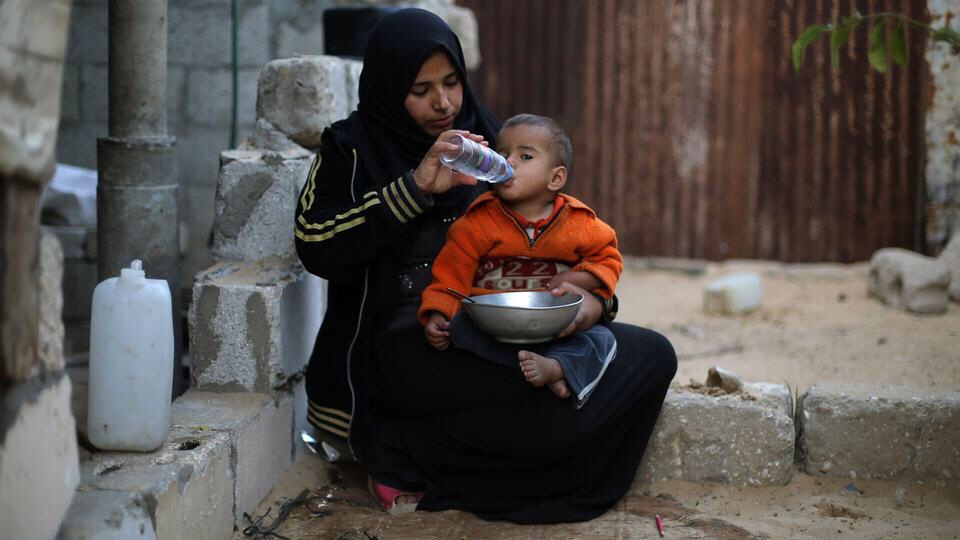
A Palestinian woman gives water to her son in Khan Younis in the southern Gaza Strip (December 19, 2018). (Ibraheem Abu Mustafa / Reuters)
Gaza heading toward a 'large size' humanitarian catastrophe: UN aid envoy
James Reinl
With depreciation of donors to support the UN's response plan, essential services, including food supplies, and medical procedures like eye and heart surgeries, could be delayed.
NEW YORK —  Gaza residents can expect more cuts to food handouts, healthcare and schools in 2019, with funding shortfalls likely to worsen their already-difficult lives, the United Nations aid envoy to the Palestinian territory told TRT World.
In an interview, Jamie McGoldrick, the UN humanitarian coordinator for the Gaza Strip, West Bank and East Jerusalem, said less money from the United States and other donors would lead to cutbacks in the New Year.
“Some people will get less services than they deserve,” McGoldrick told TRT World in a telephone interview from Gaza.
“We cannot ignore the growing large size of the humanitarian catastrophe that’s here in Gaza and also in the West Bank.”
On Wednesday, the UN’s World Food Program said it would, as of January 1, suspend food to 20 percent of recipients in the Gaza Strip. According to McGoldrick, that could grow to half of all 300,000 Gazans receiving handouts in the subsequent months.
Medical procedures, including eye and heart surgeries, could be delayed, he added. Schools that currently have two teaching shifts will “operate more round-the-clock” by filling classrooms with extra batches of students each day.
The UN unveiled its 2019 Humanitarian Response Plan for Palestinians this week, lowering its funding request to $350m — down from $550m in 2018 — and cutting the number of people targeted from 1.9m to 1.4m. Three quarters of recipients are in Gaza.
Donations were down in many areas globally, said McGoldrick. But local aid work was hit particularly hard this year when Washington ended funding for the UN agency that helps 5 million Palestinian refugees, known as UNRWA.
The Trump administration announced in August that it would halt all future donations to UNRWA, leaving it with a $300m funding gap, in a move that was widely seen as a way to pressure Ramallah to enter peace talks with Israel.
“There’s also been a depreciation of other donors to the response plan,” McGoldrick told TRTWorld.
“That’s got to do with global reality and significant competing interests in the region — places like Yemen, Libya and Syria are all taking attention away from Palestine, which has been a long-standing and politically paralysed crisis.”
Funding cuts added to the coastal strip’s woes, which include joblessness, water and electricity shortages, the Israeli-led blockade, Palestinian political divisions and casualties from demonstrations and hostilities, added McGoldrick.
Peter Mulrean, the New York-based representative for UNRWA, which assists Palestinian refugees, said cuts threatened the employment schemes and school counselling services on which many Gazans depend.
“If we see humanitarian funding diminish, we can predict that 2019 will be a very bleak year,” Mulrean told TRT World.
Mulrean noted that UNRWA employees occupied the agency’s headquarters in Gaza to protest lay offs resulting from this year’s US funding cuts. McGoldrick warned of heightened “tension” in Gaza when aid cuts bite.
Some 175 Palestinians have been shot and killed by Israeli forces in Gaza this year after a series of often-violent protests erupted in March over Israel’s long-running blockade of the overcrowded coastal territory of some 1.8 million people.
Riyad Mansour, the Palestinian envoy to the UN, told TRT World that Palestinians had been “collectively able to withstand this onslaught by the current US administration” and were coping with cuts to UNRWA and to hospitals in East Jerusalem.
He praised the “massive political support form the international community” in filling some US funding shortfalls and said “we sincerely hope that this political support and financial support would continue” in 2019.
This week, UN peace coordinator Nickolay Mladenov said that while Gaza’s humanitarian situation was dire, Qatari funding for the Gaza Power Plant had helped increase daily electricity supplies to more than 11 hours.
“Private homes, hospitals, schools, water facilities, businesses are all benefitting,” Mladenov told the UN Security Council on Tuesday.
“Seventy-five per cent of the sewage can now be treated again, significantly reducing the contamination levels caused by discharge into the sea. Piped water supply has increased by 40 percent, almost fully meeting water demand for domestic household purposes.”
The Palestinians want to establish a state in the West Bank, Gaza and East Jerusalem — territories that Israel captured and occupied in the 1967 Middle East conflict.
Israel says that its West Bank barrier and checkpoints, and restrictions on movement of people and goods to and from Gaza, are security measures needed to protect its citizens.

Thursday, December 20, 2018

Impending Crisis Outside the Temple Walls (Revelation 11:2)

UN: Gaza showing early warning signs for coming ‘unprecedented’ crisis
—December 18, 2018
Welcome to Jewish Voice for Peace’s monthly Health and Human Rights Media Watch. Members of the Health Advisory Council monitor relevant organizations and websites and compile a list of important news and issues which are summarized here.
GAZA
UN: early warning indicators show Gaza facing ‘unprecedented’ crisis
13 December 2018 OCHA oPt—The Gaza Strip faces an unprecedented humanitarian crisis, impacting the livelihoods and access to essential services by its two million residents. This crisis has been driven by over 11 years of an Israeli blockade and an unsolved internal Palestinian divide, exacerbated since March 2018 by the massive increase in Palestinian casualties in the context of demonstrations taking place near Israel’s perimeter fence, as well as limited escalations in hostilities.

(Image: OCHA oPt)
19 November 2018 Mondoweiss by Ahmad Kabariti—With all of the Israeli shootings to the lower limbs of Palestinian protesters during the weekly March of Return, a prosthetic limb workshop is struggling to deal with the needs of the injured. NPR also reported on Gaza’s prosthetic leg factory. See more: NPR
The health system in Gaza cannot handle another war
13 November 2018 +972 Magazine by Amjad Yaghi—In early November, Gaza saw one of the worst firefights since 2014, after Israeli special forces bungled a covert operation inside Gaza. If the Egyptian-brokered ceasefire does not hold, Palestinian health officials warn that a new war would lead to the collapse of Gaza’s already-debilitated medical infrastructure. Gazan hospitals are full of patients still being treated for injuries following violence in which Israeli snipers shot thousands of demonstrators during the Great Return March, which is overwhelming Gazan hospitals to the point where hundreds of patients were being treated in corridors and on the floor. A swine flu outbreak in early November has challenged Gazan health services, because no vaccine supplies are available for the virus in Gaza, neither in private practices, nor within the Health Ministry’s stocks. Of 143 medications in the Health Ministry’s formulary, nearly 100 are out of stock, with 16 more expected to be used up in the next month. There is also a shortage of specialists. 12 government-run hospitals in Gaza employ about 2,000 doctors, of whom 800 are specialists. The political division between the Fatah-run Palestinian Authority and the Hamas government in Gaza has caused young doctors to avoid joining government hospitals. The largest hospital in the Gaza Strip, Al-Shifa, performs 50 surgeries a day, and because of understaffing, surgeons have to perform 8 surgeries in a single day (much higher than surgeons in other countries). And despite this rate of surgeries, thousands of people are on waiting lists.
Surgeons in Gaza are overwhelmed with the number of injuries
11 November 2018 The Independent by Sarah Helm—The Israeli military policy to shoot to maim, with half of injuries occurring in the lower limbs of protesters and bystanders during the Great March of Return, has created an orthopedic crisis with exhausted personnel and shortages of surgical supplies.
Israeli incursions into Gaza are very common though underreported
13 November 2018 +972 Magazine by Henriette Chacar—There have been 70 known attacks, ground incursions and operations in 2018 and an unknown number of covert operations.
The terror of the Israeli air attacks, up close and personal
13 November 2018 Mondoweiss by Ahmad Kabariti—This article describes the human cost of Israeli attacks in Gaza in a very personal manner through the voices and experiences of civilians living in the Strip.
Author Sandy Tolan discusses the worsening water crisis in Gaza and the risks of water born epidemics that are affecting the most vulnerable
13 November 2018 The Daily Beast by Sandy Tolan—Two thirds of Gazans rely on a network of unregulated water trucks delivering desalinated water of dubious quality. He reminds us that raw sewage flowing into the Mediterranean knows no borders. Al Jazeera also reports on the water catastrophe, the rise of gastroenteritis, typhoid fever, childhood stunting, and blue baby syndrome. See more: Al Jazeera and Al Jazeera
WEST BANK
In the Palestinian territories, science struggles against all odds
14 November 2018 Nature: International Journal of Science by Alison Abbott—The Palestinian Neuroscience Initiative (PNI) at Al-Quds University, featured in a recent article in Nature, represents an effort to advance research, training, and care in the neurosciences under the challenging conditions of occupation. Founded in 2009, and with funding from international sources (including the U.S. National Institutes of Health), PNI has trained more than 150 Palestinian students and researchers and helped more than 5000 Palestinian patients with psychiatric disorders. One project concerns the biology of depression, which has a prevalence of around 30 percent in the Palestinian territories, one of the highest rates in the world.
EAST JERUSALEM
American Funding Cutback to East Jerusalem Hospitals: A Blow to the Health of the City
7 November 2018 American Journal of Public Health by A. Mark Clarfield MD, Karl Skorecki MD, Ora Paltiel MD, Shimon M. Glick MD, Rafi Beyar MD, DSc, MPH, Dina Ben Yehuda MD, Rivka Carmi MD, Ziv Gil MD, PhD, Salem Billan MD, Zaher Azzam MD, Fuad Basis MD, Ephrat Levy-Lahad MD, Amnon Lahad MD, Shai Izraeli MD, Dan Turner MD, and Yonatan Halevy MD—The authors protest the recent decision by the US government to withdraw funding of up to $25 million from the East Jerusalem Hospital Network (as part of a larger cancellation of Palestinian aid by the US). The authors note that the withdrawal decision was sudden and politically motivated. It will affect the 6 hospitals in the network, which primarily provide tertiary referral care for Palestinians in the West Bank and Gaza, for services which the Palestinian Authority’s Health Ministry is unable to provide, including cancer care, cardiac and eye surgeries, neonatal intensive care, pediatric dialysis, and pediatric rehabilitation.
The Palestinian government provides hospitals in East Jerusalem with $12.5 million
Ma’an News Agency 6 November 2018—In September, the US decided to cancel $20 million in funds to Palestinian hospitals in East Jerusalem weeks after it had also announced that it will cut all funds to the United Nations Relied and Aid Agency (UNRWA) and the cut of $200 million for economic and social projects for the Palestinians.
What do violent conflicts have to do with health? Everything, says People’s Health Assembly
20 November 2018 Peoples Dispatch by Subin Dennis—From November 15 – 19, in Bangladesh, approximately 1000 health care organizers and activist met in the People’s Health Assembly to discuss how to provide and organize for the health of the people and that of the planet. Representatives from around the globe shared their experiences of how the International Monetary Fund (IMF) and the World Bank recommended prescriptions of austerity and structural adjustment policies that in fact worsened the health of the people. In addition, they discussed how war and civil conflict impacted peoples’ health focusing on Palestine and the Rohingya people in Bangladesh.
See more: Shatha Odeh, from the Health Work Committees of Palestine, discussed how the Israeli occupation, from the Nakba on, was the main determinant of the health of Palestinians. Her presentation emphasized the role of land confiscation, expansion of illegal settlements, checkpoints, the wall, Israeli control over natural resources, shootings, killings, indiscriminate arrests, the siege on Gaza and movement restrictions have been brutal violations of basic human rights, affecting the Palestinians’ right to health. She highlighted the crisis in Gaza caused by the destruction of the water and electrical infrastructure and its impact on health.
On the occasion of Universal Children’s Day, the Palestinian Ministry of Foreign Affairs and Expatriates said, ‘Generations of Palestinian children have been subjected to terror’
22 November 2018 Ma’an News AgencyThe ministry said, “Generations of Palestinian children have been subjected to terror, insecurity, and injustice under the prolonged Israeli colonial occupation that started fifty-one years ago.”

“A routine founded on violence.” 24 Nov. 2018 – 7 Dec. 2018. Source information from Palestinian DCO and B’Tselem field researchers. (Image: B’Tselem)
A routine founded on violence
13 December 2018 B’Tselem—This infographic, updated monthly, gives statistics by region on arrests, raids, and “flying” checkpoints in the Occupied Territories – a measure of the impact of Israeli policies on Palestinians’ daily life.
Offline: The health of Palestinians is a global responsibility
3 November 2018 The Lancet by Richard Horton—A recent WHO report looked at the impact of the decade-long land, sea, and air blockade on Gazans’ health. In addition to effects on development and shortages of essential medical supplies, the blockade and associated security, political and economic barriers combine to cause severe restrictions on Gazans’ access to care. In 2017, only 54% of applications (from 12,153 patients seeking care primarily for cancer) were approved in time for them to be able to attend their medical appointments, the lowest approval rate since 2012 (and for comparison, patients living in the West Bank who sought access to care in East Jerusalem or in Israel had an 88% approval rate). The problem is made worse by recent severe cutbacks in US support. This editorial makes the case that the international community shares responsibility for improving the inexcusable state of affairs for the health of Palestinians.
WHO reports on the Right to Health in the OPT as a fundamental human right.
8 December 2018 World Health Organization—WHO published its report on the Right to Health in the OPT as defined by access to high quality medical care, adequate food, water, and housing. The report focuses on restrictions to access due to Israel’s strict permitting system and direct attacks on health workers and facilities as key issues. The right to health is recognized as a fundamental human right that is ultimately the responsibility of the occupying power.
ISRAEL
Netanyahu Supports Death Penalty against Palestinians
14 November 2018 TeleSur by Ramzy Baroud—On November 4, Prime Minister Benjamin Netanyahu supported legislation that would make it easier for Israeli courts to issue death sentences against Palestinians accused of carrying out “terrorist” acts.
Israeli parents protest arrests of Palestinian children in central Tel Aviv
22 November 2018 +972 Magazine by Orly Noy—On the International Day for the Rights of the Child, “Parents Against Child Arrests,” a group of Israeli parents, rallied in central Tel Aviv to raise awareness about the conditions of Palestinian minors in Israeli custody. The Israeli media are full of stories of mass arrests of Palestinians in the occupied territories, but the Israeli mainstream rarely hears about Palestinian children who are routinely rounded up from their beds in the middle of the night and taken into detention.
A good discussion of the Lancet Palestinian Health Alliance and its political ramifications
8 November 2018 Middle East Eye by Ghada Karmi—Infiltrating every area of public life in a bid to control the global discourse may well shield Israel’s crimes temporarily – but in the long run, it will only reveal Israel as the villain, including in the realm of health care.

Wednesday, December 19, 2018

Two Boys Killed Outside the Temple Walls (Revelation 11:2)


Israeli ‘Warning’ Shot Killed Two Boys in Gaza, Rights Groups Say
Mourners carrying the body of Amir al-Nimrah, 15, whom rights groups say was killed in Gaza by an Israeli airstrike meant to warn civilians of an impending attack.
Credit
Said Khatib/Agence France-Presse — Getty Images
By David M. Halbfinger
Dec. 17, 2018
JERUSALEM — An Israeli military tactic intended to spare civilians actually killed two Palestinian teenagers recently and needs to be viewed as a form of attack, not as the ethically responsible precautionary measure that Israel portrays it to be, two human rights groups said in a new report.
The tactic is referred to as “knocking on the roof,” a euphemism for hitting a building with loud but not terribly destructive munitions before switching to the powerful missiles or bombs meant to level it.
The report assembled crowdsourced video into a meticulous reconstruction of the killings of two teenage boys in an airstrike in July on an unfinished high-rise in Gaza City, the first of four “roof-knocking” missiles meant to warn off civilians that instead killed them.
The bottom line, it concluded, was that an airstrike must not be considered a warning, and must conform to international humanitarian law requiring armies to take pains to identify legitimate targets and avoid harming civilians.
The report also accused the office of the Israel Defense Forces’ spokesman of “manipulating the truth” in choosing the images it publicized of the attack.
Early Tuesday, the military spokesman’s office issued a statement acknowledging that the Israeli Air Force had failed to notice the two teenagers in harm’s way. It said that Israel’s Military Advocate General was examining that failure.
But it defended the roof-knocking tactic, insisting it “coincides entirely with international law” and had been proved “countless times” to “reduce harm to civilians located in or near structures that are military objectives.”
And it denied any effort to distort news coverage of the attack on what Israel called an urban-warfare training center of Hamas, the militant group that controls Gaza.
The report was published as a video on Monday by B’Tselem, an Israeli human rights group, and Forensic Architecture, a London-based research group that investigates state violence and human rights violations.
It pinpointed the moment on July 14, during a daylong exchange of rockets and airstrikes between Israel and Gaza, when Amir al-Nimrah and Luai Kahil were killed: at 5:45 p.m., as they sat with their legs dangling over the edge of an unfinished tower overlooking Al Katiba Square, having just taken a selfie.
(Amir was widely reported to be 15 years old and Luai a year older, but B’Tselem said on Tuesday that it had obtained documents that put the age of both boys at 14.)
In an English-language publication during the 2014 war with Gaza, the Israeli military said it used “loud but nonlethal” bombs for roof-knocking.

Young Palestinian men in front of a building damaged by an Israeli airstrike in Gaza City in July.
Credit
Mahmud Hams/Agence France-Presse — Getty Images
But videos recorded in July by people who rushed to the rooftop to try to help the two boys showed pockmarks in the concrete surface that the report said matched the shrapnel pattern of an antipersonnel missile.
That would be consistent with the Israeli practice of using munitions for roof-knocking strikes that would explode on the surface of a building, rather than pierce it and endanger those inside.
A government report on the 2014 Gaza war acknowledged that the tactic was “imperfect,” but said that it prevented many civilian deaths and injuries.
The boys, however, were seated only about 30 feet from where the missile struck, according to the report.
“Warning strikes are an essential part of the Israeli military’s claims to high ethical standards,” said Eyal Weizman, director of Forensic Architecture, which has also collaborated with The New York Times. “But such warnings are sometimes delivered with the same missiles that are used elsewhere to kill,” he said.
To support its conclusion that the Israeli military had selectively chosen images used to publicize the attack, the report analyzed video posted online by the military spokesman’s office.
All told, four roof-knocking strikes hit the building between 5:45 p.m. and 5:58 p.m., the report found. Four tremendous blasts then quickly destroyed it at 6:02 p.m.
About an hour later, the Israel Defense Forces spokesman’s office issued a Twitter post with a video of the attack, with clips of what looked like four roof-knocking strikes on the building followed by the major explosions. The two teenagers could not be seen on the roof in the first clip.
But the report found that the first roof-knocking strike, at 5:45 p.m., was actually missing from the military’s Twitter post.
In its place was an additional angle on the third strike, at 5:54 p.m. — recorded after the boys’ bodies had already been carried away by people who rushed to the roof to try to help them.
That prompted the human rights groups to ask whether the Israeli military had suppressed video that might have shown the boys on the roof when the first missile was fired — or whether it was incapable of conducting airstrikes in populated areas while still meeting its legal obligations to spare civilians.
“We don’t know if the boys were visible to the military before the first strike,” said Amit Gilutz, a B’Tselem spokesman. “If so, they should have aborted. If not, that raises grave concerns as to the military’s surveillance capabilities.”
The military spokesman’s office denied any attempt to manipulate coverage of the airstrike. It said that the first visual evidence the military had seen of the two teenagers’ presence on the rooftop — despite a review conducted in response to news reports of their deaths — was in the video published on Monday by B’Tselem and Forensic Architecture.
“Any allegations that the I.D.F. knowingly distorted or edited video footage are totally baseless and false,” it said.

Tuesday, December 18, 2018

Thousands Rally Outside the Temple Walls (Revelation 11:2)


Masked gunmen of the al-Qassam brigades, the military wing of Hamas, raise their hands as they stand in front of a huge poster showing a mock attack on a bus, during a mass rally marking the 31st anniversary of the founding of Hamas, an Islamic political party, that currently rules in Gaza, Sunday, Dec. 16, 2018, in Gaza city. (Khalil Hamra / AP)
Tens of thousands rally in Gaza to mark Hamas anniversary
Published: Dec. 16, 2018, 1:03 p.m.
Sun., Dec. 16, 2018, 1:03 p.m.

Associated Press
GAZA CITY, Gaza Strip – Tens of thousands of Palestinians have gathered in Gaza City for a rally marking the 31st anniversary of the militant Hamas group’s establishment.
Hamas fighters in military fatigues paraded with rockets and heavy machineguns during Sunday’s rally. The Islamist group said the large turnout reflects widespread support despite domestic and external challenges.
Gaza has been under an Israeli-Egyptian blockade since Hamas took power in 2007.
Hamas leader Ismail Haniyeh praised a recent series of deadly attacks against Israel in the West Bank, which is controlled by the Palestinian Authority. He said such attacks are “a response” to the anticipated American peace proposal that Palestinians believe will favor Israel.
Haniyeh also called on Palestinian President Mahmoud Abbas to meet in Gaza or Cairo to end a decade of inter-Palestinian division.

Three Palestinians shot outside the Temple Walls (Revelation 11:2)

Three Palestinians shot, injured as Israeli forces attack peaceful protest offshore Gaza City
GAZA, Monday, December 17, 2018 (WAFA) – At least three Palestinians were shot and injured and others suffocated as Israeli forces attacked Palestinians demonstrating peacefully offshore al-Sudaniya area, northwest of Gaza city, as part of the 'Great March of Return’ protests, said medical sources.
Israeli navy and forces stationed near Zikim military base, near the Gaza shore, fired live and rubber-coated steel bullets, and tear gas canisters toward protesters, shooting and injuring three people with live ammunition.
Others suffered from suffocation due to tear gas inhalation and were treated at the scene.
T.R.

Monday, December 17, 2018

50 Thousand Protest Outside the Temple Walls (Revelation 11:2)


Sea of green: 500,000 Palestinians gather in Gaza for Hamas anniversary rally
Hamas
Nearly half a million Palestinians have gathered for an afternoon rally commemorating the 31st anniversary of the founding of Hamas, the Islamist government in the Gaza Strip.
Schools of all levels, including Al-Azhar University in Gaza City, have announced the suspension of classes for the day to allows students to attend the Hamas rally.
Ismail Haniyeh, Hamas' political chief, said in a speech at the rally that a technological device had been seized from the Israeli military after an undercover operation in Gaza was exposed last month, resulting in the death of an elite Israeli soldier and seven Palestinians and sparked the most severe escalation in violence between the sides since a 2014 war.
The device, Haniyeh said, exposed the IDF's operational method in Gaza. The Hamas leader also commented on the two terror attacks in the West Bank this week, where two Israeli soldiers and a baby were killed in drive-by shootings.
“I will also respond to the Zionists who are saying what is happening in the West Bank is based on directives and arrangements from Gaza. This is an accusation that we do not deny… because it is a source of pride reigning over all of us,” Haniyeh said.

AP Photo/Khalil Hamra
“The men of the West Bank don’t need a remote control or an order,” he added.
Hamas said the first drive-by shooting that happened on Sunday last week was committed by one of its members in the West Bank. However, Hamas fell short of taking direct responsibility for the attack.
Israeli Prime Minister Benjamin Netanyahu said on Sunday that he had conveyed a message to Hamas following this week's terror attacks in the West Bank.
"I sent a clear message to Hamas: We will not accept a situation in which there is a ceasefire in Gaza and terrorism in Judea and Samaria (West Bank). We will exact a heavy price for this," Netanyahu said at his weekly cabinet meeting.
Hamas, which has its own security forces and military wing, aims to lead the Palestinian “resistance” against Israel. It is responsible for a long history of terror attacks against Israeli civilians and has fought in three wars against Israel since its founding in 1987.
Hamas’ rise to power began with the First Intifada, referred to also as the “stone uprising”, during which the movement worked to bolster tensions and ignite popular support for demonstrations against Israel.

AFP
Israel’s leadership has repeatedly said it considers Hamas responsible for all activity coming from Gaza, including recent rocket barrages launched by the Islamic Jihad terror group.
“After 31 years since the start of the Hamas movement, the occupation (Israel) is no longer the only one that controls the balance of the battle,” Hamas said in a statement leading up to the rally. “Rather, the resistance has become the most powerful…”
“This is proof of the growth of the resistance and its increase in all forms, day after day, and soon the day will come when the resistance will uproot the occupation from our land,” it reads.
Hamas has celebrated two shooting attacks against Israeli settlers in the West Bank last week, saluting the actions as proof the “resistance” was still alive outside of the Gaza Strip.
Avigdor Liberman, Israel’s ex-defense minister, responded to the attacks with a demand for the Israeli government to stop the transfer of Qatari money and fuel to Gaza, alleging Hamas was behind the two terror incidents.

AP Photo/Majdi Mohammed
“It is clear beyond any doubt that at least in one case involved a Hamas cell operated by the Hamas leadership in the Gaza Strip,” Liberman claimed. “ I demand that the Israeli government immediately announce the cessation of the transfer of money and fuel in Qatari funding to the Gaza Strip.”
Meanwhile, on Friday, Hamas organized a “day of rage” during which some 10,000 Palestinians protested along the Gaza Strip’s border with Israel against the blockade of the coastal enclave.
Israel’s Defense Forces (IDF) said that several Palestinians attempted to breach the Gaza border fence into Israeli territory.

Sunday, December 16, 2018

Over 40 More Injured Outside the Temple Walls (Revelation 11:2)

Over 40 Injured in Gaza 'March Of Return' Protest (+Video)Over 40 Injured in Gaza 'March Of Return' Protest (+Video)

TEHRAN (Tasnim) - At least 46 people were injured in clashes with Israeli forces while protesting along Gaza border on Friday evening.

 
Israeli forces used teargas and fired rubber-coated bullets to disperse the protesters who took part in the Great March of Return.
Several injured were seen being carried away by the emergency services.
The Great March of Return, launched in late March, forms a series of protests along the Israeli-Palestinian border to demand the right for Palestinians to return to their families' pre-1948 homes.

Israelis Trample Palestinians Outside the Temple Walls (Revelation 11:2)

60% of the 10,500 protesters treated for injuries in Gaza were shot by Israeli forces in the legs
KateDecember 14, 2018
In Gaza protests, Israeli troops aim at the legs
GAZA CITY, Gaza (AP) 9 Dec by Todd Pitman — Israeli forces deployed along the volatile border with the Gaza Strip have fired live rounds at rock-throwing Palestinian protesters ever since demonstrations against Israel’s long-running blockade of Gaza began in March. And for eight months, Israeli snipers have targeted one part of the body more than any other — the legs. The Israeli army says it is responding to weekly assaults on its frontier by Palestinians armed with stones, grenades and firebombs. The military says it opens fire only as a last resort, and considers firing at the lower limbs an act of restraint. Still, 175 Palestinians have been shot to death, according to an Associated Press count. And the number of wounded has reached colossal proportions. Of the 10,511 protesters treated at hospitals and field clinics in Gaza so far, at least 6,392, or roughly 60 percent, have been struck in the lower limbs, according to Gaza’s Health Ministry. At least 5,884 of those casualties were hit by live ammunition; others have been hit by rubber-coated metal bullets and tear gas canisters. The upsurge in violence has left a visible mark on Gaza that will likely remain for decades to come. It is now common to see young men walking through dilapidated streets on crutches. Most have legs bandaged or fitted with a metal frame called a fixator, which uses pins or screws that are inserted into fractured bones to help stabilize them….
Gaza City (Asia Times) 12 Dec by Mohammed Dahman — When Palestinian cycling champion Alaa al-Daly rode to the eastern edges of the Gaza Strip earlier this year to join a demonstration against a decade-long Israeli blockade, he had no idea it would end with the loss of his leg and career. The 21-year-old athlete had finished his training early on March 30 and cycled over to join thousands in a march along the Israeli-occupied border zone … Daly says the Israeli authorities on multiple occasions have prevented him from traveling abroad to compete in cycling competitions, and so a central demand of the “Great March of Return” – an end to the blockade – resonated with him.  The 2018 Asia Games were coming up in August in Jakarta, and Daly was eager to represent his people.  On that first day of the protests, he recounted, “I was on my bike, about 250 meters from the barbed wire, when suddenly a bullet from an Israeli sniper stationed at the border hit my right leg.”  The gunshot was only the first shock for Daly. In the span of eight days following the injury, doctors performed eight operations on Daly in an attempt to save his leg. Finally, they found themselves with no choice but to amputate it, shattering the cyclist’s hopes to ever return to his beloved sport, which he had been perfecting since childhood.
The Rachel Corrie Gaza Sport Initiative was held for the fifth time this year for Palestinians with special needs in the besieged Gaza Strip. The table tennis tournament held today was attended by nearly 50 players – both male and female – from a range of clubs. The majority of the players had been injured by Israeli occupation forces. The Rachel Corrie Gaza Sport Initiative is an annual project, consisting of the Rachel Corrie Ramadan Football Tournaments and the Rachel Corrie Tournament for Athletes with Disabilities. The Tournament for Athletes with Disabilities helps connect those with disabilities to the broader Palestinian society, affirms the place of the disabled in Gaza, and provides an avenue of accomplishment and fun in the sphere of athletics.

Saturday, December 15, 2018

Israel Kills Two More Outside the Temple Walls (Revelation 11:2)

By Esat Firat
RAMALLAH, Palestine (AA): Israeli forces killed two Palestinians on Friday near the West Bank city of Ramallah, according to the Palestinian Health Ministry.
Mahmoud Yousef Nakhleh, 18, and Mohammad Nahla, 16, were killed by Israeli troops during a demonstration near the Al-Jalazone refugee camp, north of Ramallah, said a ministry statement.
Both victims were shot in the abdomen with live ammunition and died from wounds at the Ramallah medical center.
Also according to the ministry, five other Palestinians sustained gunshot injuries in various parts of the occupied West Bank on Friday, while dozens of others suffered the ill effects of teargas.
West Bank Palestinians stage demonstrations each Friday to protest Israeli settlement expansion and Israel’s massive “separation barrier,” which snakes through the occupied territory, isolating many small Palestinian communities.
Meanwhile in Gaza, on Friday evening, Israeli forces wounded 120 Palestinian civilians, including 11 children, 1 woman and 2 paramedics in the peaceful demonstrations in the eastern Gaza Strip despite the decreasing intensity of the demonstrations there for the sixth week consecutively and absence of most means usually used during the demonstrations since the beginning of the Return and Breaking the Siege March 8 months ago.
According to observations by PCHR’s fieldworkers, for the seventh week since the beginning of the Return March on 30 March 2018, the demonstrators abstained from burning tires while the attempts to cross the border fence and throw stones and incendiary balloons were completely absent.
Meanwhile in West Bank and East Jerusalem, the Israeli army has detained roughly 100 Palestinians since dawn Thursday, the Palestinian Prisoners’ Association said in a Friday statement.
According to the NGO, the latest spate of arrests included two members of the Palestinian Legislative Council, Palestine’s long-moribund parliament.
The association went on to assert that the Israeli army’s latest arrest campaign had seen numerous Palestinian homes ransacked.
On Thursday, two Israelis were killed — and two others injured — in a drive-by shooting near the West Bank city of Ramallah.
Following the incident, the Israeli army launched a manhunt for the alleged Palestinian assailant, who reportedly fled the scene in the wake of the attack.
Residents of the area told Anadolu Agency earlier that two Palestinians in a car had opened fire on a group of Jewish settlers.
There has been no claim of responsibility for the attack, but the Israeli army has since closed all entrances into Ramallah and ordered all forces in the area to remain on standby.
According to local media reports, Jewish settlers vandalized several Palestinian vehicles and homes in the village of Netin east of Ramallah after the attack.
Notably, Thursday’s attack occurred hours after three Palestinians were killed by Israeli forces for their alleged involvement in an earlier West Bank shooting attack that left two Israelis dead and nine others injured.
According to Israeli media reports, Israeli forces on Thursday killed a fourth Palestinian man in the occupied West Bank after he allegedly tried to ram his vehicle into a group of Israeli soldiers in the city of Hebron (Al-Khalil).
Additional report from imemc.org
[Photo: An injured Palestinian demonstrator is being carried away after Israeli forces’ intervention in a “Great March of Return” demonstration near Al Bureij Refugee Camp on the Gaza-Israel border, in Gaza City, Gaza on November 30, 2018. Photographer: Hassan Jedi/AA]

Israelis Killed Outside the Temple Walls (Revelation 11:2)


Two Israelis shot dead in West Bank attack as Hamas claims earlier attacks
Ruth EglashJERUSALEM —
December 13 at 10:51 AM
Violence broke out in the West Bank on Thursday as two Israeli soldiers were shot dead, the Palestinian driver in an alleged car-ramming attempt was killed and two Palestinians suspected of earlier attacks were gunned down by Israeli forces.
Hamas claimed that both of those Palestinians were its operatives, threatening a delicately forged cease-fire deal between Israel and the militant group.
One had been accused of involvement in a drive-by shooting Sunday, which wounded seven Israeli civilians, including a pregnant woman whose prematurely born baby later died. The other, suspected of killing two of his Israeli co-workers, had been on the run for nine weeks.
There were no assertions of responsibility for Thursday’s incidents, and the Israeli military declined to comment on whether it believed that Hamas was also responsible.
Israeli forces sealed off checkpoints around the Palestinian city of Ramallah and carried out a large-scale manhunt for the perpetrators of Thursday’s shooting, which occurred at a bus stop near the Israeli settlement of Givat Assaf. The Palestinian assailant in the alleged car-ramming attack was fatally shot at the scene, the Israeli army said.
The uptick in violence increases pressure on Israeli Prime Minister Benjamin Netanyahu to act more aggressively against Hamas. He was already facing widespread criticism for agreeing to a cease-fire with Hamas after a barrage of rockets from Gaza last month and allowing millions of dollars of cash to enter Gaza to pay salaries. Israeli security officials have said the group is trying to expand its presence in the West Bank.
By sundown, street demonstrations had broken out in Jerusalem and the West Bank, with West Bank settlers protesting outside Netanyahu’s residence and stone-throwing Palestinians clashing with Israeli forces in Ramallah.
In response to the violence, Netanyahu’s office said that he had decided to legalize thousands of settler homes built illegally in the West Bank. He also requested that Israel’s attorney general take legal steps to facilitate the construction of 82 residential units in the West Bank settlement of Ofra.
In addition, he ordered the “accelerated demolition of terrorists’ homes” and “increased administrative detention” — incarceration without charges or trial — for suspected Hamas militants in the West Bank.
“Our guiding principle is that whoever attacks us and whoever tries to attack us — will pay with his life,” Netanyahu said in a statement. “Our enemies know this and we will find them.”
Yesh Din, an Israeli human rights group, said that Israeli settlers were carrying out revenge attacks against Palestinians in the West Bank, shooting at houses, destroying vehicles and throwing stones in the presence of soldiers, who did nothing to intervene.
“As justified as their anger may be regarding recent attacks on innocent civilians, it is unconscionable that civilians would take the law into their own hands,” the group said.
The Israeli military named the dead soldiers as Sgt. Yovel Mor Yosef, 20, and Cpl. Yosef Cohen, 19. They were both posthumously promoted. A third soldier was critically injured when the gunman, who was not alone in his car, exited his vehicle at the bus stop before fleeing toward Ramallah, said Lt. Col. Jonathan Conricus, an Israeli army spokesman.
Hours later a car attempted to ram soldiers at a checkpoint in al-Bireh, northeast of Ramallah, the army said. Palestinian television said the man, 60-year-old Hamdan Tawfiq, had failed to stop for soldiers as he suffered from hearing problems.
The incident came just a day after the baby of a 21-year-old pregnant woman shot in the chest in Sunday’s attack died after being delivered early by emergency Caesarean section.
The gunman suspected in the shooting fled the scene and evaded Israeli authorities for three days until he was killed Wednesday night, the military said. Hamas later asserted responsibility and hailed the attacker, Saleh Barghouti, as a “martyr” alongside Ashraf Naalwa, accused of killing his Israeli co-workers Oct. 7.
“The flame of resistance in the West Bank has not and will not be extinguished until the occupation is defeated from our entire land, and we regain our rights in full,” Hamas said in a statement. It called the Israeli killings of the two men a “crime.”
Hanan Ashrawi, a member of the Palestine Liberation Organization’s executive committee, described the killings of the Palestinians as “summary executions” and criticized the “rampage” by settlers.
Netanyahu’s decision to enter a cease-fire with Hamas last month after a botched Israeli raid led to the worst bout of rocket fire since the 2014 Hamas-Israel war dented his security credentials. His defense minister quit in protest, leaving the government on the brink of collapse.
The deteriorating humanitarian situation in the choked-off, 140-square-mile strip has become a security concern for Israel, which has been negotiating with Hamas to bring about calm. As part of that effort, Israel has been allowing Qatar to send $15 million in cash into Gaza each month to pay the salaries of civil servants.
Yonatan Fighel, senior research analyst at the Institute for Counter-Terrorism in Herzliya and a former military governor in the West Bank, is among many within Israel’s security establishment who believe that the government’s policy is misguided.
“By giving attention to Hamas, enabling Qatar to pour money into Gaza to create silence there, at the same time the Israeli government is weakening the Palestinian Authority,” he said, referring to the Palestinian body headed by Mahmoud Abbas that governs parts of the occupied West Bank.
“They are weakening the moderates and encouraging the extremist,” Fighel said.
[Israel says monitoring social media has cut lone-wolf attacks. Palestinians are crying foul.]
The Palestinian Authority has also opposed Israel’s direct negotiations with Hamas over the situation in Gaza. A statement issued by Abbas’s office said Israel’s “repeated raids into cities, incitement against the president and the absence of horizons for peace are what led to this unacceptable rise in violence, which we condemn and reject, and for which the two sides are paying the price.”
The attacks pose a challenge to Israeli military forces operating in the West Bank. Israeli authorities have had some success in tackling lone-wolf attacks and larger-scale attacks, but appear to have struggled with the emergence of small cells funded and supported at a distance by Hamas and other groups.
Yoram Schweitzer, head of the Terrorism and Low Intensity Conflict Program at the Institute for National Security Studies, said Israeli security services had warned in recent months of an increase in attempted attacks in the West Bank. The last few attacks were likely part of that activity, he said.
“They are the ones that succeeded,” Schweitzer said. “It is an effort by Hamas to instigate some unrest in the West Bank, as well as on the southern front.”
Hazem Balousha in Gaza contributed to this report.

Friday, December 14, 2018

More Children Killed Outside the Temple Walls (Revelation 11:2)

Palestinian toddler dies from wounds in Gaza as premature Israeli baby killed after West Bank shooting | The Independent
1 day ago
Hundreds of Palestinians in Gaza attended the funeral of a four-year-old boy who died after being injured by Israeli gunfire during a protest at the border, health officials have said.
On the same day 70 miles away a baby, who was delivered prematurely to an Israeli woman wounded in a Palestinian drive-by shooting in the West Bank, also died.
Israeli pregnant mother Shira Ish-Ran, her husband and five others were injured in an attack at a bus stop outside the illegal Israeli settlement of Ofra in the West Bank on Sunday.
Doctors said she was shot in the abdomen and that her son was born in critical condition. The Palestinian gunman apparently fled the scene.
Prime Minister Benjamin Netanyahu confirmed on Wednesday evening that the baby, who was delivered by emergency Caesarean section, had died in hospital.
“My heart, our hearts, are with Shira and Avihai at the death of a four-day-old baby who does not even have a name," Mr Netanyahu told foreign media and diplomats in a speech. "The security forces are in pursuit of the murderer."
Meanwhile in Gaza, Palestinian health officials reported that Ahmed Abu Abed, 4, had succumbed to his injuries apparently sustained by Israeli fire. He was buried in Khan Younis, at the southern end of the strip on Wednesday afternoon.
Gaza health ministry spokesman Ashraf Al-Qidra said he “was hit by shrapnel from Israeli gunfire” during protests near to the border fence with Israel on Friday.
Reuters footage from the protest showed the boy being carried by a medic into a field hospital not far from the border after being injured.
“There was one piece of bullet shrapnel in the eye that settled at the bottom of the brain, that was the most serious of all, and that what most likely killed him,” said Mohammad Abu Hilal, director of emergency department at Khan Younis hospital.
The boy’s father, Yasser Abu Abed, who suffered a leg injury, said they were among a hundred other protesters nearly 300 metres from the fence when Israeli forces opened fire. “We did not expect anything bad would happen as things were calm,” he said.
Israel’s military said it did “everything possible to avoid harming children” and accused Hamas, the militant group that runs the strip, of “cynically” using Gaza’s residents as human shields.
“[It] places them at the forefront of the violent riots, terrorist attacks and the terror of arson, demonstrating their contempt for human life,” the statement added.
Hamas denies the allegations and together with rights groups has accused Israel of using excessive force against protesters
More than 220 Palestinians have been killed by Israeli troops since March according to health ministry in Gaza.
Support free-thinking journalism and subscribe to Independent Minds
Palestinians have been marching regularly on the border since March, protesting against an 11-year-old Israeli siege of Gaza and for the right to return to the ancestral land they fled or were forced from during the 1948 conflict that surrounded the creation of Israel.
After Mr Netanyahu spoke about the West Bank incident, Israel's Shin Bet security service said troops shot and wounded a suspected militant who tried to evade arrest near the Palestinian city of Ramallah. It said he was in custody, but did not immediately confirm or deny Israeli media reports that he was sought in connection with the Ofra attack.

Thursday, December 13, 2018

East Coast Still Unprepared For Sixth Seal (Rev 6:12)


East Coast Earthquake Preparedness
By By BEN NUCKOLS
Posted: 08/25/2011 8:43 am EDT
WASHINGTON — There were cracks in the Washington Monument and broken capstones at the National Cathedral. In the District of Columbia suburbs, some people stayed in shelters because of structural concerns at their apartment buildings.
A day after the East Coast’s strongest earthquake in 67 years, inspectors assessed the damage and found that most problems were minor. But the shaking raised questions about whether this part of the country, with its older architecture and inexperience with seismic activity, is prepared for a truly powerful quake.
The 5.8 magnitude quake felt from Georgia north to Canada prompted swift inspections of many structures Wednesday, including bridges and nuclear plants. An accurate damage estimate could take weeks, if not longer. And many people will not be covered by insurance.
In a small Virginia city near the epicenter, the entire downtown business district was closed. School was canceled for two weeks to give engineers time to check out cracks in several buildings.
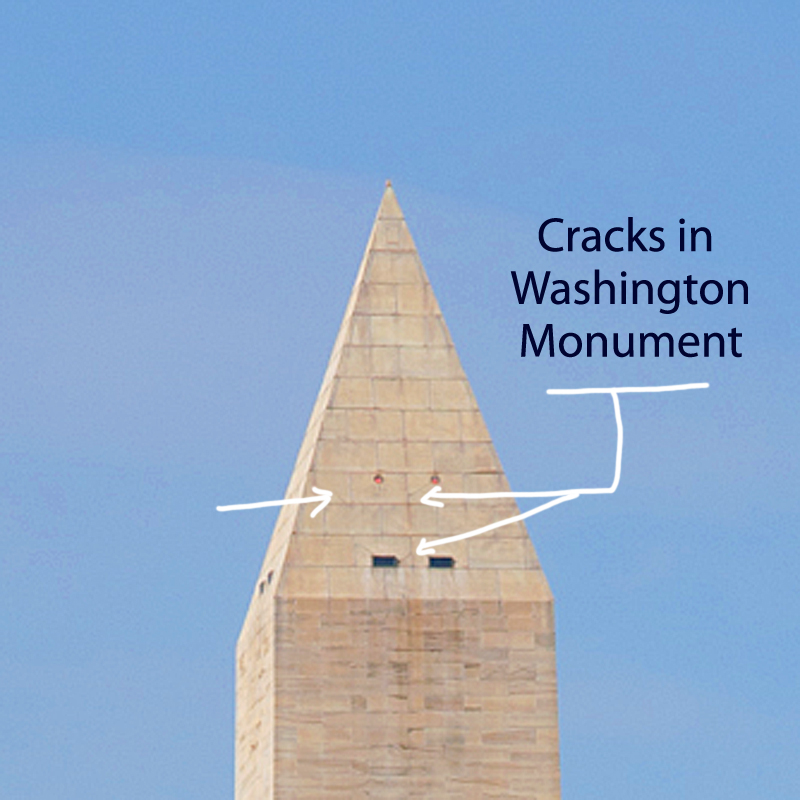
At the 555-foot Washington Monument, inspectors found several cracks in the pyramidion – the section at the top of the obelisk where it begins narrowing to a point.
A 4-foot crack was discovered Tuesday during a visual inspection by helicopter. It cannot be seen from the ground. Late Wednesday, the National Park Service announced that structural engineers had found several additional cracks inside the top of the monument.
Carol Johnson, a park service spokeswoman, could not say how many cracks were found but said three or four of them were “significant.” Two structural engineering firms that specialize in assessing earthquake damage were being brought in to conduct a more thorough inspection on Thursday.
The monument, by far the tallest structure in the nation’s capital, was to remain closed indefinitely, and Johnson said the additional cracks mean repairs are likely to take longer. It has never been damaged by a natural disaster, including earthquakes in Virginia in 1897 and New York in 1944.
Tourists arrived at the monument Wednesday morning only to find out they couldn’t get near it. A temporary fence was erected in a wide circle about 120 feet from the flags that surround its base. Walkways were blocked by metal barriers manned by security guards.
“Is it really closed?” a man asked the clerk at the site’s bookstore.
“It’s really closed,” said the clerk, Erin Nolan. Advance tickets were available for purchase, but she cautioned against buying them because it’s not clear when the monument will open.
“This is pretty much all I’m going to be doing today,” Nolan said.
Tuesday’s quake was centered about 40 miles northwest of Richmond, 90 miles south of Washington and 3.7 miles underground. In the nearby town of Mineral, Va., Michael Leman knew his Main Street Plumbing & Electrical Supply business would need – at best – serious and expensive repairs.
At worst, it could be condemned. The facade had become detached from the rest of the building, and daylight was visible through a 4- to 6-inch gap that opened between the front wall and ceiling.
“We’re definitely going to open back up,” Leman said. “I’ve got people’s jobs to look out for.”
Leman said he is insured, but some property owners might not be so lucky.
The Insurance Information Institute said earthquakes are not covered under standard U.S. homeowners or business insurance policies, although supplemental coverage is usually available.
The institute says coverage for other damage that may result from earthquakes, such as fire and water damage from burst gas or water pipes, is provided by standard homeowners and business insurance policies in most states. Cars and other vehicles with comprehensive insurance would also be protected.
The U.S. Geological Survey classified the quake as Alert Level Orange, the second-most serious category on its four-level scale. Earthquakes in that range lead to estimated losses between $100 million and $1 billion.
In Culpeper, Va., about 35 miles from the epicenter, walls had buckled at the old sanctuary at St. Stephen’s Episcopal Church, which was constructed in 1821 and drew worshippers including Confederate Gens. Robert E. Lee and J.E.B. Stuart. Heavy stone ornaments atop a pillar at the gate were shaken to the ground. A chimney from the old Culpeper Baptist Church built in 1894 also tumbled down.
At the Washington National Cathedral, spokesman Richard Weinberg said the building’s overall structure remains sound and damage was limited to “decorative elements.”
Massive stones atop three of the four spires on the building’s central tower broke off, crashing onto the roof. At least one of the spires is teetering badly, and cracks have appeared in some flying buttresses.
Repairs were expected to cost millions of dollars – an expense not covered by insurance.
“Every single portion of the exterior is carved by hand, so everything broken off is a piece of art,” Weinberg said. “It’s not just the labor, but the artistry of replicating what was once there.”
The building will remain closed as a precaution. Services to dedicate the memorial honoring Rev. Martin Luther King Jr. were moved.
Other major cities along the East Coast that felt the shaking tried to gauge the risk from another quake.
A few hours after briefly evacuating New York City Hall, Mayor Michael Bloomberg said the city’s newer buildings could withstand a more serious earthquake. But, he added, questions remain about the older buildings that are common in a metropolis founded hundreds of years ago.
“We think that the design standards of today are sufficient against any eventuality,” he said. But “there are questions always about some very old buildings. … Fortunately those tend to be low buildings, so there’s not great danger.”
An earthquake similar to the one in Virginia could do billions of dollars of damage if it were centered in New York, said Barbara Nadel, an architect who specializes in securing buildings against natural disasters and terrorism.
The city’s 49-page seismic code requires builders to prepare for significant shifting of the earth. High-rises must be built with certain kinds of bracing, and they must be able to safely sway at least somewhat to accommodate for wind and even shaking from the ground, Nadel said.
Buildings constructed in Boston in recent decades had to follow stringent codes comparable to anything in California, said Vernon Woodworth, an architect and faculty member at the Boston Architectural College. New construction on older structures also must meet tough standards to withstand severe tremors, he said.
It’s a different story with the city’s older buildings. The 18th- and 19th-century structures in Boston’s Back Bay, for instance, were often built on fill, which can liquefy in a strong quake, Woodworth said. Still, there just aren’t many strong quakes in New England.
The last time the Boston area saw a quake as powerful as the one that hit Virginia on Tuesday was in 1755, off Cape Ann, to the north. A repeat of that quake would likely cause deaths, Woodworth said. Still, the quakes are so infrequent that it’s difficult to weigh the risks versus the costs of enacting tougher building standards regionally, he said.
People in several of the affected states won’t have much time to reflect before confronting another potential emergency. Hurricane Irene is approaching the East Coast and could skirt the Mid-Atlantic region by the weekend and make landfall in New England after that.
In North Carolina, officials were inspecting an aging bridge that is a vital evacuation route for people escaping the coastal barrier islands as the storm approaches.
Speaking at an earthquake briefing Wednesday, Washington Mayor Vincent Gray inadvertently mixed up his disasters.
“Everyone knows, obviously, that we had a hurricane,” he said before realizing his mistake.
“Hurricane,” he repeated sheepishly as reporters and staffers burst into laughter. “I’m getting ahead of myself!”
___
Associated Press writers Sam Hananel in Washington; Alex Dominguez in Baltimore; Bob Lewis in Mineral, Va.; Samantha Gross in New York City; and Jay Lindsay in Boston contributed to this report.

32 More Injured Outside the Temple Walls (Revelation 11:2)


32 Palestinians injured in clashes with Israeli soldiers in northern Gaza: medics
A Palestinian protester uses a slingshot to hurl stones at Israeli troops on a beach near the border between Israel and the northern Gaza Strip, Dec. 10, 2018. At least 32 Palestinian protesters were injured on Monday during clashes with Israeli soldiers stationed on the border between the northern Gaza Strip and Israel, medics said. (Xinhua/Stringer)
GAZA, Dec. 10 (Xinhua) -- At least 32 Palestinian protesters were injured on Monday during clashes with Israeli soldiers stationed on the border between the northern Gaza Strip and Israel, medics said.
According to a press statement by the Palestinian Red Crescent Society, 11 of them were injured by live gunshots, 12 by rubber-coated metal bullets and nine by tear gas canisters.
Every Monday, Palestinian protesters gather on the beach of the northern Gaza Strip close to the border fence with Israel, calling on Israel to end its 12-year blockade on the coastal enclave.
Protests also occur every Friday as part of the Great March of Return rally which began on March 30.
The Islamic Hamas movement and other minor factions in Gaza, which are leading the anti-Israel Palestinian rally, insist that the protests won't stop until Israel lifts its blockade.
Ashraf al-Qedra, spokesman of the Health Ministry in Gaza, said in a press statement that the Israeli army has shot dead 239 Palestinians and wounded 25,000 others since March 30.

A Palestinian protester uses a slingshot to hurl stones at Israeli troops on a beach near the border between Israel and the northern Gaza Strip, Dec. 10, 2018. At least 32 Palestinian protesters were injured on Monday during clashes with Israeli soldiers stationed on the border between the northern Gaza Strip and Israel, medics said. (Xinhua/Stringer)

Palestinian protesters clash with Israeli troops on a beach near the border between Israel and the northern Gaza Strip, Dec. 10, 2018. At least 32 Palestinian protesters were injured on Monday during clashes with Israeli soldiers stationed on the border between the northern Gaza Strip and Israel, medics said. (Xinhua/Stringer)

Palestinian medics carry a wounded man during clashes with Israeli troops on a beach near the border between Israel and the northern Gaza Strip, Dec. 10, 2018. At least 32 Palestinian protesters were injured on Monday during clashes with Israeli soldiers stationed on the border between the northern Gaza Strip and Israel, medics said. (Xinhua/Stringer)

Palestinian protesters gather on the beach and on boats near the border between Israel and the northern Gaza Strip, Dec. 10, 2018. At least 32 Palestinian protesters were injured on Monday during clashes with Israeli soldiers stationed on the border between the northern Gaza Strip and Israel, medics said. (Xinhua/Stringer)

Palestinian medics help a wounded man during clashes with Israeli troops on a beach near the border between Israel and the northern Gaza Strip, Dec. 10, 2018. At least 32 Palestinian protesters were injured on Monday during clashes with Israeli soldiers stationed on the border between the northern Gaza Strip and Israel, medics said. (Xinhua/Stringer)

More Children Killed Outside the Temple Walls (Revelation 11:2)


The sister of Palestinian boy Ahmed Abed is comforted as she mourns during his funeral in Khan Younis in the southern Gaza Strip December 12, 2018.
Gaza boy, 4, dies from Israeli fire: Palestinian medics
Nidal al-Mughrabi
REUTERS/IBRAHEEM ABU MUSTAFA

Relatives of Palestinian boy Ahmed Abed mourn during his funeral in Khan Younis in the southern Gaza Strip December 12, 2018.
REUTERS/IBRAHEEM ABU MUSTAFA
GAZA (Reuters) - Hundreds of Gazans on Wednesday attended the funeral of a four-year-old boy who died after being hit by Israeli shrapnel at a border protest last week, according to Palestinian medical officials.
Wrapped in a Palestinian flag, the body of Ahmed Abu Abed was carried on people's shoulders as mourners threw flowers into the procession in Khan Younis, in southern Gaza.
Reuters footage from the protest last Friday showed the boy being carried by a medic into a field hospital not far from the border after being injured.
Gaza health ministry spokesman Ashraf Al-Qidra said he "was hit by shrapnel from Israeli gunfire".
"There was one piece of bullet shrapnel in the eye that settled at the bottom of the brain, that was the most serious of all, and that what most likely killed him," Mohammad Abu Hilal, director of emergency department at Khan Younis hospital, told Reuters.
Gaza's health ministry, run by the Islamist militant group Hamas, said more than 220 Palestinians have been killed by Israeli troops since March at border protests demanding an end to an Israeli-led blockade of the coastal strip.
Israel's military said it did "everything possible to avoid harming children," and accused Hamas of endangering the lives of civilians by orchestrating the protests.
"The Hamas terrorist organization cynically uses Gaza residents, especially women and children, as human shields and places them at the forefront of the violent riots, terrorist attacks and the terror of arson, demonstrating their contempt for human life," the military statement said.
Hamas denies the allegation and Palestinians accuse Israel of using excessive force against protesters.
The boy's father, Yasser Abu Abed, who suffered a leg injury, said they were among a hundred other protesters nearly 300 metres (1,000 feet) from the fence when Israeli forces opened fire. "We did not expect anything bad would happen as things were calm," he said.
(Writing by Nidal Almughrabi; Editing by Mark Heinrich)
Our standards: The Thomson Reuters Trust Principles.

Wednesday, December 12, 2018

Even Kushner Recognizes the Battle Outside the Temple Walls (Revelation 11:2)


President Donald Trump’s advisor and son-in-law Jared Kushner stated during his interview with Sean Hannity on Monday night that the living conditions in the West Bank and Gaza are not acceptable.
“We are focused on the broader region, which is figuring out how to hopefully bring a deal together between the Israelis and the Palestinians. That conflict has gone on for way too long. The president has been very focused on trying to bring all of the different parties together,” Kushner began.
“We are hopeful in the next couple of months we will put out our plan which, again, not every side is [going to] love, but there is enough in it and enough reasons why people should take it and move forward. This plan will keep the Israeli people safe, give them a good future, but also give a real opportunity and hope for the Palestinian people so that they can live much better lives,” he continued. “I’ve been saying a lot that there … you should not be hijacking your children’s future because of your grandparents’ conflict.”
Last week, a U.S.-sponsored resolution to condemn the Gaza-based terror organization Hamas failed to receive the necessary votes.
“This is a conflict that has been going on for way too long. And the way the people are living in Gaza and West Bank right now is not acceptable,” Kushner added. “There is a lot that we could be doing to improve the quality of life, but it comes with resolving some of these core issues. And it is not just the Israelis that want it, it’s not just the Palestinian people who want it, it is all of the people I speak to throughout the entire Middle East who would like to see the issue resolved so they can start focusing on a brighter future.”