Written by Manish Tewari | Updated: June 29, 2017 8:10 pm
 Iran’s Supreme Leader Ayatollah Ali Khamenei speaks to the audience in Tehran, Iran May 17, 2017. (Source: Reuters)
Even
before the holy month of Ramzan could conclude and Eid spread its
munificent blessings over the vale of Kashmir, a deputy superintendent
of the Jammu & Kashmir police was stripped, brutally assaulted and
killed on the premises of the Jamia Masjid in Srinagar. Just as the
faithful had gathered to mark the Shab-e-Qadr or the Night of Power,
Mohammed Ayub Pandith’s body was dragged out of the mosque and dumped in
a drain.
Only six weeks ago, on May 10, Lt Ummer Fayaz was abducted by
militants and killed in Shopian district. Even as the pall-bearers
carried the dead body of the slain soldier to a nearby orchard, the
mourners talked in whispers about the marks of torture on Ummer’s back,
his broken jaw, broken ankles, his missing teeth, and the bruises and
cuts on his body.
The lynching and the gruesome murder of both these officers made the
nation recoil in horror. Justified outrage and calls for retribution
filled the airwaves.
Growing up on the front lines of another battle against terror, this
time in Punjab in the 1980s, and having lost a parent to the
depredations of that ghastly violence, the ongoing violence in Jammu
& Kashmir is but a sickeningly familiar story of the brutalization
and dehumanization of society’s psyche brought about by the cycle of
violence.
Perhaps, we should try and imagine the mindset of a child who was
born in 1990 in Kashmir and is today 27 years old. All that he has seen
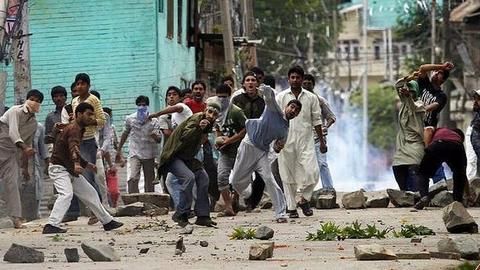
in his life are curfews, cordon and search operations, stone pelting,
enforced disappearances, and torture and fake/real encounter killings.
For him, violence is the new normal. The face of the Indian state is
someone clad in olive green or khaki carrying an AK-47, kicking the
front door down. This is the dominant narrative in any militancy-prone,
terror-infested, freedom-struggle area –- give it the label of your
choice.
In such an environment of fear, terror, intimidation, coercion and
death lurking around the next corner, it is easy for the likes of Burhan
Wani to become folk heroes and legends. As the ‘Washington Post’ said
about him “Burhan Wani was just 22 when he died, but he was already a
folk hero to many in Indian-administered Kashmir. The telegenic
insurgent — a leader of a group designated a foreign terrorist
organisation by the State Department — played his social media persona
to the hilt, mugging for pictures with automatic weapons and posting
videos on WhatsApp and
Facebook exhorting other men to join the separatist cause. He also threatened attacks on police convoys and military housing.”
There were others after him. Sabzar Ahmad renowned as ‘SAB DON’,
became the new poster boy of terror in the Kashmir Valley. Taking
forward the cult of Wani, Ahmad guided Hizbul terrorists until the
security forces neutralised him in an encounter on May 27. More such
poster children will, unfortunately, emerge, the reason for which is not
difficult to discern.
Some months ago about 40-odd young people from various districts of
Kashmir, under the aegis of an organisation called Jammu Kashmir
People’s Alliance that has an interesting tagline, “We serve, We
settle,” came to meet a Concerned Citizens Group in Delhi. This is led
by former finance and external affairs minister
Yashwant Sinha, who led two highly visible and successful outreach efforts to estranged sections in the Kashmir valley.
During the interaction these young boys and girls told us a very
disturbing story. Apparently among the most wanted stone pelters in the
valley is a gentleman called “DK” and he is all of SEVEN years old. If
the average age of stone-pelters is between 7-17 years, irrespective of
who is paying them, the Indian state is sitting on a volcano that is
belching
lava but has
not really exploded. When and if it does, a lot of people entrusted
with the remit of handling Kashmir both in the Centre and the state,
will not have the time to say goodbye.
Then there is an international dimension to the Kashmir situation
that has suddenly manifested itself. It has everything to do with the
turmoil that US President Donald Trump’s visit to Saudi Arabia has
plunged the Islamic/ Arab world into. The calling out of Qatar for its
links with Iran and subsequent developments has further divided the
already fractured polity of the Middle East.
On Eid, the Supreme Leader of the Islamic Republic of Iran gave a
very chilling address in Teheran. Ayatollah Ali Khamenei publicly called
for Jihad. “According to Islamic jurisprudence, when an enemy takes
over Muslim lands, jihad in any possible form becomes everyone’s duty,”
he said. “Palestine is the number one issue of the Islamic world, but
some Islamic countries are acting in such a way as if the Palestinian
case had been ignored and forgotten,” he added.
Then came the coup de grace. “Muslims the world over should also
openly support the people of Bahrain, Kashmir and Yemen and repudiate
oppressors and tyrants who attacked people in Ramadan,” Khamenei said.
Though Iran has earlier voted against India on the issue of Kashmir
in the Organization of Islamic Cooperation (OIC), this is the first time
the situation in the Valley has been given a religious colour by Iran’s
Supreme leader. Even those who are fighting against the Indian
establishment in some districts of J&K have refrained from labelling
their movement as “Islamic,” much less “jihadi.”
It is only one or two Hizbul Mujahideen “activists,” Zakir Rashid
Bhatt among them, who have tried to give militancy an Islamic colour. In
a video that went viral, he said, “When we pick up stones or guns it
should not be with this intention that we are fighting for Kashmir (as a
nation). The sole motive should be for the supremacy of Islam so that
Shariah is established here.”
But Zakir Bhat was quickly denounced by the other separatist leaders.
However, the fact that a Shia
religious leader of Iran has clubbed Kashmir, a predominantly Sunni area
with causes like Yemen and Bahrain should worry New Delhi, because Iran
backs up its rhetoric with logistical support, be it to the Hezbollah,
Hamas, Islamic Jihad or the Houthis in Yemen, to name but a few.
This support from Iran coincidentally comes at a time when the
predominantly Sunni ISIS, or Daesh, is trying to strike roots in Jammu
& Kashmir.
On his forthcoming visit to Israel, Prime Minister Modi would be well
advised to ask his interlocutors about the activities of General Qasem
Soleimani, the once reclusive head of the Revolutionary Guards and its
elite Quds Force. General Soleimani has suddenly surfaced from an era in
the dark leading clandestine processes overseas, to attain virtually
iconic prominence in Iran. He and the Quds Force have successfully
converted erstwhile territorial struggles into religious battles. One
can only hope that Kashmir is not their next frontline.
The government should abandon its excessive reliance on hard power in
J&K. Hard power should only be used to soften the recalcitrant so
that soft power can take over. Jammu & Kashmir is crying out for the
healing touch. All the leaders of the state cutting across the
political divide, including chief minister Mehbooba Mufti, are urging
the Central government to initiate an outreach to the alienated.
The Prime Minister will ignore their sage advice at his own peril.
Terms like “final solution” do not help, as that may mean very
differently from what the Central government has in mind.
For all the latest
Opinion News, download
Indian Express App
© IE Online Media Services Pvt Ltd
 Pakistan′s indirect role in North Korea′s nuclear program
 Pakistan welcomes Ayatollah Khamenei’s stance on Kashmir – Daily Pakistan
 Pakistan welcomes Khamenei’ stance on occupied Kashmir | Pakistan