The prophecy is more than seeing into the future. For the prophecy sees without the element of time. For the prophecy sees things as they were, as they are, and as they always shall be.
The views expressed by contributors are their own and not the view of The Hill
We’ve known about China’s massive nuclear expansion for some time now. Last year, Admiral Charles Richard, commander of U.S. Strategic Command, testified that we are on a trajectory to face two nuclear peers – Russia and China – for the first time in its history.
But things have changed. This week, Richard testified that this three-party nuclear-peer reality has already arrived.
This constitutes a significant shift in threat environment. Richard said the nuclear forces we have today are “the absolute minimum” and that the Pentagon will need to make “immediate and significant” changes to our nuclear posture.
Disarmament advocates greeted his statement with skepticism, but Richard is right. There is no time to waste when it comes to deterring nuclear attack.
The basic design of our current nuclear force posture dates to around 2010, when the overall threat of nuclear attack was expected to lessen over time. Russia was our only peer competitor, and President Obama’s 2010 Nuclear Posture Review considered Russia to no longer be an adversary. China maintained its historic “minimum deterrence” posture of fewer than 100 nuclear missiles and was expected to stay the course.
The Obama administration generally failed to anticipate the scope and size of China’s subsequent nuclear buildup. Nor did it anticipate Russian President Vladimir Putin’s nuclear saber-rattling in Ukraine.
These faulty assumptions drove many decisions about our nuclear posture. For example, the Columbia-class nuclear submarine is designed to hold fewer nuclear missiles than its predecessor, the Ohio-class. That decision “was based in part on the assumption that the multi-decade reduction in U.S. nuclear delivery systems is unlikely to be suddenly and dramatically reversed,” according to a recent RAND report.
Considering that our nuclear arsenal of around 1,550 deployed nuclear weapons was designed for the 2010 environment (with the expectation that threats would decrease) it is surely insufficient to meet the deterrence demands of today’s far more dangerous world.
There is a direct relationship between our adversaries’ capabilities and what the U.S. needs for deterrence. Deterrence hinges on the ability to hold at risk those assets our adversaries value most, including their nuclear forces and accompanying infrastructure. For deterrence to be credible, the United States must maintain the amount and types of nuclear weapons required to convince our adversaries that we can strike these targets if necessary.
Now facing double the number of peer threats that existed in 2010, the U.S. will need to adjust its nuclear forces in kind. That’s not to say that we must match China’s new capabilities one for one, but it does mean that our current nuclear force is insufficient to counter two major nuclear threats.
The U.S. cannot risk a deterrence posture that enables it to defeat only one nuclear adversary and not the other. When it comes to the most dangerous weapons in the world, the U.S. should want to deter all threats at all times.
If the United States fails to adjust its nuclear force posture, risks go up. If Russia and China do not perceive the U.S. nuclear threat to be credible, they will become further emboldened in their aggressive pursuits in Europe and Asia. Worse, they may calculate that the benefits of using nuclear weapons would outweigh the costs.
The Biden administration is expected to release its Nuclear Posture Review soon. If it has not already considered future adjustments to U.S. nuclear forces, it must do so immediately. In particular, it should review options to add more nuclear warheads to our current forces as well as to develop additional kinds of tactical weapons.
With something as dangerous as nuclear war – the only existential threat to the United States – the United States cannot afford to skimp on deterrence.
Patty-Jane Geller is a policy analyst specializing in nuclear deterrence and missile defense in The Heritage Foundation’s Center for National Defense.
Russia’s invasion of Ukraine, along with China’s threatening moves toward Taiwan and its new campaign to build up its strategic nuclear forces, likely signal an end to debate about modernizing the full nuclear triad, according to Air Force Secretary Frank Kendall.
The Air Force, Kendall said, is likely to get the green light to move forward with the Ground Based Strategic Deterrent intercontinental ballistic missile system, B-21 bomber, nuclear Long Range Stand Off missile, and command and control modernization.
Russia’s move on Ukraine was unthinkable to some in government just a few weeks before but has demonstrated that the unthinkable can happen and that the U.S. must do what’s necessary to deter them both, Kendall said:
Russia’s invasion shows that war between big nations “still happens” and that war with China in the Pacific is a “real … possibility.”
“A lot of people didn’t think that he would do it,” Kendall observed of Russian President Vladimir Putin’s invasion. “We’ve been watching this. I’ve seen him build up his forces multiple times on the borders of Ukraine. And as we watched this one, this time was different. It was clearly not a show of force this time. He was serious about it. And a lot of people didn’t expect that.”
Now, however, “I think, for better or for worse—certainly for worse for the Ukrainian people, ultimately, for worse for the Russians—we’ve had a wake-up call. We’ve had an emotional event that says that, ‘Yes, war at scale, among great powers, among modern powers, can actually happen.’ It can also happen in the Pacific.”
Despite the Ukraine invasion, Kendall said his priority is still “China, China, China” because that country has invested for 30 years in creating a military capable of challenging the U.S. in every domain, including space. Making America’s space assets “resilient” is the top priority of Kendall’s seven “operational imperatives.” Also, “we cannot give the other side impunity to operate in space,” and other countries’ assets there must be held at risk by the U.S., Kendall asserted.
“So, we’re in a whole new world, there.”
That said, “there is a huge unfunded requirement coming in space,” Kendall warned. “When you look at what we need to have”—and some of those space architectures are being built now—“there’s a bill there, that’s coming. “We’ll start to pay it … when you see [the fiscal year 2023] budget,” but bigger bills will come later. In answer to a question, Kendall said he’s “not terribly worried” about the Space Force being able to absorb a lot of new funding, should it be appropriated. “We’re pretty good at spending money in the Pentagon,” he dryly observed.
Kendall said he is “comfortable” with the fiscal 2023 budget.
“I think we’ll be able to balance those things that we’ve talked about … and move forward. But as I look beyond that, I do see challenges ahead. We have tough choices ahead of us in the next several years as we better define the things we need and then figure out how we’re going to pay for it.”
Although he would not discuss particulars about the unreleased fiscal 2023 budget, Kendall hinted that it doesn’t have as much in it for missile defense as he would like.
“What I became alarmed about in 2010 … and what I’ve been watching progress ever since, is the purchase of ballistic and cruise missiles” by China, “targeted at our high-value assets.” The Air Force needs “good warning and tracks, particularly for ballistic missiles. So if there were one area where I think we would need much more robust capability” and funding, “that would probably be it.”
More generally, he said, if he had “extra” money, he would spend it on more analysis to make sure the programs being selected to pursue, “and modernization in general,” are optimized to USAF’s true needs. Although in the past few years, “‘going fast’ has been emphasized … it’s really important that you go in the right direction … about where you make those investments.” His seven “imperatives” are about “making sure we get all that right.”
Kendall also said there will not be as many efforts to divest aircraft, meant to free up money for new programs, in the fiscal 2023 request as there were in the fiscal 2022 budget plan.
“We made the case last year,” he said, and Congress “came through pretty well. I’m pretty happy with what they did last year. The exception was the A-10.” But “I will tell you … I don’t think you’re going to see the same scale of requested retirements in this budget as you did last year. There will still be some. Going forward, there will be some hard choices, further out.”
Kendall said his new imperatives for tactical and strategic uncrewed aircraft are priorities because the manned aircraft force now envisioned is just too expensive. He also said the F-35’s sustainment costs are not going down to where the Air Force needs them to be.
“What we’re looking at is a force in which the F-35 is the ‘low end’ of a ‘high-low mix.’ That is not going to work,” Kendall said.
“We’re not going to get the F-35 sustainment cost down to a level where that’s realistic.” While he hopes production costs will keep going down—something the program office and Lockheed Martin have said are unlikely—even at $80 million a copy, the F-35 is “not a cheap airplane. So we’ve got to figure out a way to get the capacity and quantity that we need.” He quoted the trope that “quantity has a quality all its own,” and added, “that’s very true.”
In the omnibus defense bill, the hypersonic AGM-183 Air-launched Rapid Response Weapon (ARRW) took a major cut, giving up half its funding to longer research and development. Kendall noted that “there was a lot of enthusiasm for hypersonics in the previous administration, and I think I’ve made the comment why I think China is developing hypersonic capabilities. And we have to think more carefully about what we need” in that arena, and not just “mirror what they’re doing.” Kendall said. “We need to take a look at our whole portfolio, not just hypersonics.” But with regard to ARRW, he noted a series of test failures and said he’d spoken to Lockheed Martin recently, saying, “They think they’re working their way through that” and will get back to flight testing “shortly.”
However, “ARRW still has to prove itself,” he said.
It is widely believed that Ukraine gave up nuclear weapons that it could have used to deter Russia from the annexation of Crimea in 2014 and the war of aggression launched last month. This is problematic for several reasons.
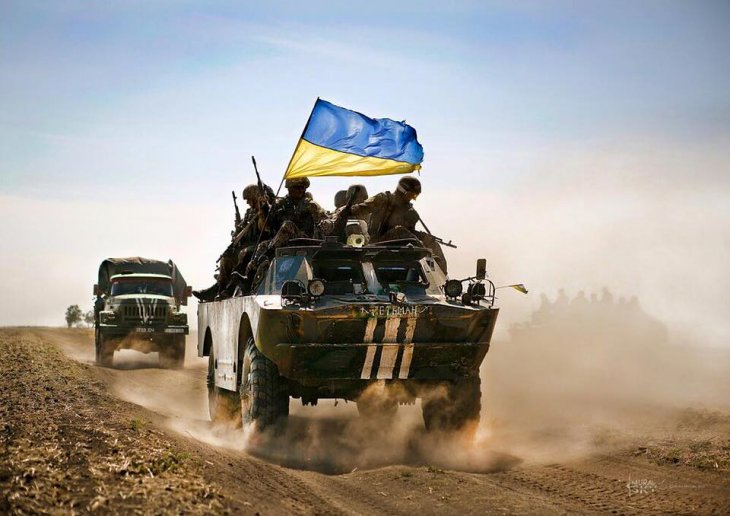
Photo: Ministry of Defense of Ukraine / CC BY-SA 2.0
Russia is using nuclear threats in order to deter NATO and European countries from direct military engagement in the war in Ukraine. Last week, Russian forces this week attacked Ukraine’s largest nuclear power plant. The Russian nuclear threat poses an important challenge for European and international security.
For Ukraine, Russia’s nuclear threats and its attack on a nuclear reactor are doubly tragic and concerning.
The country experienced the world’s worst nuclear accident at Chernobyl in 1986. In the 1990s, the Ukrainian authorities sent nuclear weapons inherited from the dissolved Soviet Union to Russia. Now the Russian government is accusing Ukraine of attempting to obtain nuclear weapons. In addition, Russia described the attack on the nuclear power plant as an act of provocation by Ukraine.When it comes to nuclear threats and the prospect of nuclear war, the prevailing perspective is often that of the superpowers.
When it comes to nuclear threats and the prospect of nuclear war, the prevailing perspective is often that of the superpowers. The discussion about Russia’s nuclear threats has primarily focused (with good reason) on what Putin is actually willing to do, and what steps NATO and the USA should take to avoid further escalation. These are crucial questions and challenges that Norway and our allies will continue to debate in the years to come. It is important, however, that the Ukrainian perspective on its nuclear history and the current events is not allowed to disappear or be misinterpreted.
There is a widespread belief that Ukraine gave up Soviet nuclear weapons that it could have used to deter Russia from both the annexation of Crimea in 2014 and the war of aggression launched last month. This belief is problematic for several reasons.
Ukrainian nuclear weapons?
When the Soviet Union collapsed in 1991, the stockpile of Soviet nuclear weapons left in Ukraine comprised what was then the world’s third largest nuclear arsenal. These weapons had been under the operational control of Soviet forces.
The United States were concerned that several former Soviet states might gain control over Soviet nuclear weapons, and that a lack of control over former Soviet nuclear expertise and materials could create new challenges for nuclear proliferation. Senior U.S. officials preferred that Russia became the sole inheritor of the Soviet nuclear arsenal.… the Ukrainian government was concerned about Russia receiving a monopoly on nuclear weapons among the former Soviet states.
For their part, the Ukrainian government was concerned about Russia receiving a monopoly on nuclear weapons among the former Soviet states. According to Harvard scholar Mariana Budjeryn, whose forthcoming monograph sheds new light on Ukraine’s nuclear options and choices, the new Ukrainian government was deeply concerned about the implications of a Russian nuclear monopoly among former Soviet states for regional and Ukrainian security.
The Ukrainian government initially sought security guarantees in exchange for sending the Soviet nuclear weapons to Russia. Ukraine also proposed a gradual phasing out of the Soviet nuclear arsenal and also took certain limited steps toward assuming military command over the remaining Soviet nuclear forces in the period 1992–1994.
Ultimately, however, Ukraine decided to transfer the remaining ex-Soviet nuclear weapons to Russia. After several years of negotiations and diplomatic pressure, Ukraine, the United States, Russia and the United Kingdom signed the so-called Budapest Memorandum in December 1994. This memorandum contained assurances that Ukraine’s sovereignty and territorial integrity would be respected. Ukraine accordingly did not obtain the security guarantees it wanted. Even so, Russia undertook to respect Ukraine’s borders and sovereignty. In 2014, Russia annexed Crimea in violation of this undertaking.
Russia is not confining itself to nuclear threats in order to achieve its military goals in its war in Ukraine. The Russian government is also making allegations about Ukraine’s nuclear capacity in an attempt to justify the war. Russian officials, including the foreign minister, Sergey Lavrov, claim that Ukraine has Soviet nuclear technology and delivery systems. It also accuses the Ukrainian government of having plans to develop nuclear weapons within a few months. This week, Lavrov said, among other things, that Russia was forced to intervene to prevent Ukraine from developing its own nuclear weapons.
Russia is unlikely to persuade many that this war was a preemptive or preventive attack intended to deny Ukraine from developing nuclear weapons. Even so, the allegation supports a Russian narrative that blames the Ukraine (and NATO) for the war.
Iraq, Libya and Ukraine?
What should we make of Ukraine’s choice to give up the Soviet nuclear arsenal in light of current events?
Should Ukraine have kept its Soviet nuclear weapons?
Could this have allowed Ukraine to avoid annexation and war?
The answers to these questions have become part of the broader debate about the current crisis, and are likely to feature in future debates about nuclear weapons and international security.
U.S. accounts of this process suggest that Ukraine did not have adequate control over the nuclear arsenal, and had no realistic choice but to hand over the weapons. From this perspective, then, Ukraine did not really have much of a choice with regards to the fate of the inherited Soviet nuclear arsenal.
In contrast, one might argue that Ukraine’s government could have chosen a different path in the 1990s. Notably, Budjeryn emphasizes that the Ukrainians did have a choice, and that they made the right one by not retaining the Soviet weapons, despite their misgivings about Russia’s intentions. Ukraine was under strong diplomatic pressure, including from the United States, which limited the set of feasible options available to the new state in the early 1990s.
Countries such as North Korea and Iran have previously pointed to countries such as Iraq and Libya, which phased out their nuclear weapons programmes and whose regimes were later toppled, as an argument for being wary of dismantling nuclear weapons programs due to pressure or as part of agreements with other states.
Last week, North Korea conducted a new missile test. Negotiations about a much-weakened Iran agreement are at a critical juncture. It is possible that the case of Ukraine will be perceived or cited by other states as an example of why a country should not disarm of nuclear weapons due to risks of future aggression.
For this reason, it is important to emphasize that the situation of Ukraine differs from that of countries that dismantled nuclear weapons programmes, such as Iraq and Libya, prior to acquiring nuclear weapons. Ukraine chose to give up Soviet nuclear weapons in return for a Russian assurance that it would respect Ukraine’s sovereignty and territorial integrity.
As Ukraine’s nuclear history is becoming part of Russia’s narrative about the war, and even its casus belli, it is important to emphasize these facts.
What does this mean for Norway?
Russia’s nuclear threats and behavior illustrate how nuclear weapons states can use nuclear weapons as a shield for conducting conventional aggression against other states.… it could become even more challenging to put in place nuclear risk reduction measures and arms control agreements that can reduce the risks of a destabilizing arms race …
This is, unfortunately, not an unprecedented challenge for NATO or other states with nuclear-armed adversaries. Pakistan has adopted similar tactics against India in the past. There are fears that China will do the same against Taiwan. The best response to such threats in Europe and Asia is to strengthen conventional military capabilities. This will be a key challenge for Norway and our NATO allies in the future.
These challenges have implications for Norwegian security. For several years, Norway’s intelligence service has pointed to arms races and regional rivalries as a key concern. The Russian nuclear threats illustrate the challenges that this can entail for European security.
Looking ahead, it could become even more challenging to put in place nuclear risk reduction measures and arms control agreements that can reduce the risks of a destabilizing arms race near our borders.
Following its unconscionable invasion of Ukraine, Russia has appallingly chosen to cast a nuclear shadow over the already unimaginable situation it created.
While this is likely an ill-advised attempt to broadcast Russian strength as its invasion of Ukraine proceeds at a much less successful pace than he expected, Russian President Vladimir Putin’s irresponsible nuclear rhetoric and posturing are highly provocative and unprecedented. Russia’s brandishing of its nuclear capabilities when its security is not threatened is further evidence of an unsafe security environment that requires a continued commitment to a strong American nuclear deterrent.
To some degree, Russia’s force structure design makes it inevitable its nuclear weapons will be flaunted any time it uses military power. It has reportedly deployed its Iskander missile systems to fire short-range conventional missiles into Ukraine, but these systems are dual-capable, meaning they can also launch nuclear-armed missiles. Media reports also indicate Russia sent its Kinzhal nuclear-capable hypersonic missiles to Kaliningrad as a part of its force buildup in advance of its invasion of Ukraine. Deployment of these systems signals anyone seeking to challenge Russia to back off.
Despite paying lip service to the principle that “a nuclear war cannot be won and must never be fought” signed onto by the P5 countries in January, Russia has blatantly demonstrated it does not adhere to this long-held norm. While it is unlikely Russia would use nuclear weapons against Ukraine, Putin’s nuclear brandishing while conducting the largest land war in Europe since World War II clearly shows that nuclear weapons remain a prevalent 21st-century concern.
Unfortunately for the Biden administration’s ambitions to reduce the role of nuclear weapons in America’s military strategy, the adversary gets a vote. Russia has the most nuclear weapons on Earth. This stark reality contrasts with the picture painted by the arms control community that treaties with Russia have achieved an equitable nuclear relationship.
The New Strategic Arms Reduction Treaty (New START) is often held up as an ideal arms control arrangement that keeps both American and Russian strategic nuclear weapon systems at 1,550 each. However, upon enactment of New START in 2011, Russia made a conscious decision to pursue an expansion of its non-treaty-covered non-strategic nuclear weapon systems, otherwise known as battlefield nuclear weapons. As a result, Russia now has about 2,000 non-strategic nuclear weapons, while the United States has only 200. Some of these Russian non-strategic systems were even developed in violation of the long-standing Intermediate-range Nuclear Forces (INF) Treaty, resulting in America’s prudent withdrawal in 2019.
When negotiating the renewal of New START, the Biden administration opted to maintain the status quo. As the administration develops its Nuclear Posture Review, rumors abound it may even aim to reduce America’s nuclear weapons.
During the Trump administration, the 2018 Nuclear Posture Review (NPR) recommended a continued commitment to modernization of the air, land and sea legs of America’s nuclear triad. The 2018 NPR further suggested two supplemental nuclear capabilities be added to enhance deterrence of Russia’s growing non-strategic nuclear arsenal: a low-yield ballistic missile and a nuclear sea-launched cruise missile. Russia’s nuclear brandishing during the Ukraine crisis makes the supplemental capabilities put forward in 2018 even more necessary.
We have found ourselves in a precarious situation. Russia’s larger nuclear arsenal is almost entirely modernized, while the United States is just now starting the process of acquiring new systems to replace decades-old platforms. Many of our nuclear systems are even being replaced on a one-to-one basis, meaning any delay would result in the reduced capacity of our nuclear deterrent.
The United States must demonstrate resolve and recommit to a strengthened nuclear deterrence posture. It is essential for the protection of our homeland and forces, as well as our allies to whom we extend nuclear deterrence. The credibility of our nuclear deterrent rests on the capability of our nuclear forces, and at this moment, we must choose strength over weakness.
Rep. Doug Lamborn, R-Colo., is ranking member of the House Armed Services strategic forces subcommittee.
With the nuclear talks reaching their final hours, and the Iranian regime remaining steadfast in promoting positive progress, Iran’s state media are now expressing scepticism and despair. They have stated that the negotiations, at its ‘final turn’, have reached a ‘dangerous, sharp and bumpy turn.’ A turn that has increased the possibility of the regime’s demise.
The media outlets are now speaking about the failure of the Vienna talks. In an interview with the state-run daily Jahan-e Sanat on March 3, Ali Bigdeli, one of the regime’s international affairs experts, said: “The status of the talks has changed slightly since Tuesday afternoon. The reason for this change may be partly due to our comments and positions on Russia. In other words, Russia’s invasion of Ukraine greatly affected the negotiating environment, which is why Mr. Ulyanov has left the negotiating path. On the other hand, the Westerners have said because of the positions and statements of our senior officials in support of Russia that they may leave the negotiating table by the end of the week if the talks do not reach the desired result.”
The result of this critical situation has put the Iranian regime in a strange position. This coupled with the prospects of European and American sides withdrawing from the negotiation process, we will get a clearer picture of the regime’s supreme leader Ali Khamenei’s weakness.
Bigdeli has also admitted that the regime’s efforts to lift all sanctions have completely failed. He said, “The Americans have separated the four areas of the (nuclear) sanctions, human rights, missiles, and regional issues, and are now ready to lift the sanctions (related to the JCPOA), but in three other areas, they suggest that negotiations continue after the JCPOA. But Iran does not want to accept this. Given that by no means it is possible that the Americans close their eyes on none JCPOA sanctions, the situation has become increasingly difficult in many ways.”
The state-run daily, Javan, affiliated with the regime’s Revolutionary Guards, also expressed the same frustration. It wrote, “Evidence shows that the US-based mafia has not responded positively to any of Iran’s legal demands and continues to beat the drum with its arrogant and mafia-style bullying and refuses to be flexible and give Iran the slightest concessions.”
The dailywarned of the regime’s ‘sheer loss’ and ‘chain JCPOAs until the complete erosion of (the regime’s) power’, noting that that it would have to address the missile, regional, and human rights issues In the next phase of negotiations.
As such, it can be said that with the start of the current war in Ukraine, the regime mistakenly thought it could play an offensive role in the nuclear talks by supporting Russia and changing the situation in its own favor. However, now it is worried that Russia will use the regime as its card in the negotiations to strike a balance with the West.
The last scenario, as Bigdeli said, is equivalent to the regime’s confrontation with the IAEA, which would likely lead to the IAEA’s Board of Governors urging the adoption of a resolution by the UN Security Council, as well as the return of all six previous sanction resolutions. If the regime does not comply with the demands of its western interlocutors will be crushed under the weight of increasing social crises and protests, and the hammer of international political and economic pressures. The accelerating developments will not just stop here, and the situation will change from bad to worse. It is apparent that the newly created parameters show us that time is against the regime.
Russia’s nuclear saber-rattling, while alarming, is at this point most likely a blaring signal for NATO not to get involved in Russia and Ukraine’s conflict, experts said. But concerns are rising of the still-slim possibility that Russia could try to strengthen its stalling offensive with a tactical nuke. This is a subject of pressing debate among experts Insider interviewed.
“We certainly should be worried about his saber-rattling — that is irresponsible and reckless,” said Hans Kristensen, director of the Nuclear Information Project at the Federation of American Scientists.
“Whether we should be worried about whether he will actually use them I think is another question,” he continued, “because there are no indications that I’ve heard of that he has taken any steps, unique steps to ready the forces to do such a thing.”
If Russia were to use nuclear weapons, it’s likely they would use tactical weapons, also known as battlefield nukes, which are designed to be used on a smaller scale — on the battlefield or for a limited strike. These Russian warheads can be fitted to cruise missiles, torpedoes, or bombs to obliterate a bunker, naval base, or air defenses. While powerful, their blasts are typically smaller by a factor of 60 or more from Russia’s intercontinental ballistic missiles, some of which carry multiple thermonuclear warheads.
Kristensen said Putin’s move could be a “bravado type of chest-thumping,” but, more than that, it’s “a very pointed message to NATO not to get involved.”
Joshua Pollack, a senior research associate at the Middlebury Institute of International Studies and a nuclear-proliferation expert, echoed Kristensen in a March 1 interview.
“Every time Putin has talked about nuclear weapons in the last week, it has been with a view to warning NATO,” he said. “It has not been with any reference to Ukraine. So as long as NATO stays out of the fight, I think that it’s less of a concern,” he said of tactical nuclear warfare.
The consequences of nuclear combat are so extreme, with deaths measured in the hundreds of thousands if not millions, that some argue the West can’t assume Putin is bluffing, a view that is shaping the Biden administration’s response. And as Putin’s offensive struggles and NATO reiterates it will not defend Ukraine, some experts warn that an increasingly desperate Putin could have reasons to turn to a battlefield nuke.
The Project 955A (Borei A) nuclear-powered ballistic-missile submarine Knyaz Oleg sets off on its first sea trial in the White Sea.Oleg Kuleshov\TASS via Getty Images
If Russia were to use tactical nukes, the results would almost certainly be catastrophic, with researchers at Princeton University estimating more than 91 million people in Russia, the US, and NATO-allied countries could be killed within three hours. The researchers, from Princeton’s Science and Global Security lab, created a simulation that shows one tactical “nuclear warning shot” from Russia could quickly devolve into full-blown nuclear war.
“This project is motivated by the need to highlight the potentially catastrophic consequences of current US and Russian nuclear war plans. The risk of nuclear war has increased dramatically in the past two years,” the project states on its website.
President Joe Biden has made it clear that the US has no interest in provoking Russia and is trying to walk a fine line of hammering Russia with economic sanctions and continuing to arm Ukraine’s military without being viewed by Russia as a combatant.
“Provocative rhetoric like this regarding nuclear weapons is dangerous, adds to the risk of miscalculation, should be avoided and we’ll not indulge in it,” the White House press secretary Jen Psaki told reporters in late February.
Although most experts agree that the chances of nuclear war are extremely low, some are concerned that Putin would use a tactical nuke if he were to become desperate enough.
Retired Brig. Gen. Kevin Ryan, a former defense attaché to Russia and senior fellow at Harvard’s Belfer Center for Science and International Affairs, is worried that Putin, in his desperation, could use a “small nuclear weapon” to keep the US and NATO out of the conflict.
“It’s not a good thing, and it’s not something I think everybody wants to jump to — including Putin,” Ryan said. “But this is everything for him now,” he said of the war with Ukraine. “If he doesn’t accomplish this, his own people will take him out.”
Jonathan Katz, a senior fellow at the German Marshall Fund, said that Putin’s nuclear threats should be taken “quite seriously.”
“The difference between this conflict and Chechnya, Syria, and other attacks in the past is that NATO and the United States are standing right now on the other side of the border, directly arming and supporting Ukraine and Ukrainians to defend their country,” Katz said.
“Putin is calculating right now, if this spills over into something more significant he may decide to use whatever weapon is at his disposal,” Katz continued. “If he feels that this is going beyond Ukraine into these other spaces, including with NATO and the United States, I think all bets are off the table.”
“The problem is, I know these people very well. They never send threats, they just kill, so there is kind of [a] weird silence around me, but I really think we’re on the brink of a nuclear war right now. I’m not exaggerating,” Baronova told Fox News Digital from Moscow, via a WhatsApp call.
“I have a son, I can’t leave because his father won’t allow me to leave with him, and so I just prefer to stay in Moscow … It seems like we’re either in North Korea or we are going to be killed by a thermonuclear mushroom,” she said. “I wouldn’t quit, and I wouldn’t lose my salary and job if I was sure that we are going to be alive for many years, but I really don’t know what is going to happen to all of us next.”
While many around the globe are gravely concerned Putin would resort to nuclear weapons, Baronova is worried his behavior will make Russia the target of a catastrophic attack.
“I suspect the Western world will use it,” Baronova said. “This is a very dangerous situation.”
The blunt Baronova agreed to talk to Fox News Digital until her son’s food was ready. She explained that the last straw before quitting RT wasn’t any sort of on-air propaganda, but rather an Instagram message from her colleague who wrote, “If you are now ashamed of being Russian, don’t worry, you are not Russian,” as Putin’s invasion of Ukraine intensified.
“I was really disturbed by that tone and level of support,” Baronova said, noting that she publicly responded to her now-former coworker’s message.
“If I chose to be with Russia, this does not mean that I should walk in a totalitarian system, be silent or, for example, rejoice that the regime, which I do not want for my country, is being exported somewhere else,” Baronova wrote. “And this regime will finally turn our life into one endless hell. What’s there. Already turned.”
Baronova then stepped down from the state-run network.
“That was the moment I decided, ‘OK, that’s it,’” she said.
Baronova said she hasn’t garnered much support from fellow Russians since leaving RT and is seen as an opposition activist. But this isn’t the first time Baronova found herself in the public eye for opposing Putin’s regime.
Her life was upended after the arrest and she eventually went to work for Dozhd, Russia’s top independent TV channel which is also known as TV Rain and famously critical of Putin.
Baronova, who was by then a single mother, jumped ship to RT in 2019, irking fellow Putin oppositionists who felt she was abandoning the movement by joining state-run media.
“People felt betrayed when I decided to join RT,” she said. “But I decided on purpose in order to have a reasonable conversation with people who are in power right now in Russia.”
Last week, Russian authorities accused TV Rain of peddling “false information regarding the actions of Russian military personnel as part of a special operation” in Ukrainec, and Baronova’s prior network was promptly forced off the air as Putin purged non-state media.
Russian President Vladimir Putin spoke to female flight attendants in comments broadcast on state television on Saturday, March 5, 2022. (Image: Reuters Video)(Reuters Video)
Baronova’s two previous employers have suffered different fates over the past few days, as RT remains on air and has echoed Putin’s message throughout the Ukraine invasion.
Baronova, who was the managing editor of RT’s Russian language unit, said she wanted to bring positivity to the state-run outlet and much of her responsibilities focused on covering problems with social institutions. Baronova said she also spent much of her time at RT working on a fundraiser for mothers of children with cerebral palsy, and she was largely kept out of conversations regarding which Kremlin talking points would be spouted by the outlet despite her editor-in-chief title.
Roughly three years after joining the state-run news organization with hopes of forcing change, the activist-turned-journalist had seen enough after Putin’s ruthless attack on Ukraine that was supported by many of her now-former RT colleagues.
“I have nothing else to talk about with them,” she said. “Our own government is bombing our relatives, our friends.”
Baronova feels many Russians are “brainwashed” and some even buy Putin’s claim that the attack was needed to help “denazify” Ukraine, which the Kremlin has insisted was the true aggressor. Putin has claimed he wants to purge Ukraine of fascism; such messages, experts have told Fox News Digital, are appealing in Russia since loathing for the defeated Nazi Germany regime runs deep.
“I try to talk with people on the streets… they even had arguments like, ‘We are fighting with Hitler,’ but look, I’ve got some news. Hitler died 80 years ago,” she said. “It seems like they’re really brainwashed.”
Putin has cracked down on non-state news since the invasion of Ukraine began, with social media platforms and independent news operations forced to shut down for refusing to parrot propaganda. Some locals don’t mind that Putin has silenced non-state media and a Moscow taxi driver even told Baronova the now-shuttered TV Rain was filled with “traitors” who opposed the Kremlin.
“A lot of people have these kind of sentiments,” she said.
Despite Putin’s attempt to control messaging related to the Ukraine invasion, Baronova is baffled that people still buy into his narrative when accurate information can be found by anyone eager to find it.
“We have internet like everybody else in this world, and you can’t hide information from people in the era of the internet, so I don’t understand how they can be brainwashed. How can they be saying that Russia is fighting with Hitler collaborators in Ukraine when Hitler died 80 years ago? But they really have these kinds of conversations,” Baronova said, noting that some Russians have begun to open their eyes because of sanctions and American companies pulling out of the nation.
“People were in favor on [the] first day of invasion. Now they are less convinced and much more skeptical because they understand now that they are going to lose their jobs, they are going to lose their cars, their iPhones, their everything,” she said. “So, let’s see what that are going to say in a month … The whole world is in a bad position.”
Painting a bleak picture, Baronova said it feels like 1945, the final year of World War II before quickly correcting herself.
“Probably more like 1939,” she said, referring to the year that World War II began. “It is really pointless to predict anything … We are watching a lie on my TV.”
Suddenly, Baronova had to go, as her son’s meal was ready – she told him to please put down his phone and eat. Before hanging up, she had one final message for Americans.
“Russians love their children, too,” she said. “Stay safe. Everybody, stay safe.”
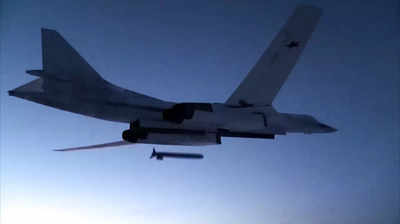
File photo: A Russian Tu-160 strategic bomber fires a cruise missile at test targets, during a military drill.
LONDON: Russian President Vladimir Putin said at the weekend that his nation’s nuclear forces should be put on high alert, raising fears that Russia’s invasion of Ukraine could lead to nuclear escalation. Here is how Russia’s chain of command would work in the event of a nuclear weapon launch. Who decides to launch Russian nuclear weapons? A 2020 document, called “Basic Principles of State Policy of the Russian Federation on Nuclear Deterrence”, the Russian president takes the decision to use nuclear weapons.
A small briefcase, known as the Cheget, is kept close to the president at all times, linking him to the command and control network of Russia’s strategic nuclear forces. The Cheget does not contain a nuclear launch button but rather transmits launch orders to the central military command – the General Staff. If Putin gives the nuclear order, what happens? The Russian General Staff has access to the launch codes and has two methods of launching nuclear warheads. It can send authorisation codes to individual weapons commanders, who would then execute the launch procedures. There is also a back-up system, known as Perimetr, which allows the General Staff to directly initiate the launch of land-based missiles, bypassing all the immediate command posts. Did Putin’s ‘high alert’ oder make a launch more likely? Putin said at the weekend that the nation’s nuclear forces should be put on high alert. The following day, Russia’s defence ministry announced that its nuclear missile forces had been placed on “enhanced” combat duty. The phrase enhanced, or special, combat duty does not appear in Russia’s nuclear doctrine, leaving military experts puzzled over what it might mean. Pavel Podvig, a senior researcher at the United Nations Institute for Disarmament Research in Geneva, said on Twitter that the order might have activated Russia’s nuclear command and control system, essentially opening communication channels for any eventual launch order. Alternatively, he said it might just mean the Russians added staff to their nuclear facilities. Do the Russian have rules on nuclear launches? The 2020 doctrine presents four scenarios which might justify the use of Russian nuclear weapons: — the use of nuclear weapons or weapons of mass destruction against Russia or its allies; — data showing the launch of ballistic missiles aimed at Russia or its allies; — an attack on critical government or military sites that would undermine the country’s nuclear forces response actions; — the use of conventional weapons against Russia “when the very existence of the state is in jeopardy”. What nuclear capabilities does Russia have? The Federation of American Scientists estimates that Russia has 5,977 nuclear warheads, more than any other country. Of these, 1,588 are deployed and ready for use. Its missiles can be fired from the land, by submarines and by airplanes. Putin oversaw a coordinated test of Russia’s nuclear forces on Feb. 19 shortly before ordering troops into Ukraine. Have Russia ever used a nuclear weapon in war? No. To date, the only use of nuclear weapons during conflict was the atomic bombs dropped on the Japanese cities of Hiroshima and Nagasaki by the United States in 1945, at the end of World War Two.
Across Western Europe, people are taking Russian president’s threats very seriously.
By Anchal Vohra, a columnist for Foreign Policy and a freelance TV correspondent and commentator on the Middle East based in Beirut.
MARCH 1, 2022, 8:50 AM
Russian President Vladimir Putin placed his nuclear forces on high alert on Sunday, citing NATO’s “aggressive” response to his invasion of Ukraine. At the same time, Russia’s allied Belarusian government warned that Western sanctions on Russia would instigate the third world war. Europe’s governments made no official response to these threats.
But many European citizens—including those in Western Europe, far from the Ukrainian front—can no longer hide their anxieties. Putin is stoking their deepest fear: a continental war that could include nuclear weapons.
Nuno Gomes was busy shuffling espresso cups under a coffee machine and serving customers at a cafe in Brussels when explosions bellowing out of a TV broadcast of Ukraine’s invasion clashed with the cacophonous chatter of coffee drinkers. “It is unbelievable,” said the 21-year-old Portuguese barista, one of the millions of Europeans who believed war happened elsewhere, far from their backyard. “I am very scared of Putin,” he added. “If Europe sends soldiers to Ukraine to help the Ukrainians, then Putin will attack us. Belgium will be the first because it’s the center of Europe.”
Meanwhile, Kristof Cresens sipped a local beer at a pub in the beer town of Hoegaarden, Belgium. “I’m sorry my words are harsh, but he is an asshole,” Cresens said of the Russian president. He is furious at Russia’s attack on Kyiv but is uncertain of what Europe can do to stop it. He voiced a deep-seated fear of the Russian president, a fear that is holding back Europe from taking more assertive action. As a social worker and nurse at an institution for people with disabilities, Cresens oozed concern for Ukrainians, but like Gomes, he too is terrified of the man with a “big army” and among the largest stock of nuclear weapons. “I would maybe, ideally, want Europe to send troops to Ukraine to fight Russia, but if we do, then Putin might attack us,” Cresens said.
At a trattoria in Cologne, western Germany, Christina Wienand, Katja Lössl, and Philip Gutowski, friends, were about to order lunch. “He is a dangerous man. He has dangerous weapons,” Wienand said. “If Germany joins the war, it will become bigger and bigger, maybe a world war.” Gutowski flipped through a menu in a centrally heated restaurant as hail lashed the cobbled streets outside on a cold winter day. An uninterrupted power supply and centrally heated indoors are among Europe’s many comforts. “Ukrainian politicians are right to describe Germany’s support thus far as a joke, but it’s hard because we heavily rely on Russia for gas,” Gutowski said. “It is a difficult situation.”
Dozens of Europeans in several European nations reiterated the same sentiment when Foreign Policy asked them if Europe was doing enough to deter the Russian president and prevent Ukraine’s fall. Even though there was general acknowledgement of Ukraine’s relatively smaller army being unable to push back Russia’s massive military enterprise, no one advocated deploying their own troops against Russia. They backed sanctions, but not everyone is ready to pay more for an alternative source of gas at higher rates. Anger against Putin in Europe is palpable—but so is fear.
Most insist that Europe must not provoke a nuclear-armed Putin. “Russia will respond immediately, and the consequences will be such as you have never seen in your entire history,” Putin said in a televised address a day before Russian military columns rolled down the streets of Ukraine and airstrikes struck Kyiv, Ukraine’s capital. “Even after the dissolution of the USSR and losing a considerable part of its capabilities, today’s Russia remains one of the most powerful nuclear states,” he added.
Nearly everyone Foreign Policy spoke with described Putin as a dangerous man with nukes aimed at Europe. They see him as someone insane enough to destroy their cities and way of life at a moment’s notice. They would like to help Ukraine, but their top priority is ensuring war does not come home.
According to a 2017 survey by the Pew Research Center, 78 percent of Europeans had no confidence in Putin’s leadership. But it wasn’t until last week’s invasion that Western Europeans thought of him as a direct security threat. Russia seems to have now replaced the Islamic State as the greatest threat in the hearts and minds of Europeans.
As Putin unflinchingly wields Russia’s nuclear threat, the Europeans that Foreign Policy spoke with were not in favor of their military alliance doing the same. French Foreign Minister Jean-Yves Le Drian very cautiously reminded Russia that, “the Atlantic alliance [NATO] is also a nuclear alliance,” as it includes the nuclear-armed states of the United Kingdom, France, and the United States. Estimates suggest that Russia has about 6,000 nuclear weapons while the United States has about 5,500.
Experts believe Russia is aware of Europe’s aversion to armed conflict in general and disdain toward the use of nuclear weapons in particular. They say Russia’s threat accomplished its goal of scaring Europeans. Russia’s nuclear might is the biggest reason the United States and its European allies have ruled out deploying boots on the ground. Desperate to save his people, Ukrainian President Volodymyr Zelensky has appealed, in vain, for immediate entry to NATO, which would oblige the alliance to come to Ukraine’s defense. “I’ve asked 27 leaders of Europe if Ukraine will be in NATO. I’ve asked them directly. All are afraid and did not respond,” he said in a video released over the weekend. “We were left by ourselves. Who is ready to go to war for us?”
The United States and its European allies insist they are determined to do everything short of sending troops. Not only has the West come together to impose a ban on Russia using the SWIFT payment system but also a ban on Russian aircraft using European airspace. Moreover, the European Union said it would finance the provision of weapons needed to stop Russia to Ukraine.
After Britain’s shoulder-fired missiles and U.S.-made Javelin anti-tank, guided missiles were spotted on the battlefield and reported to have aided Ukraine, Germany’s chancellor reversed the country’s position of not sending weapons to a conflict zone and decided to supply 1,000 anti-tank weapons and 500 Stinger missiles to Ukraine. The Dutch have announced it will supply 50 Panzerfaust 3 anti-tank weapons and hundreds of rockets, and U.S. Secretary of State Antony Blinken said Washington will provide $350 million in additional military equipment to bolster Ukraine’s defense.
Over the weekend, reports emerged that Ukrainian soldiers and fighters in Kyiv have had success in holding onto the capital despite massive Russian bombardments and ground infiltration. Ukrainians have displayed a will to fight and, so long as they continue to receive arms from the West, they might have a chance to at least bleed Russia enough to encourage Putin to rethink his invasion.
“Before the full-scale Russian attack began, I would have said (and did) that no amount of Western weapon assistance could be enough to enable Ukraine to defeat the better-equipped Russian force,” said Olga Oliker, the International Crisis Group’s program director for Europe and Central Asia. “I am no longer certain that is true, but I’m not convinced yet that it is not. Russia has not put all of its capabilities forward as yet. But the Ukrainians have fought bravely and impressively while Russian forces have not fought as well as I expected. Western states can and should continue to supply Ukraine with both lethal and nonlethal capabilities.”
U.S. and European sanctions are no match for Russia’s military might and are unlikely to dissuade Putin and his cohorts from withdrawing from eastern Ukraine. Aiding Ukrainian fighters with weaponsm, by contrast, may halt Putin’s march into Kyiv—but it will certainly heighten fears among Europeans of a nuclear response.
Anchal Vohra is a columnist for Foreign Policy and a freelance TV correspondent and commentator on the Middle East based in Beirut. Twitter: @anchalvohra
So, how should we think about the US as a superpower in 2022?
It’s too early to draw broad conclusions about what war in Eastern Europe means for the future of America in the world. But there are enough clues to suggest that America’s power has limits, and indeed it always has. With the Soviet Union’s demise, the United States achieved global dominance for a brief unipolar moment. Then President George W. Bush squandered it through destructive (and expensive) misguided regime-change wars. Subsequent presidents gaslit the American public on progress in the Middle East in two conflicts that killed hundreds of thousands. Despite all those unforced errors, the United States remains a superpower, though the limits of non-military power have been exposed.
Thomas Pickering, who served as ambassador to Russia from 1993 to 1996, says that the “caricature” of America as a superpower has obscured the way most Americans think about how the world works.
As a career diplomat over four decades, Pickering witnessed America’s global position change from the Cold War to the breakup of the Soviet Union to the height of US supremacy at the turn of the millennium. “If your assumption is that a superpower can do anything, anywhere, anytime it wishes, without suffering the consequences of risk and uncertainty, then you misperceived the current world situation,” he told me.
A superpower is not infallible and omnipotent. The United States will not send in troops but has shipped hundreds of millions of dollars of weapons to Ukraine, shepherded an international coalition to institute wide-ranging economic sanctions, and encouraged tech companies and global organizations like FIFA and the Olympics to pursue the cultural isolation of Russia. And yet the United States, even with the world’s largest military and most robust economy, has not been able to induce Russia toward a different path. So, Putin continues to deploy his army toward Kyiv. And stopping that incursion does not appear to be something America has the power to change without risking nuclear war.
Superpowers need to pick their battles and engage in the same tough choices as any other country — especially when confronted with an adversary with nuclear capability, such as Russia. And rather than grasping the complexity of world affairs, many Americans have internalized the shibboleths that the US has never lost a war and that the US never compromises with enemies, especially during a conflict. Neither is true.
Both factors show that, as a country, the United States has failed to recognize its own constraints, some of which have long existed and are simply accentuated by Russian aggression.
How the unipolar moment ended
When the Cold War ended in the ’90s, the United States possessed unrivaled economic and military power. Scholar Francis Fukuyama claimed the “End of History” and former Secretary of State Madeleine Albright asserted the centrality of American exceptionalism in her coinage, “the indispensable nation.”
Some argue that that unipolar moment was overstated. “Look, the Americans suffered from hubris after the end of the Soviet Union,” said Joseph Nye, a Harvard professor who has written widely about American power. “The unipolar moment, I think, was always illusory.”
At the end of the Cold War, the US did continue to hold itself out as the guarantor of security. “The United States appointed itself as responsible for peace, security, and democracy in Europe,” Stephen Wertheim, a historian of US foreign policy at the Carnegie Endowment for International Peace, told me. In response to ethnic cleansing in Bosnia, the United States, through NATO, took military action against Serbia. The intervention was relatively limited, and the outcome of it was a successful projection of US might.
But that unilateral moment, real or imagined, was short-lived.
The terrorist attacks on September 11, 2001, were not what challenged that global supremacy, argues Wertheim. Rather, it was the 20 disastrous years ofoverreach in America’s response. The invasions of Iraq and Afghanistan exposed the limits of US power.
It could be said that Osama bin Laden understood something about Americans that they didn’t understand about themselves, namely that in reaction to heinous terror attacks America would overreact. With the invasion and occupation of two countries, the US would face two decades of blowback that tore at the country’s seams, that undermined democratic values through the war on terrorism at home and abroad. “Basically, with the Iraq invasion, we bite off more than we can chew, and we get a comeuppance,” said Nye.
The United States, mired in the Middle East and Afghanistan, continued to expand its role as global policeman through a network of US bases and military commitments that, counterintuitively, detracted from US power. It’s at this time that China began to rise as a counterbalancing force and Russia reemerged as a power in Europe.
“As the wars in Iraq and Afghanistan have obvious problems, we start to enter into a gradual period of decline in belief that the United States can reshape other societies,” Wertheim explained. “One problem is that this led us to make commitments to Ukraine. That means that we suffer a loss of prestige when we don’t make good those commitments.”
President Joe Biden speaks about the end of the war in Afghanistan from the White House on August 31, 2021.
Now that the US is caught in a potential face-off with a nuclear superpower, it is clear that perhaps the biggest failure of recent years has been the de-emphasis on arms control and the reduction of nuclear weapons worldwide. President Barack Obama, who in his early life was a staunch anti-nuclear activist, negotiated a new START Treaty in 2011, which curbs and monitors the US and Russia’s nuclear warheads.That’s now been extended to 2026, but more is needed. Over decades, Washington and Moscow allowed the arms control regime to decline, which culminated in President Donald Trump’s withdrawal from the important 1987 Intermediate-Range Nuclear Forces.
“Slowly, the structures that kept US-Russian military competition visible and predictable fell away,” said Heather Hurlburt, of the think tank New America. “At the same time, Beijing” — itself a nuclear power — “is building up its arsenal and making it very clear that it’s not interested in the US-Soviet arms control model.”
And other global crises, such as the pandemic, have exposed the inability of the US to lead as the indispensable nation.
The lesser-discussed dynamics that have undermined US power
Now the United States and Europe are waging an economic war against Russia. Underneath that, one can see America’s failure to imagine a post-oil economy or a globally urgent set of policies to address the climate crisis. Even as sanctions hobble Russia, the international market depends on Russian energy resources — with inevitable knock-on effects that damage everyone else.
The human rights rhetoric from American leaders has also deluded Americans. Most US presidents, with the exception of Trump, have spotlighted abuses worldwide. But they have not stopped the American way of doing hefty business with prominent abusers like Russia and China. Europe also got comfortable with this equation, as Maximilian Popp writes in Spiegel International. It’s a contradiction that has empowered authoritarians like Putin.
Europe has wondered whether the problem wasn’t only Trump but, at its core, America. This is especially the case after the chaotic withdrawal from Afghanistan last summer. “The Afghanistan thing got to a deeper worry that they have about American power,” said Jeremy Shapiro of the European Council on Foreign Relations. Though European leaders may be muted about this issue now, he told me that there are concerns about American competence because of polarization in Washington, “because the Republicans and Democrats are playing domestic politics with everything.”
US democracy and America’s capacity to promote human rights worldwide are connected, says Suzanne Nossel, the CEO of PEN America. “It’s now hit home at a much deeper level, that those two things are intertwined and that our democracy is seen as teetering and crumbling at the edges, that we cannot be an effective force for democracy globally,” she told me.
A country that has depended on its standing as an economic force and a democratic authority worldwide is at its weakest and most dysfunctional in half a century or more. Hurlburt calls it “self-inflicted decline.” The combined result is that the US is effectively not showing up.
It’s good that Biden has ruled out putting US troops into Russia’s new war in Europe, a potentially endless conflict for a country that took two decades to leave Afghanistan. That decision lays bare a reality that American foreign policy circles have too often ignored. AsHurlburt put it, “Gravity applies to us just like everybody else.”






/cdn.vox-cdn.com/uploads/chorus_image/image/70564258/GettyImages_1339871841.0.jpg)
:no_upscale()/cdn.vox-cdn.com/uploads/chorus_asset/file/23278776/AP21243718525587.jpg)