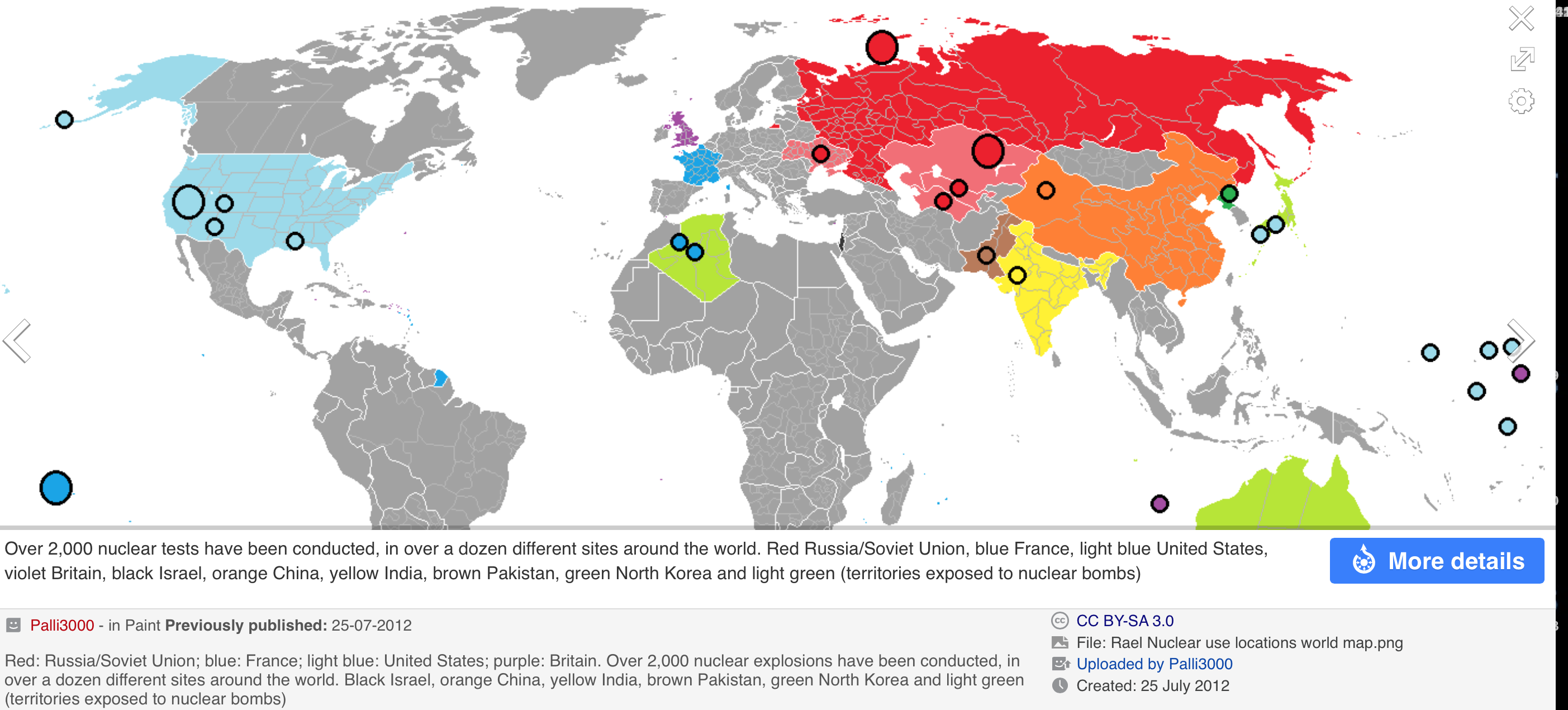
More than 2000 nuclear explosions have occurred since 1945 as part of nuclear weapons’ testing.
Officially only two nuclear bombs (Hiroshima and Nagasaki, 6 and 9, August 1945) have been used in an act of war.
The media consensus is that a nuclear holocaust is an impossibility.
Should we be concerned?
Publicly available military documents confirm that nuclear war is still on the drawing board of the Pentagon.
Compared to the 1950s, however, today’s nuclear weapons are far more
advanced. The delivery system is more precise. In addition to China and
Russia, Iran, Syria and North Korea are targets for a first strike
pre-emptive nuclear attack.
Let us be under no illusions, the Pentagon’s plan to blow up the planet using advanced nuclear weapons is still on the books.
War is Good for Business: Spearheaded by the “defense contractors”
(Lockheed Martin, Northrop Grumman, Boeing, British Aerospace et al),
the Obama administration has proposed a one trillion dollar plan
over a 30 year period to develop a new generation of nuclear weapons,
bombers, submarines, and intercontinental ballistic missiles (ICBM)
largely directed at Russia and China.
A new arms race is unfolding. Russia has in turn responded to US
threats through a major modernization of its strategic nuclear weapons
arsenal.
Political Insanity
The use of nuclear weapons is
casually endorsed by presidential candidate Hillary Clinton, who
believes that nuclear weapons are instruments of peace-making. Her election campaign is financed by the US military industrial complex which produces the WMDs.
Meanwhile, scientists on
contract to the Pentagon have endorsed the use of tactical nuclear
weapons, which are said to be “harmless to the surrounding civilian
population because the explosion is underground.” The tactical nukes
are bona fide thermonuclear weapons, with an explosive capacity between
one third and six times a Hiroshima bomb. They have been cleared for
battlefield use (in the conventional war theater) by the US Senate and
their use does not require the approval by the Commander in Chief.
The people at the highest levels of government who make decisions
regarding the use of nuclear weapons haven’t the foggiest idea as to
the implications of their actions.
Cold War versus Post Cold War Nuclear Doctrine
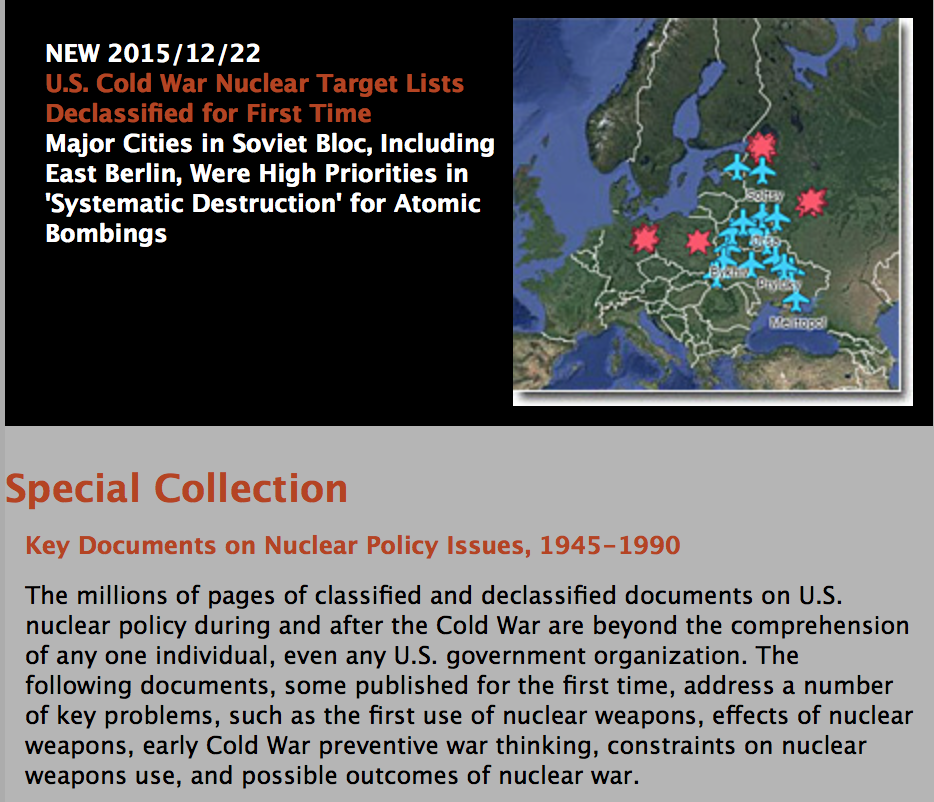
A recently released classified
Pentagon document (1959) confirms that during the Cold War, 1200 cities
extending from Eastern Europe to the Far East were targeted for systemic
destruction.

Source: National Security Archive
According to 1956 Plan, H-Bombs were to be Used Against
Priority “Air Power” Targets in the Soviet Union, China, and Eastern
Europe.
Major Cities in Soviet Bloc, Including East Berlin, Were High
Priorities in “Systematic Destruction” for Atomic Bombings. (William
Burr, U.S. Cold War Nuclear Attack Target List of 1200 Soviet Bloc
Cities “From East Germany to China”, National Security Archive Electronic Briefing Book No. 538, December 2015
 Excerpt of list of 1200 cities targeted for nuclear attack in alphabetical order.
 National Security Archive
Today’s List of Targeted Cities
This policy of nuclear bombing of targeted cities is still on the drawing board of the Pentagon.
While today’s list of targets remains classified, cities in Russia, China, the Middle East, North Korea are on the target list. An Associated Press report quoting Pentagon sources (June 4, 2015) confirms that:
The Pentagon has been actively considering the use of nuclear missiles against military targets inside Russia,
… Three options being considered by the Pentagon are the placement of
anti-missile defenses in Europe aimed at shooting Russian missiles out
of the sky; a “counterforce” option that would involve pre-emptive
non-nuclear strikes on Russia military sites; and finally,
“countervailing strike capabilities,” involving the pre-emptive
deployment of nuclear missiles against targets inside Russia.
The AP states: “The options go so far as one implied—but not stated explicitly—that would improve the ability of US nuclear weapons to destroy military targets on Russian territory.” In other words, the US is actively preparing nuclear war against Russia.
Robert Scher, one of Carter’s nuclear policy aides, told Congress in
April that the deployment of “counterforce” measures would mean “we
could go about and actually attack that missile where it is in Russia.”
According to other Pentagon officials, this option would entail the
deployment of ground-launched cruise missiles throughout Europe.
The criminality and recklessness of the foreign policy of Washington and its NATO allies is staggering. A
pre-emptive nuclear strike against Russian forces, many of them near
populated areas, could claim millions of lives in seconds and lead to a
nuclear war that would obliterate humanity.
Even assuming that the US officials threatening Russia do not
actually want such an outcome, however, and that they are only trying to
intimidate Moscow, there is a sinister objective logic to such
threats.” (Niles Williamson, Military Madness: US Officials Consider
Nuclear Strikes against Russia, World Socialist Website, June 5, 2015,
emphasis added)
Nuclear Tests Worldwide
Over 2000 Nuclear Tests have been conducted since 1945. Scroll down for video

Source: Wikipedia, click to enlarge
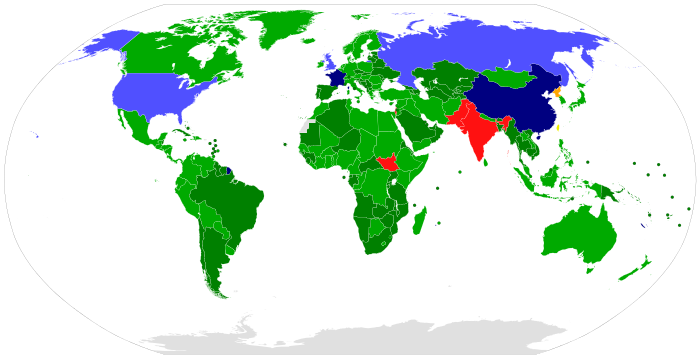
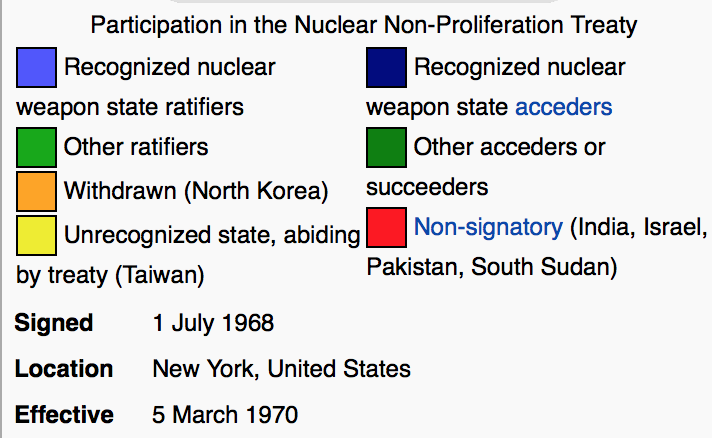
Undeclared Nuclear States under NNPT: India, Pakistan, Israel, DPRK


Source
Wikipedia
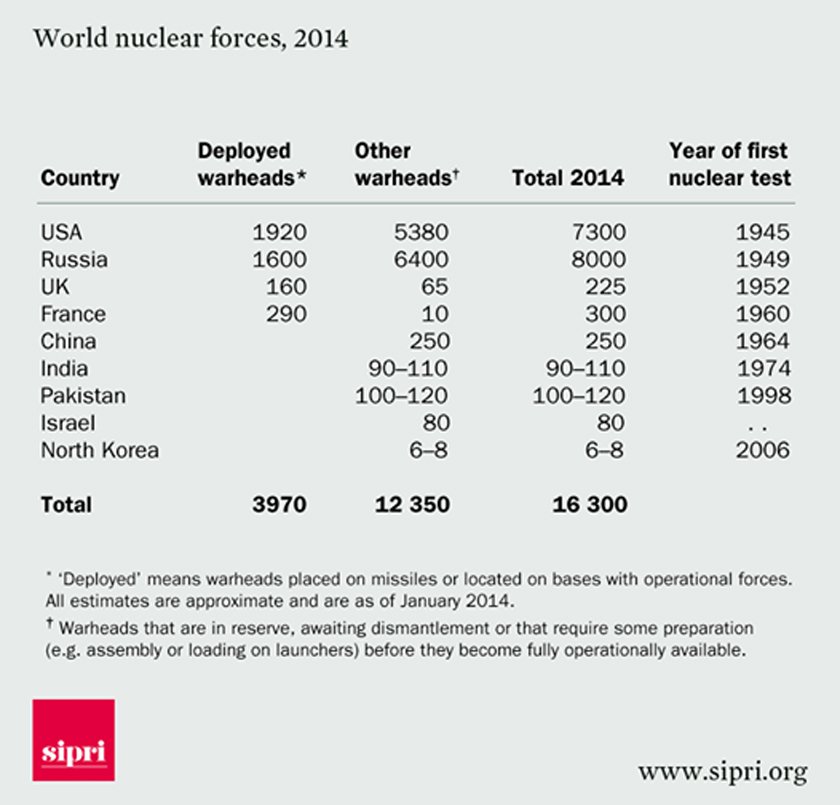
The Deployment of Nuclear Weapons by Nine Nuclear States

Source:
www.Sipri.org
Nuclear Sites in the US
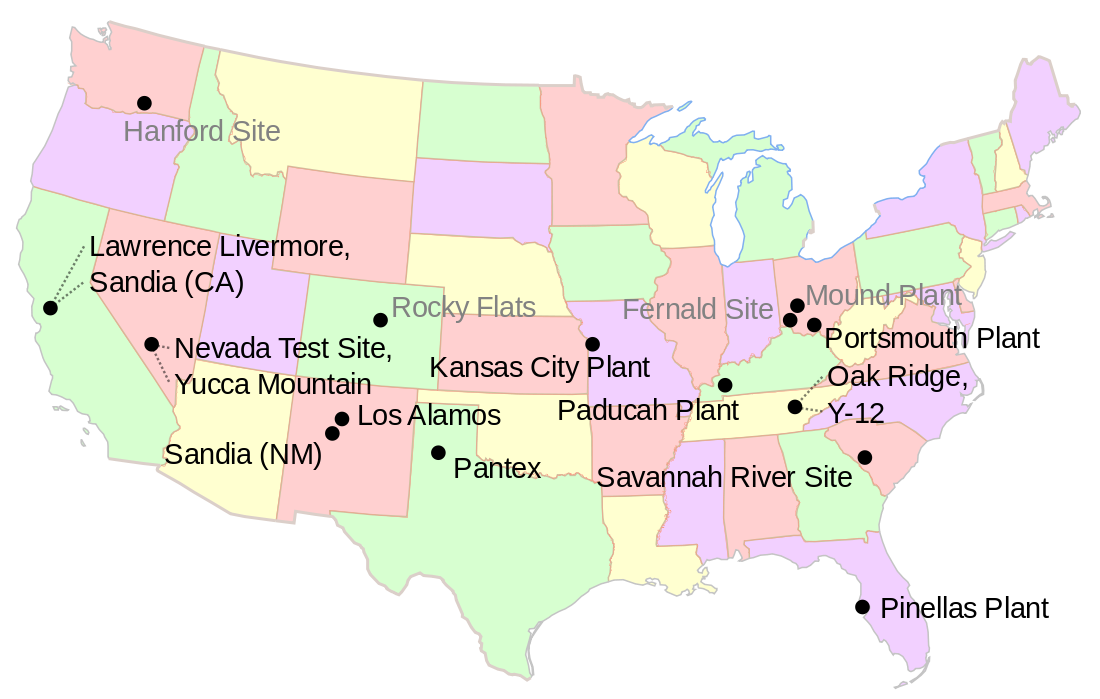
“Map of major U.S. nuclear weapons infrastructure sites during the
Cold War and into the present. Places with grayed-out names are no
longer functioning and are in various stages of environmental
remediation.” (Wikipedia). Scroll down for Google Map.

Source: Wikipedia

Source: Google Maps and
Daily Mail
‘The map was produced from data suppled by the Defense Department and nuclear watchdog groups.
It shows where the warheads are (in red on the map), where the
civilian nuclear power plants can be found (in green) and the location
of labs and nuclear weapons plants (in blue). Daily Mail
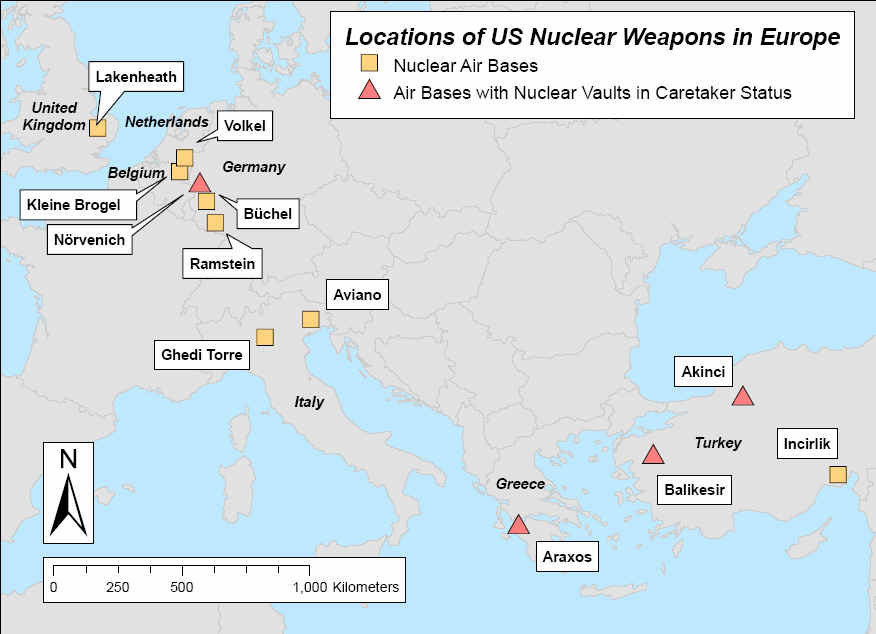
Five “Non-Nuclear States” (Netherlands, Belgium, Italy, Germany, Turkey)
Possess and Deploy Nuclear Weapons
Five non-nuclear states (Belgium, Netherlands, Germany, Italy,
Turkey) have deployed the B61 tactical (thermonuclear) against targets
in the Middle East and the Russian Federation.. The latest and more
advanced version is the B61-12, which is contemplated to replace the
older B61 version.

Source:
National Resources Defense Council, Nuclear Weapons in Europe , February 2005
Today’s Potential Targets for US Nuclear Attacks
Are countries in the Middle East potential targets for a nuclear
attack? (For further details, see Michel Chossudovsky, Dangerous
Crossroads: Is America Considering the Use of Nuclear Weapons against
Libya? Global Research, April 2011).
The tactical nuclear weapons were specifically developed for use in
post Cold War “conventional conflicts with third world nations”. In
October 2001, in the immediate wake of 9/11, Defense Secretary Donald
Rumsfeld
envisaged the use of the B61-11 tactical nuclear bomb in Afghanistan. The targets were Al Qaeda cave bunkers in the Tora Bora mountains.
Rumsfeld stated at the time that while the “conventional” bunker buster bombs “‘are going to be able to do the job’, …
he did not rule out the eventual use of nuclear weapons.” (Quoted in the Houston Chronicle, 20 October 2001, emphasis added.)
The use of the B61-11 was also contemplated during the 2003 bombing and invasion of
Iraq as well as in the 2011 NATO bombings of Libya.
In this regard, the B61-11 was described as “a precise,
earth-penetrating low-yield nuclear weapon against high-value
underground targets”, which included Saddam Hussein’s underground
bunkers:
”If Saddam was arguably the highest value target in
Iraq, then a good case could be made for using a nuclear weapon like the
B61-11 to assure killing him and decapitating the regime” (Defense
News, December 8, 2003).
The 1996 Plan to Nuke Libya
The B61-11 tactical nuclear weapon was slated by the Pentagon to be
used in 1996 against Libya: “Five months after [Assistant Defense
Secretary] Harold Smith called for an acceleration of the B61-11
production schedule, he went public with an assertion that the Air Force
would use the B61-11 [nuclear weapon] against Libya… “
(http://www.nukestrat.com/us/afn/B61-11.htm,)
“Senior Pentagon officials ignited controversy last April [1996] by suggesting that the
earth-penetrating [nuclear] weapon would soon be available for possible
use against a suspected underground chemical factory being built by
Libya at Tarhunah. (David Muller, Penetrator N-Bombs, International Action Center, 1997)
Tarbunah has a population of more than 200,000 people, men, women and
children. It is about 60 km East of Tripoli. Had this “humanitarian
bomb” (with a ”yield” or explosive capacity of two-thirds of a Hiroshima
bomb) been launched on this “suspected” WMD facility, it would have
resulted in tens of thousands of deaths, not to mention the nuclear
fallout… The man behind this diabolical project to nuke Libya was
Assistant Secretary of
Defense Harold Palmer Smith Junior. “Even before the B61 came on line, Libya was identified as a potential target”. (
Bulletin of the Atomic Scientists – September/ October 1997, p. 27 )
Concluding Remarks
Nuclear war –which threatens life on planet earth– is not front page
news in comparison to the most insignificant issues of public concern,
including the local level crime scene or the tabloid gossip reports on
Hollywood celebrities.
What we are dealing with is the criminalization of the State, whereby
officials in high office are complicit in fostering the pre-emptive use
of nuclear weapons. The media has camouflaged the implications of
America’s post Cold war nuclear doctrine, which was formulated in a
secret meeting at US Strategic Command Headquarters on Hiroshima Day,
August 6, 2003.
On August 6, 2003, on Hiroshima Day, commemorating when
the first atomic bomb was dropped on Hiroshima (August 6 1945), a secret
meeting was held behind closed doors at Strategic Command Headquarters
at the Offutt Air Force Base in Nebraska.
Senior executives from the nuclear industry and the military
industrial complex were in attendance. This mingling of defense
contractors, scientists and policy-makers was not intended to
commemorate Hiroshima. The meeting was intended to set the stage for the
development of a new generation of “smaller”, “safer” and “more usable”
nuclear weapons, to be used in the “in-theater nuclear wars” of the
21st Century.
In a cruel irony, the participants to this secret meeting, which
excluded members of Congress, arrived on the anniversary of the
Hiroshima bombing (August 6) and departed on the anniversary of the
attack on Nagasaki (August 9). (Michel Chossudovsky, Towards a World War III Scenario, The Dangers of Nuclear War, Global Research, Montreal, 2012)
The Hiroshima Day 2003 meetings had set the stage for the
“privatization of nuclear war”. Corporations not only reap
multibillion-dollar profits from the production of nuclear bombs, they
also have a direct voice in setting the agenda regarding the use and
deployment of nuclear weapons.
All the safeguards of the Cold War era, which categorized the nuclear
bomb as “a weapon of last resort”, have been scrapped. “Offensive”
military actions using nuclear warheads are now described as acts of
“self-defense”. During the Cold War, the doctrine of Mutually Assured
Destruction (MAD) prevailed, namely that the use of nuclear weapons
against the Soviet Union would result in “the destruction of both the
attacker and the defender”.
In the post Cold war era, US nuclear doctrine was redefined. There is
no sanity in what is euphemistically called US foreign policy.
At no point since the first atomic bomb was dropped on Hiroshima on August 6th, 1945, has humanity been closer to the unthinkable…
Stay informed, spread the word far and wide. To reverse the tide of
war, the broader public must be informed. Post on Facebook/Twitter.
Confront the war criminals in high office.
What we really need is real “Regime Change in America”.