Showing posts with label bomber. Show all posts

Friday, May 31, 2019

Russia Enlarges Her Nuclear Horn (Daniel 7)

U.S. Believes Russia Has Restarted Low-Yield Nuclear Tests

By Julian E. Barnes and William J. Broad

Ballistic missile systems were paraded through Red Square in Moscow during a Victory Day celebration this month. Russia may have restarted low-yield nuclear testing.Mladen Antonov/Agence France-Presse — Getty Images
WASHINGTON — The Trump administration believes Russia has restarted very low-yield nuclear tests, officials said on Wednesday in a finding that could be used to renew in earnest the arms race between Moscow and Washington.
But the significance of the statements by the director of the Defense Intelligence Agency and a senior National Security Council official was immediately debated by nuclear weapons experts.
Some experts said claims of low-yield tests would be nothing new. Intelligence officials and nuclear analysts in Washington have long raised the possibility of such violations going back nearly two decades, to when Russia ratified the Comprehensive Nuclear Test Ban Treaty in 2000.

Friday, May 24, 2019

Russia Ups the Nuclear Ante

RUSSIA SENDS NUCLEAR BOMBERS OFF U.S. COAST TWICE IN 2 DAYS, AIR FORCE RESPONDS

A Russian Tu-95 strategic bomber and missile carrier (top) is accompanied by a U.S. F-22 fighter jet in international airspace off the coast of Alaska, on May 22. The series of intercepts was the second of its kind in two days.PHOTO: NORTH AMERICAN AEROSPACE DEFENSE COMMAND
The Russian Defense Ministry said Wednesday in a statement that „two Tu-95MS strategic missile carriers of the Russian Aerospace Forces carried out planned flights in the airspace over the neutral waters of the Chukotka, Bering and Okhotsk seas, as well as along the western coast of Alaska and the northern coast of the Aleutian Islands.“ The statement was nearly identical to that of the previous day, when four Tu-95MSs took a similar route and were also „escorted by F-22 fighter jets of the USAF“ at certain points.
This time the flight took 11 hours, as opposed to more than 12 last time, but Moscow again maintained that „long-range pilots make regular flights over neutral waters of the Arctic, North Atlantic, Black and Caspian seas and Pacific Ocean“ and that this was „carried out in strict accordance with the International Airspace Management System without violating the borders of other states.“
And once again, the North American Aerospace Defense Command (NORAD) put out a statement that also noted the presence of Russian Su-35 fighter jets.
NORAD, which is the joint U.S.-Canadian organization that guards the skies over the northern stretch of North America that comprises the territory of the two allies, dispatched four F-22 fighter jets, accompanied by a KC-135 refueling aircraft and an E-3 airborne early warning and control aircraft. The entire incident took place in international airspace, over Alaska’s Air Defense Identification Zone (ADIZ).
„NORAD committed an additional two F-22s and E-3 to relieve the initial intercept aircraft. A KC-135 refueling aircraft supported both of NORAD’s intercept teams. The Russian aircraft remained in international airspace and at no time entered U.S. or Canadian sovereign airspace,“ it added.
As Newsweek noted in coverage of the previous day’s incident, such occurrences were not uncommon as the U.S. and Russian mainlands were within 55 miles of one another and the two countries actually shared a chain of Bering Sea islands known as the Aleutian Islands. In a follow-up tweet, NORAD noted that it „intercepted an avg of approx. six to seven Russian sorties entering its ADIZ since Russia resumed long range aviation patrols in 2007.“
„#WeHaveTheWatch,“ NORAD added, referring to a popular U.S. Navy slogan.
In yesterday’s series of tweets, NORAD cited Air Force General Terrence J. O’Shaughnessy, the head of the military’s Northern Command, as saying, „Our ability to deter and defeat threats to our citizens and vital infrastructure starts with detecting, tracking, and positively identifying aircraft in our airspace. We are on alert 24 hours a day, seven days a week, 365 days a year.“
In two separate incidents that took place weeks apart in March, Russian Su-27 fighter jets intercepted a U.S. RC-135 reconnaissance aircraft and a U.S. B-52H strategic bomber flying over the Baltic Sea, where forces belonging both to Moscow and the U.S.-led NATO Western military alliance were located.

Friday, December 7, 2018

Babylon the Great’s Nuclear Horn

This Pictures Should Terrify Russia, North Korea and China Like Nothing Else
The bomber’s weapons bay could end up being more of a mission payload bay, with surveillance, communications, drone or electronic warfare packages loaded inside to facilitate a variety of missions, particularly in denied environments. The Raider is on the path to being America’s first multirole bomber.
On October 27, 2015, nearly thirty-four years to the day after Northrop Grumman was awarded the contract to develop the first stealth bomber, the U.S. Air Force awarded Northrop a contract for a new bomber: the B-21 Raider. While many of the details of the Raider are shrouded in mystery, we do know a few things about it, and can infer others.
(This first appeared last year.)
The B-21 Raider bomber takes its name from both the twenty-first century and the legendary 1942 raid by Gen. James “Jimmy” Doolittle’s force of B-25 Mitchell bombers against targets in and around Tokyo, Japan. In invoking the Doolittle Raid, the Air Force is drawing attention to attack’s audacious nature, the strategic and tactical surprise, and the epic distances General Doolittle and his “raiders” flew to accomplish their mission.
A tailless, batlike aircraft, the official rendering of the B-21 Raider released by the Air Force bears a superficial resemblance to the B-2 Spirit bomber. There are important distinctions, however. The B-21 moves its engines closer to the wing root, where they occupy the juncture between wing and fuselage, whereas the B-2’s twin pairs of General Electric F118-GE-100 engines are distinctly apart from the fuselage on the wing. The Raider’s engine air intakes are angled and not serrated like those on the B-2 Spirit. The Raider also has overwing exhausts to mask the infrared signature of the four engines, unlike the B-2. (Interestingly, this is exactly how the B-2’s exhausts were depicted in an April 1988 artist’s conception of that bomber.)
The aircraft appears similar in size to the B-2 Spirit, almost certainly making it a four-engine bomber. The  announcement of Pratt and Whitney in 2016  as a B-21 subcontractor narrows down the new bomber’s engines to two designs: the F-100 and the F-135. The mature F-100, which powers the F-15 Eagle series of fighters, seems a sound choice, but the Air Force may want the F-135, which powers the F-35 Joint Strike Fighter, for its growth potential and ability to lower engine costs for the F-35 fleet.
Like its predecessor, the B-21 Raider will be a heavy strategic bomber designed to carry both nuclear and conventional weapons. If the B-2 is of similar size, it follows it will carry a similar amount of ordinance. This means two bomb bays. In order to keep costs down, the Air Force may elect to reuse the Advanced Applications Rotary Launcher from the B-2 bomber. The AARL is fitted one per bomb bay, each capable of carrying eight bombs or missiles.
In the nuclear mission, the Air Force will arm the B-21 with the Long-Range Stand-Off (LRSO) missile, the next-generation stealthy nuclear cruise missile. It will also carry B-61 free-fall nuclear gravity bombs, particularly the new  B61-12 bomb  with “dial-a-yield” capability. A combination of these two weapons will allow the B-21 to use its stealthy cruise missiles to clear a path through the enemy air-defense network before dropping B-61 bombs on primary and secondary targets.
For conventional missions, the B-21 will carry the  JASSM-ER conventional cruise missile  and two-thousand-pound  GBU-31 Joint Directed Attack Munition  satellite-guided bombs. The B-21 could use these weapons in a similar manner as its nuclear weapons, blasting its way through the enemy’s defenses before dropping JDAMs. Alternately, the B-21 could be used as a missile truck, launching up to sixteen JASSM-ERs at enemy targets from a distance, or penetrating less sophisticated enemy defenses to deliver JDAMs on target. The B-21 will also need to carry the thirty-thousand-pound  Massive Ordnance Penetrator bomb , the largest conventional bomb in the U.S. arsenal, as the B-2 is currently the only bomber capable of lifting the enormous bomb.
Like many new weapons systems, the Air Force has instructed Northrop Grumman to build the bomber with a so-called “open architecture” hardware and software system. As a result, unlike previous bombers, the B-21 could become much more than just a heavy bomber. The open-architecture specification should ensure that future upgrades will be relatively easy to integrate into the B-21, and for the bomber to adapt to a slew of new, different missions. The bomber’s weapons bay could end up being more of a mission payload bay, with surveillance, communications, drone or electronic warfare packages loaded inside to facilitate a variety of missions, particularly in denied environments. The Raider is on the path to being America’s first multirole bomber.
The B-21 Raider is set to fly in the mid-2020s, and the Air Force plans to buy at least a hundred of the bombers to replace the B-52H Stratofortress and B-1B Lancer bombers. A larger fleet of up to two hundred bombers is possible, but entirely bound to fiscal realities. We don’t know what the Raider in its final form will look like, or when the Air Force will release more information on an aircraft it wants to carefully protect. The B-21 has disappeared into the “black” world of military technology, and will only reemerge when the bomber is ready.
Kyle Mizokami is a defense and national-security writer based in San Francisco who has appeared in the  Diplomat, Foreign Policy, War is Boring  and the  Daily Beast.  In 2009 he cofounded the defense and security blog Japan Security Watch. You can follow him on Twitter:  @KyleMizokami.

Monday, October 9, 2017

The Futility of the Nuclear Peace Prize

The Long Nuclear History Behind the 2017 Nobel Peace Prize
Friday's announcement that the 2017 Nobel Peace Prize went to The International Campaign to Abolish Nuclear Weapons (ICAN) represents just the latest step in the long relationship between the Oslo-based Norwegian Nobel Committee and nuclear technology.
ICAN, which played a key role in the negotiations that led to the recent signing of the Treaty on the Prohibition of Nuclear Weapons at the United Nations, scored the prize in honor of "its work to draw attention to the catastrophic humanitarian consequences of any use of nuclear weapons and for its ground-breaking efforts to achieve a treaty-based prohibition of such weapons." It's the latest group of people involved in world nuclear-disarmament efforts to be recognized with the Nobel Peace Prize, an award that's also been presented to such advocates in 1959, 1962, 1974, 1982, 1985, 1990, 1995 and 2005.
But disarmament and non-proliferation are not the only parts of the nuclear past that have been recognized by the Nobel Committee.
In the first decades of the prize's existence, for obvious reasons, it was much more likely to see nuclear technology recognized in science categories, as awards went to those whose work would make nuclear weapons possible. A prominent example is the 1938 Nobel Prize in Physics, awarded to Enrico Fermi for work that led to the discovery of nuclear fission. He was a leader of the Manhattan Project, the American lab that produced nuclear weapons, and TIME called him "the world's foremost nuclear physicist" in 1945, while his New York Times obituary described him as "an architect of the atomic age." The Nobel Committee has given out more than 30 prizes honoring various research that enhances the study of nuclear activity, dating all the way back to 1903. (A list of such prizes up until 2000 can be found here.)
But as the science and implications of nuclear weapons started to be better understood — almost immediately from the time they were first used — efforts to regulate the use of them increased, and so did the Nobel Prizes on the other side.
In fact, in 1946, one year after the first wartime use of nuclear weapons, TIME noticed nuclear scientists were "conspicuously absent" from the list of lineup of honorees that year.
As the magazine pointed out, there was deep history behind that decision: Alfred Nobel is said to have endowed the Peace Prize specifically as "penance" for having introduced dynamite into the world; it would thus be "embarrassing" for the prize committee to honor the inventors of something being hailed as "super-dynamite."
Get your history fix in one place: sign up for the weekly TIME History newsletter
And so the Peace Prizes for disarmament activists began.
One of the earliest people to receive the Peace Prize for such efforts was Philip Noel-Baker, who won the 1959 Peace Prize in part for his visions for an international agreement to curb the spread of nukes, which was published in the manifesto The Arms Race: A Programme for World Disarmament.
In fact, it was Baker's work that inspired the American cardiologist Bernard Lown to start a group called International Physicians for the Prevention of Nuclear War (IPPNW), which was in turned recognized with a Nobel in 1985. "His views had a profound intellectual impact on me," Lown told People in 1985. "He spelled out the consequences of nuclear war like some ancient Hebrew prophet." And IPPNW would, in turn, launch ICAN, this year's winner.
The Peace Prize has also gone to people who have tried to keep the peace as world leaders and diplomats. For example, Eisaku Sato, former prime minister of Japan, won in 1974 for maintaining that his country shouldn't have nukes and for having signed, on behalf of the nation, the nuclear arms Non-Proliferation Treaty (NPT). That treaty, which went into effect in 1970, has been described by the United Nations as "the only binding commitment in a multilateral treaty to the goal of disarmament by the nuclear-weapon States." And in 1990, Soviet leader Mikhail Gorbachev got the prize for his role in landmark treaties designed to reduce arms supplies instead of just capping them.
And yet, the work of activists did not stop the spread of nuclear weapons. As TIME noted in a feature on the diplomats who shared the 1982 prize for their work on disarmament, it was awarded at a time when the world had amassed nearly 5,000 intercontinental ballistic missile launchers, up from 500 in 1962.
The organization says it will continue to honor those who work to ensure peace in the atomic age, frankly, for "as long as the risks of nuclear proliferation and nuclear war continue to exist."

Saturday, September 30, 2017

Awaiting the Bowls of Wrath (Revelation 15)

https://blogger.googleusercontent.com/img/b/R29vZ2xl/AVvXsEh5u1hoPrIficzHeuF-s9fZA88rjQG_CVefjlhyphenhyphen0X_A3yvzlFcKtfvRRwpaLTMW634oGTvCNwCqn5B4udqJZ6puCwVxKGbU4Auqev9DBQX4rOkkVHOJC5DdQ9C-nWXExVNpDClkouYYI7w/s1600/The+Divide.jpgThe effects of a single terrorist nuclear bomb
Bulletin of the Atomic Scientists
Matthew BunnNickolas Roth
The escalating threats between North Korea and the United States make it easy to forget the “nuclear nightmare,” as former US Secretary of Defense William J. Perry put it, that could result even from the use of just a single terrorist nuclear bomb in the heart of a major city.
At the risk of repeating the vast literature on the tragedies of Hiroshima and Nagasaki—and the substantial literature surrounding nuclear tests and simulations since then—we attempt to spell out here the likely consequences of the explosion of a single terrorist nuclear bomb on a major city, and its subsequent ripple effects on the rest of the planet. Depending on where and when it was detonated, the blast, fire, initial radiation, and long-term radioactive fallout from such a bomb could leave the heart of a major city a smoldering radioactive ruin, killing tens or hundreds of thousands of people and wounding hundreds of thousands more. Vast areas would have to be evacuated and might be uninhabitable for years. Economic, political, and social aftershocks would ripple throughout the world. A single terrorist nuclear bomb would change history. The country attacked—and the world—would never be the same.
The idea of terrorists accomplishing such a thing is, unfortunately, not out of the question; it is far easier to make a crude, unsafe, unreliable nuclear explosive that might fit in the back of a truck than it is to make a safe, reliable weapon of known yield that can be delivered by missile or combat aircraft. Numerous government studies have concluded that it is plausible that a sophisticated terrorist group could make a crude bomb if they got the needed nuclear material. And in the last quarter century, there have been some 20 seizures of stolen, weapons-usable nuclear material, and at least two terrorist groups have made significant efforts to acquire nuclear bombs.
Terrorist use of an actual nuclear bomb is a low-probability event—but the immensity of the consequences means that even a small chance is enough to justify an intensive effort to reduce the risk. Fortunately, since the early 1990s, countries around the world have significantly reduced the danger—but it remains very real, and there is more to do to ensure this nightmare never becomes reality.
Brighter than a thousand suns. Imagine a crude terrorist nuclear bomb—containing a chunk of highly enriched uranium just under the size of a regulation bowling ball, or a much smaller chunk of plutonium—suddenly detonating inside a delivery van parked in the heart of a major city. Such a terrorist bomb would release as much as 10 kilotons of explosive energy, or the equivalent of 10,000 tons of conventional explosives, a volume of explosives large enough to fill all the cars of a mile-long train. In a millionth of a second, all of that energy would be released inside that small ball of nuclear material, creating temperatures and pressures as high as those at the center of the sun. That furious energy would explode outward, releasing its energy in three main ways: a powerful blast wave; intense heat; and deadly radiation.
The ball would expand almost instantly into a fireball the width of four football fields, incinerating essentially everything and everyone within. The heated fireball would rise, sucking in air from below and expanding above, creating the mushroom cloud that has become the symbol of the terror of the nuclear age. The ionized plasma in the fireball would create a localized electromagnetic pulse more powerful than lightning, shorting out communications and electronics nearby—though most would be destroyed by the bomb’s other effects in any case. (Estimates of heat, blast, and radiation effects in this article are drawn primarily from Alex Wellerstein’s “Nukemap,” which itself comes from declassified US government data, such as the government textbook The Effects of Nuclear Weapons.)
At the instant of its detonation, the bomb would also release an intense burst of gamma and neutron radiation which would be lethal for nearly everyone directly exposed within about two-thirds of a mile from the center of the blast. (Those who happened to be shielded by being inside, or having buildings between them and the bomb, would be partly protected—in some cases, reducing their doses by ten times or more.)
The nuclear flash from the heat of the fireball would radiate in both visible light and the infrared; it would be “brighter than a thousand suns,” in the words of the title of a book describing the development of nuclear weapons—adapting a phrase from the Hindu epic the Bhagavad-Gita. Anyone who looked directly at the blast would be blinded. The heat from the fireball would ignite fires and horribly burn everyone exposed outside at distances of nearly a mile away. (In the Nagasaki Atomic Bomb Museum, visitors gaze in horror at the bones of a human hand embedded in glass melted by the bomb.)
No one has burned a city on that scale in the decades since World War II, so it is difficult to predict the full extent of the fire damage that would occur from the explosion of a nuclear bomb in one of today’s cities. Modern glass, steel, and concrete buildings would presumably be less flammable than the wood-and-rice-paper housing of Hiroshima or Nagasaki in the 1940s—but many questions remain, including exactly how thousands of broken gas lines might contribute to fire damage (as they did in Dresden during World War II). On 9/11, the buildings of the World Trade Center proved to be much more vulnerable to fire damage than had been expected. Ultimately, even a crude terrorist nuclear bomb would carry the possibility that the countless fires touched off by the explosion would coalesce into a devastating firestorm, as occurred at Hiroshima. In a firestorm, the rising column of hot air from the massive fire sucks in the air from all around, creating hurricane-force winds; everything flammable and everything alive within the firestorm would be consumed. The fires and the dust from the blast would make it extremely difficult for either rescuers or survivors to see.
The explosion would create a powerful blast wave rushing out in every direction. For more than a quarter-mile all around the blast, the pulse of pressure would be over 20 pounds per square inch above atmospheric pressure (known as “overpressure”), destroying or severely damaging even sturdy buildings. The combination of blast, heat, and radiation would kill virtually everyone in this zone. The blast would be accompanied by winds of many hundreds of miles per hour.
The damage from the explosion would extend far beyond this inner zone of almost total death. Out to more than half a mile, the blast would be strong enough to collapse most residential buildings and create a serious danger that office buildings would topple over, killing those inside and those in the path of the rubble. (On the other hand, the office towers of a modern city would tend to block the blast wave in some areas, providing partial protection from the blast, as well as from the heat and radiation.) In that zone, almost anything made of wood would be destroyed: Roofs would cave in, windows would shatter, gas lines would rupture. Telephone poles, street lamps, and utility lines would be severely damaged. Many roads would be blocked by mountains of wreckage. In this zone, many people would be killed or injured in building collapses, or trapped under the rubble; many more would be burned, blinded, or injured by flying debris. In many cases, their charred skin would become ragged and fall off in sheets.
The effects of the detonation would act in deadly synergy. The smashed materials of buildings broken by the blast would be far easier for the fires to ignite than intact structures. The effects of radiation would make it far more difficult for burned and injured people to recover. The combination of burns, radiation, and physical injuries would cause far more death and suffering than any one of them would alone.
The silent killer. The bomb’s immediate effects would be followed by a slow, lingering killer: radioactive fallout. A bomb detonated at ground level would dig a huge crater, hurling tons of earth and debris thousands of feet into the sky. Sucked into the rising fireball, these particles would mix with the radioactive remainders of the bomb, and over the next few hours or days, the debris would rain down for miles downwind. Depending on weather and wind patterns, the fallout could actually be deadlier and make a far larger area unusable than the blast itself. Acute radiation sickness from the initial radiation pulse and the fallout would likely affect tens of thousands of people. Depending on the dose, they might suffer from vomiting, watery diarrhea, fever, sores, loss of hair, and bone marrow depletion. Some would survive; some would die within days; some would take months to die. Cancer rates among the survivors would rise. Women would be more vulnerable than men—children and infants especially so.
Much of the radiation from a nuclear blast is short-lived; radiation levels even a few days after the blast would be far below those in the first hours. For those not killed or terribly wounded by the initial explosion, the best advice would be to take shelter in a basement for at least several days. But many would be too terrified to stay. Thousands of panic-stricken people might receive deadly doses of radiation as they fled from their homes. Some of the radiation will be longer-lived; areas most severely affected would have to be abandoned for many years after the attack. The combination of radioactive fallout and the devastation of nearly all life-sustaining infrastructure over a vast area would mean that hundreds of thousands of people would have to evacuate.
Ambulances to nowhere. The explosion would also destroy much of the city’s ability to respond. Hospitals would be leveled, doctors and nurses killed and wounded, ambulances destroyed. (In Hiroshima, 42 of 45 hospitals were destroyed or severely damaged, and 270 of 300 doctors were killed.) Resources that survived outside the zone of destruction would be utterly overwhelmed. Hospitals have no ability to cope with tens or hundreds of thousands of terribly burned and injured people all at once; the United States, for example, has 1,760 burn beds in hospitals nationwide, of which a third are available on any given day.
And the problem would not be limited to hospitals; firefighters, for example, would have little ability to cope with thousands of fires raging out of control at once. Fire stations and equipment would be destroyed in the affected area, and firemen killed, along with police and other emergency responders. Some of the first responders may become casualties themselves, from radioactive fallout, fire, and collapsing buildings. Over much of the affected area, communications would be destroyed, by both the physical effects and the electromagnetic pulse from the explosion.
Better preparation for such a disaster could save thousands of lives—but ultimately, there is no way any city can genuinely be prepared for a catastrophe on such a historic scale, occurring in a flash, with zero warning. Rescue and recovery attempts would be impeded by the destruction of most of the needed personnel and equipment, and by fire, debris, radiation, fear, lack of communications, and the immense scale of the disaster. The US military and the national guard could provide critically important capabilities—but federal plans assume that “no significant federal response” would be available for 24-to-72 hours. Many of those burned and injured would wait in vain for help, food, or water, perhaps for days.
The scale of death and suffering. How many would die in such an event, and how many would be terribly wounded, would depend on where and when the bomb was detonated, what the weather conditions were at the time, how successful the response was in helping the wounded survivors, and more. Many estimates of casualties are based on census data, which reflect where people sleep at night; if the attack occurred in the middle of a workday, the numbers of people crowded into the office towers at the heart of many modern cities would be far higher. The daytime population of Manhattan, for example, is roughly twice its nighttime population; in Midtown on a typical workday, there are an estimated 980,000 people per square mile. A 10-kiloton weapon detonated there might well kill half a million people—not counting those who might die of radiation sickness from the fallout. (These effects were analyzed in great detail in the Rand Corporation’s Considering the Effects of a Catastrophic Terrorist Attack and the British Medical Journal’s “Nuclear terrorism.”)
On a typical day, the wind would blow the fallout north, seriously contaminating virtually all of Manhattan above Gramercy Park; people living as far away as Stamford, Connecticut would likely have to evacuate.
Seriously injured survivors would greatly outnumber the dead, their suffering magnified by the complete inadequacy of available help. The psychological and social effects—overwhelming sadness, depression, post-traumatic stress disorder, myriad forms of anxiety—would be profound and long-lasting.
The scenario we have been describing is a groundburst. An airburst—such as might occur, for example, if terrorists put their bomb in a small aircraft they had purchased or rented—would extend the blast and fire effects over a wider area, killing and injuring even larger numbers of people immediately. But an airburst would not have the same lingering effects from fallout as a groundburst, because the rock and dirt would not be sucked up into the fireball and contaminated. The 10-kiloton blast we have been discussing is likely toward the high end of what terrorists could plausibly achieve with a crude, improvised bomb, but even a 1-kiloton blast would be a catastrophic event, having a deadly radius between one-third and one-half that of a 10-kiloton blast.
These hundreds of thousands of people would not be mere statistics, but countless individual stories of loss—parents, children, entire families; all religions; rich and poor alike—killed or horribly mutilated. Human suffering and tragedy on this scale does not have to be imagined; it can be remembered through the stories of the survivors of the US atomic bombings of Hiroshima and Nagasaki, the only times in history when nuclear weapons have been used intentionally against human beings. The pain and suffering caused by those bombings are almost beyond human comprehension; the eloquent testimony of the Hibakusha—the survivors who passed through the atomic fire—should stand as an eternal reminder of the need to prevent nuclear weapons from ever being used in anger again.
Global economic disaster. The economic impact of such an attack would be enormous. The effects would reverberate for so far and so long that they are difficult to estimate in all their complexity. Hundreds of thousands of people would be too injured or sick to work for weeks or months. Hundreds of thousands more would evacuate to locations far from their jobs. Many places of employment would have to be abandoned because of the radioactive fallout. Insurance companies would reel under the losses; but at the same time, many insurance policies exclude the effects of nuclear attacks—an item insurers considered beyond their ability to cover—so the owners of thousands of buildings would not have the insurance payments needed to cover the cost of fixing them, thousands of companies would go bankrupt, and banks would be left holding an immense number of mortgages that would never be repaid.
Consumer and investor confidence would likely be dramatically affected, as worried people slowed their spending. Enormous new homeland security and military investments would be very likely. If the bomb had come in a shipping container, the targeted country—and possibly others—might stop all containers from entering until it could devise a system for ensuring they could never again be used for such a purpose, throwing a wrench into the gears of global trade for an extended period. (And this might well occur even if a shipping container had not been the means of delivery.)
Even the far smaller 9/11 attacks are estimated to have caused economic aftershocks costing almost $1 trillion even excluding the multi-trillion-dollar costs of the wars that ensued. The cost of a terrorist nuclear attack in a major city would likely be many times higher.
The most severe effects would be local, but the effects of trade disruptions, reduced economic activity, and more would reverberate around the world. Consequently, while some countries may feel that nuclear terrorism is only a concern for the countries most likely to be targeted—such as the United States—in reality it is a threat to everyone, everywhere. In 2005, then-UN Secretary-General Kofi Annan warned that these global effects would push “tens of millions of people into dire poverty,” creating “a second death toll throughout the developing world.” One recent estimate suggested that a nuclear attack in an urban area would cause a global recession, cutting global Gross Domestic Product by some two percent, and pushing an additional 30 million people in the developing world into extreme poverty.
Desperate dilemmas. In short, an act of nuclear terrorism could rip the heart out of a major city, and cause ripple effects throughout the world. The government of the country attacked would face desperate decisions: How to help the city attacked? How to prevent further attacks? How to respond or retaliate?
Terrorists—either those who committed the attack or others—would probably claim they had more bombs already hidden in other cities (whether they did or not), and threaten to detonate them unless their demands were met. The fear that this might be true could lead people to flee major cities in a large-scale, uncontrolled evacuation. There is very little ability to support the population of major cities in the surrounding countryside. The potential for widespread havoc and economic chaos is very real.
If the detonation took place in the capital of the nation attacked, much of the government might be destroyed. A bomb in Washington, D.C., for example, might kill the President, the Vice President, and many of the members of Congress and the Supreme Court. (Having some plausible national leader survive is a key reason why one cabinet member is always elsewhere on the night of the State of the Union address.) Elaborate, classified plans for “continuity of government” have already been drawn up in a number of countries, but the potential for chaos and confusion—if almost all of a country’s top leaders were killed—would still be enormous. Who, for example, could address the public on what the government would do, and what the public should do, to respond? Could anyone honestly assure the public there would be no further attacks? If they did, who would believe them? In the United States, given the practical impossibility of passing major legislation with Congress in ruins and most of its members dead or seriously injured, some have argued for passing legislation in advance giving the government emergency powers to act—and creating procedures, for example, for legitimately replacing most of the House of Representatives. But to date, no such legislative preparations have been made.
In what would inevitably be a desperate effort to prevent further attacks, traditional standards of civil liberties might be jettisoned, at least for a time—particularly when people realized that the fuel for the bomb that had done such damage would easily have fit in a suitcase. Old rules limiting search and surveillance could be among the first to go. The government might well impose martial law as it sought to control the situation, hunt for the perpetrators, and find any additional weapons or nuclear materials they might have. Even the far smaller attacks of 9/11 saw the US government authorizing torture of prisoners and mass electronic surveillance.
And what standards of international order and law would still hold sway? The country attacked might well lash out militarily at whatever countries it thought might bear a portion of responsibility. (A terrifying description of the kinds of discussions that might occur appeared in Brian Jenkins’ book, Will Terrorists Go Nuclear?) With the nuclear threshold already crossed in this scenario—at least by terrorists—it is conceivable that some of the resulting conflicts might escalate to nuclear use. International politics could become more brutish and violent, with powerful states taking unilateral action, by force if necessary, in an effort to ensure their security. After 9/11, the United States led the invasions of two sovereign nations, in wars that have since cost hundreds of thousands of lives and trillions of dollars, while plunging a region into chaos. Would the reaction after a far more devastating nuclear attack be any less?
In particular, the idea that each state can decide for itself how much security to provide for nuclear weapons and their essential ingredients would likely be seen as totally unacceptable following such an attack. Powerful states would likely demand that others surrender their nuclear material or accept foreign troops (or other imposed security measures) to guard it.
That could well be the first step toward a more profound transformation of the international system. After such a catastrophe, major powers may feel compelled to more freely engage in preventive war, seizing territories they worry might otherwise be terrorist safe havens, and taking other steps they see as brutal but necessary to preserve their security. For this reason, foreign policy analyst Stephen Krasner has argued that “conventional rules of sovereignty would be abandoned overnight.” Confidence in both the national security institutions of the country attacked and international institutions such as the International Atomic Energy Agency and the United Nations, which had so manifestly failed to prevent the devastation, might erode. The effect on nuclear weapons policies is hard to predict: One can imagine new nuclear terror driving a new push for nuclear disarmament, but one could also imagine states feeling more certain than ever before that they needed nuclear weapons.
Prevention: The essential remedy. Given the horrifying consequences of such an event, while there is certainly a need to be better prepared to respond, the primary focus must be on prevention. Fortunately, there is good news on this front. To date, there is no evidence that nuclear weapons or the materials needed to make them have ever fallen into the hands of a terrorist group; even large and sophisticated terrorist groups that have tried to get nuclear weapons have failed to do so; and the international community has taken a wide range of actions over the past quarter-century (and particularly over the 2010-2016 period of the nuclear security summits) that have drastically improved the security measures for nuclear weapons and materials around the world.
Nevertheless, while the chance of such a nightmare unfolding is probably small, it is certainly not small enough to justify complacency. Al Qaeda had a focused effort to acquire nuclear weapons that reported directly to Ayman al-Zawahiri, now the group’s leader, and included multiple attempts to get nuclear material and recruit nuclear expertise; Al Qaeda progressed as far as carrying out crude conventional explosive tests for their bomb program in the Afghan desert. The Japanese terror cult Aum Shinrikyo—the group that launched nerve gas attacks in the Tokyo subway in 1995— also pursued nuclear weapons. To date, there are only hints of nuclear interest from the Islamic State, but if it did turn to nuclear pursuits, even with the imminent defeat of its geographic caliphate in Iraq and Syria, it still has more money, people, and ability to recruit experts globally than most past terrorist groups, raising a serious concern. With at least two terrorist groups having pursued nuclear weapons over the past quarter-century, and possibly more, it is unlikely they will be the last.
Moreover, the past seizures of stolen weapons-usable nuclear material demonstrate that nuclear security failures have occurred at some point in the past. While nuclear security has improved dramatically in many countries in the past quarter-century, the possibility that terrorists could get the essential ingredients of a nuclear bomb still cannot be ruled out.
What then, must be done? First, major efforts are needed to recover some of the momentum imparted to nuclear security programs by the now-completed nuclear security summit process, revitalizing efforts to address remaining weaknesses. Second, because nuclear security is unlikely to be perfect, other layers of defense are needed to cope with nuclear material that has already been stolen, including stronger anti-nuclear smuggling efforts (especially national police and intelligence teams), better intelligence focused on nuclear smuggling, beefed-up interdiction abilities if intelligence identifies where such items are located, and improved means of detecting efforts to bring a nuclear weapon or its pieces into major cities. Third, deterrence can play a part, particularly in convincing states never to consciously provide nuclear weapons or materials to terrorists —and toward that end, continued investments in nuclear forensics capabilities are needed, to help identify where nuclear material might have come from. Fourth, more intelligence effort—and more international intelligence cooperation—is needed that is targeted on identifying and stopping terrorist plots aimed at nuclear terrorism, and dismantling groups that may harbor such ambitions.
No one knows what the real probability of nuclear terrorism is. It may well be quite low. There is no need for panic, which is exactly what terrorists have sought to achieve by repeatedly claiming to have nuclear weapons. But there is a need for prudent, focused action. Given the scale of the consequences, the countries of the world have an obligation to do everything in their power to ensure that the dark day after a terrorist nuclear blast never comes.

Thursday, September 21, 2017

The Fallacy of a Nuclear Treaty (Revelation 15)


With the North Korean nuclear crisis looming large, 51 countries on Wednesday lined up to sign a new treaty outlawing nuclear weapons that has been fiercely opposed by the United States and other nuclear powers.
The treaty was adopted by 122 countries at the United Nations in July following negotiations led by Austria, Brazil, Mexico, South Africa and New Zealand.
None of the nine countries that possess nuclear weapons - the United States, Russia, Britain, China, France, India, Pakistan, North Korea and Israel - took part in the negotiations.
NATO condemned the treaty, saying that it may in fact be counter-productive by creating divisions.
As leaders formally signed on the sidelines of the annual UN General Assembly, Secretary-General Antonio Guterres hailed as historic the first multilateral disarmament treaty in more than two decades.
But Guterres acknowledged that much work was needed to rid the world of its stockpile of 15,000 atomic warheads.
"Today we rightfully celebrate a milestone. Now we must continue along the hard road towards the elimination of nuclear arsenals," said Guterres.
The treaty will enter into force when 50 countries have signed and ratified it, a process that could take months or years.
"At a time when the world needs to remain united in the face of growing threats, in particular the grave threat posed by North Korea's nuclear program, the treaty fails to take into account these urgent security challenges," the 29-nation Western alliance said.
It added: "Seeking to ban nuclear weapons through a treaty that will not engage any state actually possessing nuclear weapons will not be effective, will not reduce nuclear arsenals, and will neither enhance any country's security, nor international peace and stability.
Rejecting need for nuclear weapons
Foreign Minister Sebastian Kurz of Austria, one of the few Western European nations that is not in NATO, rejected the idea that nuclear weapons were indispensable for security.
"If you look at the world's current challenges, this narrative is not only false, it is dangerous," he told AFP.
"The new treaty on the prohibition on nuclear weapons provides a real alternative for security: a world without any nuclear weapons, where everyone is safer, where no one needs to possess these weapons," he said.
Brazilian President Michel Temer was the first to sign the treaty. Others included South African President Jacob Zuma and representatives from Indonesia, Ireland and Malaysia as well as the Palestinian Authority and the Vatican.
But even Japan, the only nation to have suffered atomic attack and a longstanding advocate of abolishing nuclear weapons, boycotted the treaty negotiations.
Japan is a top target of North Korea, which has triggered global alarm over its rapidly progressing drive to develop nuclear weapons, following its sixth and most powerful nuclear test and the firing of two intercontinental ballistic missiles.
The signing ceremony came a day after President Donald Trump threatened to "totally destroy North Korea" if the United States is forced to defend itself or its allies Japan and South Korea.
Nuclear powers argue their arsenals serve as a deterrent against a nuclear attack and say they remain committed to the nuclear Non-Proliferation Treaty.
That decades-old treaty seeks to prevent the spread of nuclear weapons. It recognizes the right of five nations - Britain, China, France, Russia and the United States - to maintain them, while encouraging them to reduce their stockpiles.

Wednesday, July 12, 2017

Celebrating for Nothing (Revelation 15)


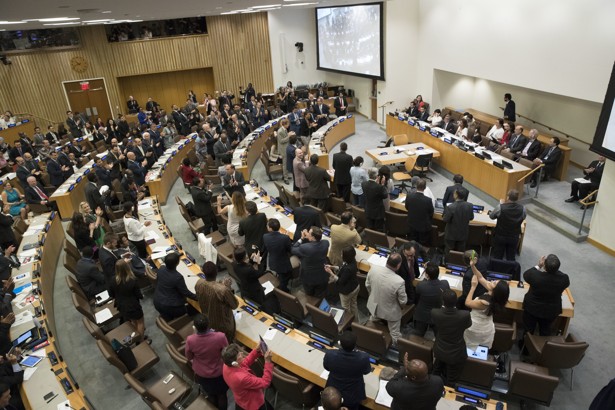
http://leftopia.org/wp-content/uploads/2017/07/Nuclear-powers-rebuked-as-122-nations-adopt-U.N.-ban-696x365.jpgCelebration as UN adopts historic nuclear weapons ban
Tim Wright
For more than seven decades, the international community has grappled with the threat of nuclear weapons. At the United Nations on Friday, July 7th, the vast majority of the world’s governments made clear their total rejection of these abhorrent devices, concluding a treaty to prohibit them, categorically, for all time. It was a moment of great historical significance.
Prolonged applause broke out as the president of the negotiating conference, Costa Rican ambassador Elayne Whyte Gomez, gavelled through the landmark accord. “We have managed to sow the first seeds of a world free of nuclear weapons,” she said. Diplomats and campaigners who had worked tirelessly over many years to make the treaty a reality embraced in celebration of the extraordinary achievement.
Setsuko Thurlow, a survivor of the atomic bombing of Hiroshima and long-time champion of disarmament, became overwhelmed with emotion as she welcomed the formal adoption of the treaty, backed by 122 nations. She asked delegates to pause to feel the witness of those who perished in 1945 or died later from radiation-related illnesses. She was a 13-year-old schoolgirl when hell descended on earth.
“Each person who died had a name. Each person was loved by someone,” she told the crowded conference room. “I’ve been waiting for this day for seven decades, and I am overjoyed that it has finally arrived. This is the beginning of the end of nuclear weapons.” She urged nations never to return to the failed policy of nuclear deterrence, and never to return to funding nuclear violence instead of meeting human needs.
The treaty recognizes the harm suffered both from nuclear weapons use and the two-thousand-plus nuclear test explosions that have been conducted across the globe since 1945. It obliges nations to provide assistance to the victims of these heinous acts. Its overriding mission, as reflected in the preamble, is to ensure that no one else ever suffers as they have.
Abacca Anjain-Maddison, from the Marshall Islands—a Pacific nation devastated by US nuclear testing in the 1940s and 1950s—delivered a powerful closing statement on behalf of the International Campaign to Abolish Nuclear Weapons, whose 400 non-governmental organizations in 100 nations worked for more than a decade to bring about the treaty.
“The adoption of this landmark agreement today fills us with hope that the mistakes of the past will never be repeated,” she said, emphasizing the special meaning that it has for those who have suffered nuclear harm. “The international community has at last acknowledged what we have always known: that nuclear weapons are abhorrent and immoral.”
Governments, too, delivered impassioned statements in celebration of the treaty’s adoption. Among them was South Africa, which played a pivotal role during the negotiations and is the only nation to have built a nuclear arsenal before eliminating it completely. “Working hand in hand with civil society, [we] took an extraordinary step [today] to save humanity from the frightful specter of nuclear weapons,” its ambassador, Nozipho Mxakato-Diseko, said. “For us, as a country, it was a duty to vote ‘yes’ for this treaty … to have voted ‘no’ would have been a slap in the face to the victims of Hiroshima and Nagasaki.”
One nation participating in ban negotations, the Netherlands—which hosts US nuclear weapons on its territory—did opt to vote against the treaty. Its government opposes meaningful disarmament efforts, despite overwhelming public support.
All nine nuclear-armed nations boycotted the negotiations, and therefore were absent for the vote. Some had exerted great pressure on other nations not to participate. But ultimately they failed to thwart the process. The commitment and resolve of the international community to declare nuclear weapons illegal was evident from the beginning of negotiations.
The treaty prohibits its state parties from developing, testing, producing, manufacturing, transferring, possessing, stockpiling, using, or threatening to use nuclear weapons. It also prohibits them from assisting, encouraging, or inducing anyone to engage in any of those activities, and they must not permit nuclear weapons to be stationed on their territory.
A nation that possesses nuclear weapons may join the treaty, so long as it agrees to remove them from operational status immediately and destroy them in accordance with a legally binding, time-bound plan. One that hosts another nation’s nuclear weapons on its territory may also join the treaty on condition that it will remove them by a specified deadline.
The treaty will open for signature in New York on September 20th, when world leaders meet for the annual opening of the UN General Assembly. “If you love this planet, you will sign this treaty,” said Setsuko Thurlow. Fifty nations will need to ratify it before it can enter into full legal force. Much work will then be needed to ensure that it is implemented and becomes universal.
With close to 15,000 nuclear weapons remaining in the world—and efforts underway in all nuclear-armed nations to bolster their arsenals—the ultimate goal of eliminating this paramount threat to humanity is far from being realized. But now, the United Nations has established the foundations for making a nuclear-weapon-free world possible.
The treaty establishes a powerful norm that, many expect, will prove transformative. It closes a major gap in international law. Nuclear weapons—like other indiscriminate weapons, including biological and chemical weapons, anti-personnel landmines and cluster munitions—are now categorically and permanently banned.
This post is part of Ban Brief, a series of updates on the historic 2017 negotiations to create a treaty banning nuclear weapons. Ban Brief is written by Tim Wright, Asia-Pacific director of the International Campaign to Abolish Nuclear Weapons, and Ray Acheson, director of Reaching Critical Will.

Monday, July 10, 2017

Too Little Too Late (Revelation 15)

More than 120 nations adopted the first international treaty banning nuclear weapons on Friday at the United Nations headquarters in New York City. The initiative—led by Austria, Brazil, Mexico, South Africa, and New Zealand—was approved by 122 votes, with only the Netherlands opposed, and Singapore abstaining. The nine countries generally recognized as possessing nuclear weapons—the U.S., Russia, Britain, China, France, India, Pakistan, North Korea, and Israel—were noticeably absent from the negotiations, as were most members of NATO.
Despite being a victim of atomic attacks in 1945, Japan also boycotted the meeting. Nevertheless, the bombings of Hiroshima and Nagasaki informed Friday’s dialogue—and the conversation thereafter. “It’s been seven decades since the world knew the power of destruction of nuclear weapons,” the president of the UN conference, Elayne Whyte Gómez, told The Guardian. The agreement, she added, “is a very clear statement that the international community wants to move to a completely different security paradigm that does not include nuclear weapons.”
Friday’s ten-page treaty is extensive in its demands, prohibiting signatories from developing, testing, manufacturing, possessing, or threatening to use nuclear weapons. Nations are also prohibited from transferring nuclear weapons to one another. Having now been approved by the UN, the treaty will be open for signatures on September 20, at which point it will need to be ratified by 50 states before entering into international law.The major obstacle, of course, is that many prominent members of the international community—and their allies—remain vocally opposed. In a joint statement on Friday, the UN ambassadors for the U.S., Britain, and France said they had no intention of joining the treaty, arguing that it “clearly disregards the realities of the international security environment.” Of particular concern, they said, was the fact that the treaty failed to address of the growing threat of North Korea’s nuclear and missile programs. Earlier this week, North Korea claimed to have tested its first intercontinental ballistic missile, which experts say may be capable of striking Hawaii and Alaska. The nation has also conducted five nuclear tests since 2006—and could be preparing for its sixth.Rather than ban nuclear weapons and risk vulnerability to a North Korean attack, the U.S., Britain, and France hope to strengthen the Nuclear Nonproliferation Treaty (NPT), which provides nations other than the five original nuclear powers—the U.S., Russia, Britain, France, and China—from pursuing nuclear programs. In exchange, the five powers have pledged to make steps toward nuclear disarmament and give non-nuclear states access to nuclear technology for producing energy. But many nations have criticized the NPT for failing to elicit a speedy disarmament. At the very least, Friday’s treaty introduces the concept of a nuclear-free world, and could even put pressure on nuclear powers to adopt a new set of standards. “The key thing is that it changes the legal landscape,” Richard Moyes, the managing director of Article 36, a U.K.-based organization that aims to prevent harm caused by nuclear weapons, told Agence France-Presse. As Moyes sees it, the newly-approved treaty “stops states with nuclear weapons from being able to hide behind the idea that they are not illegal.”

Sunday, July 9, 2017

World War 3 Will Soon Happen (Revelation 15)


Donald Trump’s attack on the Syrian regime could be viewed as a direct affront to Moscow
Could World War 3 actually happen? How chemical warfare and nuclear weapons could lead to a global conflict
By Neal Baker, Tom Gillespie and Mark Hodge
Tensions between the US, Russia, China and North Korea continue to escalate
TENSIONS between the US, Russia, China and North Korea continue to escalate, with each power refusing to back down.
And after Kim Jong-un tested the country’s first intercontinental ballistic missile – are these signs of an outbreak of World War 3?
Tensions between US, Russia, China and North Korea are increasing.
Kim Jong-un laughed as he fired North Korea’s first ICBM declaring it was a special “gift for American b******s” on July 4 – the nation’s Independence Day.
It launched the Hwasong-14 – said to be capable of hitting the US – as Donald Trump warned of “severe consequences” for his “bad behaviour”.
Prior to that, North Korea conducted two nuclear tests and 24 ballistic missile tests in 2016 alone, defying six UN Security Council resolutions banning any testing.
And this year, one of the nation’s additional missile tests failed when it blew up soon after launching.
The secretive country has shown no signs of slowing down, warning that it is ready for “full out war”.
It has even warned that it would be a “piece of cake” to nuke Japan – and that anyone supporting their detractors would also be in the firing line.
The hermit state has threatened that “nuclear war could break out at any moment”, but most experts believe it would not launch an attack as it would not survive a revenge strike by the US.
Paranoid Kim Jong-un has even dubbed America’s leaders a bunch of “rats sneaking around in the dark” amid claims the CIA plotted to wipe him out.
The tyrannical country has threatened the US with a “full-scale” nuclear war and claims the superpower is running scared of Kim Jong-un’s missiles.
Russia, along with China, is said to have sent a spy ship to the area to ward off the task force amid rising tensions in the region.
And Putin urged the US to show “restraint”.
There was a time when it seemed like the prospect of war with the likes of Russia and China had disappeared with the end of the Cold War.
But tense relationships between the world’s major military players means the outbreak of another global conflict has been raised higher than ever before.

Kim Jong-un
Russia and America’s involvement in the war in Syria has created a situation where the two nations’ planes are reportedly flying dangerously close to each other on bombing runs.
Putin threatened in June to shoot down all RAF and US jets in western Syria in retaliation for a US Navy fighter downing a Syrian plane.
If World War Three does kick off it seems the Russians could have something to do with it.
But it is more likely that if it ever did happen, it would be sparked hundreds of miles away from Syria.
One expert claimed Latvia will be Ground Zero — the country where the next global conflict will begin.
Professor Paul D Miller of the National Defence University in Washington DC — who predicted the invasion of Crimea and the Ukraine conflict — said the Baltic state is next on Russia’s hit list.
But Putin won’t use conventional troops. Instead, he will recreate what happened in Ukraine and stir up the patriotism of ethnic Russians in the country.
“Putin will instigate an ambiguous militarised crisis using deniable proxies, probably in the next two years”, he said.
A Russian jet came within just five feet of a US reconnaissance plane in the Baltic in June, reports claimed, with one official quoted as saying the SU-27 was “provocative”, “unsafe” and flying “erratically”.

A missile is driven past the Kim Jong-un during a military parade in Pyongyang
It is impossible to say who would win with any certainty, but the US has the best arsenal.
The US is the only country in possession of fifth-gen fighter jets – 187 F-22s and an F-35 that is not yet out of the testing phase.
Russia is developing one stealth fighter and China is working on four.
In terms of submarines the US Navy has 14 ballistic missile submarines with a combined 280 nuclear missiles.
They also possess four guided missile submarines with 154 Tomahawk cruise missiles each and 54 nuclear attack submarines.
Russia has only 60 submarines but they are said to have outstanding stealth capabilities.
They are also developing a 100-megaton nuclear torpedo.
China has five nuclear attack submarines, 53 diesel attack submarines, and four nuclear ballistic missile submarines to date.
But the emerging superpower is developing more.
North Korea say U.S. bombers push tension ‘to the brink of nuclear war’
On the brink

Thursday, July 6, 2017

Of Course There Will Be a Nuclear Armageddon (Revelation 15)


https://socioecohistory.files.wordpress.com/2012/05/nuclear_armageddon.gif
FactCheck Q&A: Could there be a nuclear Armageddon?

By Martin Williams
4 JUL 2017
After a successful missile test, North Korea claims it is now a “full-fledged nuclear power” which is “capable of hitting any part of the world”.
Russia and the US believe this is a slight exaggeration, saying the missile actually had a medium-range and posed no immediate threat to either country.
But the development has scared many about the prospect of nuclear war. So how likely is it?
Who’s got nuclear weapons?
The US and Russia both reduced their nuclear weapon arsenal after the Cold War. But since the 1990s, the speed of this reduction has slowed down.
What’s more, because of constantly improving technology, the potential impact of each warhead is now far greater than it once was.
The Federation of American Scientists (FAS) says: “Comparing today’s inventory with that of the 1950s is like comparing apples and oranges; today’s forces are vastly more capable.
“The pace of reduction has slowed significantly. Instead of planning for nuclear disarmament, the nuclear-armed states appear to plan to retain large arsenals for the indefinite future.”
As far as we know, nine countries have nuclear weapons: Russia, the US, France, China, the UK, Pakistan, India, Israel and North Korea. Between them, they are thought to have around 15,000 nuclear weapons.
Of these, Russia and the US have by far the most. But the FAS says that China, Pakistan, India and North Korea appear to have been increasing their stockpiles, while the others are either reducing the numbers or making no significant changes.
We can’t be sure of exact numbers because of the high level of secrecy, not least in North Korea.
Israel has also refused to confirm or deny its arsenal, but it is widely suspected to have about 80 nuclear warheads and enough plutonium to make many more.
Out of the 15,000 nuclear weapons in the world, the majority are not immediately deployable. A report by the United Nations Institute for Disarmament Research in 2012 estimated that the US, UK, France and Russia had around 1,940 warheads which were “ready for use on short notice”.
The report said the numbers were so high because of “circular (though flawed) logic”.
“US nuclear forces are maintained on alert because Russian nuclear forces are on alert, and vice versa for Russian forces. Put in another way, if nuclear forces were not on alert, there would be no requirement to keep nuclear forces on alert.”
What would happen in a nuclear war?
After the US dropped a nuclear bombs on Hiroshima and Nagasaki in 1945, an initial report said that two-thirds of the people who were within half a mile of the blasts had been killed. People suffered skin burns up to two miles away.
The final death toll of Hiroshima alone is now estimated to be between 66,000 and 150,000.
That was more than 70 years ago, though. Nuclear weapons today can be many, many times more powerful.
And that’s to say nothing of the economic, political and social consequences, which could potentially be monumental.
Bill Perry, a nuclear weapons expert who served as President Clinton’s Secretary of Defense spoke to Vice earlier this year. He said a worst case scenario would now mean nothing short of a total Armageddon.
“An all-out general nuclear war between the United States and Russia would mean no less than the end of civilisation,” Perry said. “That’s not being dramatic; that’s not being hyperbolic. That’s just what would happen.”
How likely is a nuclear war?
The world survived the Cold War without nuclear weapons being used. And with the main two nuclear powers reducing their arsenals, it might be tempting to think the risk is reducing.
But global security threats are very different to what they once were. And one bomb could lead to retaliation strikes.
Bill Perry said he believes the most likely scenario for a nuclear attack would be if a terrorist group got hold of a small amount of enriched uranium, allowing them to make an improvised nuclear bomb.
“Of all of the nuclear catastrophes that could happen, this is the most probable,” he said. “I think I would say it’s probably an even chance that this will happen sometime in the next ten years.”
He added: “We have the possibility of a regional nuclear war, between Pakistan and India, for example. Even if they used only half of their nuclear arsenal, those bombs would put enough smoke in the air – enough dust in the air – that will go up and settle in the stratosphere and then distribute itself around the planet and would block the rays of the sun for years to come.
“It could be millions of people who die from that alone.”

Saturday, July 1, 2017

Russia is Ready for Nuclear Holocaust (Revelation 15)


“A deep underground facility at the Kremlin and an enormous underground leadership bunker adjacent to Moscow State University are intended for the national command authority in wartime,” says the report, according to the Times of London.
“Highly effective life-support systems may permit independent operations for many months following a nuclear attack.”
The Defense Intelligence Agency report on Moscow’s military might — the first since the Cold War — says the “enormous” bunkers are 985 feet underground and can house as many as 10,000 people in the case of nuclear Armageddon, according to the paper.
The shelters are linked to other bunkers outside of the city — as well as the VIP terminal at Vnukovo airfield, in case the honchos need to flee, the report said.
The report, which predates President Trump’s election but was released Wednesday, says Putin believes the U.S. is intent on regime change as part of our “efforts to promote democracy around the world.”
“The Kremlin is convinced the United States is laying the groundwork for regime-change in Russia,” the report says.

Sunday, May 21, 2017

Russia Spreads Nukes Into Europe


REUTERS
“Crimea was turned into a military base … We even have information that there are now six nuclear warheads,” he said, LIGA.net reports.
Dzhemilev also noted that it is dangerous to deploy any military operations in the peninsula.
Experts stated earlier that the militarization of Crimea led to its high subsidization and decline in tourism.
UNIAN memo. Russia annexed Ukraine’s Crimea in March 2014 after its troops had occupied the peninsula. An illegal referendum was held for Crimeans to decide on accession to Russia. De-facto Crimean authorities reported that allegedly 96.77% of the Crimean population had voted for joining Russia.
On March 18, 2014, the so-called agreement on the accession of Crimea and the city of Sevastopol to Russia was signed in the Kremlin. The West did not recognize the annexation in response to which sanctions against Russia were introduced.
Ukraine’s parliament voted to designate February 20, 2014, as the official date when the temporary occupation of Crimea began.

Friday, May 12, 2017

Russia Prepares For Nuclear War in Arctic


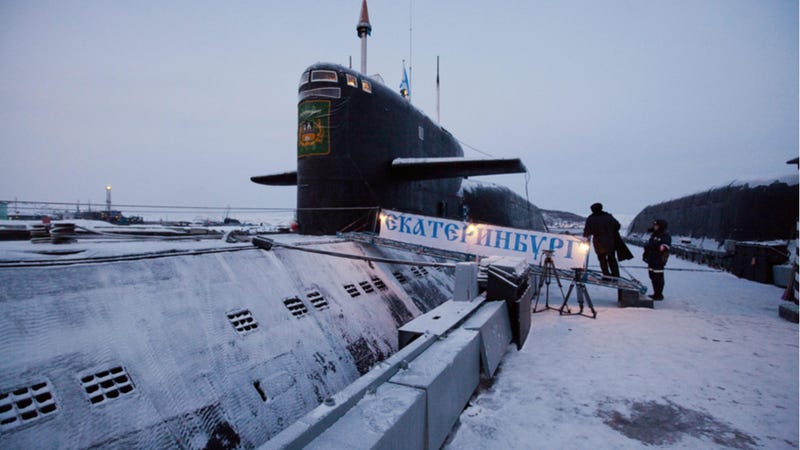
The Russian Delta IV-class submarine Yekaterinburg, photographed in 2010. Photo credit: AP
Russia has deployed 215 more nuclear warheads than allowed by the New START treaty, setting itself up to violate a provision that goes into effect next year. Surely this will end well.
New START allows 1,500 deployed warheads, with that goal supposed to be reached in February 2018, and it’s designed to help both the U.S. and Russia know what each country has as far as its stockpiles. It also allows verification to ensure both nations are honoring their obligations, with on-site inspections and data exchanges are required. The regime is extremely intrusive and, arguably, has helped avoid another Cold War, if you consider how unstable relations would be if neither Washington nor Moscow knew what the other country had.
And right now, the two parties are supposed to be working to reduce their number of deployed warheads, not actively increasing them. But it looks like Russia is doing the latter
New satellite images reveal extensive construction of two Northern Fleet facilities for warheads and ballistic missiles on the Kola Peninsula in far northwest Russia, according to The Barents Observer, which analyzed satellite images via Google Earth along with open-source data on Russia’s nuclear weapons stockpiles. There are four storage areas for nuclear weapons on the peninsula, all of which are in close proximity to Norway. The nearest weapons storage area is Zaozersk, which is around 40 miles from the Norwegian town of Grense Jakobselv. All four are within an 118-mile radius away from Norway, a NATO member state.
To put this context for folks stateside, Norway is roughly 4,463 miles away from the United States.
One of the satellite images (below) shows Yegelnaya Bay, where the Gadzhiyevo naval base is located. Based there are six Delta IV-class ballistic missile submarines and the Yury Dolgoruky of the Borei-class. Three more Borei-class submarines, the most advanced in the Russian ballistic missile submarine fleet, are expected to arrive there soon.
Here are more details of the kinds of construction that are going on at the base, per The Barents Observer:
It is possible to date the image to late summer 2016 by counting the 81 reactor compartments stored in the nearby Saida Bay where also the “Itarus” transport barge can been seen. This barge was tranferred from Italy to the Kola Peninsula last spring.
At the jetty in the bay, a Delta-IV class submarine is visible dockside the crane for loading and unloading ballistic missiles. The missiles are driven to the jetty from the storage in the valley behind where both the original storage and the new under construction are visible. The nuclear warheads are, for the most, stored inside the mountain to the left.
Three new reinforced bunkers and five similar bunkers under construction are visible. In the end of the valley, the entrance to an underground storage can be seen. The entrance to another underground storage is visible also at the first nuclear weapon storage facility. A nuclear missile transit hangar is located on the road towards the loading jetty.
The Barents Observer analyzed other sites on the Kola Peninsula, but the developments mean one thing for U.S. national security: the Russians are well ahead of the U.S. in their Arctic strategy and are solidifying their supremacy with nuclear weapons. As we’ve noted before, Washington has long been asleep at the wheel when it comes to prioritizing the Arctic Circle from a geopolitical standpoint. The United States Coast Guard, for example, is the primary service that oversees all issues Arctic. Yet, President Donald Trump’s current budget proposal calls for a 14 percent cut to the Coast Guard.
At the most basic level, Congress seems unwilling to invest in heavy icebreakers that provide critical access to the Arctic Circle. During a recent trip to Seattle, I had an opportunity to tour America’s only heavy icebreaker, the USCGC Polar Star (WAGB-10); the engineers have done a great job maintaining it, but it should have been retired more than ten years ago. The Coast Guard has to use it due to lack of funding over the years to build new ones. Russia, on the other hand, has 40 icebreakers.
Indeed, Russia’s northern border lines the Arctic area, so it makes sense for it to command the region. But, it appears that the United States isn’t even trying to counter the Kremlin for some significant presence. The increase of nuclear weapons facilities in the Arctic region is just another major geopolitical step in Moscow securing the area as its own.
Right now, some 60 percent of Russia’s 700 sea-based strategic nuclear warheads are on the Kola Peninsula, according to The Barents Observer; the remaining 40 percent are with the Pacific Fleet at Kamchatka. Russia isn’t technically violating the New START treaty, however: as long as it reduces the number of deployed warheads to the agreed-upon limit before February 2018, it should be fine, Kristian Ã…tland, a senior researcher with the Norwegian Defence Research Establishment, told the publication.
The main issue is whether or not New START is a major policy item for President Trump. It doesn’t appear to be. During his first official phone call with Russian President Vladimir Putin, Trump didn’t even know what the treaty was. He has also blasted the treaty as a one-sided deal, which is simply not true, as not only does it limit warhead deployment and increase transparency for the Russians, but it does exactly the same for the Americans.
So far, the current administration has not signaled that it is ready to make a move on New START or the Arctic Circle. Russia, on the other hand, has certainly made theirs. Several of them, in fact.