Showing posts with label Iran Iraq. Show all posts

Sunday, May 19, 2019

Iraq is One of the Four Horns of Prophecy (Daniel 8:8)

An Iraqi policeman stands guard at a border crossing between Iran and Iraq near the southern Iraqi city of Basra on Feb 26, 2007.An Iraqi policeman stands guard at a border crossing between Iran and Iraq near the southern Iraqi city of Basra on Feb 26, 2007.  Essam al-Sudani/AFP/Getty Images

Iraq Is Not an Iranian Vassal State

These days, Tehran is having trouble getting what it wants from its neighbor—a development Washington can encourage by backing off.

It almost goes without saying these days that Iran dominates its western neighbor. On April 27, for example, Bahraini Foreign Minister Khalid bin Ahmed tweeted that Iran’s regime “controls” Iraq. Now-U.S. National Security Advisor John Bolton once compared Tehran’s grip on Iraq to the Soviet Union’s stranglehold over Eastern Europe during the late 1940s. And while she was U.S. ambassador to the United Nations, Nikki Haley assailed Iran last September for working to “build an Iraqi government that is under the control of the Iranian regime.”
Yes, Iran wields significant influence in Iraq. It is the country’s third-largest trade partner, at approximately $12 billion annually. In the 2018 elections, Iran loyalists in the Fatah Alliance won 48 of the seats—14.6 percent—in Iraq’s parliament, making it the second-largest bloc in the legislature. And Iran has armed Shiite militias, which have cornered parts of the Iraqi economy and are responsible for security in some regions even after the territorial defeat of the Islamic State.
However, the limits of Iranian interference are quickly becoming clear.

In late 2018, U.S. President Donald Trump made an unannounced visit to Iraq’s Al Asad Air Base. Seeing this as disrespecting Baghdad’s sovereignty, Fatah lawmakers protested the move by intensifying their efforts to expel the 5,200 remaining U.S. troops from the country. They had the backing of Iranian Supreme Leader Ali Khamenei, who later called on Iraq to evict the United States “as soon as possible.”
But despite Iran and Fatah’s demands, legislation to actually kick out the U.S. troops has stalled. Sunni and Kurdish parties have refused to back the bill, and without at least some of them, it is unlikely to pass. In March, Mohammed al-Halbousi, the speaker of Iraq’s parliament, even traveled to Washington to reaffirm Iraq’s appreciation for the U.S. military presence. And in late April, Iraqi President Barham Salih met with U.S. Sen. Tammy Duckworth, who lost both of her legs fighting in Iraq, to “honor her sacrifice.”
The next day, a senior Fatah official admitted that the effort to oust U.S. troops was going nowhere. “I do not think there is a real desire from the political blocs to remove the foreign forces from Iraq,” Fatah’s Naseem Abdullah said, “especially as many alliances have one stance in the media, while revealing a different position behind the scenes.”
Also pointing to resistance to Iranian influence is the ongoing battle over staffing a critical interior ministry post in the Iraqi cabinet. Iraqi Prime Minister Adel Abdul Mahdi has struggled to finalize his cabinet for approximately eight months.
Fatah has repeatedly pushed for Falih al-Fayyadh—currently the chairman of the Popular Mobilization Forces, a coalition of mainly Iran-backed Shiite paramilitaries—as interior minister. Abdul Mahdi nominated him in December, but his approval was blocked by lawmakers in the Sadr alliance, which under the leadership of the cleric Moqtada al-Sadr has fashioned itself as a nationalist movement fighting both U.S. and Iranian influence. “Our decision is Iraqi” chanted the Sadr-allied parliamentarians—an apparent dig at Fayyadh, who met with Iranian President Hassan Rouhani earlier this year.
In March, Fatah withdrew Fayyadh as its pick for interior minister, and the position remains unfilled. The saga demonstrates the powerlessness of Iran’s Iraqi allies to ramrod their favored pick into the cabinet.
Another sign of Iraqi independence is that a visit to Baghdad by Rouhani in March was followed the next month with a trip to Saudi Arabia by Abdul Mahdi and a delegation of 12 ministers. During the tour, the Iraqi government signed 13 agreements with Riyadh. The same month, Saudi Arabia reopened a Baghdad consulate—for the first time in nearly 30 years.
A Hezbollah supporter displays a picture of Iran's late founder of the Islamic Republic Ayatollah Khomeini as he marks Ashura in a southern suburb of the Lebanese capital Beirut on Oct. 1, 2017.
Iraqi boys walk past a shop in a local market in the northern city of Mosul on Nov. 21. ( Zaid al-Obeidi/AFP/Getty Images)
A customer looks at an Iranian-made washing machine at a store in the Iraqi capital, Baghdad, on Aug. 8, 2018.
Iran, of course, is not pleased. In a meeting with Abdul Mahdi, Khamenei accused Saudi Arabia of supporting the Islamic State. And last year, a senior advisor to the supreme leader warned, “We will not allow liberals and communists to govern Iraq,” a dig against Sadr after the Iraqi cleric held a landmark meeting with Saudi Crown Prince Mohammed bin Salman in 2017 and advocated for a less lopsided relationship with Tehran. But that has not deterred the Iraqi premier from establishing closer ties with Riyadh.
Finally, there’s the Iraqi public to think of. An Iraqi poll published in the Washington Post showed a 41-percentage-point decline in Iraqi Shiite favorability toward Iran between 2015 and the fall of 2018. Furthermore, amid rampant electricity outages and some 100,00 cases of people poisoned by polluted last summer, Iraqis broke into protest, furious at the central government for neglecting its citizens. Some protesters apparently blamed Iran as well. In addition to burning down an office of the Iran-backed militia Asaib Ahl al-Haq, Iraqis in Basra stormed the Iranian consulate, smashing furniture before setting the building on fire. The torching of an Iranian diplomatic facility in one of Iraq’s most important Shiite cities was a clear sign of the limits of Iran’s reach.

To claim that Iran single-handedly dominates Iraq ignores the competing influences of multiple global powers, including the United States. Turkey also maintains considerable influence in Iraq with some 10 military bases. It has launched hundreds of airstrikes in the Kurdish region.
Despite Tehran’s considerable influence in Baghdad, its ambitions in Iraq have repeatedly been thwarted. As a compromise candidate between Sadr and Fatah, Abdul Mahdi is no Iran stooge; his reluctance to advance legislation to expel U.S. forces highlights his understanding that Baghdad must preserve friendly ties with many competing powers.
The Trump administration’s exaggeration of Iranian domination over Iraq—part of a bid to pressure Abdul Mahdi to cut energy ties with his country’s eastern neighbor and put further pressure on Tehran—is dangerous. It jeopardizes Iraq’s security and undermines those Iraqi factions looking to establish a more even-handed relationship with Tehran.

Wednesday, April 3, 2019

Iranian Hegemony in Iraq (Daniel 8:3)


Image result for iran hegemony iraqA year after US withdrawal from the nuclear deal, Iran digs in
Barbara Slavin
Nearly a year after the Trump administration unilaterally withdrew from the Iran nuclear deal, it is loudly proclaiming the harsh impact of reinstated US secondary sanctions on the Iranian economy.
As a result of reduced revenues, US officials assert that Iran is under increasing pressure to scale back its support for proxy groups that have widened Iran’s regional reach.
Tehran appears to be digging
in, prepared to wait out
Trump in hopes that he will
be a one-term president.
But although Iranians are clearly suffering from high inflation and unemployment, there are no signs that their government is willing to talk to Trump officials about a “better” deal or that it is abandoning long-standing regional partners. Instead, Tehran appears to be digging in, prepared to wait out Trump in hopes that he will be a one-term president and that a successor administration would return to the 2015 nuclear agreement.
Iran has undoubtedly taken notice that half a dozen Democratic candidates for president have pledged to return to the Joint Comprehensive Plan of Action (JCPOA) if elected in 2020. Meanwhile, pro-JCPOA analysts at US think tanks are already providing road maps for resumed US compliance and new negotiations on a “more-for-more” agreement. (The Brookings Institution is the latest.)
The Trump administration has described its policy on Iran as “maximum pressure”. But US ability to further squeeze Iran in the next 18 months is constrained by a number of factors.
While sanctions have cut Iran’s oil exports by about a million barrels a day and are causing obvious pain to the Iranian population, Iran is still selling enough oil – about 1.2 million barrels – to get by and has the benefit of about $100 billion in hard currency reserves unfrozen after implementation of the JCPOA in 2016.
In May, the Trump administration must decide whether to renew waivers to a half dozen countries permitted to buy Iranian oil without threat of US sanctions. A failure by the administration to renew waivers to key importers such as China and India risks spiking global oil prices at a time when Venezuelan crude exports are also restricted by US sanctions. In recent weeks, oil prices have flirted with $70 a barrel – a level that appears to worry President Donald Trump.
It is also unlikely that the US will seek to punish the European Union for trying to maintain minimal economic ties with Iran. The EU has come up with a mechanism called INSTEX to facilitate trade in food and medicine with Iran. The Europeans are waiting for Iran’s parliament to pass anti-money laundering legislation before activating INSTEX later this year.
The US must also balance conflicting interests with regard to Iraq, which shares a long border with Iran and relies on Iranian natural gas for nearly half its electricity. The Trump administration recently renewed waivers for Baghdad to keep importing Iranian natural gas for another three months. The last thing the US wants to see is more unrest in Iraq this summer because of electricity shortages and climate change-goosed high temperatures.

US Secretary of State Mike Pompeo speaks to the press alongside Lebanon’s Foreign Minister Gebran Bassil (Photo: US State Department/Flickr)
On a recent visit to the Middle East, Secretary of State Mike Pompeo urged Iraq to clamp down on Iran-backed Shi’ite Muslim militias that took part in the campaign to defeat the Islamic State group. Iraq has instead put these militias on the government payroll. A US decision to declare Iran’s Revolutionary Guards as a terrorist group – reportedly being pushed by Pompeo – would put Iraq in an extremely difficult situation given the guards’ strong ties with Iraqi militias and politicians. It could also put the few thousand US troops in Iraq at greater risk.
In Lebanon, which Pompeo also visited on his recent tour, he harshly attacked Hezbollah, Iran’s oldest regional partner, as a terrorist organization that “stands in the way of the Lebanese people’s dreams” and whose “foot soldiers serve at Tehran’s bidding”.
However, Lebanon’s foreign minister, Gebran Bassil, contradicted Pompeo’s view. Standing next to the American chief diplomat, Bassil told reporters, including Americans covering Pompeo, “Hezbollah is a political party … it is not terrorist” and it has “huge political support” in Lebanon. Indeed, supporters of the group won 70 of 128 seats in the Lebanese parliament in elections last year.
The Trump administration claims to be building a global coalition against Iran’s “malign” activities. But while many Western countries would like to see Iran pull back from regional interventions, curb its ballistic missile program and treat its own citizens better, US policy is strongly supported by only a handful of Iran’s rivals in the Middle East. In an interview on 28 March, Pompeo acknowledged:
We’ve got the Gulf states and Israel sharing our view of the threat from the Islamic Republic of Iran.
Even that coalition is shaky because of the nearly two-year-old blockade of Qatar by Saudi Arabia and the United Arab Emirates, which has forced Qatar to deepen ties with Iran. In Washington, the Saudis are increasingly unpopular not just because of the embargo but the murder of journalist Jamal Khashoggi and a seemingly unending war in Yemen. The US Congress has demanded accountability for Khashoggi’s gruesome death in the Saudi consulate in Istanbul and majorities in both houses oppose continued US support for the Saudis and Emiratis in Yemen, now the world’s worst humanitarian disaster.
Ordinary Iranians are caught between their own government’s malfeasance and a hostile Washington. They are angry at their government’s poor performance, as evidenced in poor preparation for recent floods, but derive little comfort from an aggressive US propaganda campaign that seeks to blame every problem on Iranian officials.

Monday, April 1, 2019

Israel Wants to Stop the Inevitable Iranian Horn


Stop Iran From Going Nuclear
Gatestone Institute
24 Adar II 5779 – March 31, 2019
Photo Credit: Wikipedia
Iran’s Natanz nuclear site.
{Originally posted to the Gatestone Institute website}
Advocates of Iran’s nuclear deal are conspicuously ignoring the Iranian government’s nuclear activities, even though they jeopardize global security as much as Israel’s security. Advocates of Iran are also rushing to criticize the Trump administration in the United States for tightening its sanctions in response to Iran’s illegal defiance.
In a recent interview with Iran’s state-owned Channel 2 in the Persian language, Ali Akbar Salehi, the head of the Atomic Energy Organization of Iran, made it clear that the flimsy “nuclear deal” initiated by then US President Barack Obama has done nothing to stop Iran from making advances in its nuclear program.
Salehi boasted:
“If we have to go back and withdraw from the nuclear deal, we certainly do not go back to where we were before … We will be standing in a much, much higher position.”
The latest reports on Iran’s nuclear progress also indicate that Iran is on the threshold of modernizing its mechanism for producing highly enriched uranium, which can be utilized to build a nuclear weapon.
The Iranian government is bragging that it is exploring new uranium enrichment programs and the production of centrifuges. As Salehi said recently:
“Thank God, the tests on the IR4 and IR2M (centrifuges) have been completed. They were tested for over 12 years. Today we have all the data, and we can easily manufacture them on an industrial scale.”
Several intelligence reports warning of Iran’s clandestine nuclear activities have been distributed throughout the international community. Germany’s domestic intelligence agency, the Federal Office for the Protection of the Constitution, revealed in its annual report that the Iranian government has pursued a “clandestine” path to obtain illicit nuclear technology and equipment from German companies “at what is, even by international standards, a quantitatively high level.”
The intelligence report also stated that “it is safe to expect that Iran will continue its intensive procurement activities in Germany using clandestine methods to achieve its objectives.”
Further illustrating this disregard for the regulations Iranian officials are supposed to be following, on several occasions after the “nuclear deal” was in place, Iran held onto more heavy water, used to produce nuclear weapons, than it was allowed to have.
Those who promote the idea of taking a gentler stance on Iran and its nuclear program argue that Iran is not pursuing any illicit nuclear activities because the International Atomic Energy Agency (IAEA) has verified that.
The IAEA, however, was not allowed to inspect or monitor Iran’s military sites where nuclear activities were most likely being carried out. Among the many concessions that the Obama administration gave the Iranian government, one was accepting the Iranian leaders’ demand that these military sites would be out of the IAEA’s reach.
Due to this surrender, various high-profile Iranian sites such as the Parchin military complex, located southeast of Tehran, were free to engage in nuclear activities without the risk of inspection.
The IAEA itself had previously stated that the Parchin military complex was the location where Iran carried out the explosive tests required to set off a nuclear charge.
In addition, Israel’s international intelligence agency, the Mossad, obtained files and photographs from inside Iran relating to the country’s nuclear program.
The files pointed to Iran’s efforts to build a nuclear bomb, and the set of photographs taken at the Parchin military site “appears to show a giant metal chamber built to conduct high-explosive experiments.”
Moreover, the National Council of Resistance of Iran (NCRI) — which revealed Iran’s clandestine and undeclared uranium enrichment facility at Natanz and a heavy water facility at Arak in 2002 — has recently confirmed that Iran is continuing to pursue its nuclear ambitions. Its report states:
“… the ‘nerve center’ of the Iranian regime’s nuclear weapons project, responsible for designing a nuclear bomb, has been continuing its work… following the establishment of the Joint Comprehensive Plan of Action (JCPOA) in 2015, not only has the unit remained in place and active, it is now clear that in some fields its activities have even expanded.
Iran’s breakout time — the amount of time needed to produce enough weapons-grade uranium for one nuclear bomb — is believed to be less than a year.
When will the international community take seriously the latest intelligence reports and Iran’s efforts to build a nuclear bomb? When will the United Nations’ nuclear watchdog, the IAEA, inspect Iran’s military sites?
Once the authoritarian, anti-Semitic and anti-American government of Iran possess a nuclear bomb, no amount of actions will be able reverse the catastrophe.
Iran is clearly continuing to demonstrate its interest in, and active pursuit of, nuclear weapons. Act now.
(Dr. Majid Rafizadeh, is a business strategist and advisor)

Sunday, March 31, 2019

Defiant Khamenei Emphasizes Iranian Hegemony (Daniel 8)


Defiant Khamenei emphasizes Iranian regime’s aggressive policies
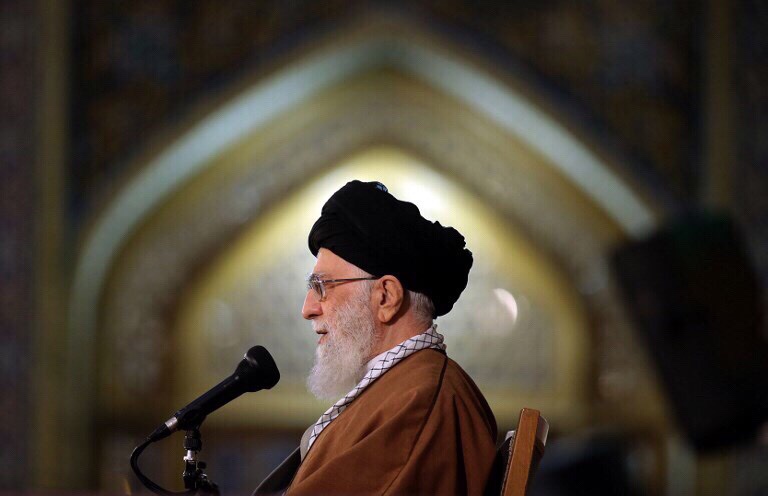
Supreme leader Ayatollah Ali Khamenei addresses crowds of Iranians in the northeastern holy city of Mashhad for a celebration of Nowraz. (AFP)
Every year, Iranian Supreme Leader Ali Khamenei delivers a few speeches, with the annual address in Mashhad, a city in northeast Iran, considered to be the most important.
It is imperative to meticulously examine the points made by Khamenei in this speech, which is delivered after the Persian New Year. The comments by the most powerful man in Iran outline the path the Islamic Republic will take in the next year.
Iran’s lawmakers in the Majlis (parliament) and military generals view Khamenei’s annual speech as direct instructions to be followed. Policymakers should also search for the important issues that Khamenei deliberately and shrewdly evades.
In his most recent annual speech, which he gave on March 21, Iran’s supreme leader highlighted several important issues. First of all, he went on at length to explain that the Islamic Republic ought to maintain its core revolutionary principle of opposing Western countries.
Intriguingly, Khamenei did not make any distinction between the US and European countries in this year’s speech. After the Joint Comprehensive Plan of Action (JCPOA), commonly known as the Iran nuclear deal, was reached between six world powers and the Islamic Republic, Iran’s supreme leader employed a softer tone toward the European nations in his annual speeches.
The main reason behind Khamenei’s shift this year is the fact that European countries have been incapable of assisting Tehran in bypassing the renewed US sanctions. After the Trump administration reimposed the primary and secondary sanctions that had been lifted or waived under the nuclear deal, both American individuals and companies and non-American entities could be punished for continuing to trade and have business dealings with the Iranian government. Many European firms and corporations, including French energy giant Total, subsequently abandoned their plans to invest in Iran.
As a result of this move, Khamenei’s main military institutions, including the Islamic Revolutionary Guard Corps, its elite Quds Force branch, and Iran’s militia and terror groups, which were the main beneficiaries of the increased cash flow following the nuclear deal, witnessed a significant drop in their income.
The supreme leader was initially hoping that the EU would come to his aid. However, as Hassan Rouhani’s government searched for assistance from European governments in helping Tehran increase its revenues and trades, the Islamic Republic soon realized that the EU’s projects and mechanisms, such as INSTEX — the Instrument in Support of Trade Exchanges — were totally ineffective.
This is why Khamenei ridiculed the EU, stating: “This financial channel they recently set up resembles a joke, a bitter joke… Europeans should have stood up to the US after it left the JCPOA and should have lifted all sanctions against Iran.”
But European companies will not risk their business with the US or access to the US financial systems by dealing with Iran.
Khamenei demonstrated escalating antagonism toward those state or non-state actors that his regime views as enemies
Dr. Majid Rafizadeh
The second critical comment that Khamenei made was linked to deploying more hard power, rather than diplomacy and soft power, for carrying out domestic and foreign policies. He emphasized that the country’s military infrastructure ought to be advanced.
His move is in clear defiance of the international community’s pressure on Tehran’s military adventurism and advancement of its ballistic missile program. Khamenei pointed out that: “We shall continue to strengthen our military power in spite of the enemies and will not relent under pressure.”
In addition, Khamenei demonstrated escalating antagonism toward those state or non-state actors that his regime views as enemies and rivals. For example, he lashed out at Saudi Arabia and further incited anti-Western sentiments. He referred to Western politicians as savages. “Deep inside, Western politicians are savage individuals in the true sense of the word. You should not be surprised at this. They wear a suit, they wear a tie, they put on perfume and they carry a Samsonite briefcase, but they are savages and they act in a bestial manner in practice,” he said.
Iran’s supreme leader did not take responsibility for the most important issue in Iran: The economic difficulties and challenges that many Iranians are facing on a daily basis. He blamed the West for the nation’s economic crisis and labeled the coming year as one “of opportunities, possibilities and openness” and a year for “boosting production.”
How can the Iranian people regard the new year as a “year of opportunities” and “boost production” when the country’s leaders have not taken any concrete steps to address the regime’s financial corruption, misuse of public funds and the widespread banking crisis, which are among the major reasons behind the present currency and economic crises? In fact, these problems are systemic and exist deep in Tehran’s economic infrastructure.
Khamenei made it clear in his important speech that he is determined to defy international norms and standards, continue to expand the stranglehold of his military institutions, further destabilize the region, and evade responsibility and accountability for Iran’s economic crisis.
Dr. Majid Rafizadeh is a Harvard-educated Iranian-American political scientist. He is a leading expert on Iran and US foreign policy, a businessman and president of the International American Council. Twitter: @Dr_Rafizadeh
Disclaimer: Views expressed by writers in this section are their own and do not necessarily reflect Arab News’ point-of-view

Friday, March 15, 2019

In Rare Move, Iraq Accepts Iran


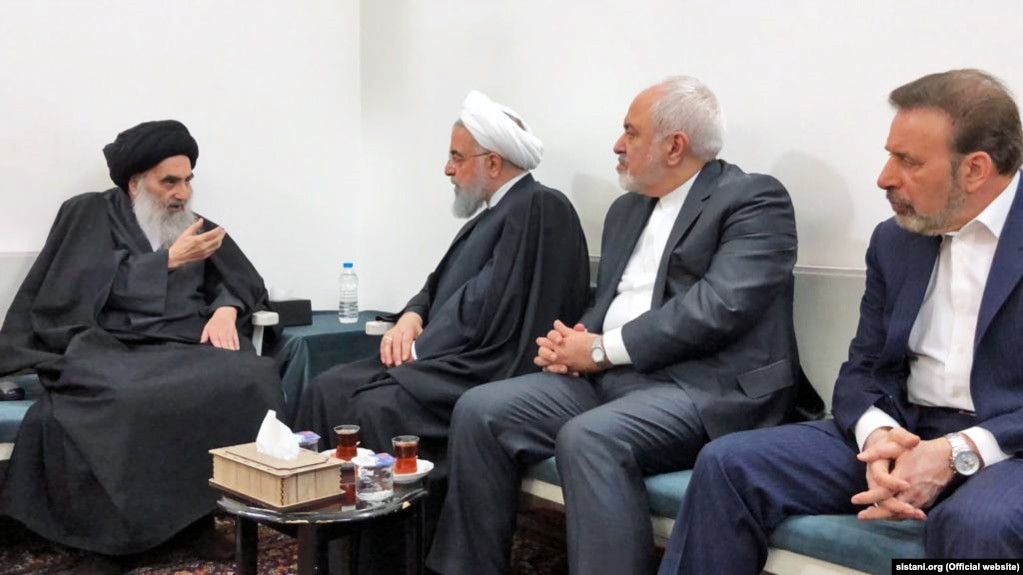
Before wrapping up his official visit to Iraq, President Hassan Rouhani was granted a rare audience with Grand Ayatollah Ali al-Sistani, an Iranian-born Shi’ite cleric based in Iraq, and one of the highest religious authorities in the Shi’ite world.
Sistani rarely meets officials, and the exception he made for Rouhani marked the first time the ayatollah has met with a sitting Iranian president. He rejected an offer to meet with Rouhani’s predecessor, hard-line Mahmoud Ahmadinejad, during his 2008 visit to Iraq.
The 88-year-old Sistani has also rebuffed an envoy of Supreme Leader Ayatollah Khamenei, Chairman of the Iranian Expediency Council Ayatollah Mahmoud Hashemi Shahroudi.
Iraq-born Shahroudi was reportedly supported by Khamenei and his conservative cleric allies in Iran to succeed Sistani after the ayatollah’s death, however Shahroudi died last December.
Earlier, Shahroudi’s predecessor as the chairman of the powerful Expediency Discernment Council (EDC), Ayatollah Akbar Hashemi Rafsanjani, had succeeded to win an audience with Sistani in 2009.
Referring to Sistani as a “Sayyid,” (a direct descendant of the Prophet Mohammad), Rafsanjani said at the time, “For a long time, visiting Grand Ayatollah Sayyid Ali Sistani was a yearning for me, and the meeting was historic and so valuable.”
Echoing Rafsanjani’s phrases, the Islamic Republic’s English-speaking television, Press TV, also described Rouhani’s meeting with Sistani as “historic” and a “landmark.”
Rouhani met Ayatollah Sistani at his residence in the city of Najaf, after visiting the shrine of Imam Ali, the first Imam of Shi’ite Muslims.
Iran’s Foreign Minister Mohammed Javad Zarif was also in attendance. During the meeting, the Iranian president briefed Ayatollah Sistani on his discussions with Iraqi officials, as well as agreements about the further promotion of Tehran-Baghdad ties.
Meanwhile, Ayatollah Sistani welcomed any effort aimed at improving Iraq’s ties with its neighbors based on mutual interests, non-interference, and respect for national sovereignty.
Furthermore, Grand Ayatollah Sistani, who reportedly supports separation of the state from religious institutions, said fighting corruption and promoting public services were now the significant challenges facing Iraq.
Sistani’s office has reported that it financially supports 35,000 students in the cities of Qom, 10,000 in Mashhad, and 4,000 in Isfahan, in Iran. Additionally, Sistani has a substantial following within Shia communities all over the world and is the current Grand “Marja” or source of emulation of the Twelver sect of Shi’ites.
Following the opening of the Shi’ite religious cities in Iraq of Najaf and Karbala to Iranian pilgrims after the U.S.-led invasion toppled Iraqi President Hussein in 2003, many Iranian pilgrims return from the cities as supporters of Sistani, according to Dean of the Johns Hopkins School of Advanced International Studies in Washington, D.C. and a Senior Fellow in foreign policy at Brookings Institution, Vali Nasr, making the ayatollah a an influential figure in Iranian society.

Save the Oil and the Wine (Revelation 6:6)


US Wants to Swiftly Bring Iranian Crude Oil Exports to Zero

Thursday, 14 March, 2019 – 07:00
FILE PHOTO: US Secretary of State Mike Pompeo speaks at a news conference at Lazienki Palace in Warsaw, Poland February 12, 2019. REUTERS/Kacper Pempel
Washington – Heba El Koudsy
US Secretary of State Mike Pompeo has stressed Washington’s commitment to swiftly bring Iranian crude oil exports to zero, saying Tehran’s role in the energy market has been diminishing due to US pressure.
Washington reimposed oil sanctions on Iran last year, sharply reducing its volume of crude exports in the past several months in an effort to curb Tehran’s nuclear, missile and regional activities.
“We’re committed to bringing Iranian crude oil exports to zero as quickly as market conditions will permit,” Pompeo said in a speech at IHS Markit’s CERAWeek conference in Houston, where US oil and gas executives, energy luminaries and officials of the Organization of the Petroleum Exporting Countries gather annually to discuss global energy development.
“You know its role in global energy markets. We know that role is diminishing. Its exports have tanked due to our pressure campaign,” he said.
Iran uses its energy exports to exert undue influence all across the Middle East, most particularly today on Iraq. While the United States is working to develop an independent, sovereign Iraq, Iran is using its energy to create a vassal state,” Pompeo added.
Brian Hook, the State Department’s special representative on Iran, also said in remarks at the CERAWeek energy conference that Iran has lost $10 billion in revenue since US sanctions in November have removed about 1.5 million barrels per day (bpd) of Iranian crude from global markets.
Trump “has made it very clear that we need to have a campaign of maximum economic pressure” on Iran, Hook said, “but he also doesn’t want to shock oil markets, he wants to ensure a stable and well-supplied oil market. That policy has not changed.”
“When you have a better supplied oil market it enables us to accelerate our path to zero. But we also know that there are a lot of variables that go into a well-supplied and stable oil market,” said Hook, a senior policy adviser to Pompeo.
Sigal Mandelker, US Treasury under secretary for terrorism and financial intelligence, briefed the House Committee on Appropriations on the establishment of the Iran Finance Fusion Cell to monitor Tehran’s activities.
“Last November, we re-imposed all of the US sanctions authorities previously lifted under the Iran nuclear agreement, and added over 700 individuals, entities, aircraft, and vessels onto our sanctions list on a single day. As part of that, we designated 70 Iran-linked financial institutions and subsidiaries. This brings the total number of Iran-related sanctions targets under this Administration to 927 entities, individuals, vessels, and aircraft,” she said.

Thursday, March 14, 2019

Creating the Shi’a Horn (Daniel 8:8)


The visit of Iranian President Hassan Rouhani to Baghdad this week — his first since he took office six years ago — comes amid heavy pressure on the Iraqis exerted by the Tehran regime, which wants to use Iraq as an escape route away from American sanctions. Given these pressures and threats, do we have to worry that Iraq will become an Iranian satellite?
Tehran succeeded in entering the Iraqi arena following the fall of Saddam Hussein’s regime. Since then, it has participated in marginalizing the US presence through its support of Sunni and Shiite armed groups.
Iran now intends to turn Iraq into another “banana republic,” just like Lebanon; subsequently exploiting it with the recruitment of militants who would fight on its behalf around the world, as they are currently doing in Syria under Gen. Qassem Soleimani’s command. It also wants Iraq to become its financial agent, funding Lebanon’s Hezbollah and Bashar Assad’s Syrian government with billions of dollars.
Iran does not wish Iraq to have a strong authority, but rather be a weak state like Lebanon, governed by militias like Asa’ib Ahl Al-Haq. However, Iraq is a big country that has its own interests and aspirations, which are incompatible with the interests and ideas of the extremist religious regime in Tehran.
Furthermore, Iran is a country under siege, while Iraq is open to the world. Today, Iraq enjoys its best relations and circumstances since 1990, and is in a transitional phase of development that will drive it to become one of the wealthiest countries in the region. It can play an independent, sovereign, and free role without being subservient or subordinate to any other country.
Prime Minister Adil Abdul-Mahdi is well aware of Iraq’s status, and he knows well the available options. Abdul-Mahdi knows that Rouhani wants him to give up his country’s interests after he said in Tehran on Monday: “We have supported the Iraqi people in their difficult days.” However, Iran would have escaped the US siege had it agreed to abandon its nuclear project and stopped exporting chaos and rebellions, as well as its foreign military interventions. So why should the Iraqis pay for Tehran’s extremist policies?
Tehran is now more besieged than ever: Its oil tankers are abandoned in the middle of oceans, it cannot use the US dollar when selling its carpets, pistachios, and vegetables, and it has been deserted even by China and Russia, the two countries on whose support it was counting in its preparations for the confrontation with the US. Indeed, Iran was not forced to fight these battles; rather, its regime has chosen to play the role of the villain in the region, which is why it is facing this situation and a siege like the one Saddam faced in the past.
Iraqis must now realize that what is going on is an international battle, and they will lose all that they have achieved since stability and state authority returned to Baghdad.
Rouhani, Foreign Minister Mohammed Javad Zarif, Soleimani, and all Iran’s senior officials who have visited Baghdad want Iraq to become a subordinate satellite state. Lebanon is a clear example, as it has been fighting and suffering on behalf of Iran since the 1980s. Iraq will not be luckier than the current, divided Lebanon if it falls under Iranian control.

Wednesday, March 13, 2019

Iran Seeks Help from Smaller Horn (Daniel 8)


Iran’s President Rouhani seeks Iraqi help to mitigate US sanctions
AFP
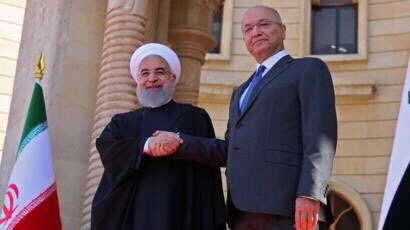
Iranian President Hassan Rouhani (L) was welcomed by his Iraqi counterpart, Barham Saleh
Iran’s President Hassan Rouhani has begun his first official visit to Iraq since taking office five years ago.
After meeting his Iraqi counterpart, Mr Rouhani said he wanted deeper political and economic ties between their states, which fought a bloody war in the 1980s.
He noted that Iran had come to Iraq’s aid in recent years when it was threatened by the Islamic State group.
Iranian officials see Iraq as a way to mitigate the US sanctions reinstated by President Donald Trump last year.
Mr Trump’s decision, made after he abandoned a 2015 nuclear deal, has led to a sharp downturn in Iran’s economy, pushing the value of its currency to record lows, quadrupling its annual inflation rate, and driving away foreign investors.
Europe creates pay system for Iran trade
US sanctions on Iran come into force
Iranians describe impact of US sanctions
What has Iran’s president said?
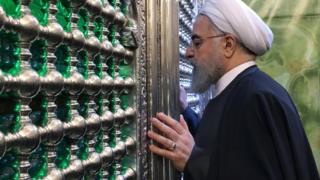
Mr Rouhani began his three-day visit to Iraq with a visit to the shrine of Shia Muslim Imam Moussa al-Kadhim in northern Baghdad. He was then greeted by his Iraqi counterpart, Barham Saleh, at the presidential palace.
At a joint news conference, Mr Rouhani said: “We want to forge very close relations with Iraq. We do not seek to be allied against others, but rather seek to invite other regional states to our alliance as well.”

Reuters
Mr Rouhani visited the shrine of Imam Moussa al-Kadhim in Baghdad
He pointed out that Iran had stood by Iraq in “difficult” times – a reference to its training and arming of thousands of Iraqi Shia paramilitary fighters who have helped drive Islamic State (IS) militants out of the large parts of Iraq they seized in 2014.
Mr Saleh said he agreed with the “necessity of enhancing trade” and “setting up related economic infrastructure between our countries and peoples”.
Iran’s president later held talks with Prime Minister Adel Abdul Mahdi, whose governing coalition includes Shia parties with deep links to Tehran.
Before leaving Tehran, Mr Rouhani said Iraq’s ties with Iran could not be compared to its links with an “occupying country” like the US that was “hated in the region”.
The US, which invaded Iraq in 2003 to overthrow President Saddam Hussein, has sent thousands of troops to the country to advise and assist security personnel battling IS. But it and Iran back opposing sides of the conflicts in Syria and Yemen.
How much trade already takes place?
A senior Iranian official accompanying the president told Reuters news agency that Iraq was “another channel for Iran to bypass America’s unjust sanctions” and that his trip to Baghdad would “provide opportunities for Iran’s economy”.
Economic ties between the neighbours are already extensive.

AFP
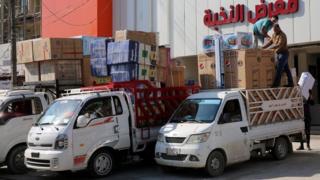
Household appliances and air conditioners are major Iranian exports to Iraq
In the 12 months up to March 2018, Iraq imported about $6bn (£4.6bn) of goods from Iran, including food, agricultural products, household appliances, air conditioners and car parts. Iraq paid another $6bn to Iran for natural gas, petroleum products and electricity.
Mr Rouhani has said he wants to increase bilateral trade from $12bn to $20bn annually. However, Iraq has faced pressure from the US to stop doing business with Iran.
Iraq discontinued crude oil swaps with Iran in October and did not receive an exemption when a new wave of sanctions came into effect the following month. It was, though, reportedly granted a limited waiver to give it time to find alternative supplies of electricity.
Have Iran-Iraq ties always been good?
No. Under Saddam – who was a Sunni – Iraqi forces invaded Iran in 1980, sparking an eight-year war that left a million people dead and devastated both countries.
Bilateral relations only began to improve after Saddam was toppled and an Iraqi government led by Shia parties – many of them backed by Iran – came to power.
Iran later armed Shia militants who attacked US forces in Iraq to press them to withdraw and targeted Sunnis in a brutal sectarian conflict.
In last year’s elections in Iraq, parties linked to Iran-backed paramilitary groups won the second largest number of seats in parliament. But the largest number went to a bloc led by the Shia cleric Moqtada al-Sadr, who opposes US and Iranian influence

Tuesday, March 12, 2019

Iraq and Iran Join Horns (Daniel 8:8)


Iran’s president to visit Iraq for first time


Facing pressure at home over US pullout from nuclear deal, Rouhani to try to warm up ties with fellow Shiite neighbor
By AP
10 Mar 2019, 12:54 pm
TEHRAN, Iran — Iranian President Hassan Rouhani will make his first official visit to Iraq this week as he faces mounting pressure from hardliners at home in the wake of the unraveling of the nuclear deal under the Trump administration.
Hassan Rouhani’s trip — billed as “historic and noble” by his foreign minister — is meant to solidify ties between Shiite power Iran and Iraq’s Shiite led-government, a strong Tehran ally. It is also Iran’s response to President Donald Trump’s snap December trip to Iraq and the American president’s comments that US forces should stay in Iraq to keep an eye on neighboring Iran, with which Iraq shares a 1,400-kilometer-long (870 miles) border.
Rouhani’s visit to Iraq will provide an opportunity for reaching “serious understandings” between the two neighbors, Iran’s top diplomat, Mohammad Javad Zarif told the official IRNA news agency from Baghdad, where he was preparing for Rouhani’s three-day visit that starts on Monday.
Tehran sees the US military presence at its doorstep in Iraq has a threat — one that could also undermine Iran’s influence over Baghdad.
Zarif alluded to that on Sunday, saying that any country which tries to interfere with the good Iran-Iraq relations would “be deprived of opportunities for itself.”
Iran also sees Iraq as a possible route to bypass US sanctions that Trump re-imposed last year after pulling the US out of the 2015 nuclear deal between Tehran and world powers.
Last year, Iran’s exports to Iraq amounted to nearly $9 billion. Tehran hopes to increase the roughly $13 billion volume in trade between the two neighboring countries to $20 billion. Also, some 5 million religious tourists bring in nearly $5 billion a year as Iraqis and Iranians visit Shiite holy sites in the two countries.
Under former dictator Saddam Hussein, Iraq waged an eight-year war in the 1980s against Iran, a conflict that left nearly 1 million killed on both sides.

Monday, March 11, 2019

Babylon the Great’s New Nuclear Missiles


File photo – An unarmed U.S. Air Force Minuteman III intercontinental ballistic missile launches during an operational test May 3, 2017, at Vandenberg Air Force Base, Calif. (U.S. Air Force photo by Airman 1st Class Daniel Brosam)
The Air Force is building a new generation of nuclear-armed Intercontinental Ballistic Missiles (ICBMs) using cutting edge “digital engineering” methods intended to fast-track development of the new weapons system and fire off initial prototypes as soon as next year.
Digital engineering, using advanced computer programming, design work and engineering software enables Air Force developers to analyze a wide range of realistic weapons designs without having to build them all. Naturally, this streamlines weapons development and potentially circumvents some lengthy or more cumbersome elements of the traditional acquisition process – to bring powerful new high tech weapons to the force on a faster timeframe.
“With digital engineering, we can look at 10 to 20 designs,” William Roper, Assistant Secretary of the Air Force, Acquisition, Technology & Logistics, told an audience recently at an Air Force Association Symposium.
The Air Force plans to fire off new prototype ICBMs in the early 2020s, assessing new ICBMs with improved range, durability, targeting technology and overall lethality when compared to the existing arsenal, service officials said. The new arsenal of ICBMs to serve well into the 2070s – called Ground-Based Strategic Deterrent, or GBSD.
Given the aging arsenal of Minuteman III ICBMs, this program is taking center stage for the Air Force. The service has awarded two developmental deals to Northrop Grumman and Boeing and plans fire off early prototypes as soon as next year.
Northrop Grumman and Boeing teams were awarded Technology Maturation and Risk Reduction deals from the Air Force last year as part of a longer-term developmental trajectory aimed at developing, testing, firing and ultimately deploying new ICBMs.
Following an initial 3-year developmental phase, the Air Force plans an Engineering and Manufacturing Development phase and eventual deployment of the new weapons.
The Air Force plans to award the single EMD contract in late fiscal year 2020.
The new weapons will be engineered with improved guidance technology, boosters, flight systems and command and control systems, compared to the existing Minuteman III missiles. The weapon will also have upgraded circuitry and be built with a mind to long-term maintenance and sustainability, developers said.
Initial subsystem prototypes are included within the scope of the current Boeing and Northrop deals, service developers said. Senior nuclear weapons developers have told Warrior that upgraded guidance packages, durability and new targeting technology are all among areas of current developmental emphasis for the GBSD.
The new ICBMs will be deployed roughly within the same geographical expanse in which the current weapons are stationed. In total, dispersed areas across three different sites span 33,600 miles, including missiles in Cheyenne, Wyoming, Minot, North Dakota and Great Falls, Montana.
The Paradox of Strategic Deterrence
“GBSD will provide a safe, secure and effective land-based deterrent through 2075,” Cronin claimed.
If one were to passively reflect upon the seemingly limitless explosive power to instantly destroy, vaporize or incinerate cities, countries and massive swaths of territory or people — images of quiet, flowing green meadows, peaceful celebratory gatherings or melodious sounds of chirping birds might not immediately come to mind.
After all, lethal destructive weaponry does not, by any means, appear to be synonymous with peace, tranquility and collective happiness. However, it is precisely the prospect of massive violence which engenders the possibility of peace. Nuclear weapons, therefore, in some unambiguous sense, can be interpreted as being the antithesis of themselves; simply put – potential for mass violence creates peace – thus the conceptual thrust of nuclear deterrence.

Iran: The Imminent And Uncontrollable Fourth Horn (Daniel 8)

Iran: An Imminent And Uncontrollable Explosion

by Hassan Mahmoudi

March 9, 2019

The Iranian Regime has always harshly put down all demonstrations. The repression and systematic violations of human rights have been the Islamic Republic’s main response to the political, social and economic demands of the population.

On Mar.7, 2019, Ali Khamenei, leader of Iran’s religious dictatorship, appointed Ebrahim Raisi, a member of the Death Committee in the massacre of 30,000 political prisoners in 1988, and a devoted supporter of the supreme leader, as head of Iran’s judiciary.

Raisi should be subject to international prosecution for committing crimes against humanity in the massacre of political prisoners in 1988 and tried for the genocide of People’s Mujahadeen Of Iran (PMOI) members. His appointment as the highest judicial authority of the clerical regime signals a hard turn to even more repression by the clerical regime against the Iranian people and resistance. Khamenei described his appointment as a “new era” and the “second stage” of the regime’s so-called revolution, and ordered Raisi not “to pay heed to outsiders when dealing with judicial matters.”

In 1988, Grand Ayatollah Hossein-Ali Montazeri, Khomeini’s successor at the time, and a higher-ranking cleric than Khamenei and his minions, summoned members of the Death Committee including Raisi. Montazeri and addressed them in a meeting that was recorded and later published, stating, “The greatest crime committed under the Islamic Republic, for which history will condemn us, has been committed by you. Your (names) will in the future be etched in the annals of history as criminals.”

Raisi’s appointment by Khamenei proves once again that as the head of the crisis-stricken theocratic regime, he finds no other solution than a hard turn towards further repression in order to contain the crisis of the coming new Iranian year (starting March 21, 2019). Khamenei thus wants to barricade his clerical regime against the uprising of the Iranian people and their organized resistance for justice and freedom in Iran.

In more than a century, Iranians have experienced four major movements in search of democracy: the Constitutional Revolution of 1906, Mohammad Mossadegh’s nationalist movement in the early 1950s, the Antimonarchist Revolution of 1979 and resistance against the Islamic Republic from the 1980s to the present. Because of an ideology that emerged from the depths of the Middle Ages, the clergy regime has nothing in common with this progressive orientation. This regime represents the aspirations that belong to the pre-capitalist period, which makes it incapable of solving the social, economic and political problems of Iranian society. This distinguishes the Islamic Republic from any other classical dictatorship that the contemporary world has known or is experiencing. This explains why the repression in Iran is taking on a completely different dimension than anywhere else in the world. 

The Islamic Revolutionary Guard Corps (IRGC), the Bassij militia which deals with urban repression in all areas of society’s activity, justice in the hands of religious who do not comply with any of the rules of law, a prison system that applies torture and killings beyond the imagination, secret services that have become a killing machine, and a multitude of vice patrols, in addition to the police, are responsible for ensuring the proper functioning of this repression which is the only reason for maintaining power in place.

Abuse of religion: a complement to repression

The regime of the Supreme Leader has used religion as a justification for repression. A disfiguration of Islam’s precepts served this alibi to justify all the horrors. Thus it gives the name “rehabilitation” to torture, “call for modesty” to merciless repression of women in all their social behavior. In its war against Iraq in the 1980s, this regime offered keys to paradise to schoolchildren and high school students whom it recruited to wipe minefields in order to facilitate the passage of its troops. The Constitution openly denies national sovereignty and gives absolute powers to the Supreme Leader. These are the features of a regime that is not a republic and has nothing to do with Islam but calls itself the Islamic Republic.

An increase in resistance among the population

The Fars news agency, known to be affiliated directly to the notorious Revolutionary Guards (IRGC), published an article Wednesday morning reflecting the mullahs’ growing concerns about the country’s young generation leaning more and more towards the Iranian opposition People’s Mojahedin Organization of Iran (PMOI/MEK). The piece literally warns that people should not be deceived by “the PMOI/MEK’s mediums on the internet!”

“The measures carried out by the PMOI/MEK’s mediums on social media indicates that most of their criteria and the provocative methods are designed to influence the younger generation… Usually the youth under the age of 20, due to their inexperience, are easily influenced and begin undergoing training by the enemy’s elements…,” the piece reads in part.

“In the past, the enemy was forced to come inside the country to establish contact… Today, however, the internet and social media are allowing the enemy to establish contact with social media users on their mobile phones and personal computers. As a result, the enemy’s mediums can easily use deceitful methods to establish direct contact with mainly the younger and lesser informed users,” the Fars piece continues.

Babylon the Great Prepares for Nuclear War (Revelation 15)


A nuclear missile was detonated in the upper atmosphere (Image: GETTY)
THE US government ran a series of nuclear tests over the South Atlantic Ocean to test an electromagnetic pulse in space, a documentary revealed.
PUBLISHED: 17:46, Sun, Feb 10, 2019
UPDATED: 09:24, Mon, Feb 11, 2019
Operation Argus was a series of high-atmosphere nuclear weapons tests conducted between August and September 1958 over the South Atlantic ocean. The whole project, which was highly classified, took just 11 days and was carried out by the Defence Nuclear Agency during the Cold War period. It was proposed by scientist Nicholas Christofilos as a means to verify whether the high-altitude nuclear detonations would create a radiation belt in the extreme upper regions of the Earth’s atmosphere.
However, many believe the real intent was much more sinister.
Aaron and Melissa Dykes put forward an alternative theory during their YouTube documentary “The Real Secrets Hidden in Antarctica”.
Ms Dykes revealed: “In 1963 there were claims made that a nuclear bomb had been detonated on Antarctica.
The blast was detonated in space (Image: GETTY)
“Although the US initially denied reports, trying to pass it off as a natural phenomenon, they later admitted it had actually happened.
“They may have set this off in the upper atmosphere of the South Pole in order to create an artificial EMP.
“If they did it would have been allowed under the Antarctica treaty if it was deemed to be for scientific purposes.”
Just yesterday, more details on a secret Pentagon project below the ice was revealed.
Declassified files showed the well publicised Camp Century of the 1960s was actually a cover-up for a top-secret programme.
Project Iceworm was the codename for the United States Army’s mission to build a network of mobile nuclear missile launch sites in Greenland.
The ultimate objective was to place medium-range missiles under the ice – close enough to strike targets within the Soviet Union.
However, just three years after it was built, ice core samples taken by geologists demonstrated that the glacier was moving much faster than anticipated and would destroy the tunnels and planned launch stations in about two years.
The facility was evacuated in 1965 and the nuclear generator removed.

Saturday, March 9, 2019

Bolton Prepares Babylon the Great For War With Iran


John Bolton is trying to steer Trump and the US into another Mideast war. Don’t let him.


I thought neocons were gone, but the most bombastic of them all has Trump’s ear. Let’s learn from Iraq mistakes and avoid a devastating war with Iran.
Michael Morford  |  Opinion contributor 9:41 a.m. MST Mar. 7, 2019
I was surprised to see my commanding general in the conference room that December 2001 day. Almost immediately following 9/11, he had been in Kuwait at Camp Doha overseeing the logistics of the Afghanistan War efforts alongside my direct commander and a small team from our Theater Support Command. Now, a mere two months later, he was back.
I became even more surprised when he sent word to finish the Operations Plan for Central Command, a project we had been developing and honing for several years. This plan was essentially the go-to-war strategy for the United States against Iraq. Although we were only weeks removed from the World Trade Center and Pentagon attacks, we knew the anti-U.S. terrorists involved were in Afghanistan, not Iraq. We also knew that 15 of the 19 hijackers were Saudis.
I wasn’t sure what invading Iraq had to do with our Global War on Terror. It did not seem to be about national security; after all, Iraqi leader Saddam Hussein had been successfully contained for  more than a decade. However, I was just an Army captain. If our two-star commanding general said that’s what we were doing, then that’s what we were doing
We now know the truth behind the U.S. invasion of Iraq. It had very little if anything to do with the 9/11 attacks and everything to do with the hubris of men. In the Bush administration, Vice President Dick Cheney, Undersecretary of State John Bolton and Deputy Defense Secretary Paul Wolfowitz were three of the leading neoconservative architects in the late 1990s. What they cared about was spreading their vision of a new world order. These delusions of grandeur were their personal goals, and they were guiding our nation’s strategic policies.
I heard echoes of that era during the recent Middle East Conference in Warsaw. Remarks by Vice President Mike Pence, Secretary of State Mike Pompeo and national security adviser John Bolton sounded eerily similar to the run-up to the 2003 Iraq invasion. And I have the same uneasy feeling now that I had then.
Bolton was a driving force in 2002, when he was undersecretary of State for arms control. He insisted on access to raw intelligence databefore it had been evaluated, and he also insisted that it confirmed Hussein had weapons of mass destruction. “The end of the story is clear here,” he said in a BBC debate. “And if Saddam Hussein does not cooperate, we have made it clear this is the last chance for him.”
Neocons are back and making same mistakes
These same statements and patterns are in front of our eyes today. One could hear the sound of Bolton’s new war drum in 2007 when he said, “Ultimately, the only thing that will stop Iran from getting nuclear weapons is regime change in Tehran.”
That clamor has only intensified. “President Trump told me that if Iran does anything at all to the negative, they will pay a price like few countries have ever paid,” Bolton said last July. During the Warsaw event, he released a short video with a not-so-veiled threat to Iranian Supreme Leader Ali Khamenei: “I don’t think you’ll have many more anniversaries to enjoy.”
Until recently, I believed that the neocons had become a footnote in America’s history — that the multiple threats to our national security that arose as a result of failed foreign policy had shown our nation and our leaders the errors of the neocon approach. I was wrong.
But Bolton, the most bombastic of that group, is now whispering in President Donald Trump’s ear, and the United States is heading down a familiar path. In Trump, Bolton has found someone focused not on national security but on dismantling presidential actions that preceded his term. Trump is not interested in the nation of Iran, the Iranian people or any Iranian threat. He merely abhors former President Barack Obama and the  Joint Comprehensive Plan of Action, more commonly known as the Iranian nuclear deal that the Obama administration negotiated.
Bolton is trying to repeat his 2003 role as a worldview maker, and in Trump he has a receptive commander in chief. The difference this time, however, is that there is no 9/11 for political cover. And even more troubling, Iraq is no Iran.
Learn from history, don’t repeat it
In geographic and demographics consideration, Iraq has just more than  40 million citizens; Iran has more than  80 million. Iraq is close to  169,000 square miles, a bit larger than  California. Iran is almost  four times that size. Iraq has struggled with decades of internal sectarian strife between the Sunni and Shiite Muslim sects. In Iran, up to 95 percent of its citizens are Shiite, which translates to minimal internal distraction.
Experts estimate that Iraq’s army, 1 million troops strong during the 1991 Persian Gulf War, was down to about  40 percent of that total, or 400,000, in 2003. Iran now has about  550,000 active military personnel and is armed with newer and better weapons. The U.S. military was fresh and itching for a fight in 2003. Now, after 18 years of war since 9/11, our readiness levels are ill-equipped to handle anything more than a protracted skirmish in a new region. Plus, where the Bush administration developed a coalition of international support for invading Iraq, the Trump administration has spent two years intentionally fracturing our relationships across the world.
From Sun Tzu’s “The Art of War” to Carl von Clausewitz’s “On War,” decision-makers have been taught that they need “the will of the people” to go to war. Currently, the political and societal environment of Iran meets this requirement. In the United States, there is none.
These differences between Iraq and Iran are not minor; the United States would be fighting not a single house cat but a pride of mountain lions. It is imperative that those in Washington who understand national security thwart this absurd direction in which John Bolton is trying to steer President Trump and America. We should learn from our mistakes, not willingly repeat them.
Michael Morford, a former Army captain, is a Security Fellow with the Truman National Security Project. He is also president of VertiPrime Aerospace Manufacturing, a service disabled veteran-owned small business. The views expressed here are his own.