
Showing posts with label Indian Point Nuclear Will Be Trouble At The Sixth Seal (Rev 6:12)Andrew the Prophet. Show all posts

Wednesday, January 22, 2020

Earthquakes Shaking Parts Of North America Before the Sixth Seal (Revelation 6)

By Mark Horowitz January 21, 2020
There are some parts of the planet where earthquakes have come to be expected, because they sit near fault lines and have them on a regular basis, like California, for example, but for most of the world, this type of seismic activity is not very common. The Northeast region of the continent of North America experiences earthquakes very rarely, but in recent months there has been an unusually high level of seismic activity in this part of the world.
The most recent quake registered as a 3.3 magnitude and occurred around 5:37 a.m on Monday of last week, with an epicenter roughly 10 miles south of Ormstown, Canada, just along the border. Luckily, there was no damage or injuries reported as a result of the quake, but it did shake the homes of many residents, leaving them shocked and alarmed by this uncommon natural occurrence.
As you can see in the map below, provided by Earthquake Track, there have been a series of quakes in the same region in the past few months.
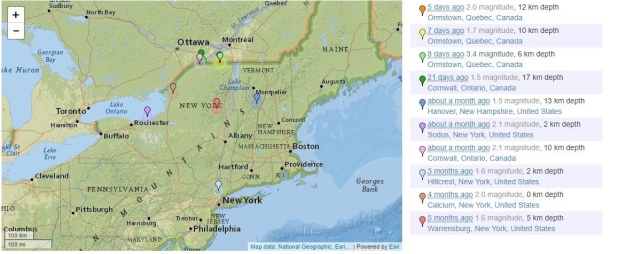
Photo: Screenshot
It seems that many of the quakes had an epicenter that was just along the border between the United States and Canada, with only two occurring a good distance away from the border. It is not clear what is causing this recent flurry of seismic activity, although there are a variety of different theories.
These recent quakes also come at a time of heightened volcanic activity around the earth, with many eruptions taking place around the world in the past month. Some researchers speculate that the earthquakes and volcanic eruptions could somehow be linked, but this is mostly speculation, as it has not been significantly proven that volcanic eruptions can trigger other earthquakes or eruptions a long distance away, although it has been proven that this phenomenon takes place if volcanoes are in close proximity.
Meanwhile, many activists suggest that the quakes have been caused by the practice of “hydraulic fracturing,” which is a natural gas extraction method that has become extremely controversial for its environmental impacts. Also known as “fracking,” this extraction process involves drilling down into the earth, then directing a high-pressure water mixture at the rock below to release the gas inside. Water, sand, and chemicals are injected into the rock at high pressure, which allows the gas to flow out to the head of the well. Wastewater produced from this process is highly toxic and filled with a variety of chemicals.
The government in the UK recently issued a temporary ban on fracking throughout the country until scientists can prove that it is actually safe. The ban came in response to concerns that fracking sites were poising water supplies and disrupting the earth’s crust in a way that was causing a large number of earthquakes.

Sunday, March 10, 2019

New Jersey #1 Disaster State: The Sixth Seal (Rev 6:12)


States of danger
Kiplinger News
Disasters can happen anywhere and at any time. But some places experience more than their fair share of floods, tornadoes, hurricanes, winter storms and severe weather — so much so that certain locales earn frightening nicknames, such as Tornado Alley. No matter where you live, make sure you have the right kinds and necessary amounts of insurance coverage to protect your finances.
No. 1: New Jersey
• Estimated property damage (2006-2013): $26.4 billion
• Most frequent disasters: damaging wind, winter storms, floods and flash floods
• Weather-related fatalities (2006-2013): 87
New Jersey earns the top spot on this list, in large part due to damage wrought by Sandy — which had weakened from a hurricane to a post-tropical cyclone by the time it the Jersey Shore — in October 2012. The state was among the hardest hit by Sandy, which was the second-costliest storm in U.S. history, after Hurricane Katrina. Many homes and businesses were destroyed along the Jersey Shore, and a portion of the Atlantic City Boardwalk washed away. Shortly after Sandy hit, another storm brought wet snow that caused more power outages and damage.
Homeowners who live along the coast or in areas where there are frequent storms should take steps before hurricane season begins to protect their homes and finances from damage.

Sunday, February 18, 2018

Indian Point shuts down again before the Sixth Seal

Indian Point reactor automatically shuts down again, feds investigating
Thomas C. ZambitoUpdated 22
Indian Point officials say no radiation was released during the shutown
This is the second time in four months that a component in the generator failed, forcing a shut down
Unit 3 shut down after a generator failed on the non-nuclear side of the power plant.
Show Caption
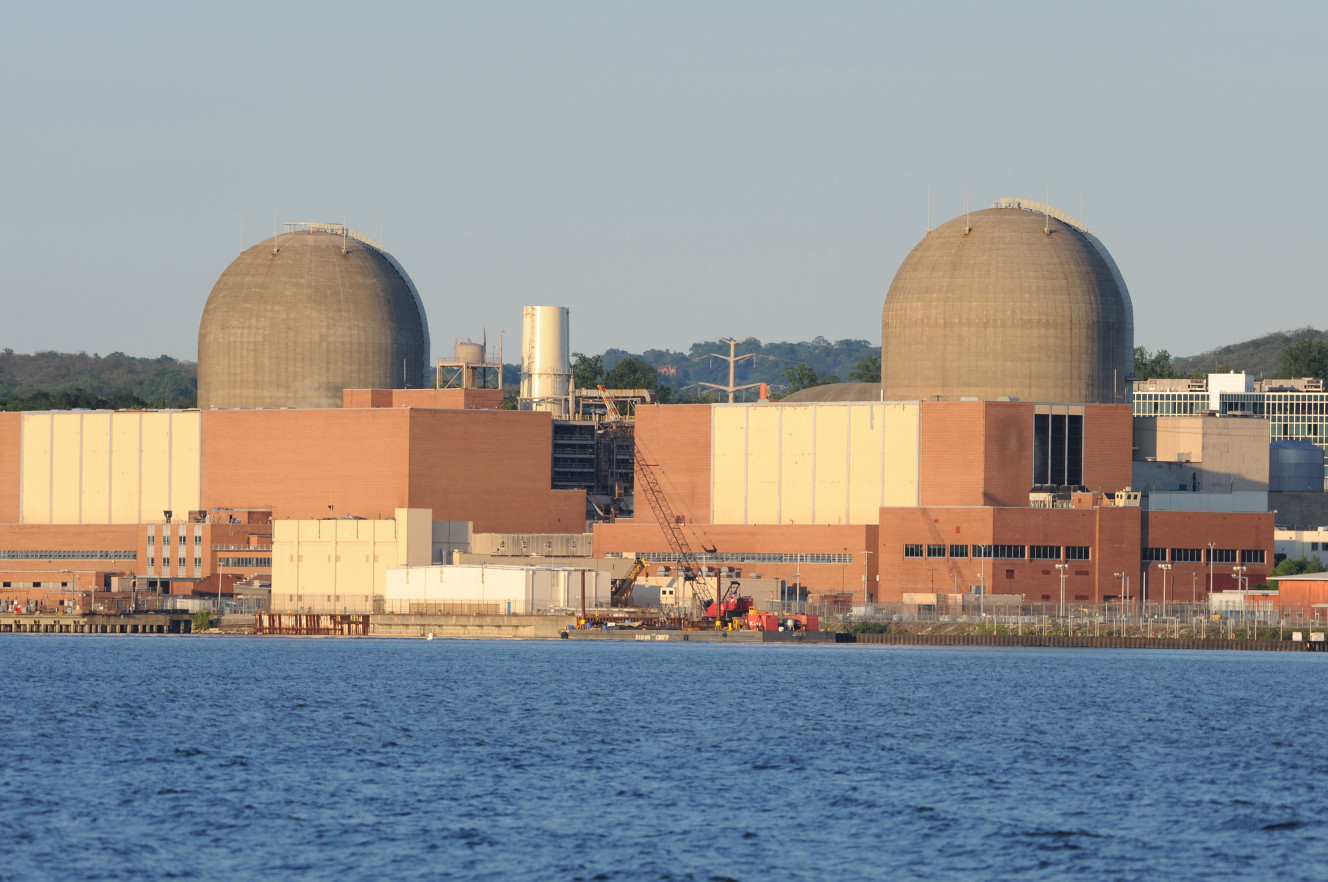
One of Indian Point’s two nuclear reactors automatically shut down early Friday when a generator failed, prompting an inquiry by the Nuclear Regulatory Commission.
This is the second time in four months that Indian Point’s Unit 3 shut down after an issue with a generator on the non-nuclear side of the pressurized water reactor.
This aerial view of the Indian Point nuclear power station, located in Buchanan, N.Y. and taken ...more
Spencer Ainsley
A spokesman for Indian Point's owner, Entergy, said no radiation was released during the shutdown. “Engineers are investigating to more fully understand the cause of the shutdown before the unit is returned to service,” spokesman Jerry Nappi said.
SHUTDOWN: Indian Point reactor back up and running after six-day shutdown
LEAKS: Nuclear Regulatory Commission says Indian Point must resolve leak issue in reactors
WASTE: Nuclear waste stranded at Indian Point
In both shutdowns, a component in the electrical generator system failed.
Indian Point’s second reactor, Unit 2, was functioning at 100 percent of its capacity.
NRC’s resident inspector for Indian Point visited the plant shortly after being notified of the shutdown, NRC spokesman Neil Sheehan said.
“He traveled to the control room, where he observed shutdown activities and independently verified plant safety conditions,” Sheehan said. “No immediate safety concerns were identified.”
The NRC will continue monitoring repairs and plans to restart the unit. It took six days to restore power following the November shutdown.
Nappi said officials will try to determine whether there are any common issues between the two shutdowns.
During a test of Indian Point's emergency warning system Wednesday, two of 172 sirens – one in Putnam County, the other in Rockland County -- failed to sound. Both sirens have since been repaired.
Entergy has plans to shut down Indian Point by 2021.

Friday, February 16, 2018

More Problems at Indian Point Before the Sixth Seal

See the source image2 Indian Point sirens fail to sound during test

Posted: Feb 14, 2018 4:57 AM MST Updated: Feb 14, 2018 10:42 AM MST
BUCHANAN - Two sirens failed to sound during a test of the emergency siren system at the Indian Point power plant in Buchanan today.
Only 170 of 172 sirens went off  and could be heard for four full minutes in Westchester, Rockland, Putnam and Orange counties. One siren in Putnam and another in Orange County did not sound. Indian Point offcials say they are investigating to find out why the sirens didn’t sound.
Plant officials stress that the sirens are not a signal to evacuate. In an actual emergency, the sirens will sound at full volume to alert the public to tune in to a local EAS radio or television station for important information and direction.
The plant generates as much as 30 percent of the electricity used in New York City and Westchester County. The plant is scheduled to be taken completely offline by 2021 after an agreement between Gov. Andrew Cuomo's office and Entergy, the company that owns Indian Point.

Wednesday, February 14, 2018

More Problems at Indian Nuclear Point before the Sixth Seal

indian-point-cuomo

More problems with closing Indian Point

By Post Editorial Board

New Yorkers, especially in Westchester, just got another painful reminder of the cost of Gov. Cuomo’s foolish drive to shut the Indian Point nuclear power plant.
Last week, Rep. Nita Lowey (D-West­chester) introduced three bills to deal with some consequences — namely, the risks of storing spent fuel rods on-site and the loss of tax revenue to the local communities.
The bills would require that safety-related fines against the plant go to the communities. They would also speed up removal of the spent rods and bolster safety in the interim.
The loss of a major source of reliable power (Indian Point supplies 25 percent of the electricity for the city and its environs) is still the top concern here. But ending Indian Point’s tax payments also presents huge problems: The plant funds half Buchanan’s budget. Cortlandt and the Hendrick Hudson School District’s finances are at risk, too.
These communities face combined losses of some $32 million a year. Residents must worry about daunting tax hikes — even as many will lose their jobs if the plant closes as scheduled by 2021.
Lowey, who supports the shutdown, is grasping for ways to deal with the blowback. It’d be better to keep the plant open and preserve a pillar of the region’s economy — but that would mean facing down the hysterical fearmongers.

Wednesday, November 29, 2017

More Problems at Indian Nuclear Point before the Sixth Seal

More problems with closing Indian PointMore problems with closing Indian PointMore problems with closing Indian PointMore problems with closing Indian Pointindian-point-cuomo

More problems with closing Indian Point

By Post Editorial Board

New Yorkers, especially in Westchester, just got another painful reminder of the cost of Gov. Cuomo’s foolish drive to shut the Indian Point nuclear power plant.
Last week, Rep. Nita Lowey (D-West­chester) introduced three bills to deal with some consequences — namely, the risks of storing spent fuel rods on-site and the loss of tax revenue to the local communities.
The bills would require that safety-related fines against the plant go to the communities. They would also speed up removal of the spent rods and bolster safety in the interim.
The loss of a major source of reliable power (Indian Point supplies 25 percent of the electricity for the city and its environs) is still the top concern here. But ending Indian Point’s tax payments also presents huge problems: The plant funds half Buchanan’s budget. Cortlandt and the Hendrick Hudson School District’s finances are at risk, too.
These communities face combined losses of some $32 million a year. Residents must worry about daunting tax hikes — even as many will lose their jobs if the plant closes as scheduled by 2021.
Lowey, who supports the shutdown, is grasping for ways to deal with the blowback. It’d be better to keep the plant open and preserve a pillar of the region’s economy — but that would mean facing down the hysterical fearmongers.