Tuesday, December 23, 2025

On the Road to America’s Next Devastating Earthquake in NYC: Revelation 6


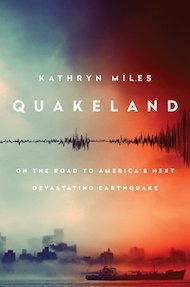
Quakeland: On the Road to America’s Next Devastating Earthquake
Roger BilhamQuakeland: New York and the Sixth Seal (Revelation 6:12)
Given recent seismic activity — political as well as geological — it’s perhaps unsurprising that two books on earthquakes have arrived this season. One is as elegant as the score of a Beethoven symphony; the other resembles a diary of conversations overheard during a rock concert. Both are interesting, and both relate recent history to a shaky future.
Journalist Kathryn Miles’s Quakeland is a litany of bad things that happen when you provoke Earth to release its invisible but ubiquitous store of seismic-strain energy, either by removing fluids (oil, water, gas) or by adding them in copious quantities (when extracting shale gas in hydraulic fracturing, also known as fracking, or when injecting contaminated water or building reservoirs). To complete the picture, she describes at length the bad things that happen during unprovoked natural earthquakes. As its subtitle hints, the book takes the form of a road trip to visit seismic disasters both past and potential, and seismologists and earthquake engineers who have first-hand knowledge of them. Their colourful personalities, opinions and prejudices tell a story of scientific discovery and engineering remedy.
Miles poses some important societal questions. Aside from human intervention potentially triggering a really damaging earthquake, what is it actually like to live in neighbourhoods jolted daily by magnitude 1–3 earthquakes, or the occasional magnitude 5? Are these bumps in the night acceptable? And how can industries that perturb the highly stressed rocks beneath our feet deny obvious cause and effect? In 2015, the Oklahoma Geological Survey conceded that a quadrupling of the rate of magnitude-3 or more earthquakes in recent years, coinciding with a rise in fracking, was unlikely to represent a natural process. Miles does not take sides, but it’s difficult for the reader not to.
She visits New York City, marvelling at subway tunnels and unreinforced masonry almost certainly scheduled for destruction by the next moderate earthquake in the vicinity. She considers the perils of nuclear-waste storage in Nevada and Texas, and ponders the risks to Idaho miners of rock bursts — spontaneous fracture of the working face when the restraints of many million years of confinement are mined away. She contemplates the ups and downs of the Yellowstone Caldera — North America’s very own mid-continent supervolcano — and its magnificently uncertain future. Miles also touches on geothermal power plants in southern California’s Salton Sea and elsewhere; the vast US network of crumbling bridges, dams and oil-storage farms; and the magnitude 7–9 earthquakes that could hit California and the Cascadia coastline of Oregon and Washington state this century. Amid all this doom, a new elementary school on the coast near Westport, Washington, vulnerable to inbound tsunamis, is offered as a note of optimism. With foresight and much persuasion from its head teacher, it was engineered to become an elevated safe haven.
Miles briefly discusses earthquake prediction and the perils of getting it wrong (embarrassment in New Madrid, Missouri, where a quake was predicted but never materialized; prison in L’Aquila, Italy, where scientists failed to foresee a devastating seismic event) and the successes of early-warning systems, with which electronic alerts can be issued ahead of damaging seismic waves. Yes, it’s a lot to digest, but most of the book obeys the laws of physics, and it is a engaging read. One just can’t help wishing that Miles’s road trips had taken her somewhere that wasn’t a disaster waiting to happen.
Catastrophic damage in Anchorage, Alaska, in 1964, caused by the second-largest earthquake in the global instrumental record.
In The Great Quake, journalist Henry Fountain provides us with a forthright and timely reminder of the startling historical consequences of North America’s largest known earthquake, which more than half a century ago devastated southern Alaska. With its epicentre in Prince William Sound, the 1964 quake reached magnitude 9.2, the second largest in the global instrumental record. It released more energy than either the 2004 Sumatra–Andaman earthquake or the 2011 Tohoku earthquake off Japan; and it generated almost as many pages of scientific commentary and description as aftershocks. Yet it has been forgotten by many.
The quake was scientifically important because it occurred at a time when plate tectonics was in transition from hypothesis to theory. Fountain expertly traces the theory’s historical development, and how the Alaska earthquake was pivotal in nailing down one of the most important predictions. The earthquake caused a fjordland region larger than England to subside, and a similarly huge region of islands offshore to rise by many metres; but its scientific implications were not obvious at the time. Eminent seismologists thought that a vertical fault had slipped, drowning forests and coastlines to its north and raising beaches and islands to its south. But this kind of fault should have reached the surface, and extended deep into Earth’s mantle. There was no geological evidence of a monster surface fault separating these two regions, nor any evidence for excessively deep aftershocks. The landslides and liquefied soils that collapsed houses, and the tsunami that severely damaged ports and infrastructure, offered no clues to the cause.
“Previous earthquakes provide clear guidance about present-day vulnerability.” The hero of The Great Quake is the geologist George Plafker, who painstakingly mapped the height reached by barnacles lifted out of the intertidal zone along shorelines raised by the earthquake, and documented the depths of drowned forests. He deduced that the region of subsidence was the surface manifestation of previously compressed rocks springing apart, driving parts of Alaska up and southwards over the Pacific Plate. His finding confirmed a prediction of plate tectonics, that the leading edge of the Pacific Plate plunged beneath the southern edge of Alaska along a gently dipping thrust fault. That observation, once fully appreciated, was applauded by the geophysics community.
Fountain tells this story through the testimony of survivors, engineers and scientists, interweaving it with the fascinating history of Alaska, from early discovery by Europeans to purchase from Russia by the United States in 1867, and its recent development. Were the quake to occur now, it is not difficult to envisage that with increased infrastructure and larger populations, the death toll and price tag would be two orders of magnitude larger than the 139 fatalities and US$300-million economic cost recorded in 1964.
What is clear from these two books is that seismicity on the North American continent is guaranteed to deliver surprises, along with unprecedented economic and human losses. Previous earthquakes provide clear guidance about the present-day vulnerability of US infrastructure and populations. Engineers and seismologists know how to mitigate the effects of future earthquakes (and, in mid-continent, would advise against the reckless injection of waste fluids known to trigger earthquakes). It is merely a matter of persuading city planners and politicians that if they are tempted to ignore the certainty of the continent’s seismic past, they should err on the side of caution when considering its seismic future.

USA’s Fukushima At The Sixth Seal in New York (Revelation 6)

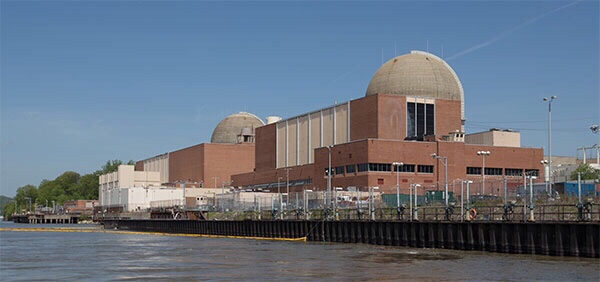
https://blogger.googleusercontent.com/img/b/R29vZ2xl/AVvXsEiwxKqptJjF3dQRDopSk4rL1Fu0lpui59K_RYxZGXXH6FXpHL59qqlplf4J4G_sfPVIEt2t2Z91EliclsBnzQpWdGF2Kx0WrWN96KJJfwu4uHteognTlv__3qJz4irNjRQG5_4IoyIDxw8/s1600/Shut_Down_Indian_Point_March.jpg


Ernie Garcia, elgarcia@lohud.com
A review of unplanned shutdowns from January 2012 to the present showed this year’s events happened within a short time frame, between May 7 and July 8, in contrast with events from other years that were more spread out, according to data released by Indian Point.
If a nuclear plant has more than three unplanned shutdowns in a nine-month period, its performance indicator could be changed by the federal Nuclear Regulatory Commission, which results in additional oversight. That’s what happened with Entergy’s Pilgrim Nuclear Power Station in Plymouth, Mass., after four unplanned shutdowns in 2013.
So far, Entergy said there doesn’t appear to be a pattern to the Indian Point shutdowns.
“You do want to look at these events holistically to see if there is something in common, but you also look individually to see what the causes were,” Nappi said. “A plant shutdown in and of itself is not a safety issue.”
One of the four recent Buchanan shutdowns triggered a special inspection by the NRC and calls to close the nuclear plant by environmental groups and elected officials. Gov. Andrew Cuomo has said in the past Indian Point should close, but his office did not respond to a request for comment about whether the recent shutdowns have prompted any state scrutiny.
The NRC is expected to release a quarterly report on Indian Point this month that will address the transformer failure and, by year’s end, is planning an inspection of the transformer and an analysis of transformer issues since 2007.
Besides its transformer-related inquiries, the other three shutdowns have not raised “any immediate safety concerns or crossed any thresholds that would result in additional NRC oversight,” agency spokesman Neil Sheehan wrote in an email.
The unplanned shutdowns at Indian Point and Pilgrim in Massachusetts were  mostly preventable, said Paul Blanch, a former Indian Point employee with 45 years of nuclear power experience.
“For this to happen this frequently indicates a deeper problem,” he said. “I believe it’s management oversight in the maintenance of these plants.”
Nappi said the transformer that failed May 9 and caused a fire and oil spill into the Hudson was regularly monitored. Investigators determined the failure was due to faulty insulation.
“The transformer inspection and reviews were in accordance with our standards and industry expectations, yet there was no indication the transformer was going to fail,” Nappi said.
The NRC conducted a separate, but related special inspection into the May 9 incident that focused on a half-inch of water that collected in an electrical switchgear room floor. Inspectors determined a fire suppression system’s valve failed to close properly.
Inspectors noted in their report that Entergy knew about that problem since April 2011 and replaced the valve but didn’t discover the actual cause — a dysfunctional switch — until after the fire.
Indian Point’s Unit 3 was down 19 days May through July, with the transformer failure accounting for 16 days. The shutdowns didn’t cause the public any supply problems because New York’s grid can import electricity from other states and New York has an energy plan to maintain reliability, according to the U.S. Energy Information Administration.
The nuclear energy industry judges a power plant on how continuously it produces energy, which is called a capacity factor.
There were 100 nuclear plants in the United States in 2014, a record year in terms of efficiency. In January, the Nuclear Energy Institute announced the U.S. average capacity factor was 91.9 percent.
Indian Point has an above-average efficiency rate. The plant’s Unit 2 and 3 reactors were each online more than 99 percent of the time during their most recent two-year operating cycles. They are currently in the middle of other cycles.

Saturday, December 20, 2025

The Sixth Seal of NYC Long Overdue (Revelation 6)


The Big One Awaits
By MARGO NASH
Published: March 25, 2001
Alexander Gates, a geology professor at Rutgers-Newark, is co-author of “The Encyclopedia of Earthquakes and Volcanoes,“ which will be published by Facts on File in July. He has been leading a four-year effort to remap an area known as the Sloatsburg Quadrangle, a 5-by-7-mile tract near Mahwah that crosses into New York State. The Ramapo Fault, which runs through it, was responsible for a big earthquake in 1884, and Dr. Gates warns that a recurrence is overdue. He recently talked about his findings.
Q. What have you found?
A. We’re basically looking at a lot more rock, and we’re looking at the fracturing and jointing in the bedrock and putting it on the maps. Any break in the rock is a fracture. If it has movement, then it’s a fault. There are a lot of faults that are offshoots of the Ramapo. Basically when there are faults, it means you had an earthquake that made it. So there was a lot of earthquake activity to produce these features. We are basically not in a period of earthquake activity along the Ramapo Fault now, but we can see that about six or seven times in history, about 250 million years ago, it had major earthquake activity. And because it’s such a fundamental zone of weakness, anytime anything happens, the Ramapo Fault goes.
Q. Where is the Ramapo Fault?
 A. The fault line is in western New Jersey and goes through a good chunk of the state, all the way down to Flemington. It goes right along where they put in the new 287. It continues northeast across the Hudson River right under the Indian Point power plant up into Westchester County. There are a lot of earthquakes rumbling around it every year, but not a big one for a while.
Q. Did you find anything that surprised you?
A. I found a lot of faults, splays that offshoot from the Ramapo that go 5 to 10 miles away from the fault. I have looked at the Ramapo Fault in other places too. I have seen splays 5 to 10 miles up into the Hudson Highlands. And you can see them right along the roadsides on 287. There’s been a lot of damage to those rocks, and obviously it was produced by fault activities. All of these faults have earthquake potential.
Q. Describe the 1884 earthquake.
A. It was in the northern part of the state near the Sloatsburg area. They didn’t have precise ways of describing the location then. There was lots of damage. Chimneys toppled over. But in 1884, it was a farming community, and there were not many people to be injured. Nobody appears to have written an account of the numbers who were injured.
Q. What lessons we can learn from previous earthquakes?
A. In 1960, the city of Agadir in Morocco had a 6.2 earthquake that killed 12,000 people, a third of the population, and injured a third more. I think it was because the city was unprepared.There had been an earthquake in the area 200 years before. But people discounted the possibility of a recurrence. Here in New Jersey, we should not make the same mistake. We should not forget that we had a 5.4 earthquake 117 years ago. The recurrence interval for an earthquake of that magnitude is every 50 years, and we are overdue. The Agadir was a 6.2, and a 5.4 to a 6.2 isn’t that big a jump.
Q. What are the dangers of a quake that size?
A. When you’re in a flat area in a wooden house it’s obviously not as dangerous, although it could cut off a gas line that could explode. There’s a real problem with infrastructure that is crumbling, like the bridges with crumbling cement. There’s a real danger we could wind up with our water supplies and electricity cut off if a sizable earthquake goes off. The best thing is to have regular upkeep and keep up new building codes. The new buildings will be O.K. But there is a sense of complacency.
MARGO NASH

On the Road to America’s Next Devastating Earthquake NYC: Revelation 6


Quakeland: On the Road to America’s Next Devastating Earthquake
Roger BilhamQuakeland: New York and the Sixth Seal (Revelation 6:12)
Given recent seismic activity — political as well as geological — it’s perhaps unsurprising that two books on earthquakes have arrived this season. One is as elegant as the score of a Beethoven symphony; the other resembles a diary of conversations overheard during a rock concert. Both are interesting, and both relate recent history to a shaky future.
Journalist Kathryn Miles’s Quakeland is a litany of bad things that happen when you provoke Earth to release its invisible but ubiquitous store of seismic-strain energy, either by removing fluids (oil, water, gas) or by adding them in copious quantities (when extracting shale gas in hydraulic fracturing, also known as fracking, or when injecting contaminated water or building reservoirs). To complete the picture, she describes at length the bad things that happen during unprovoked natural earthquakes. As its subtitle hints, the book takes the form of a road trip to visit seismic disasters both past and potential, and seismologists and earthquake engineers who have first-hand knowledge of them. Their colourful personalities, opinions and prejudices tell a story of scientific discovery and engineering remedy.
Miles poses some important societal questions. Aside from human intervention potentially triggering a really damaging earthquake, what is it actually like to live in neighbourhoods jolted daily by magnitude 1–3 earthquakes, or the occasional magnitude 5? Are these bumps in the night acceptable? And how can industries that perturb the highly stressed rocks beneath our feet deny obvious cause and effect? In 2015, the Oklahoma Geological Survey conceded that a quadrupling of the rate of magnitude-3 or more earthquakes in recent years, coinciding with a rise in fracking, was unlikely to represent a natural process. Miles does not take sides, but it’s difficult for the reader not to.
She visits New York City, marvelling at subway tunnels and unreinforced masonry almost certainly scheduled for destruction by the next moderate earthquake in the vicinity. She considers the perils of nuclear-waste storage in Nevada and Texas, and ponders the risks to Idaho miners of rock bursts — spontaneous fracture of the working face when the restraints of many million years of confinement are mined away. She contemplates the ups and downs of the Yellowstone Caldera — North America’s very own mid-continent supervolcano — and its magnificently uncertain future. Miles also touches on geothermal power plants in southern California’s Salton Sea and elsewhere; the vast US network of crumbling bridges, dams and oil-storage farms; and the magnitude 7–9 earthquakes that could hit California and the Cascadia coastline of Oregon and Washington state this century. Amid all this doom, a new elementary school on the coast near Westport, Washington, vulnerable to inbound tsunamis, is offered as a note of optimism. With foresight and much persuasion from its head teacher, it was engineered to become an elevated safe haven.
Miles briefly discusses earthquake prediction and the perils of getting it wrong (embarrassment in New Madrid, Missouri, where a quake was predicted but never materialized; prison in L’Aquila, Italy, where scientists failed to foresee a devastating seismic event) and the successes of early-warning systems, with which electronic alerts can be issued ahead of damaging seismic waves. Yes, it’s a lot to digest, but most of the book obeys the laws of physics, and it is a engaging read. One just can’t help wishing that Miles’s road trips had taken her somewhere that wasn’t a disaster waiting to happen.
Catastrophic damage in Anchorage, Alaska, in 1964, caused by the second-largest earthquake in the global instrumental record.
In The Great Quake, journalist Henry Fountain provides us with a forthright and timely reminder of the startling historical consequences of North America’s largest known earthquake, which more than half a century ago devastated southern Alaska. With its epicentre in Prince William Sound, the 1964 quake reached magnitude 9.2, the second largest in the global instrumental record. It released more energy than either the 2004 Sumatra–Andaman earthquake or the 2011 Tohoku earthquake off Japan; and it generated almost as many pages of scientific commentary and description as aftershocks. Yet it has been forgotten by many.
The quake was scientifically important because it occurred at a time when plate tectonics was in transition from hypothesis to theory. Fountain expertly traces the theory’s historical development, and how the Alaska earthquake was pivotal in nailing down one of the most important predictions. The earthquake caused a fjordland region larger than England to subside, and a similarly huge region of islands offshore to rise by many metres; but its scientific implications were not obvious at the time. Eminent seismologists thought that a vertical fault had slipped, drowning forests and coastlines to its north and raising beaches and islands to its south. But this kind of fault should have reached the surface, and extended deep into Earth’s mantle. There was no geological evidence of a monster surface fault separating these two regions, nor any evidence for excessively deep aftershocks. The landslides and liquefied soils that collapsed houses, and the tsunami that severely damaged ports and infrastructure, offered no clues to the cause.
“Previous earthquakes provide clear guidance about present-day vulnerability.” The hero of The Great Quake is the geologist George Plafker, who painstakingly mapped the height reached by barnacles lifted out of the intertidal zone along shorelines raised by the earthquake, and documented the depths of drowned forests. He deduced that the region of subsidence was the surface manifestation of previously compressed rocks springing apart, driving parts of Alaska up and southwards over the Pacific Plate. His finding confirmed a prediction of plate tectonics, that the leading edge of the Pacific Plate plunged beneath the southern edge of Alaska along a gently dipping thrust fault. That observation, once fully appreciated, was applauded by the geophysics community.
Fountain tells this story through the testimony of survivors, engineers and scientists, interweaving it with the fascinating history of Alaska, from early discovery by Europeans to purchase from Russia by the United States in 1867, and its recent development. Were the quake to occur now, it is not difficult to envisage that with increased infrastructure and larger populations, the death toll and price tag would be two orders of magnitude larger than the 139 fatalities and US$300-million economic cost recorded in 1964.
What is clear from these two books is that seismicity on the North American continent is guaranteed to deliver surprises, along with unprecedented economic and human losses. Previous earthquakes provide clear guidance about the present-day vulnerability of US infrastructure and populations. Engineers and seismologists know how to mitigate the effects of future earthquakes (and, in mid-continent, would advise against the reckless injection of waste fluids known to trigger earthquakes). It is merely a matter of persuading city planners and politicians that if they are tempted to ignore the certainty of the continent’s seismic past, they should err on the side of caution when considering its seismic future.

The Year of the Sixth Seal in NYC 2026 (Revelation 6:12)

          15073790937_a2b5f1e61f_bSloshing of Earth’s core may spike major earthquakes

By Paul VoosenOct. 30, 2017 , 1:45 PM

The number of major earthquakes, like the magnitude-7 one that devastated Haiti in 2010, seems to be correlated with minute fluctuations in day length.
SEATTLE—The world doesn’t stop spinning. But every so often, it slows down. For decades, scientists have charted tiny fluctuations in the length of Earth’s day: Gain a millisecond here, lose a millisecond there. Last week at the annual meeting of the Geological Society of America here, two geophysicists argued that these minute changes could be enough to influence the timing of major earthquakes—and potentially help forecast them.
During the past 100 years, Earth’s slowdowns have correlated surprisingly well with periods with a global increase in magnitude-7 and larger earthquakes, according to Roger Bilham of the University of Colorado (CU) in Boulder and Rebecca Bendick at the University of Montana in Missoula. Usefully, the spike, which adds two to five more quakes than typical, happens well after the slow-down begins. “The Earth offers us a 5-years heads up on future earthquakes, which is remarkable,” says Bilham, who presented the work.
Most seismologists agree that earthquake prediction is a minefield. And so far, Bilham and Bendick have only fuzzy, hard-to-test ideas about what might cause the pattern they found. But the finding is too provocative to ignore, other researchers say. “The correlation they’ve found is remarkable, and deserves investigation,” says Peter Molnar, a geologist also at CU.
The research started as a search for synchrony in earthquake timing. Individual oscillators, be they fireflies, heart muscles, or metronomes, can end up vibrating in synchrony as a result of some kind of cross-talk—or some common influence. To Bendick, it didn’t seem a far jump to consider the faults that cause earthquakes, with their cyclical buildup of strain and violent discharge, as “really noisy, really crummy oscillators,” she says. She and Bilham dove into the data, using the only complete earthquake catalog for the past 100 years: magnitude-7 and larger earthquakes.
In work published in August in Geophysical Research Letters they reported two patterns: First, major quakes appeared to cluster in time
—although not in space. And second, the number of large earthquakes seemed to peak at 32-year intervals. The earthquakes could be somehow talking to each other, or an external force could be nudging the earth into rupture.
Exploring such global forces, the researchers eventually discovered the match with the length of day. Although weather patterns such as El Nino can drive day length to vary back and forth by a millisecond over a year or more, a periodic, decades-long fluctuation of several milliseconds—in particular, its point of peak slow down about every three decades or so—lined up with the quake trend perfectly. "Of course that seems sort of crazy," Bendick says. But maybe it isn’t. When day length changes over decades, Earth’s magnetic field also develops a temporary ripple. Researchers think slight changes in the flow of the molten iron of the outer core may be responsible for both effects. Just what happens is uncertain—perhaps a bit of the molten outer core sticks to the mantle above. That might change the flow of the liquid metal, altering the magnetic field, and transfer enough momentum between the mantle and the core to affect day length.
Seismologists aren’t used to thinking about the planet’s core, buried 2900 kilometers beneath the crust where quakes happen. But they should, Bilham said during his talk here. The core is “quite close to us. It’s closer than New York from here,” he said.
At the equator, Earth spins 460 meters per second. Given this high velocity, it’s not absurd to think that a slight mismatch in speed between the solid crust and mantle and the liquid core could translate into a force somehow nudging quakes into synchrony, Molnar says. Of course, he adds, “It might be nonsense.” But the evidence for some kind of link is compelling, says geophysicist Michael Manga of the University of California, Berkeley. “I’ve worked on earthquakes triggered by seasonal variation, melting snow. His correlation is much better than what I’m used to seeing.”
One way or another, says James Dolan, a geologist at the University of Southern California in Los Angeles, “we’re going to know in 5 years.” That’s because Earth’s rotation began a periodic slow-down 4-plus years ago. Beginning next year, Earth should expect five more major earthquakes a year than average—between 17 to 20 quakes, compared with the anomalously low four so far this year. If the pattern holds, it will put a new spin on earthquake forecasting.
doi:10.1126/science.aar3598

Friday, December 19, 2025

Too Little Too Late (Revelation 6:12)

Image result for indian pointBuchanan Mayor Talks About Game Plan For Indian Point Closure
  MAY 28, 2019
Less than a year from now, one of two reactors at New York’s Indian Point nuclear power plant will be permanently shut down. The second is slated for closure by April 30, 2021. Indian Point is in Buchanan, where Theresa Knickerbocker is mayor. She spoke with WAMC’s Hudson Valley Bureau Chief Allison Dunne about plans to replace revenue from the plant and more.
Indian Point is the largest employer and taxpayer in the village and surrounding communities. A bill recently introduced by Democrat Sandy Galef in the state Assembly would allow spent fuel rods, whether stored in pools or dry cask storage, to be taxed as real property. And with Buchanan standing to lose close to 50 percent of its revenue from Indian Point’s closure, Knickerbocker welcomes the possibility of making up for some of the loss.
She says securing a new revenue source from storing spent fuel would be novel in New York.
The surprise January 2017 announcement that an agreement had been reached to permanently close Westchester County-based Indian Point left Knickerbocker scratching her head about a new PILOT, or payment in lieu of taxes, deal.
Knickerbocker says she just focused on how to move forward.
And part of that game plan includes economic development, along with exploring shared services with the county and other municipalities. Knickerbocker addresses work on the state Indian Point Closure Task Force, of which she’s a member.
She says a biotech firm had inquired but needed the site ready within the year, which the village wasn’t sure it could pull off in time. She says another business is looking for financing, but declined to speak more about it. In April, Indian Point’s parent company Entergy announced it would sell the plant after shutting down to a subsidiary of Holtec International. Meantime, Knickerbocker is up for re-election to a fourth, two-year term in March 2020.
Independent Theresa Knickerbocker is mayor of the Village of Buchanan, home to the Indian Point nuclear power plant.

Thursday, December 18, 2025

The Sixth Seal by Nostradamus (Revelation 6:12)


The Sixth Seal by Nostradamus
To Andrew the Prophet
Completed February 5, 2008
Nostradamus and the New City
Les Propheties
(Century 1 Quatrain 27)
Michel de Nostredame Earth-shaking fire from the center of the earth.Will cause the towers around the New City to shake,Two great rocks for a long time will make war, And then Arethusa will color a new river red.(And then areth USA will color a new river red.) Earth-shaking fire from the center of the earth.Will cause the towers around the New City to shake,Two great rocks for a long time will make war
There is recent scientific evidence from drill core sampling in Manhattan, that the southern peninsula is overlapped by several tectonic plates. Drill core sampling has been taken from regions south of Canal Street including the Trade Towers’ site. Of particular concern is that similar core samples have been found across the East River in Brooklyn. There are also multiple fault lines along Manhattan correlating with north-northwest and northwest trending neo-tectonic activity. And as recently as January and October of 2001, New York City has sustained earthquakes along these plates. For there are “two great rocks” or tectonic plates that shear across Manhattan in a northwestern pattern. And these plates “for a longtime will make war”, for they have been shearing against one other for millions of years. And on January 3 of 2010, when they makewar with each other one last time, the sixth seal shall be opened, and all will know that the end is near.
And then Arethusa will color a new river red.
Arethusa is a Greek mythological figure, a beautiful huntress and afollower of the goddess Artemis. And like Artemis, Arethusa would have nothing to do with me; rather she loved to run and hunt in the forest. But one day after an exhausting hunt, she came to a clear crystal stream and went in it to take a swim. She felt something from beneath her, and frightened she scampered out of the water. A voice came from the water, “Why are you leaving fair maiden?” She ran into the forest to escape, for the voice was from Alpheus, the god of the river. For he had fallen in love with her and became a human to give chase after her. Arethusa in exhaustion called out to Artemis for help, and the goddess hid her by changing her into a spring.But not into an ordinary spring, but an underground channel that traveled under the ocean from Greece to Sicily. But Alpheus being the god of the river, converted back into water and plunged downthe same channel after Arethusa. And thus Arethusa was captured by Artemis, and their waters would mingle together forever. And of great concern is that core samples found in train tunnels beneath the Hudson River are identical to those taken from southern Manhattan. Furthermore, several fault lines from the 2001 earthquakes were discovered in the Queen’s Tunnel Complex, NYC Water Tunnel #3. And a few years ago, a map of Manhattan drawn up in 1874 was discovered, showing a maze of underground waterways and lakes. For Manhattan was once a marshland and labyrinth of underground streams. Thus when the sixth seal is broken, the subways of the New City shall be flooded be Arethusa:the waters from the underground streams and the waters from the sea. And Arethusa shall be broken into two. And then Arethusa will color a new river red.
And then areth USA will color a new river red.
For Arethusa broken into two is areth USA. For areth (αρετη) is the Greek word for values. But the values of the USA are not based on morality, but on materialism and on wealth. Thus when the sixth seal is opened, Wall Street and our economy shall crash and “arethUSA”, the values of our economy shall fall “into the red.” “Then the kings of the earth and the great men and the commanders and the rich and the strong and every slave and free man hid themselves in the caves and among the rocks of the mountains; and they said to the mountains and to the rocks, ‘Fall on us and hide us from the presence of Him who sits on the throne, and from the wrath of the Lamb; for the great day of their wrath has come, and who is able to stand?’” (Revelation 6:15-17)

Wednesday, December 17, 2025

The History of Earthquakes Before the Sixth Seal — Revelation 6:12

   History of earthquakes in Lower Hudson Valley

Swapna Venugopal Ramaswamy
9:05 a.m. ET Feb. 7, 2018
At around 6:14 a.m. this morning, a 2.2-magnitude earthquake was reported about three miles northwest of Mohegan Lake in Yorktown, according to the United States Geological Survey. The epicenter of the quake was in Putnam Valley.
Social media was rife with posts on the quake with people from Chappaqua, Cortlandt, Lewisboro, Mahopac and Putnam Valley chiming in with their rattling experiences, though it wasn’t nearly as strong as the 5.0 earthquake our forefathers experienced here in 1783.
Lower Hudson Valley earthquakes through the years:
1783 — The epicenter of a magnitude 5.0 earthquake may have been the Westchester-Putnam county line and was felt as far south as Philadelphia.
1884 — A magnitude 5.2 earthquake was centered off Rockaway, Queens, causing property damage but no injuries to people. A dead dog was reported.
1970 to 1987 — Between these years, instruments at the Lamont-Doherty Observatory in Rockland County recorded 21 quakes in Westchester and two in Manhattan.
October 1985 — A magnitude 4.0 earthquake was centered in an unincorporated part of Greenburgh between Ardsley and Yonkers. Tremors shook the metropolitan area and were felt in Philadelphia, southern Canada and Long Island.
November 1988 — A quake 90 miles north of Quebec City in eastern Canada registered magnitude 6.0 with tremors felt in the Lower Hudson Valley and New York City.
June 1991 — A 4.4-magnitude quake struck west of Albany, rattling homes.
April 1991 — A quake registering between magnitude 2.0 and 2.6 struck Westchester and Fairfield, Conn. It lasted just five seconds and caused no damage.
https://tpc.googlesyndication.com/safeframe/1-0-15/html/container.html
January 2003 — Two small earthquakes struck the area surrounding Hastings-on-Hudson. One was a magnitude of 1.2, the other 1.4.
March 2006 — Two earthquakes struck Rockland. The first, at 1.1 magnitude, hit 3.3 miles southwest of Pearl River; the second, 1.3 magnitude, was centered in the West Nyack-Blauvelt-Pearl River area.
July 2014 — “Micro earthquake” struck, 3.1 miles beneath the Appalachian Trail in a heavily wooded area of Garrison.
January 2016 —  A 2.1 magnitude earthquake occurred at 12:58 a.m. northwest of Ringwood, N.J., and the earthquake was felt in the western parts of Ramapo, including the Hillburn and Sloatsburg areas.
April 2017 —  A 1.3 magnitude quake rumbled in Pawling on April 10. Putnam County residents in Brewster, Carmel, Patterson and Putnam Valley, as well as Dutchess County residents in Wingdale felt the earthquake.
Twitter: @SwapnaVenugopal

Tuesday, December 16, 2025

History Expects the Sixth Seal in NYC (Revelation 6:12)


If the past is any indication, New York can be hit by an earthquake, claims John Armbruster, a seismologist at Columbia University’s Lamont-Doherty Earth Observatory.
Based on historical precedent, Armbruster says the New York City metro area is susceptible to an earthquake of at least a magnitude of 5.0 once a century.
According to the New York Daily News, Lynn Skyes, lead author of a recent study by seismologists at the Lamont-Doherty Earth Observatory adds that a magnitude-6 quake hits the area about every 670 years, and magnitude-7 every 3,400 years.
A 5.2-magnitude quake shook New York City in 1737 and another of the same severity hit in 1884.
Tremors were felt from Maine to Virginia.
There are several fault lines in the metro area, including one along Manhattan’s 125th St. – which may have generated two small tremors in 1981 and may have been the source of the major 1737 earthquake, says Armbruster.
There’s another fault line on Dyckman St. and one in Dobbs Ferry in nearby Westchester County.
“The problem here comes from many subtle faults,” explained Skyes after the study was published.
He adds: “We now see there is earthquake activity on them. Each one is small, but when you add them up, they are probably more dangerous than we thought.”
“Considering population density and the condition of the region’s infrastructure and building stock, it is clear that even a moderate earthquake would have considerable consequences in terms of public safety and economic impact,” says the New York City Area Consortium for Earthquake Loss Mitigation on its website.
Armbruster says a 5.0-magnitude earthquake today likely would result in casualties and hundreds of millions of dollars in damage.
“I would expect some people to be killed,” he notes.
The scope and scale of damage would multiply exponentially with each additional tick on the Richter scale. (ANI)

Monday, December 15, 2025

The Sixth Seal (Revelation 6:12)

 NEW YORK IS 40 YEARS OVERDUE A MAJOR EARTHQUAKE AND AMERICA ISN'T PROPERLY PREPARED, 'QUAKELAND' AUTHOR KATHRYN MILES TELLS TREVOR NOAH

BY TUFAYEL AHMED ON 9/27/17 AT 9:28 AM
Updated | An earthquake is long overdue to hit New York and America isn’t prepared, author and environmental theorist Kathryn Miles told Trevor Noah on Tuesday’s Daily Show.
Miles is the author of a new book, Quakeland, which investigates how imminently an earthquake is expected in the U.S. and how well-prepared the country is to handle it. The answer to those questions: Very soon and not very well.
“We know it will, that’s inevitable, but we don’t know when,” said Miles when asked when to expect another earthquake in the U.S.
She warned that New York is in serious danger of being the site of the next one, surprising considering that the West Coast sits along the San Andreas fault line.
“New York is 40 years overdue for a significant earthquake...Memphis, Seattle, Washington D.C.—it’s a national problem,” said Miles.
Miles told Noah that though the U.S. is “really good at responding to natural disasters,” like the rapid response to the hurricanes in Texas and Florida, the country and its government is, in fact, lagging behind in its ability to safeguard citizens before an earthquake hits.
“We’re really bad at the preparedness side,” Miles responded when Noah asked how the infrastructure in the U.S. compares to Mexico’s national warning system, for example.
“Whether it’s the literal infrastructure, like our roads and bridges, or the metaphoric infrastructure, like forecasting, prediction, early warning systems. Historically, we’ve underfunded those and as a result we’re way behind even developing nations on those fronts.”
Part of the problem, Miles says, is that President Donald Trump and his White House are not concerned with warning systems that could prevent the devastation of natural disasters.
“We can invest in an early warning system. That’s one thing we can definitely do. We can invest in better infrastructures, so that when the quake happens, the damage is less,” said the author.
“The scientists, the emergency managers, they have great plans in place. We have the technology for an early warning system, we have the technology for tsunami monitoring. But we don’t have a president that is currently interested in funding that, and that’s a problem.”
This article has been updated to reflect that Miles said New York is the possible site of an upcoming earthquake, and not the likeliest place to be next hit by one.

1884 A Forewarning Of The Sixth Seal (Revelation 6:12)


The Coney Island earthquake of 1884

New York City isn’t immune to earthquakes; a couple of small tremors measuring about 2.5 on the Richter scale even struck back in 2001 and 2002.
The quake was subsequently thought to have been centered off Far Rockaway or Coney Island.
Translation: We’re about 30 years overdue. Lucky for us the city adopted earthquake-resistant building codes in 1995.

Sunday, December 14, 2025

Real Risk, Few Precautions (Revelation 6:12)

        By WILLIAM K. STEVENS

Published: October 24, 1989
AN EARTHQUAKE as powerful as the one that struck northern California last week could occur almost anywhere along the East Coast, experts say. And if it did, it would probably cause far more destruction than the West Coast quake.
The chances of such an occurrence are much less in the East than on the West Coast. Geologic stresses in the East build up only a hundredth to a thousandth as fast as in California, and this means that big Eastern quakes are far less frequent. Scientists do not really know what the interval between them might be, nor are the deeper-lying geologic faults that cause them as accessible to study. So seismologists are at a loss to predict when or where they will strike.
But they do know that a temblor with a magnitude estimated at 7 on the Richter scale – about the same magnitude as last week’s California quake – devastated Charleston, S.C., in 1886. And after more than a decade of study, they also know that geologic structures similar to those that caused the Charleston quake exist all along the Eastern Seaboard.
For this reason, ”we can’t preclude that a Charleston-sized earthquake might occur anywhere along the East Coast,” said David Russ, the assistant chief geologist of the United States Geological Survey in Reston, Va. ”It could occur in Washington. It could occur in New York.”
If that happens, many experts agree, the impact will probably be much greater than in California.Easterners, unlike Californians, have paid very little attention to making buildings and other structures earthquake-proof or earthquake-resistant. ”We don’t have that mentality here on the East Coast,” said Robert Silman, a New York structural engineer whose firm has worked on 3,800 buildings in the metropolitan area.
Moreover, buildings, highways, bridges, water and sewer systems and communications networks in the East are all older than in the West and consequently more vulnerable to damage. Even under normal conditions, for instance, water mains routinely rupture in New York City.
The result, said Dr. John Ebel, a geophysicist who is the assistant director of Boston College’s Weston Observatory, is that damage in the East would probably be more widespread, more people could be hurt and killed, depending on circumstances like time of day, and ”it would probably take a lot longer to get these cities back to useful operating levels.”
On top of this, scientists say, an earthquake in the East can shake an area 100 times larger than a quake of the same magnitude in California. This is because the earth’s crust is older, colder and more brittle in the East and tends to transmit seismic energy more efficiently. ”If you had a magnitude 7 earthquake and you put it halfway between New York City and Boston,” Dr. Ebel said, ”you would have the potential of doing damage in both places,” not to mention cities like Hartford and Providence.
Few studies have been done of Eastern cities’ vulnerability to earthquakes. But one, published last June in The Annals of the New York Academy of Sciences, calculated the effects on New York City of a magnitude 6 earthquake. That is one-tenth the magnitude of last week’s California quake, but about the same as the Whittier, Calif., quake two years ago.
The study found that such an earthquake centered 17 miles southeast of City Hall, off Rockaway Beach, would cause $11 billion in damage to buildings and start 130 fires. By comparison, preliminary estimates place the damage in last week’s California disaster at $4 billion to $10 billion. If the quake’s epicenter were 11 miles southeast of City Hall, the study found, there would be about $18 billion in damage; if 5 miles, about $25 billion.
No estimates on injuries or loss of life were made. But a magnitude 6 earthquake ”would probably be a disaster unparalleled in New York history,” wrote the authors of the study, Charles Scawthorn and Stephen K. Harris of EQE Engineering in San Francisco.
The study was financed by the National Center for Earthquake Engineering Research at the State University of New York at Buffalo. The research and education center, supported by the National Science Foundation and New York State, was established in 1986 to help reduce damage and loss of life from earthquakes.
The study’s postulated epicenter of 17 miles southeast of City Hall was the location of the strongest quake to strike New York since it has been settled, a magnitude 5 temblor on Aug. 10, 1884. That 1884 quake rattled bottles and crockery in Manhattan and frightened New Yorkers, but caused little damage. Seismologists say a quake of that order is likely to occur within 50 miles of New York City every 300 years. Quakes of magnitude 5 are not rare in the East. The major earthquake zone in the eastern half of the country is the central Mississippi Valley, where a huge underground rift causes frequent geologic dislocations and small temblors. The most powerful quake ever known to strike the United States occurred at New Madrid, Mo., in 1812. It was later estimated at magnitude 8.7 and was one of three quakes to strike that area in 1811-12, all of them stronger than magnitude 8. They were felt as far away as Washington, where they rattled chandeliers, Boston and Quebec.
Because the New Madrid rift is so active, it has been well studied, and scientists have been able to come up with predictions for the central Mississippi valley, which includes St. Louis and Memphis. According to Dr. Russ, there is a 40 to 63 percent chance that a quake of magnitude 6 will strike that area between now and the year 2000, and an 86 to 97 percent chance that it will do so by 2035. The Federal geologists say there is a 1 percent chance or less of a quake greater than magnitude 7 by 2000, and a 4 percent chance or less by 2035.
Elsewhere in the East, scientists are limited in their knowledge of probabilities partly because faults that could cause big earthquakes are buried deeper in the earth’s crust. In contrast to California, where the boundary between two major tectonic plates creates the San Andreas and related faults, the eastern United States lies in the middle of a major tectonic plate. Its faults are far less obvious, their activity far more subtle, and their slippage far slower. 
Any large earthquake would be ”vastly more serious” in the older cities of the East than in California,  said Dr. Tsu T. Soong, a professor of civil engineering at the State University of New York at Buffalo who is a researcher in earthquake-mitigation technology at the National Center for Earthquake Engineering Research. First, he said, many buildings are simply older, and therefore weaker and more  vulnerable to collapse. Second, there is no seismic construction code in most of the East as there is in California, where such codes have been in place for decades.
The vulnerability is evident in many ways. ”I’m sitting here looking out my window,” said Mr. Silman, the structural engineer in New York, ”and I see a bunch of water tanks all over the place” on rooftops. ”They are not anchored down at all, and it’s very possible they would fall in an earthquake.”
 Many brownstones, he said, constructed as they are of unreinforced masonry walls with wood joists between, ”would just go like a house of cards.” Unreinforced masonry, in fact, is the single most vulnerable structure, engineers say. Such buildings are abundant, even predominant, in many older cities. The Scawthorn-Harris study reviewed inventories of all buildings in Manhattan as of 1972 and found that 28,884, or more than half, were built of unreinforced masonry. Of those, 23,064 were three to five stories high.
Buildings of reinforced masonry, reinforced concrete and steel would hold up much better, engineers say, and wooden structures are considered intrinsically tough in ordinary circumstances. The best performers, they say, would probably be skyscrapers built in the last 20 years. As Mr. Silman explained, they have been built to withstand high winds, and the same structural features that enable them to do so also help them resist an earthquake’s force. But even these new towers have not been provided with the seismic protections required in California and so are more vulnerable than similar structures on the West Coast.
Buildings in New York are not generally constructed with such seismic protections as base-isolated structures, in which the building is allowed to shift with the ground movement; or with flexible frames that absorb and distribute energy through columns and beams so that floors can flex from side to side, or with reinforced frames that help resist distortion.
”If you’re trying to make a building ductile – able to absorb energy – we’re not geared to think that way,” said Mr. Silman.
New York buildings also contain a lot of decorative stonework, which can be dislodged and turned into lethal missiles by an earthquake. In California, building codes strictly regulate such architectural details.
Manhattan does, however, have at least one mitigating factor: ”We are blessed with this bedrock island,” said Mr. Silman. ”That should work to our benefit; we don’t have shifting soils. But there are plenty of places that are problem areas, particularly the shoreline areas,” where landfills make the ground soft and unstable.
As scientists have learned more about geologic faults in the Northeast, the nation’s uniform building code – the basic, minimum code followed throughout the country – has been revised accordingly. Until recently, the code required newly constructed buildings in New York City to withstand at least 19 percent of the side-to-side seismic force that a comparable building in the seismically active areas of California must handle. Now the threshold has been raised to 25 percent.
New York City, for the first time, is moving to adopt seismic standards as part of its own building code. Local and state building codes can and do go beyond the national code. Charles M. Smith Jr., the city Building Commissioner, last spring formed a committee of scientists, engineers, architects and government officials to recommend the changes.
”They all agree that New York City should anticipate an earthquake,” Mr. Smith said. As to how big an earthquake, ”I don’t think anybody would bet on a magnitude greater than 6.5,” he said. ”I don’t know,” he added, ”that our committee will go so far as to acknowledge” the damage levels in the Scawthorn-Harris study, characterizing it as ”not without controversy.”
For the most part, neither New York nor any other Eastern city has done a detailed survey of just how individual buildings and other structures would be affected, and how or whether to modify them.
”The thing I think is needed in the East is a program to investigate all the bridges” to see how they would stand up to various magnitudes of earthquake,” said Bill Geyer, the executive vice president of the New York engineering firm of Steinman, Boynton, Gronquist and Birdsall, which is rehabilitating the cable on the Williamsburg Bridge. ”No one has gone through and done any analysis of the existing bridges.”
In general, he said, the large suspension bridges, by their nature, ”are not susceptible to the magnitude of earthquake you’d expect in the East.” But the approaches and side spans of some of them might be, he said, and only a bridge-by-bridge analysis would tell. Nor, experts say, are some elevated highways in New York designed with the flexibility and ability to accommodate motion that would enable them to withstand a big temblor.
Tunnels Vulnerable
The underground tunnels that carry travelers under the rivers into Manhattan, those that contain the subways and those that carry water, sewers and natural gas would all be vulnerable to rupture, engineers say. The Lincoln, Holland, PATH and Amtrak tunnels, for instance, go from bedrock in Manhattan to soft soil under the Hudson River to bedrock again in New Jersey, said Mark Carter, a partner in Raamot Associates, geotechnical engineers specializing in soils and foundations.
Likewise, he said, subway tunnels between Manhattan and Queens go from hard rock to soft soil to hard rock on Roosevelt Island, to soft soil again and back to rock. The boundaries between soft soil and rock are points of weakness, he said.
”These structures are old,” he said, ”and as far as I know they have not been designed for earthquake loadings.”
Even if it is possible to survey all major buildings and facilities to determine what corrections can be made, cities like New York would then face a major decision: Is it worth spending the money to modify buildings and other structures to cope with a quake that might or might not come in 100, or 200 300 years or more?
”That is a classical problem” in risk-benefit analysis, said Dr. George Lee, the acting director of the Earthquake Engineering Research Center in Buffalo. As more is learned about Eastern earthquakes, he said, it should become ”possible to talk about decision-making.” But for now, he said, ”I think it’s premature for us to consider that question.”

Saturday, December 13, 2025

Columbia University Warns Of Sixth Seal (Revelation 6:12)


Earthquakes May Endanger New York More Than Thought, Says Study
A study by a group of prominent seismologists suggests that a pattern of subtle but active faults makes the risk of earthquakes to the New York City area substantially greater than formerly believed. Among other things, they say that the controversial Indian Point nuclear power plants, 24 miles north of the city, sit astride the previously unidentified intersection of two active seismic zones. The paper appears in the current issue of the Bulletin of the Seismological Society of America.
Many faults and a few mostly modest quakes have long been known around New York City, but the research casts them in a new light. The scientists say the insight comes from sophisticated analysis of past quakes, plus 34 years of new data on tremors, most of them perceptible only by modern seismic instruments. The evidence charts unseen but potentially powerful structures whose layout and dynamics are only now coming clearer, say the scientists. All are based at Columbia University’s Lamont-Doherty Earth Observatory, which runs the network of seismometers that monitors most of the northeastern United States.
Lead author Lynn R. Sykes said the data show that large quakes are infrequent around New Yorkcompared to more active areas like California and Japan, but that the risk is high, because of the overwhelming concentration of people and infrastructure. “The research raises the perception both of how common these events are, and, specifically, where they may occur,” he said. “It’s an extremely populated area with very large assets.” Sykes, who has studied the region for four decades, is known for his early role in establishing the global theory of plate tectonics.
The authors compiled a catalog of all 383 known earthquakes from 1677 to 2007 in a 15,000-square-mile area around New York City. Coauthor John Armbruster estimated sizes and locations of dozens of events before 1930 by combing newspaper accounts and other records. The researchers say magnitude 5 quakes—strong enough to cause damage–occurred in 1737, 1783 and 1884. There was little settlement around to be hurt by the first two quakes, whose locations are vague due to a lack of good accounts; but the last, thought to be centered under the seabed somewhere between Brooklyn and Sandy Hook, toppled chimneys across the city and New Jersey, and panicked bathers at Coney Island. Based on this, the researchers say such quakes should be routinely expected, on average, about every 100 years. “Today, with so many more buildings and people, a magnitude 5 centered below the city would be extremely attention-getting,” said Armbruster. “We’d see billions in damage, with some brick buildings falling. People would probably be killed.”
Starting in the early 1970s Lamont began collecting data on quakes from dozens of newly deployed seismometers; these have revealed further potential, including distinct zones where earthquakes concentrate, and where larger ones could come. The Lamont network, now led by coauthor Won-Young Kim, has located hundreds of small events, including a magnitude 3 every few years, which can be felt by people at the surface, but is unlikely to cause damage. These small quakes tend to cluster along a series of small, old faults in harder rocks across the region. Many of the faults were discovered decades ago when subways, water tunnels and other excavations intersected them, but conventional wisdom said they were inactive remnants of continental collisions and rifting hundreds of millions of years ago. The results clearly show that they are active, and quite capable of generating damaging quakes, said Sykes.
One major previously known feature, the Ramapo Seismic Zone, runs from eastern Pennsylvania to the mid-Hudson Valley, passing within a mile or two northwest of Indian Point. The researchers found that this system is not so much a single fracture as a braid of smaller ones, where quakes emanate from a set of still ill-defined faults. East and south of the Ramapo zone—and possibly more significant in terms of hazard–is a set of nearly parallel northwest-southeast faults. These include Manhattan’s 125th Street fault, which seems to have generated two small 1981 quakes, and could have been the source of the big 1737 quake; the Dyckman Street fault, which carried a magnitude 2 in 1989; the Mosholu Parkway fault; and the Dobbs Ferry fault in suburban Westchester, which generated the largest recent shock, a surprising magnitude 4.1, in 1985. Fortunately, it did no damage. Given the pattern, Sykes says the big 1884 quake may have hit on a yet-undetected member of this parallel family further south.
The researchers say that frequent small quakes occur in predictable ratios to larger ones, and so can be used to project a rough time scale for damaging events. Based on the lengths of the faults, the detected tremors, and calculations of how stresses build in the crust, the researchers say that magnitude 6 quakes, or even 7—respectively 10 and 100 times bigger than magnitude 5–are quite possible on the active faults they describe. They calculate that magnitude 6 quakes take place in the area about every 670 years, and sevens, every 3,400 years. The corresponding probabilities of occurrence in any 50-year period would be 7% and 1.5%. After less specific hints of these possibilities appeared in previous research, a 2003 analysis by The New York City Area Consortium for Earthquake Loss Mitigation put the cost of quakes this size in the metro New York area at $39 billion to $197 billion. A separate 2001 analysis for northern New Jersey’s Bergen County estimates that a magnitude 7 would destroy 14,000 buildings and damage 180,000 in that area alone. The researchers point out that no one knows when the last such events occurred, and say no one can predict when they next might come.
“We need to step backward from the simple old model, where you worry about one large, obvious fault, like they do in California,” said coauthor Leonardo Seeber. “The problem here comes from many subtle faults. We now see there is earthquake activity on them. Each one is small, but when you add them up, they are probably more dangerous than we thought. We need to take a very close look.” Seeber says that because the faults are mostly invisible at the surface and move infrequently, a big quake could easily hit one not yet identified. “The probability is not zero, and the damage could be great,” he said. “It could be like something out of a Greek myth.”
The researchers found concrete evidence for one significant previously unknown structure: an active seismic zone running at least 25 miles from Stamford, Conn., to the Hudson Valley town of Peekskill, N.Y., where it passes less than a mile north of the Indian Point nuclear power plant. The Stamford-Peekskill line stands out sharply on the researchers’ earthquake map, with small events clustered along its length, and to its immediate southwest. Just to the north, there are no quakes, indicating that it represents some kind of underground boundary. It is parallel to the other faults beginning at 125th Street, so the researchers believe it is a fault in the same family. Like the others, they say it is probably capable of producing at least a magnitude 6 quake. Furthermore, a mile or so on, it intersects the Ramapo seismic zone.
Sykes said the existence of the Stamford-Peekskill line had been suggested before, because the Hudson takes a sudden unexplained bend just ot the north of Indian Point, and definite traces of an old fault can be along the north side of the bend. The seismic evidence confirms it, he said. “Indian Point is situated at the intersection of the two most striking linear features marking the seismicity and also in the midst of a large population that is at risk in case of an accident,” says the paper. “This is clearly one of the least favorable sites in our study area from an earthquake hazard and risk perspective.”
The findings comes at a time when Entergy, the owner of Indian Point, is trying to relicense the two operating plants for an additional 20 years—a move being fought by surrounding communities and the New York State Attorney General. Last fall the attorney general, alerted to the then-unpublished Lamont data, told a Nuclear Regulatory Commission panel in a filing: “New data developed in the last 20 years disclose a substantially higher likelihood of significant earthquake activity in the vicinity of [Indian Point] that could exceed the earthquake design for the facility.” The state alleges that Entergy has not presented new data on earthquakes past 1979. However, in a little-noticed decision this July 31, the panel rejected the argument on procedural grounds. A source at the attorney general’s office said the state is considering its options.
The characteristics of New York’s geology and human footprint may increase the problem. Unlike in California, many New York quakes occur near the surface—in the upper mile or so—and they occur not in the broken-up, more malleable formations common where quakes are frequent, but rather in the extremely hard, rigid rocks underlying Manhattan and much of the lower Hudson Valley. Such rocks can build large stresses, then suddenly and efficiently transmit energy over long distances. “It’s like putting a hard rock in a vise,” said Seeber. “Nothing happens for a while. Then it goes with a bang.” Earthquake-resistant building codes were not introduced to New York City until 1995, and are not in effect at all in many other communities. Sinuous skyscrapers and bridges might get by with minimal damage, said Sykes, but many older, unreinforced three- to six-story brick buildings could crumble.
Art Lerner-Lam, associate director of Lamont for seismology, geology and tectonophysics, pointed out that the region’s major highways including the New York State Thruway, commuter and long-distance rail lines, and the main gas, oil and power transmission lines all cross the parallel active faults, making them particularly vulnerable to being cut. Lerner-Lam, who was not involved in the research, said that the identification of the seismic line near Indian Point “is a major substantiation of a feature that bears on the long-term earthquake risk of the northeastern United States.” He called for policymakers to develop more information on the region’s vulnerability, to take a closer look at land use and development, and to make investments to strengthen critical infrastructure.
“This is a landmark study in many ways,” said Lerner-Lam. “It gives us the best possible evidence that we have an earthquake hazard here that should be a factor in any planning decision. It crystallizes the argument that this hazard is not random. There is a structure to the location and timing of the earthquakes. This enables us to contemplate risk in an entirely different way. And since we are able to do that, we should be required to do that.”
New York Earthquake Briefs and Quotes:
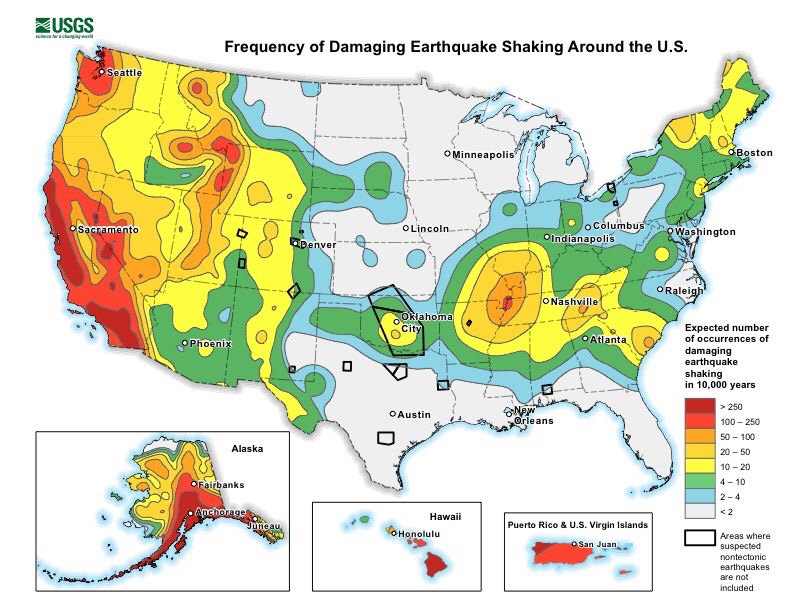
Existing U.S. Geological Survey seismic hazard maps show New York City as facing more hazard than many other eastern U.S. areas. Three areas are somewhat more active—northernmost New York State, New Hampshire and South Carolina—but they have much lower populations and fewer structures. The wider forces at work include pressure exerted from continuing expansion of the mid-Atlantic Ridge thousands of miles to the east; slow westward migration of the North American continent; and the area’s intricate labyrinth of old faults, sutures and zones of weakness caused by past collisions and rifting.
Due to New York’s past history, population density and fragile, interdependent infrastructure, a 2001 analysis by the Federal Emergency Management Agency ranks it the 11th most at-risk U.S. city for earthquake damage. Among those ahead: Los Angeles, San Francisco, Seattle and Portland. Behind: Salt Lake City, Sacramento, Anchorage.
New York’s first seismic station was set up at Fordham University in the 1920s. Lamont-Doherty Earth Observatory, in Palisades, N.Y., has operated stations since 1949, and now coordinates a network of about 40.
Dozens of small quakes have been felt in the New York area. A Jan. 17, 2001 magnitude 2.4, centered  in the Upper East Side—the first ever detected in Manhattan itself–may have originated on the 125th Street fault. Some people thought it was an explosion, but no one was harmed.
The most recent felt quake, a magnitude 2.1 on July 28, 2008, was centered near Milford, N.J. Houses shook and a woman at St. Edward’s Church said she felt the building rise up under her feet—but no damage was done.
Questions about the seismic safety of the Indian Point nuclear power plant, which lies amid a metropolitan area of more than 20 million people, were raised in previous scientific papers in 1978 and 1985.
Because the hard rocks under much of New York can build up a lot strain before breaking, researchers believe that modest faults as short as 1 to 10 kilometers can cause magnitude 5 or 6 quakes.
In general, magnitude 3 quakes occur about 10 times more often than magnitude fours; 100 times more than magnitude fives; and so on. This principle is called the Gutenberg-Richter relationship.