Friday, November 15, 2024

History Warns New York Is The Sixth Seal (Revelation 6:12)


New York Earthquake 1884
Friday, 18 March 2011 – 9:23pm IST | Place: NEW YORK | Agency: ANI
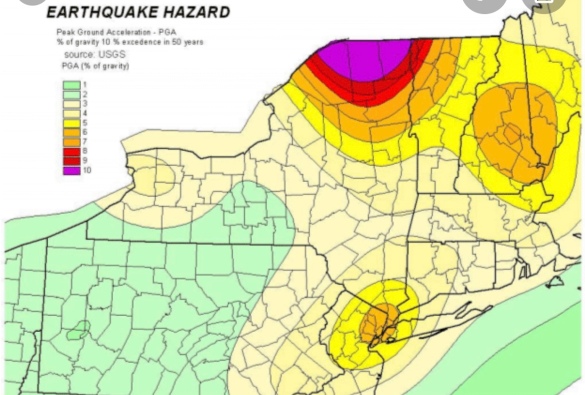
If the past is any indication, New York can be hit by an earthquake, claims John Armbruster, a seismologist at Columbia University’s Lamont-Doherty Earth Observatory.Based on historical precedent, Armbruster says the New York City metro area is susceptible to an earthquake of at least a magnitude of 5.0 once a century.According to the New York Daily News, Lynn Skyes, lead author of a recent study by seismologists at the Lamont-Doherty Earth Observatory adds that a magnitude-6 quake hits the area about every 670 years, and magnitude-7 every 3,400 years.A 5.2-magnitude quake shook New York City in 1737 and another of the same severity hit in 1884.
Tremors were felt from Maine to Virginia.
“The problem here comes from many subtle faults,” explained Skyes after the study was published.
He adds: “We now see there is earthquake activity on them. Each one is small, but when you add them up, they are probably more dangerous than we thought.”
Armbruster says a 5.0-magnitude earthquake today likely would result in casualties and hundreds of millions of dollars in damage.
“I would expect some people to be killed,” he notes.
The scope and scale of damage would multiply exponentially with each additional tick on the Richter scale.

Saturday, July 20, 2024

Why We Are In Trouble At The Sixth Seal (Revelation 6:12)


Dave Lochbaum
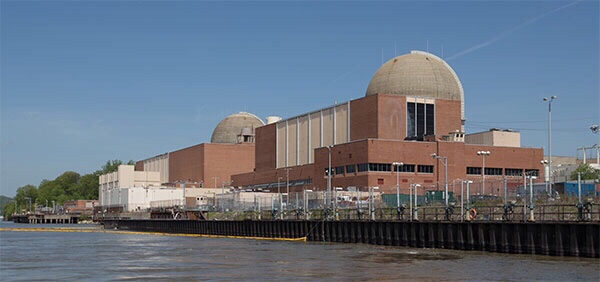
This is the second in a series of commentaries about the vital role nuclear safety inspections conducted by the Nuclear Regulatory Commission (NRC) play in protecting the public. The initial commentary described how NRC inspectors discovered that limits on the maximum allowable control room air temperature at the Columbia Generating Station in Washington had been improperly relaxed by the plant’s owner. This commentary describes a more recent finding by NRC inspectors about animproper safety assessment of a leaking cooling water system pipe on Entergy’s Unit 3 reactor at Indian Point outside New York City.
Indian Point Unit 3: Leak Before Break
On February 3, 2017, the NRC issued Indian Point a Green finding for a violation of Appendix B to 10 CFR Part 50. Specifically, the owner failed to perform an adequate operability review per its procedures after workers discovered water leaking from a service water system pipe.
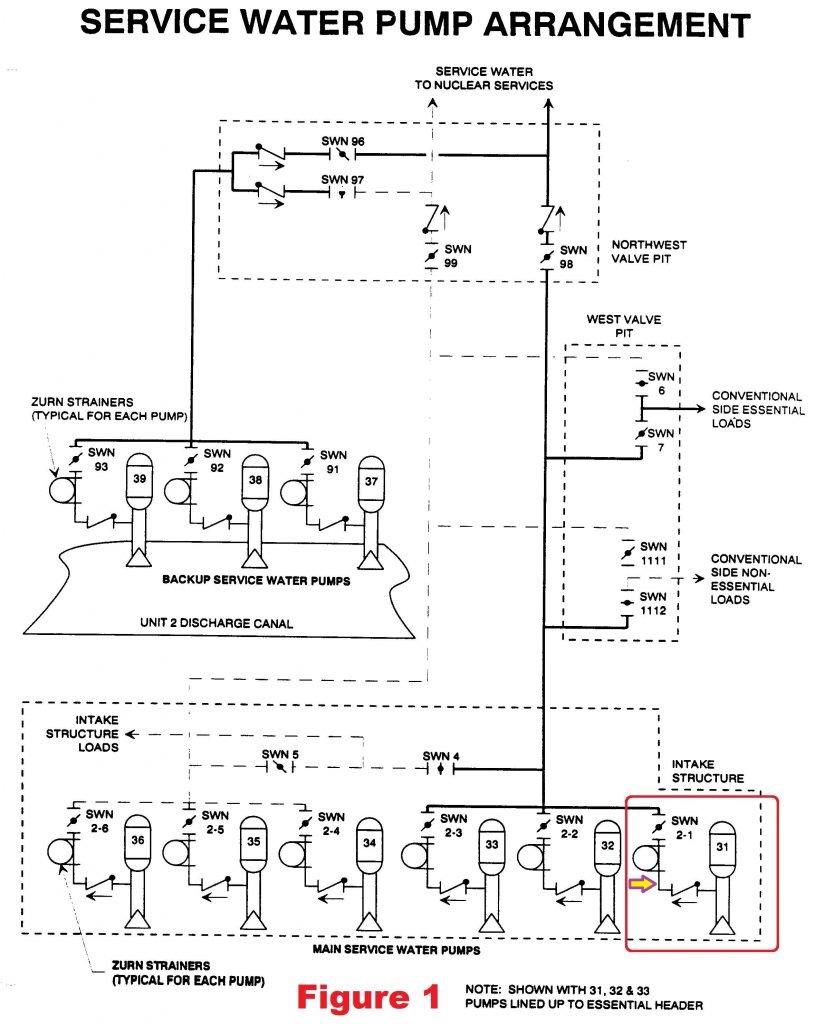
On April 27, 2016, workers found water leaking from the pipe downstream of the strainer for service water (SW) pump 31. As shown in Figure 1, SW pump 31 is one of six service water pumps located within the intake structure alongside the Hudson River. The six SW pumps are arranged in two sets of three pumps. Figure 1 shows SW pumps 31, 32, and 33 aligned to provide water drawn from the Hudson River to essential (i.e, safety and emergency) components within Unit 3. SW pumps 34, 35, and 36 are aligned to provide cooling water to non-essential equipment within Unit 3.
Fig. 1 (Source: Nuclear Regulatory Commission Plant Information Book) (click to enlarge)
Each SW pump is designed to deliver 6,000 gallons of flow. During normal operation, one SW pump can handle the essential loads while two SW pumps are needed for the non-essential loads. Under accident conditions, two SW pumps are needed to cool the essential equipment. The onsite emergency diesel generators can power either of the sets of three pumps, but not both simultaneously. If the set of SW pumps aligned to the essential equipment aren’t getting the job done, workers can open/close valves and electrical breakers to reconfigure the second set of three SW pumps to the essential equipment loops.
Because river water can have stuff in it that could clog some of the coolers for essential equipment, each SW pump has a strainer that attempts to remove as much debris as possible from the water. The leak discovered on April 27, 2016, was in the piping between the discharge check valve for SW pump 31 and its strainer. An arrow points to this piping section in Figure 1. The strainers were installed in openings called pits in the thick concrete floor of the intake structure. Water from the leaking pipe flowed into the pit housing the strainer for SW pump 31.
The initial leak rate was modest—estimated to be about one-eighth of a gallon per minute. The leak was similar to other pinhole leaks that had occurred in the concrete-lined, carbon steel SW pipes. The owner began daily checks on the leakage and prepared an operability determination. Basically, “operability determinations” are used within the nuclear industry when safety equipment is found to be impaired or degraded. The operability determination for the service water pipe leak concluded that the impairment did not prevent the SW pumps from fulfilling their required safety function. The operability determination relied on a sump pump located at the bottom of the strainer pit transferring the leaking water out of the pit before the water flooded and submerged safety components.
The daily checks instituted by the owner included workers recording the leak rate and assessing whether it had significantly increased. But the checks were against the previous day’s leak rate rather than the initial leak rate. By September 18, 2016, the leakage had steadily increased by a factor of 64 to 8 gallons per minute. But the daily incremental increases were small enough that they kept workers from finding the overall increase to be significant.
The daily check on October 15, 2016, found the pump room flooded to a depth of several inches. The leak rate was now estimated to be 20 gallons per minute. And the floor drain in the strainer pit was clogged (ironic, huh?) impairing the ability of its sump pump to remove the water. Workers placed temporary sump pumps in the room to remove the flood water and cope with the insignificantly higher leak rate. On October 17, workers installed a clamp on the pipe that reduced the leakage to less than one gallon per minute.
The operability determination was revised in response to concerns expressed by the NRC inspectors. The NRC inspectors were not satisfied by the revised operability determination. It continued to rely on the strainer pit sump pump removing the leaking water. But that sump pump was not powered from the emergency diesel generator and thus would not remove water should offsite power become unavailable. Step 5.6.4 of procedure EN-OP-14, “Operability Determination Process,” stated “If the Operability is based on the use or availability of other equipment, it must be verified that the equipment is capable of performing the function utilized in the evaluation.”
The operability determination explicitly stated that no compensatory measures or operator manual actions were needed to handle the leak, but the situation clearly required both compensatory measures and operator manual actions.
The NRC inspectors found additional deficiencies in the revised operability determination. The NRC inspectors calculated that a 20 gallon per minute leak rate coupled with an unavailable strainer pit sump pump would flood the room to a depth of three feet in three hours. There are no flood alarms in the room and the daily checks might not detect flooding until the level rose to three feet. At that level, water would submerge and potentially disable the vacuum breakers for the SW pumps. Proper vacuum breaker operation could be needed to successfully restart the SW pumps.
The NRC inspectors calculated that the 20 gallon per minute leak rate without remediation would flood the room to the level of the control cabinets for the strainers in 10 hours. The submerged control cabinets could disable the strainers, leading to blocked cooling water flow to essential equipment.
The NRC inspects calculated that the 20 gallon per minute leak rate without remediation would completely fill the room in about 29 hours, or only slightly longer than the daily check interval.
Flooding to depths of 3 feet, 10 feet, and the room’s ceiling affected all six SW pumps. Thus, the flooding represented a common mode threat that could disable the entire service water system. In turn, all safety equipment shown in Figure 2 no longer cooled by the disabled service water system could also be disabled. The NRC estimated that the flooding risk was about 5×10⁻⁶ per reactor year, solidly in the Green finding band.
Fig. 2 (Source: Nuclear Regulatory Commission Plant Information Book) (click to enlarge)
UCS Perspective
“Leak before break” is a longstanding nuclear safety philosophy. Books have been written about it (well, at least one report has been written and may even have been read.)  The NRC’s approval of a leak before break analysis can allow the owner of an existing nuclear power reactor to remove pipe whip restraints and jet impingement barriers. Such hardware guarded against the sudden rupture of a pipe filled with high pressure fluid from damaging safety equipment in the area. The leak before break analyses can provide the NRC with sufficient confidence that piping degradation will be detected by observed leakage with remedial actions taken before the pipe fails catastrophically. More than a decade ago, the NRC issued a Knowledge Management document on the leak before break philosophy and acceptable methods of analyzing, monitoring, and responding to piping degradation.
This incident at Indian Point illustrated an equally longstanding nuclear safety practice of “leak before break.” In this case, the leak was indeed followed by a break. But the break was not the failure of the piping but failure of the owner to comply with federal safety regulations. Pipe breaks are bad. Regulation breaks are bad. Deciding which is worse is like trying to decide which eye one wants to be poked in. None is far better than either.
As with the prior Columbia Generating Station case study, this Indian Point case study illustrates the vital role that NRC’s enforcement efforts plays in nuclear safety. Even after NRC inspectors voiced clear concerns about the improperly evaluated service water system pipe leak, Entergy failed to properly evaluate the situation, thus violating federal safety regulations. To be fair to Entergy, the company was probably doing its best, but in recent years, Entergy’s best has been far below nuclear industry average performance levels.
The NRC’s ROP is the public’s best protection against hazards caused by aging nuclear power reactors, shrinking maintenance budgets, emerging sabotage threats, and Entergy.Replacing the NRC’s engineering inspections with self-assessments by Entergy would lessen the effectiveness of that protective shield.
The NRC must continue to protect the public to the best of its ability. Delegating safety checks to owners like Entergy is inconsistent with that important mission.

Support from UCS members make work like this possible. Will you join us? Help UCS advance independent science for a healthy environment and a safer world.he Hudson River. The six SW pumps are arranged in two sets of three pumps. Figure 1 shows SW pumps 31, 32, and 33 aligned to provide water drawn from the Hudson River to essential (i.e, safety and emergency) components within Unit 3. SW pumps 34, 35, and 36 are aligned to provide cooling water to non-essential equipment within Unit 3. Fig. 1 (Source: Nuclear Regulatory Commission Plant Information Book) (click to enlarge) Each SW pump is designed to deliver 6,000 gallons of flow. During normal operation, one SW pump can handle the essential loads while two SW pumps are needed for the non-essential loads. Under accident conditions, two SW pumps are needed to cool the essential equipment. The onsite emergency diesel generators can power either of the sets of three pumps, but not both simultaneously. If the set of SW pumps aligned to the essential equipment aren’t getting the job done, workers can open/close valves and electrical breakers to reconfigure the second set of three SW pumps to the essential equipment loops. Because river water can have stuff in it that could clog some of the coolers for essential equipment, each SW pump has a strainer that attempts to remove as much debris as possible from the water. The leak discovered on April 27, 2016, was in the piping between the discharge check valve for SW pump 31 and its strainer. An arrow points to this piping section in Figure 1. The strainers were installed in openings called pits in the thick concrete floor of the intake structure. Water from the leaking pipe flowed into the pit housing the strainer for SW pump 31. The initial leak rate was modest—estimated to be about one-eighth of a gallon per minute. The leak was similar to other pinhole leaks that had occurred in the concrete-lined, carbon steel SW pipes. The owner began daily checks on the leakage and prepared an operability determination. Basically, “operability determinations” are used within the nuclear industry when safety equipment is found to be impaired or degraded. The operability determination for the service water pipe leak concluded that the impairment did not prevent the SW pumps from fulfilling their required safety function. The operability determination relied on a sump pump located at the bottom of the strainer pit transferring the leaking water out of the pit before the water flooded and submerged safety components. The daily checks instituted by the owner included workers recording the leak rate and assessing whether it had significantly increased. But the checks were against the previous day’s leak rate rather than the initial leak rate. By September 18, 2016, the leakage had steadily increased by a factor of 64 to 8 gallons per minute. But the daily incremental increases were small enough that they kept workers from finding the overall increase to be significant. The daily check on October 15, 2016, found the pump room flooded to a depth of several inches. The leak rate was now estimated to be 20 gallons per minute. And the floor drain in the strainer pit was clogged (ironic, huh?) impairing the ability of its sump pump to remove the water. Workers placed temporary sump pumps in the room to remove the flood water and cope with the insignificantly higher leak rate. On October 17, workers installed a clamp on the pipe that reduced the leakage to less than one gallon per minute. The operability determination was revised in response to concerns expressed by the NRC inspectors. The NRC inspectors were not satisfied by the revised operability determination. It continued to rely on the strainer pit sump pump removing the leaking water. But that sump pump was not powered from the emergency diesel generator and thus would not remove water should offsite power become unavailable. Step 5.6.4 of procedure EN-OP-14, “Operability Determination Process,” stated “If the Operability is based on the use or availability of other equipment, it must be verified that the equipment is capable of performing the function utilized in the evaluation.” The operability determination explicitly stated that no compensatory measures or operator manual actions were needed to handle the leak, but the situation clearly required both compensatory measures and operator manual actions. The NRC inspectors found additional deficiencies in the revised operability determination. The NRC inspectors calculated that a 20 gallon per minute leak rate coupled with an unavailable strainer pit sump pump would flood the room to a depth of three feet in three hours. There are no flood alarms in the room and the daily checks might not detect flooding until the level rose to three feet. At that level, water would submerge and potentially disable the vacuum breakers for the SW pumps. Proper vacuum breaker operation could be needed to successfully restart the SW pumps. The NRC inspectors calculated that the 20 gallon per minute leak rate without remediation would flood the room to the level of the control cabinets for the strainers in 10 hours. The submerged control cabinets could disable the strainers, leading to blocked cooling water flow to essential equipment. The NRC inspects calculated that the 20 gallon per minute leak rate without remediation would completely fill the room in about 29 hours, or only slightly longer than the daily check interval. Flooding to depths of 3 feet, 10 feet, and the room’s ceiling affected all six SW pumps. Thus, the flooding represented a common mode threat that could disable the entire service water system. In turn, all safety equipment shown in Figure 2 no longer cooled by the disabled service water system could also be disabled. The NRC estimated that the flooding risk was about 5×10⁻⁶ per reactor year, solidly in the Green finding band. Fig. 2 (Source: Nuclear Regulatory Commission Plant Information Book) (click to enlarge) UCS Perspective “Leak before break” is a longstanding nuclear safety philosophy. Books have been written about it (well, at least one report has been written and may even have been read.) The NRC’s approval of a leak before break analysis can allow the owner of an existing nuclear power reactor to remove pipe whip restraints and jet impingement barriers. Such hardware guarded against the sudden rupture of a pipe filled with high pressure fluid from damaging safety equipment in the area. The leak before break analyses can provide the NRC with sufficient confidence that piping degradation will be detected by observed leakage with remedial actions taken before the pipe fails catastrophically. More than a decade ago, the NRC issued a Knowledge Management document on the leak before break philosophy and acceptable methods of analyzing, monitoring, and responding to piping degradation. This incident at Indian Point illustrated an equally longstanding nuclear safety practice of “leak before break.” In this case, the leak was indeed followed by a break. But the break was not the failure of the piping but failure of the owner to comply with federal safety regulations. Pipe breaks are bad. Regulation breaks are bad. Deciding which is worse is like trying to decide which eye one wants to be poked in. None is far better than either. As with the prior Columbia Generating Station case study, this Indian Point case study illustrates the vital role that NRC’s enforcement efforts plays in nuclear safety. Even after NRC inspectors voiced clear concerns about the improperly evaluated service water system pipe leak, Entergy failed to properly evaluate the situation, thus violating federal safety regulations. To be fair to Entergy, the company was probably doing its best, but in recent years, Entergy’s best has been far below nuclear industry average performance levels. The NRC’s ROP is the public’s best protection against hazards caused by aging nuclear power reactors, shrinking maintenance budgets, emerging sabotage threats, and Entergy.Replacing the NRC’s engineering inspections with self-assessments by Entergy would lessen the effectiveness of that protective shield. The NRC must continue to protect the public to the best of its ability. Delegating safety checks to owners like Entergy is inconsistent with that important mission. Support from UCS members make work like this possible. Will you join us? Help UCS advance independent science for a healthy environment and a safer world.

Thursday, April 25, 2024

The Trend Leading to the Sixth Seal (Revelation 6:12)


HOPKINS
January 14, 2020
Are we seeing a trend? After two small earthquakes hit upstate New York on January 3 and January 7, a slightly larger one was felt near the New York-Canadian border early Monday morning. And while the quake actually happened in an entirely different country, the effects were felt far south into New York state, and the surrounding region.
The United States Geological Survey says the 3.3 magnitude quake hit several mikes south of the town of Ormstown, Quebec a little after 5:30 A.M. There are some slightly conflicting reports, as the Montreal Gazette reports that the quake was a 3.6 magnitude. Ormstown is located around 20 minutes north of the New York border.
The Times Union says the quake was felt as far south as the town of Ticonderoga in Essex County, and as far west as the city of Ogdensburg on the New York-Ontario border. The effects were also felt as far north as Montreal.
No damage was reported.
Yes, earthquakes do happen in the northeastern U.S and Canada occasionally. In December 2019, a 2.1 tremor was reported near Sodus Point, off the coast of Lake Ontario.
Some strike even closer to home. In April 2017, a 1.3 tremor occurred around two and half miles west of Pawling. In early 2016, an even smaller quake happened near Port Chester and Greenwich, CT. In the summer of 2019, a quake struck off the New Jersey coast.
On August 23, 2011, a 5.8 quake, that was centered in Virginia, was felt all the way up the east coast. Several moderate (at least a 5 on the richter scale) quakes have occurred near New York City in 1737, 1783 and 1884.
Listen to Middays With Hopkins weekdays from 10AM to 2PM on 101.5 WPDH. Stream us live through the website, Alexa-enabled device, Google Home or the WPDH mobile app.

Sunday, April 14, 2024

New York Subways at the Sixth Seal (Revelation 6)

                      How vulnerable are NYC’s underwater subway tunnels to flooding?

Ashley Fetters
New York City is full of peculiar phenomena—rickety fire escapes; 100-year-old subway tunnelsair conditioners propped perilously into window frames—that can strike fear into the heart of even the toughest city denizen. But should they? Every month, writer Ashley Fetters will be exploring—and debunking—these New York-specific fears, letting you know what you should actually worry about, and what anxieties you can simply let slip away.
The 25-minute subway commute from Crown Heights to the Financial District on the 2/3 line is, in my experience, a surprisingly peaceful start to the workday—save for one 3,100-foot stretch between the Clark Street and Wall Street stations, where for three minutes I sit wondering what the probability is that I will soon die a torturous, claustrophobic drowning death right here in this subway car.
The Clark Street Tunnel, opened in 1916, is one of approximately a dozen tunnels that escort MTA passengers from one borough to the next underwater—and just about all of them, with the exception of the 1989 addition of the 63rd Street F train tunnel, were constructed between 1900 and 1936.
Each day, thousands of New Yorkers venture across the East River and back again through these tubes buried deep in the riverbed, some of which are nearing or even past their 100th birthdays. Are they wrong to ponder their own mortality while picturing one of these watery catacombs suddenly springing a leak?
Mostly yes, they are, says Michael Horodniceanu, the former president of MTA Capital Construction and current principal of Urban Advisory Group. First, it’s important to remember that the subway tunnel is built under the riverbed, not just in the river—so what immediately surrounds the tunnel isn’t water but some 25 feet of soil. “There’s a lot of dirt on top of it,” Horodniceanu says. “It’s well into the bed of the bottom of the channel.”
And second, as Angus Kress Gillespie, author of Crossing Under the Hudson: The Story of the Holland and Lincoln Tunnels, points out, New York’s underwater subway tunnels are designed to withstand some leaking. And withstand it they do: Pumps placed below the floor of the tunnel, he says, are always running, always diverting water seepage into the sewers. (Horodniceanu says the amount of water these pumps divert into the sewer system each day numbers in the thousands of gallons.)
Additionally, MTA crews routinely repair the grouting and caulking, and often inject a substance into the walls that creates a waterproof membrane outside the tunnel—which keeps water out of the tunnel and relieves any water pressure acting on its walls. New tunnels, Horodniceanu points out, are even built with an outside waterproofing membrane that works like an umbrella: Water goes around it, it falls to the sides, and then it gets channeled into a pumping station and pumped out.
Of course, the classic New York nightmare scenario isn’t just a cute little trickle finding its way in. The anxiety daydream usually involves something sinister, or seismic. The good news, however, is that while an earthquake or explosion would indeed be bad for many reasons, it likely wouldn’t result in the frantic flooding horror scene that plays out in some commuters’ imaginations.
The Montague Tube, which sustained severe damage during Hurricane Sandy.
MTA New York City Transit / Marc A. Hermann
Horodniceanu assures me that tunnels built more recently are “built to withstand a seismic event.” The older tunnels, however—like, um, the Clark Street Tunnel—“were not seismically retrofitted, let me put it that way,” Horodniceanu says. “But the way they were built is in such a way that I do not believe an earthquake would affect them.” They aren’t deep enough in the ground, anyway, he says, to be too intensely affected by a seismic event. (The MTA did not respond to a request for comment.)
One of the only real threats to tunnel infrastructure, Horodniceanu adds, is extreme weather. Hurricane Sandy, for example, caused flooding in the tunnels, which “created problems with the infrastructure.” He continues, “The tunnels have to be rebuilt as a result of saltwater corroding the infrastructure.”
Still, he points out, hurricanes don’t exactly happen with no warning. So while Hurricane Sandy did cause major trauma to the tunnels, train traffic could be stopped with ample time to keep passengers out of harm’s way. In 2012, Governor Andrew Cuomo directed all the MTA’s mass transit services to shut down at 7 p.m. the night before Hurricane Sandy was expected to hit New York City.
And Gillespie, for his part, doubts even an explosion would result in sudden, dangerous flooding. A subway tunnel is not a closed system, he points out; it’s like a pipe that’s open at both ends. “The force of a blast would go forwards and backwards out the exit,” he says.
So the subway-train version of that terrifying Holland Tunnel flood scene in Sylvester Stallone’s Daylight is … unrealistic, right?
“Yeah,” Gillespie laughs. “Yeah. It is.”
Got a weird New York anxiety that you want explored? E-mail tips@curbed.com, and we may include it in a future column.

Friday, April 12, 2024

Quakeland: On the Road to America’s Next Devastating Earthquake: Revelation 6


Quakeland: On the Road to America’s Next Devastating Earthquake
Roger BilhamQuakeland: New York and the Sixth Seal (Revelation 6:12)
Given recent seismic activity — political as well as geological — it’s perhaps unsurprising that two books on earthquakes have arrived this season. One is as elegant as the score of a Beethoven symphony; the other resembles a diary of conversations overheard during a rock concert. Both are interesting, and both relate recent history to a shaky future.
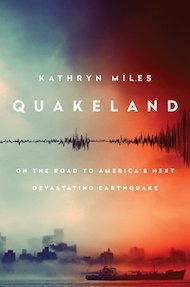
Journalist Kathryn Miles’s Quakeland is a litany of bad things that happen when you provoke Earth to release its invisible but ubiquitous store of seismic-strain energy, either by removing fluids (oil, water, gas) or by adding them in copious quantities (when extracting shale gas in hydraulic fracturing, also known as fracking, or when injecting contaminated water or building reservoirs). To complete the picture, she describes at length the bad things that happen during unprovoked natural earthquakes. As its subtitle hints, the book takes the form of a road trip to visit seismic disasters both past and potential, and seismologists and earthquake engineers who have first-hand knowledge of them. Their colourful personalities, opinions and prejudices tell a story of scientific discovery and engineering remedy.
Miles poses some important societal questions. Aside from human intervention potentially triggering a really damaging earthquake, what is it actually like to live in neighbourhoods jolted daily by magnitude 1–3 earthquakes, or the occasional magnitude 5? Are these bumps in the night acceptable? And how can industries that perturb the highly stressed rocks beneath our feet deny obvious cause and effect? In 2015, the Oklahoma Geological Survey conceded that a quadrupling of the rate of magnitude-3 or more earthquakes in recent years, coinciding with a rise in fracking, was unlikely to represent a natural process. Miles does not take sides, but it’s difficult for the reader not to.
She visits New York City, marvelling at subway tunnels and unreinforced masonry almost certainly scheduled for destruction by the next moderate earthquake in the vicinity. She considers the perils of nuclear-waste storage in Nevada and Texas, and ponders the risks to Idaho miners of rock bursts — spontaneous fracture of the working face when the restraints of many million years of confinement are mined away. She contemplates the ups and downs of the Yellowstone Caldera — North America’s very own mid-continent supervolcano — and its magnificently uncertain future. Miles also touches on geothermal power plants in southern California’s Salton Sea and elsewhere; the vast US network of crumbling bridges, dams and oil-storage farms; and the magnitude 7–9 earthquakes that could hit California and the Cascadia coastline of Oregon and Washington state this century. Amid all this doom, a new elementary school on the coast near Westport, Washington, vulnerable to inbound tsunamis, is offered as a note of optimism. With foresight and much persuasion from its head teacher, it was engineered to become an elevated safe haven.
Miles briefly discusses earthquake prediction and the perils of getting it wrong (embarrassment in New Madrid, Missouri, where a quake was predicted but never materialized; prison in L’Aquila, Italy, where scientists failed to foresee a devastating seismic event) and the successes of early-warning systems, with which electronic alerts can be issued ahead of damaging seismic waves. Yes, it’s a lot to digest, but most of the book obeys the laws of physics, and it is a engaging read. One just can’t help wishing that Miles’s road trips had taken her somewhere that wasn’t a disaster waiting to happen.
Catastrophic damage in Anchorage, Alaska, in 1964, caused by the second-largest earthquake in the global instrumental record.
In The Great Quake, journalist Henry Fountain provides us with a forthright and timely reminder of the startling historical consequences of North America’s largest known earthquake, which more than half a century ago devastated southern Alaska. With its epicentre in Prince William Sound, the 1964 quake reached magnitude 9.2, the second largest in the global instrumental record. It released more energy than either the 2004 Sumatra–Andaman earthquake or the 2011 Tohoku earthquake off Japan; and it generated almost as many pages of scientific commentary and description as aftershocks. Yet it has been forgotten by many.
The quake was scientifically important because it occurred at a time when plate tectonics was in transition from hypothesis to theory. Fountain expertly traces the theory’s historical development, and how the Alaska earthquake was pivotal in nailing down one of the most important predictions. The earthquake caused a fjordland region larger than England to subside, and a similarly huge region of islands offshore to rise by many metres; but its scientific implications were not obvious at the time. Eminent seismologists thought that a vertical fault had slipped, drowning forests and coastlines to its north and raising beaches and islands to its south. But this kind of fault should have reached the surface, and extended deep into Earth’s mantle. There was no geological evidence of a monster surface fault separating these two regions, nor any evidence for excessively deep aftershocks. The landslides and liquefied soils that collapsed houses, and the tsunami that severely damaged ports and infrastructure, offered no clues to the cause.
“Previous earthquakes provide clear guidance about present-day vulnerability.” The hero of The Great Quake is the geologist George Plafker, who painstakingly mapped the height reached by barnacles lifted out of the intertidal zone along shorelines raised by the earthquake, and documented the depths of drowned forests. He deduced that the region of subsidence was the surface manifestation of previously compressed rocks springing apart, driving parts of Alaska up and southwards over the Pacific Plate. His finding confirmed a prediction of plate tectonics, that the leading edge of the Pacific Plate plunged beneath the southern edge of Alaska along a gently dipping thrust fault. That observation, once fully appreciated, was applauded by the geophysics community.
Fountain tells this story through the testimony of survivors, engineers and scientists, interweaving it with the fascinating history of Alaska, from early discovery by Europeans to purchase from Russia by the United States in 1867, and its recent development. Were the quake to occur now, it is not difficult to envisage that with increased infrastructure and larger populations, the death toll and price tag would be two orders of magnitude larger than the 139 fatalities and US$300-million economic cost recorded in 1964.
What is clear from these two books is that seismicity on the North American continent is guaranteed to deliver surprises, along with unprecedented economic and human losses. Previous earthquakes provide clear guidance about the present-day vulnerability of US infrastructure and populations. Engineers and seismologists know how to mitigate the effects of future earthquakes (and, in mid-continent, would advise against the reckless injection of waste fluids known to trigger earthquakes). It is merely a matter of persuading city planners and politicians that if they are tempted to ignore the certainty of the continent’s seismic past, they should err on the side of caution when considering its seismic future.

Saturday, April 6, 2024

The Sixth Seal Long Overdue (Revelation 6)


The Big One Awaits
By MARGO NASH
Published: March 25, 2001
Alexander Gates, a geology professor at Rutgers-Newark, is co-author of “The Encyclopedia of Earthquakes and Volcanoes,“ which will be published by Facts on File in July. He has been leading a four-year effort to remap an area known as the Sloatsburg Quadrangle, a 5-by-7-mile tract near Mahwah that crosses into New York State. The Ramapo Fault, which runs through it, was responsible for a big earthquake in 1884, and Dr. Gates warns that a recurrence is overdue. He recently talked about his findings.
Q. What have you found?
A. We’re basically looking at a lot more rock, and we’re looking at the fracturing and jointing in the bedrock and putting it on the maps. Any break in the rock is a fracture. If it has movement, then it’s a fault. There are a lot of faults that are offshoots of the Ramapo. Basically when there are faults, it means you had an earthquake that made it. So there was a lot of earthquake activity to produce these features. We are basically not in a period of earthquake activity along the Ramapo Fault now, but we can see that about six or seven times in history, about 250 million years ago, it had major earthquake activity. And because it’s such a fundamental zone of weakness, anytime anything happens, the Ramapo Fault goes.
Q. Where is the Ramapo Fault?
 A. The fault line is in western New Jersey and goes through a good chunk of the state, all the way down to Flemington. It goes right along where they put in the new 287. It continues northeast across the Hudson River right under the Indian Point power plant up into Westchester County. There are a lot of earthquakes rumbling around it every year, but not a big one for a while.
Q. Did you find anything that surprised you?
A. I found a lot of faults, splays that offshoot from the Ramapo that go 5 to 10 miles away from the fault. I have looked at the Ramapo Fault in other places too. I have seen splays 5 to 10 miles up into the Hudson Highlands. And you can see them right along the roadsides on 287. There’s been a lot of damage to those rocks, and obviously it was produced by fault activities. All of these faults have earthquake potential.
Q. Describe the 1884 earthquake.
A. It was in the northern part of the state near the Sloatsburg area. They didn’t have precise ways of describing the location then. There was lots of damage. Chimneys toppled over. But in 1884, it was a farming community, and there were not many people to be injured. Nobody appears to have written an account of the numbers who were injured.
Q. What lessons we can learn from previous earthquakes?
A. In 1960, the city of Agadir in Morocco had a 6.2 earthquake that killed 12,000 people, a third of the population, and injured a third more. I think it was because the city was unprepared.There had been an earthquake in the area 200 years before. But people discounted the possibility of a recurrence. Here in New Jersey, we should not make the same mistake. We should not forget that we had a 5.4 earthquake 117 years ago. The recurrence interval for an earthquake of that magnitude is every 50 years, and we are overdue. The Agadir was a 6.2, and a 5.4 to a 6.2 isn’t that big a jump.
Q. What are the dangers of a quake that size?
A. When you’re in a flat area in a wooden house it’s obviously not as dangerous, although it could cut off a gas line that could explode. There’s a real problem with infrastructure that is crumbling, like the bridges with crumbling cement. There’s a real danger we could wind up with our water supplies and electricity cut off if a sizable earthquake goes off. The best thing is to have regular upkeep and keep up new building codes. The new buildings will be O.K. But there is a sense of complacency.
MARGO NASH

Saturday, March 30, 2024

The Trend Leading to the Sixth Seal (Revelation 6:12)


HOPKINS
January 14, 2020
Are we seeing a trend? After two small earthquakes hit upstate New York on January 3 and January 7, a slightly larger one was felt near the New York-Canadian border early Monday morning. And while the quake actually happened in an entirely different country, the effects were felt far south into New York state, and the surrounding region.
The United States Geological Survey says the 3.3 magnitude quake hit several mikes south of the town of Ormstown, Quebec a little after 5:30 A.M. There are some slightly conflicting reports, as the Montreal Gazette reports that the quake was a 3.6 magnitude. Ormstown is located around 20 minutes north of the New York border.
The Times Union says the quake was felt as far south as the town of Ticonderoga in Essex County, and as far west as the city of Ogdensburg on the New York-Ontario border. The effects were also felt as far north as Montreal.
No damage was reported.
Yes, earthquakes do happen in the northeastern U.S and Canada occasionally. In December 2019, a 2.1 tremor was reported near Sodus Point, off the coast of Lake Ontario.
Some strike even closer to home. In April 2017, a 1.3 tremor occurred around two and half miles west of Pawling. In early 2016, an even smaller quake happened near Port Chester and Greenwich, CT. In the summer of 2019, a quake struck off the New Jersey coast.
On August 23, 2011, a 5.8 quake, that was centered in Virginia, was felt all the way up the east coast. Several moderate (at least a 5 on the richter scale) quakes have occurred near New York City in 1737, 1783 and 1884.
Listen to Middays With Hopkins weekdays from 10AM to 2PM on 101.5 WPDH. Stream us live through the website, Alexa-enabled device, Google Home or the WPDH mobile app.