Earthquake activity in the New York City area
The prophecy is more than seeing into the future. For the prophecy sees without the element of time. For the prophecy sees things as they were, as they are, and as they always shall be.
Monday, November 14, 2022
THE SIXTH SEAL: NEW YORK CITY (REVELATION 6:12)
Sunday, November 13, 2022
We really are due for the sixth seal: Revelation 6:12

Opinion/Al Southwick: Could an earthquake really rock New England? We are 265 years overdue
On Nov. 8, a 3.6 magnitude earthquake struck Buzzard’s Bay off the coast of New Bedford. Reverberations were felt up to 100 miles away, across Massachusetts, Rhode Island, and parts of Connecticut and New York. News outlets scrambled to interview local residents who felt the ground shake their homes. Seismologists explained that New England earthquakes, while uncommon and usually minor, are by no means unheard of.
The last bad one we had took place on Nov. 18, 1755, a date long remembered.
It’s sometimes called the Boston Earthquake and sometimes the Cape Ann Earthquake. Its epicenter is thought to have been in the Atlantic Ocean about 25 miles east of Gloucester. Estimates say that it would have registered between 6.0 and 6.3 on the modern Richter scale. It was an occasion to remember as chronicled by John E. Ebel, director of the Weston observatory of Boston College:
“At about 4:30 in the morning on 18 November, 1755, a strong earthquake rocked the New England area. Observers reported damage to chimneys, brick buildings and stone walls in coastal communities from Portland, Maine to south of Boston … Chimneys were also damaged as far away as Springfield, Massachusetts, and New Haven, Connecticut. The earthquake was felt at Halifax, Nova Scotia to the northeast, Lake Champlain to the northwest, and Winyah, South Carolina to the southwest. The crew of a ship in deep water about 70 leagues east of Boston thought it had run aground and only realized it had felt an earthquake after it arrived at Boston later that same day.
“The 1755 earthquake rocked Boston, with the shaking lasting more than a minute. According to contemporary reports, as many as 1,500 chimneys were shattered or thrown down in part, the gable ends of about 15 brick buildings were broken out, and some church steeples ended up tilted due to the shaking. Falling chimney bricks created holes in the roofs of some houses. Some streets, particularly those on manmade ground along the water, were so covered with bricks and debris that passage by horse-drawn carriage was impossible. Many homes lost china and glassware that was thrown from shelves and shattered. A distiller’s cistern filled with liquor broke apart and lost its contents.”
We don’t have many details of the earthquake’s impact here, there being no newspaper in Worcester County at that time. We do know that one man, Christian Angel, working in a “silver” mine in Sterling, was buried alive when the ground shook. He is the only known fatality in these parts. We can assume that, if the quake shook down chimneys in Springfield and New Haven, it did even more damage hereabouts. We can imagine the cries of alarm and the feeling of panic as trees swayed violently, fields and meadows trembled underfoot and pottery fell off shelves and crashed below.
The Boston Earthquake was an aftershock from the gigantic Lisbon Earthquake that had leveled Lisbon, Portugal, a few days before. That cataclysm, estimated as an 8 or 9 on the modern Richter scale, was the most devastating natural catastrophe to hit western Europe since Roman times. The first shock struck on Nov. 1, at about 9 in the morning.
According to one account: ”Suddenly the city began to shudder violently, its tall medieval spires waving like a cornfield in the breeze … In the ancient cathedral, the Basilica de Santa Maria, the nave rocked and the massive chandeliers began swinging crazily. . . . Then came a second, even more powerful shock. And with it, the ornate façade of every great building in the square … broke away and cascaded forward.”
Until that moment, Lisbon had been one of the leading cities in western Europe, right up there with London and Paris. With 250,000 people, it was a center of culture, financial activity and exploration. Within minutes it was reduced to smoky, dusty rubble punctuated by human groans and screams. An estimated 60,000 to 100,000 lost their lives.
Since then, New England has been mildly shaken by quakes from time to time. One series of tremors on March 1, 1925, was felt throughout Worcester County, from Fitchburg to Worcester, and caused a lot of speculation.
What if another quake like that in 1755 hit New England today? What would happen? That question was studied 15 years ago by the Massachusetts Civil Defense Agency. Its report is sobering:
“The occurrence of a Richter magnitude 6.25 earthquake off Cape Ann, Massachusetts … would cause damage in the range of 2 to 10 billion dollars … in the Boston metropolitan area (within Route 128) due to ground shaking, with significant additional losses due to secondary effects such as soil liquefaction failures, fires and economic interruptions. Hundreds of deaths and thousands of major and minor injuries would be expected … Thousands of people could be displaced from their homes … Additional damage may also be experienced outside the 128 area, especially closer to the earthquake epicenter.”
So even if we don’t worry much about volcanoes, we know that hurricanes and tornadoes are always possible. As for earthquakes, they may not happen in this century or even in this millennium, but it is sobering to think that if the tectonic plates under Boston and Gloucester shift again, we could see a repeat of 1755.
East Coast Quakes and the Sixth Seal: Revelation 6

Items lie on the floor of a grocery store after an earthquake on Sunday, August 9, 2020 in North Carolina.
East Coast Quakes: What to Know About the Tremors Below
By Meteorologist Dominic Ramunni Nationwide PUBLISHED 7:13 PM ET Aug. 11, 2020 PUBLISHED 7:13 PM EDT Aug. 11, 2020
People across the Carolinas and Mid-Atlantic were shaken, literally, on a Sunday morning as a magnitude 5.1 earthquake struck in North Carolina on August 9, 2020.
Centered in Sparta, NC, the tremor knocked groceries off shelves and left many wondering just when the next big one could strike.
Fault Lines
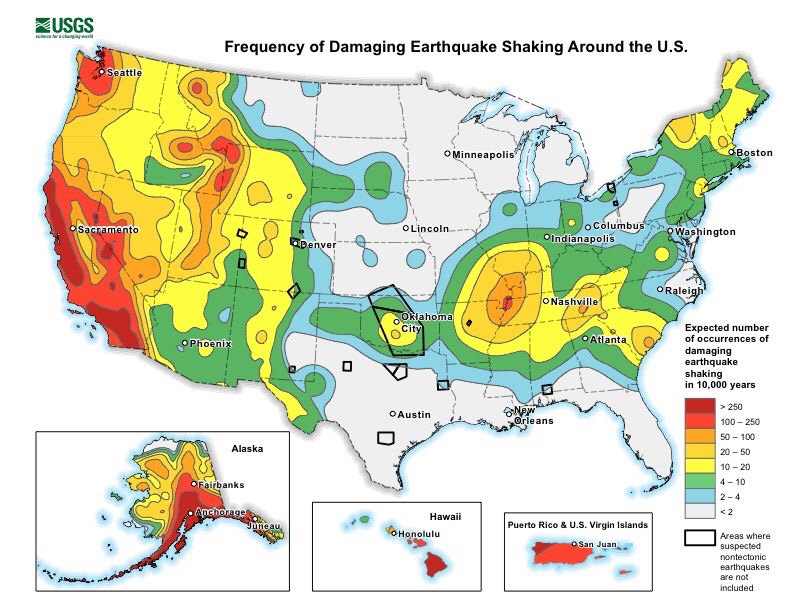
Compared to the West Coast, there are far fewer fault lines in the East. This is why earthquakes in the East are relatively uncommon and weaker in magnitude.
That said, earthquakes still occur in the East.
According to Spectrum News Meteorologist Matthew East, “Earthquakes have occurred in every eastern U.S. state, and a majority of states have recorded damaging earthquakes. However, they are pretty rare. For instance, the Sparta earthquake Sunday was the strongest in North Carolina in over 100 years.”

While nowhere near to the extent of the West Coast, damaging earthquakes can and do affect much of the eastern half of the country.
For example, across the Tennesse River Valley lies the New Madrid Fault Line. While much smaller in size than those found farther west, the fault has managed to produce several earthquakes over magnitude 7.0 in the last couple hundred years.
In 1886, an estimated magnitude 7.0 struck Charleston, South Carolina along a previously unknown seismic zone. Nearly the entire town had to be rebuilt.
Vulnerabilities
The eastern half of the U.S. has its own set of vulnerabilities from earthquakes.
Seismic waves actually travel farther in the East as opposed to the West Coast. This is because the rocks that make up the East are tens, if not hundreds, of millions of years older than in the West.
These older rocks have had much more time to bond together with other rocks under the tremendous pressure of Earth’s crust. This allows seismic energy to transfer between rocks more efficiently during an earthquake, causing the shaking to be felt much further.
This is why, during the latest quake in North Carolina, impacts were felt not just across the state, but reports of shaking came as far as Atlanta, Georgia, nearly 300 miles away.

Reports of shaking from different earthquakes of similar magnitude.
Quakes in the East can also be more damaging to infrastructure than in the West. This is generally due to the older buildings found east. Architects in the early-to-mid 1900s simply were not accounting for earthquakes in their designs for cities along the East Coast.
When a magnitude 5.8 earthquake struck Virginia in 2011, not only were numerous historical monuments in Washington, D.C. damaged, shaking was reported up and down the East Coast with tremors even reported in Canada.
Unpredictable
There is no way to accurately predict when or where an earthquake may strike.
Some quakes will have a smaller earthquake precede the primary one. This is called a foreshock.
The problem is though, it’s difficult to say whether the foreshock is in fact a foreshock and not the primary earthquake. Only time will tell the difference.
The United State Geological Survey (USGS) is experimenting with early warning detection systems in the West Coast.
While this system cannot predict earthquakes before they occur, they can provide warning up to tens of seconds in advance that shaking is imminent. This could provide just enough time to find a secure location before the tremors begin.
Much like hurricanes, tornadoes, or snowstorms, earthquakes are a natural occuring phenomenon that we can prepare for.
The USGS provides an abundance of resources on how to best stay safe when the earth starts to quake.
Friday, November 11, 2022
East Coast Still Unprepared For The Sixth Seal (Revelation 6:12)

East Coast Earthquake Preparedness
By By BEN NUCKOLS
Posted: 08/25/2011 8:43 am EDT
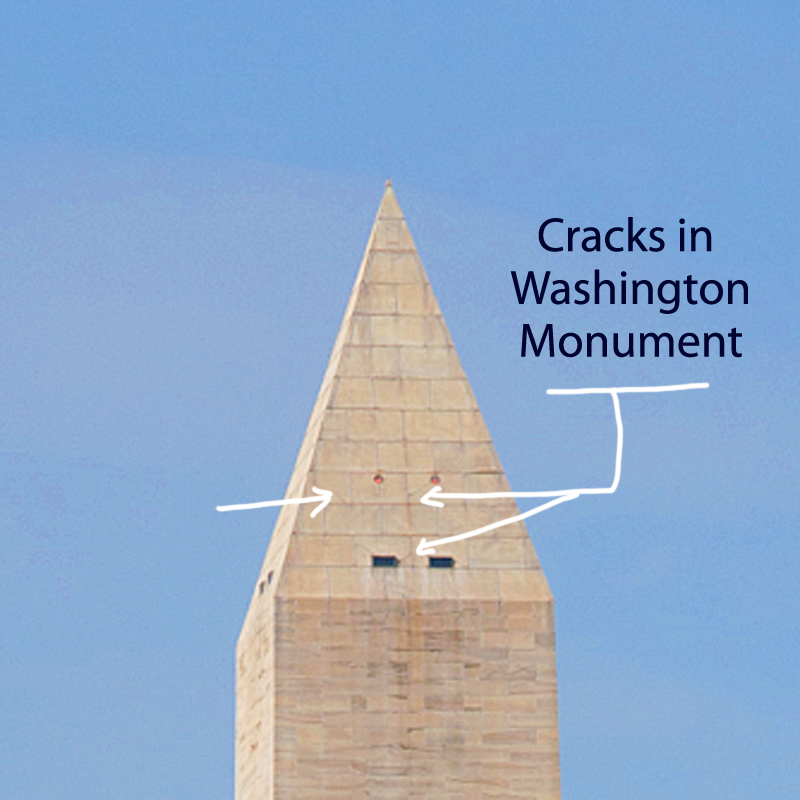
WASHINGTON — There were cracks in the Washington Monument and broken capstones at the National Cathedral. In the District of Columbia suburbs, some people stayed in shelters because of structural concerns at their apartment buildings.
A day after the East Coast’s strongest earthquake in 67 years, inspectors assessed the damage and found that most problems were minor. But the shaking raised questions about whether this part of the country, with its older architecture and inexperience with seismic activity, is prepared for a truly powerful quake.
The 5.8 magnitude quake felt from Georgia north to Canada prompted swift inspections of many structures Wednesday, including bridges and nuclear plants. An accurate damage estimate could take weeks, if not longer. And many people will not be covered by insurance.
In a small Virginia city near the epicenter, the entire downtown business district was closed. School was canceled for two weeks to give engineers time to check out cracks in several buildings.
At the 555-foot Washington Monument, inspectors found several cracks in the pyramidion – the section at the top of the obelisk where it begins narrowing to a point.
A 4-foot crack was discovered Tuesday during a visual inspection by helicopter. It cannot be seen from the ground. Late Wednesday, the National Park Service announced that structural engineers had found several additional cracks inside the top of the monument.
Carol Johnson, a park service spokeswoman, could not say how many cracks were found but said three or four of them were “significant.” Two structural engineering firms that specialize in assessing earthquake damage were being brought in to conduct a more thorough inspection on Thursday.
The monument, by far the tallest structure in the nation’s capital, was to remain closed indefinitely, and Johnson said the additional cracks mean repairs are likely to take longer. It has never been damaged by a natural disaster, including earthquakes in Virginia in 1897 and New York in 1944.
Tourists arrived at the monument Wednesday morning only to find out they couldn’t get near it. A temporary fence was erected in a wide circle about 120 feet from the flags that surround its base. Walkways were blocked by metal barriers manned by security guards.
“Is it really closed?” a man asked the clerk at the site’s bookstore.
“It’s really closed,” said the clerk, Erin Nolan. Advance tickets were available for purchase, but she cautioned against buying them because it’s not clear when the monument will open.
“This is pretty much all I’m going to be doing today,” Nolan said.
Tuesday’s quake was centered about 40 miles northwest of Richmond, 90 miles south of Washington and 3.7 miles underground. In the nearby town of Mineral, Va., Michael Leman knew his Main Street Plumbing & Electrical Supply business would need – at best – serious and expensive repairs.
At worst, it could be condemned. The facade had become detached from the rest of the building, and daylight was visible through a 4- to 6-inch gap that opened between the front wall and ceiling.
“We’re definitely going to open back up,” Leman said. “I’ve got people’s jobs to look out for.”
Leman said he is insured, but some property owners might not be so lucky.
The Insurance Information Institute said earthquakes are not covered under standard U.S. homeowners or business insurance policies, although supplemental coverage is usually available.
The institute says coverage for other damage that may result from earthquakes, such as fire and water damage from burst gas or water pipes, is provided by standard homeowners and business insurance policies in most states. Cars and other vehicles with comprehensive insurance would also be protected.
The U.S. Geological Survey classified the quake as Alert Level Orange, the second-most serious category on its four-level scale. Earthquakes in that range lead to estimated losses between $100 million and $1 billion.
In Culpeper, Va., about 35 miles from the epicenter, walls had buckled at the old sanctuary at St. Stephen’s Episcopal Church, which was constructed in 1821 and drew worshippers including Confederate Gens. Robert E. Lee and J.E.B. Stuart. Heavy stone ornaments atop a pillar at the gate were shaken to the ground. A chimney from the old Culpeper Baptist Church built in 1894 also tumbled down.
At the Washington National Cathedral, spokesman Richard Weinberg said the building’s overall structure remains sound and damage was limited to “decorative elements.”
Massive stones atop three of the four spires on the building’s central tower broke off, crashing onto the roof. At least one of the spires is teetering badly, and cracks have appeared in some flying buttresses.
Repairs were expected to cost millions of dollars – an expense not covered by insurance.
“Every single portion of the exterior is carved by hand, so everything broken off is a piece of art,” Weinberg said. “It’s not just the labor, but the artistry of replicating what was once there.”
The building will remain closed as a precaution. Services to dedicate the memorial honoring Rev. Martin Luther King Jr. were moved.
Other major cities along the East Coast that felt the shaking tried to gauge the risk from another quake.
A few hours after briefly evacuating New York City Hall, Mayor Michael Bloomberg said the city’s newer buildings could withstand a more serious earthquake. But, he added, questions remain about the older buildings that are common in a metropolis founded hundreds of years ago.
“We think that the design standards of today are sufficient against any eventuality,” he said. But “there are questions always about some very old buildings. … Fortunately those tend to be low buildings, so there’s not great danger.”
An earthquake similar to the one in Virginia could do billions of dollars of damage if it were centered in New York, said Barbara Nadel, an architect who specializes in securing buildings against natural disasters and terrorism.
The city’s 49-page seismic code requires builders to prepare for significant shifting of the earth. High-rises must be built with certain kinds of bracing, and they must be able to safely sway at least somewhat to accommodate for wind and even shaking from the ground, Nadel said.
Buildings constructed in Boston in recent decades had to follow stringent codes comparable to anything in California, said Vernon Woodworth, an architect and faculty member at the Boston Architectural College. New construction on older structures also must meet tough standards to withstand severe tremors, he said.
It’s a different story with the city’s older buildings. The 18th- and 19th-century structures in Boston’s Back Bay, for instance, were often built on fill, which can liquefy in a strong quake, Woodworth said. Still, there just aren’t many strong quakes in New England.
The last time the Boston area saw a quake as powerful as the one that hit Virginia on Tuesday was in 1755, off Cape Ann, to the north. A repeat of that quake would likely cause deaths, Woodworth said. Still, the quakes are so infrequent that it’s difficult to weigh the risks versus the costs of enacting tougher building standards regionally, he said.
People in several of the affected states won’t have much time to reflect before confronting another potential emergency. Hurricane Irene is approaching the East Coast and could skirt the Mid-Atlantic region by the weekend and make landfall in New England after that.
In North Carolina, officials were inspecting an aging bridge that is a vital evacuation route for people escaping the coastal barrier islands as the storm approaches.
Speaking at an earthquake briefing Wednesday, Washington Mayor Vincent Gray inadvertently mixed up his disasters.
“Everyone knows, obviously, that we had a hurricane,” he said before realizing his mistake.
“Hurricane,” he repeated sheepishly as reporters and staffers burst into laughter. “I’m getting ahead of myself!”
___
Associated Press writers Sam Hananel in Washington; Alex Dominguez in Baltimore; Bob Lewis in Mineral, Va.; Samantha Gross in New York City; and Jay Lindsay in Boston contributed to this report.
Wednesday, November 9, 2022
New York Earthquake: City of the Sixth Seal (Revelation 6:12)

Joshua Nevett
Published 30th April 2018
SOME of New York City’s tallest skyscrapers are at risk of being shaken by seismic waves triggered by powerful earthquakes from miles outside the city, a natural disaster expert has warned.
Researchers believe that a powerful earthquake, magnitude 5 or greater, could cause significant damage to large swathes of NYC, a densely populated area dominated by tall buildings.
A series of large fault lines that run underneath NYC’s five boroughs, Manhattan, Brooklyn, Queens, The Bronx and Staten Island, are capable of triggering large earthquakes.
Some experts have suggested that NYC is susceptible to at least a magnitude 5 earthquake once every 100 years.
The last major earthquake measuring over magnitude 5.0 struck NYC in 1884 – meaning another one of equal size is “overdue” by 34 years, according their prediction model.
Natural disaster researcher Simon Day, of University College London, agrees with the conclusion that NYC may be more at risk from earthquakes than is usually thought.
EARTHQUAKE RISK: New York is susceptible to seismic shaking from far-away tremors
But the idea of NYC being “overdue” for an earthquake is “invalid”, not least because the “very large number of faults” in the city have individually low rates of activity, he said.
The model that predicts strong earthquakes based on timescale and stress build-up on a given fault has been “discredited”, he said.
What scientists should be focusing on, he said, is the threat of large and potentially destructive earthquakes from “much greater distances”.
The dangerous effects of powerful earthquakes from further away should be an “important feature” of any seismic risk assessment of NYC, Dr Day said.

GETTY
THE BIG APPLE: An aerial view of Lower Manhattan at dusk in New York City

USGS
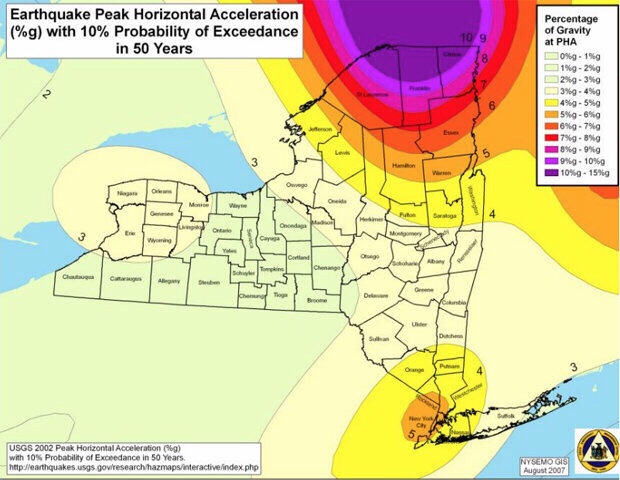
RISK: A seismic hazard map of New York produced by USGS
“New York is susceptible to seismic shaking from earthquakes at much greater distances” Dr Simon Day, natural disaster researcher
This is because the bedrock underneath parts of NYC, including Long Island and Staten Island, cannot effectively absorb the seismic waves produced by earthquakes.
“An important feature of the central and eastern United States is, because the crust there is old and cold, and contains few recent fractures that can absorb seismic waves, the rate of seismic reduction is low.
Central regions of NYC, including Manhattan, are built upon solid granite bedrock; therefore the amplification of seismic waves that can shake buildings is low.
But more peripheral areas, such as Staten Island and Long Island, are formed by weak sediments, meaning seismic hazard in these areas is “very likely to be higher”, Dr Day said.
“Thus, like other cities in the eastern US, New York is susceptible to seismic shaking from earthquakes at much greater distances than is the case for cities on plate boundaries such as Tokyo or San Francisco, where the crustal rocks are more fractured and absorb seismic waves more efficiently over long distances,” Dr Day said.
In the event of a large earthquake, dozens of skyscrapers, including Chrysler Building, the Woolworth Building and 40 Wall Street, could be at risk of shaking.
“The felt shaking in New York from the Virginia earthquake in 2011 is one example,” Dr Day said.
On that occasion, a magnitude 5.8 earthquake centered 340 miles south of New York sent thousands of people running out of swaying office buildings.

USGS
FISSURES: Fault lines in New York City have low rates of activity, Dr Day said
NYC Mayor Michael Bloomberg said the city was “lucky to avoid any major harm” as a result of the quake, whose epicenter was near Louisa, Virginia, about 40 miles from Richmond.
“But an even more impressive one is the felt shaking from the 1811-1812 New Madrid earthquakes in the central Mississippi valley, which was felt in many places across a region, including cities as far apart as Detroit, Washington DC and New Orleans, and in a few places even further afield including,” Dr Day added.
“So, if one was to attempt to do a proper seismic hazard assessment for NYC, one would have to include potential earthquake sources over a wide region, including at least the Appalachian mountains to the southwest and the St Lawrence valley to the north and east.”
Tuesday, November 8, 2022
New York Subways at the Sixth Seal (Revelation 6)
How vulnerable are NYC’s underwater subway tunnels to flooding?
New York City is full of peculiar phenomena—rickety fire escapes; 100-year-old subway tunnels; air conditioners propped perilously into window frames—that can strike fear into the heart of even the toughest city denizen. But should they? Every month, writer Ashley Fetters will be exploring—and debunking—these New York-specific fears, letting you know what you should actually worry about, and what anxieties you can simply let slip away.
The 25-minute subway commute from Crown Heights to the Financial District on the 2/3 line is, in my experience, a surprisingly peaceful start to the workday—save for one 3,100-foot stretch between the Clark Street and Wall Street stations, where for three minutes I sit wondering what the probability is that I will soon die a torturous, claustrophobic drowning death right here in this subway car.
The Clark Street Tunnel, opened in 1916, is one of approximately a dozen tunnels that escort MTA passengers from one borough to the next underwater—and just about all of them, with the exception of the 1989 addition of the 63rd Street F train tunnel, were constructed between 1900 and 1936.
Each day, thousands of New Yorkers venture across the East River and back again through these tubes buried deep in the riverbed, some of which are nearing or even past their 100th birthdays. Are they wrong to ponder their own mortality while picturing one of these watery catacombs suddenly springing a leak?
Mostly yes, they are, says Michael Horodniceanu, the former president of MTA Capital Construction and current principal of Urban Advisory Group. First, it’s important to remember that the subway tunnel is built under the riverbed, not just in the river—so what immediately surrounds the tunnel isn’t water but some 25 feet of soil. “There’s a lot of dirt on top of it,” Horodniceanu says. “It’s well into the bed of the bottom of the channel.”
And second, as Angus Kress Gillespie, author of Crossing Under the Hudson: The Story of the Holland and Lincoln Tunnels, points out, New York’s underwater subway tunnels are designed to withstand some leaking. And withstand it they do: Pumps placed below the floor of the tunnel, he says, are always running, always diverting water seepage into the sewers. (Horodniceanu says the amount of water these pumps divert into the sewer system each day numbers in the thousands of gallons.)
Additionally, MTA crews routinely repair the grouting and caulking, and often inject a substance into the walls that creates a waterproof membrane outside the tunnel—which keeps water out of the tunnel and relieves any water pressure acting on its walls. New tunnels, Horodniceanu points out, are even built with an outside waterproofing membrane that works like an umbrella: Water goes around it, it falls to the sides, and then it gets channeled into a pumping station and pumped out.
Of course, the classic New York nightmare scenario isn’t just a cute little trickle finding its way in. The anxiety daydream usually involves something sinister, or seismic. The good news, however, is that while an earthquake or explosion would indeed be bad for many reasons, it likely wouldn’t result in the frantic flooding horror scene that plays out in some commuters’ imaginations.
The Montague Tube, which sustained severe damage during Hurricane Sandy.
MTA New York City Transit / Marc A. Hermann
Horodniceanu assures me that tunnels built more recently are “built to withstand a seismic event.” The older tunnels, however—like, um, the Clark Street Tunnel—“were not seismically retrofitted, let me put it that way,” Horodniceanu says. “But the way they were built is in such a way that I do not believe an earthquake would affect them.” They aren’t deep enough in the ground, anyway, he says, to be too intensely affected by a seismic event. (The MTA did not respond to a request for comment.)
One of the only real threats to tunnel infrastructure, Horodniceanu adds, is extreme weather. Hurricane Sandy, for example, caused flooding in the tunnels, which “created problems with the infrastructure.” He continues, “The tunnels have to be rebuilt as a result of saltwater corroding the infrastructure.”
Still, he points out, hurricanes don’t exactly happen with no warning. So while Hurricane Sandy did cause major trauma to the tunnels, train traffic could be stopped with ample time to keep passengers out of harm’s way. In 2012, Governor Andrew Cuomo directed all the MTA’s mass transit services to shut down at 7 p.m. the night before Hurricane Sandy was expected to hit New York City.
And Gillespie, for his part, doubts even an explosion would result in sudden, dangerous flooding. A subway tunnel is not a closed system, he points out; it’s like a pipe that’s open at both ends. “The force of a blast would go forwards and backwards out the exit,” he says.
So the subway-train version of that terrifying Holland Tunnel flood scene in Sylvester Stallone’s Daylight is … unrealistic, right?
“Yeah,” Gillespie laughs. “Yeah. It is.”
Got a weird New York anxiety that you want explored? E-mail tips@curbed.com, and we may include it in a future column.
A Lack Of Vigilance Before The Sixth Seal (Revelation 6:12)
Faults Underlying Exercise Vigilant Guard
Dated: Thu, Nov 5, 2009
This map illustrates the earthquake fault lines in Western New York. An earthquake in the region is a likely event, says University of Buffalo Professor Dr. Robert Jacobi.
TONAWANDA, NY — An earthquake in western New York, the scenario that Exercise Vigilant Guard is built around, is not that far-fetched, according to University of Buffalo geology professor Dr. Robert Jacobi.
When asked about earthquakes in the area, Jacobi pulls out a computer-generated state map, cross-hatched with diagonal lines representing geological faults.
The faults show that past earthquakes in the state were not random, and could occur again on the same fault systems, he said.
“In western New York, 6.5 magnitude earthquakes are possible,” he said.
This possibility underlies Exercise Vigilant Guard, a joint training opportunity for National Guard and emergency response organizations to build relationships with local, state, regional and federal partners against a variety of different homeland security threats including natural disasters and potential terrorist attacks.
The exercise was based on an earthquake scenario, and a rubble pile at the Spaulding Fibre site here was used to simulate a collapsed building. The scenario was chosen as a result of extensive consultations with the earthquake experts at the University of Buffalo’s Multidisciplinary Center for Earthquake Engineering Research (MCEER), said Brig. Gen. Mike Swezey, commander of 53rd Troop Command, who visited the site on Monday.
Earthquakes of up to 7 magnitude have occurred in the Northeastern part of the continent, and this scenario was calibrated on the magnitude 5.9 earthquake which occurred in Saguenay, Quebec in 1988, said Jacobi and Professor Andre Filiatrault, MCEER director.
“A 5.9 magnitude earthquake in this area is not an unrealistic scenario,” said Filiatrault.
Closer to home, a 1.9 magnitude earthquake occurred about 2.5 miles from the Spaulding Fibre site within the last decade, Jacobi said. He and other earthquake experts impaneled by the Atomic Energy Control Board of Canada in 1997 found that there’s a 40 percent chance of 6.5 magnitude earthquake occurring along the Clareden-Linden fault system, which lies about halfway between Buffalo and Rochester, Jacobi added.
Jacobi and Filiatrault said the soft soil of western New York, especially in part of downtown Buffalo, would amplify tremors, causing more damage.
“It’s like jello in a bowl,” said Jacobi.
The area’s old infrastructure is vulnerable because it was built without reinforcing steel, said Filiatrault. Damage to industrial areas could release hazardous materials, he added.
“You’ll have significant damage,” Filiatrault said.
Exercise Vigilant Guard involved an earthquake’s aftermath, including infrastructure damage, injuries, deaths, displaced citizens and hazardous material incidents. All this week, more than 1,300 National Guard troops and hundreds of local and regional emergency response professionals have been training at several sites in western New York to respond these types of incidents.
Jacobi called Exercise Vigilant Guard “important and illuminating.”
“I’m proud of the National Guard for organizing and carrying out such an excellent exercise,” he said.
Training concluded Thursday.