Showing posts with label netankyahu. Show all posts

Thursday, September 21, 2017

Israel Will Trump the Iran Deal


Dangerous Words Of Escalation: Trump Threatens To Abandon Iran’s Nuclear Deal As Israeli Officials Call For Action Against Iran
Timothy Alexander Guzman
Once again, the annual United Nations General Assembly is taking place in New York City with U.S. President Donald Trump set to take center stage as he is expected to focus on the North Korean Crisis and the 2015 Iran Nuclear Deal also known as the Joint Comprehensive Plan of Action (JCPOA).
As the Western media’s attention has been focused on the North Korea crisis (which is also another very serious matter), another development has been taking place in Tel Aviv, as calls for action by Israeli officials against Iran’s Nuclear Program although it’s not a new development (it’s been going on for many years). Channel 2 on Israeli TV reported that Mossad chief Yossi Cohen is calling on the Israeli government to take action against the Iranian government. The Times of Israel reported that “Channel 2 on Sunday paraphrased Cohen as asserting that “Today’s Iran is the North Korea of yesterday, and so we need to act now so that we don’t wake up to [an Iranian] bomb.”
The report also mentioned that other security officials “are warning that Israel should not be pushing the US into another Middle Eastern adventure, given what happened when the US tackled Iraq and Saddam’s ostensible weapons of mass destruction over a decade ago.”
However, Netanyahu wants the 2015 Iran nuclear deal to be amended or canceled.
“Our position is straightforward. This is a bad deal. Either fix it — or cancel it. This is Israel’s position,” said Netanyahu in Buenos Aires” the report said.
Netanyahu will meet with Trump and will hold a brief press conference before they go behind closed doors to talk about the Iran Nuclear Deal, Syria and Israel’s future conflict with Hezbollah. The Associated Press (AP) mentioned that the Trump administration has threatened to walk away from the nuclear deal:
U.S. President Donald Trump warned Monday that Washington will walk away from a nuclear deal it agreed to with Iran and five other nations if it deems that the International Atomic Energy Agency is not tough enough in monitoring it
U.S. Energy Secretary Rick Perry quoted Trump at the U.N. agency’s annual meeting in Vienna according to the AP report and said that the deal could either “stand or fail on IAEA access to Iranian military sites, declaring “we will not accept a weakly enforced or inadequately monitored deal.” Arutz Sheva 7 (www.israelnationalnews.com) also reported on what Amos Yadlin, the Executive Director at the Tel Aviv University Institute for National Security Studies had said about Barack Obama who he claims was not an appropriate partner and that the Trump White House was supportive to Israel’s cause:
According to Amos, Netanyahu did not act before now because former US President Barack Obama was not an appropriate partner.
“In 2015, I suggested the Prime Minister sit with the US government and make a strategy for dealing with this problematic agreement,” he explained. “Back then, Netanyahu said we didn’t have a partner in the White House.”
“Thankfully, today we have a supportive government which understands the threat very well, especially in light of what is happening with North Korea. We can’t let this opportunity deteriorate into simple rhetoric, we need to make a general strategy. We need to fight Iran determinedly in every way, including those not included in the Iran deal, such as ballistic missiles, Iran’s support of terror, and their involvement in Syria. We also need to strengthen our supervision of them and collect better intelligence.
“There needs to be an Israeli-American agreement which supports our understanding that Iran cannot acquire a nuclear weapon, and detailing when and how we will work together to ensure our success”
The International Atomic Energy Agency (IAEA) Director General Yukiya Amano confirmed that Iran is implementing its nuclear-related commitment’s. Amano said that the “the nuclear-related commitments undertaken by Iran under (the 2015 nuclear deal) are being implemented.” Amano continued “the verification regime in Iran is the most robust regime which currently exists. We have increased the inspection days in Iran, we have increased inspector numbers … and the number of images has increased,” he said, “From a verification point of view, it is a clear and significant gain.”
Will the Trump administration ignore the IAEA’s statement that Iran is in compliance with the nuclear deal? Haaretz also reported what Yisrael Katz, Israel’s Intelligence Affairs Minister had said about Iran’s Nuclear Deal:
Intelligence Affairs Minister Yisrael Katz (Likud) said:
“The first mission of the Israeli prime minister during his upcoming visit to the United States is to demand that the U.S. president suspend, amend or annul the nuclear agreement with Iran,” said Katz. “Iran is the new North Korea. Action should be taken against it now, lest we regret tomorrow what we did not do yesterday”
Israel wants Iran destabilized just like its neighbor, Iraq to weaken its political and economic standing in the Middle East. Iran’s allies are Hezbollah and Syria, enemies to both Israel and Saudi Arabia. Iran is an economic and military power which can challenge the U.S. and Israel’s hegemonic power in the region. Netanyahu is trying to influence Trump’s decision to terminate the nuclear deal, which would put the U.S. on the fast track to war with Iran. Netanyahu would welcome an attack on Iran by U.S. forces which would free Israel’s military and allow it to focus on Hezbollah and possibly Syria in the next conflict with help from Saudi Arabia. It’s been a long-term goal of Washington’s political establishment and Netanyahu to realign the Middle East in Israel’s favor. With Trump in the White House, the Israeli’s see an opportunity while the rest of the world sees pure madness.
This article was originally published by Silent Crow News where the featured image was sourced.

Wednesday, September 20, 2017

It Is Already Too Late For Israel (Daniel 8:3)

170915150101-hezbollah-syria-lebanese-border-exlarge-169Iran: The one issue Netanyahu wants to discuss with Trump
 
Trump, Netanyahu meeting to focus on Iran
 
Jerusalem (CNN)When US President Donald Trump meets with Israeli Prime Minister Benjamin Netanyahu on Monday ahead of the United Nations General Assembly, the conversation itself will be private, but Netanyahu has made it very clear what he wants to discuss: Iran.
 
Netanyahu's first dire warning about Iran came more than two decades ago. In 1996, Netanyahu, then in his first term as Prime Minister, delivered his maiden speech before Congress. In it, he warned that Iran "has wed a cruel despotism to a fanatic militancy. If this regime, or its despotic neighbor Iraq, were to acquire nuclear weapons, this could presage catastrophic consequences, not only for my country, and not only for the Middle East, but for all mankind."
 
In the intervening years, his language has barely changed.
 
In 2011, again speaking before Congress, Netanyahu said, "The tyranny in Tehran brutalizes its own people." In 2015 -- his most recent speech before Congress in which he lobbied against the Iran nuclear accord -- the Israeli Prime Minister said, "Iran's founding document pledges death, tyranny, and the pursuit of jihad."
 
What has changed is Netanyahu's singular focus on Iran. He mentioned it only once in 1996. In 2011, he said it 12 times. In 2015, he said "Iran" a staggering 107 times in his speech.
 
Once the most vocal critic of the Iran nuclear deal, officially called the Joint Comprehensive Plan of Action (JCPOA), Netanyahu went largely quiet after the signing of the accord in July 2015, realizing he could do little to change it, especially as relations deteriorated between Netanyahu and former President Barack Obama.
 
In Trump, Netanyahu sees a new window of opportunity.
 
Trump has blasted the Iran deal since his days on the campaign trail, calling it "the worst deal ever" and vowing to "rip it up." Since taking office, his tone has softened, but only slightly.
 
Trump has still voiced strong criticism, leaving open the possibility that the United States will leave the deal, despite the International Atomic Energy Agency finding at the end of August that Iran was complying with the terms of the accord. Earlier this month, US Ambassador to the UN Nikki Haley laid out a case for the US to abandon the deal, saying Iran's technical compliance wasn't enough.
Netanyahu has urged Trump to do so, saying in an exclusive interview with CNN this week, "This agreement should be changed. It should be changed so that the removal of restrictions on Iran's nuclear program should be not a matter of [a] change [in] the calendar, but a change in Iran's aggressive behavior. They must stop their aggression. They must stop their terror in the Middle East and everywhere else."
Israel's concern about the nuclear deal isn't the only Iran issue Trump and Netanyahu will discuss. In fact, it may not even be the primary one, since even Netanyahu acknowledges that the current accord will keep Tehran from developing a nuclear weapon within the next decade.

Hezbollah's evolution

 
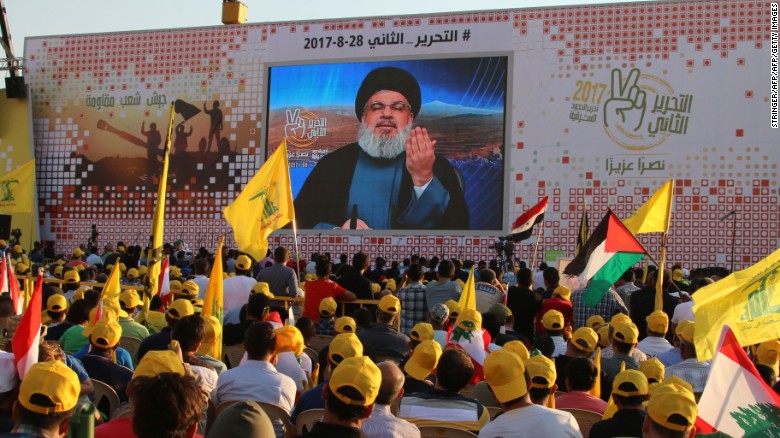
Across Israel's northern border among the rolling hills of southern Lebanon, Iranian-proxy Hezbollah has built a stronghold. A few feet away from the border, near the Israeli town of Malkiya, a Hezbollah flag marks the territory. On a nearby hill, another flag waves in the breeze, near a UN outpost.
 
Since Israel and Lebanon fought a month-long war in the summer of 2006, this border has been Israel's quietest, despite the war ending with no clear winner or loser. But the tranquility masks a simple truth -- the border is perpetually tense.
 
Last week, Israel ran its biggest military exercise in twenty years along the northern border, including its army, air force, and navy, simulating a conflict with Hezbollah. And for years, Hezbollah's arsenal has been growing — now with 100,000 short range rockets and several thousand more missiles in its cache, according to state-run Iranian news agency Tasnim and Israeli officials. Once a guerilla militia, Hezbollah is now an experienced army, learning from the conflict in Syria, where it has fought alongside the Syrian regime.
 
 
"In the last five years, there is a huge, dramatic change in the tactical, but also operational capabilities of this organization as a fighting organization. You find yourself with an organization that is working with military formations - battalions, brigades - that has a command and control structure that has dramatically changed," General (Res.) Eli Ben-Meir, the former Chief Intelligence Officer of Israel's military said.
 
Even so, over the last decade, Israel and Hezbollah have preferred to shoot rhetoric back and forth across the border instead of live fire. But increasingly it is Iran's deployment of Hezbollah in neighboring Syria that is alarming Israel.
 
 
Last year, Netanyahu acknowledged that Israel struck Syria dozens of times to prevent advanced weaponry from reaching Hezbollah, also saying Israel would work to prevent Iran from digging in along Israel's borders.

The Russia connection

To push back against Iran's growing influence, Israel has turned not to the US, but to Russia. Netanyahu has made regular trips to Russia to meet with President Vladimir Putin ever since Russian forces moved into Syria in 2015, touting the Israeli and Russian military coordination over Syria. But Israeli politicians are acutely aware that Russia's primary concern in the region is its own interests, not Israel's security.
 
This is where Israel feels the lack of US presence in the region most sharply -- starting in the Obama administration. Despite Trump's tough talk on the Iran nuclear deal and the possibility of harsher measures against Iran, he now presides over what many Israelis regard as the absence of the US in the Syria conflict. In multiple conversations with Israeli politicians, this fear is often repeated.
 
"The United States can prevent a permanent Iranian military presence in Syria," Minister of Intelligence and security cabinet member Israel Katz told CNN, urging the US to get more involved. "I think the lesson both in the nuclear sphere and the conventional sphere is that the US cannot ignore the fact that she is the leader of the free world and everything that comes from that."
 
Sebastian Gorka, who until recently served as a counter-terrorism adviser to President Trump, tried to allay Israeli fears. "Key individuals inside the National Security Council understand we are at war with Sunni Jihadis - al-Qaeda, ISIS - and they also understand that any action we take against groups like ISIS should not occur in ways that profit Iran in ways that are strategic and long-term," Gorka said in an interview with CNN, on the sidelines of a counter-terrorism conference in Herzliya.
 
"I hope those voices maintain their positions and their influence. Again, this is about the long game.

But without a concrete plan, Gorka's statements do little to ease Israeli fears.
 
Another full-blown conflict between Israel and Hezbollah would be devastating for both sides. Hezbollah has the rockets and missiles to hit deep within Israel. Israel has the firepower to level southern Lebanon.

Israel Won't Be Here In 25 Years (Revelation 11)

'Israel may not exist in 25 years'

News DeskThe International News Desk reports on issues and events world wide.
Iranian revolutionary guard soldiers march during the annual military parade marking the Iraqi invasion in 1980, which led to an eight-year-long war (1980-1988) in Tehran, Iran, 22 September 2013. Iranian president Hasan Rowhani said that Iran only wants to end the civil war in Syria for avoiding a new escalation of violence in the Middle East. EPA/ABEDIN TAHERKENAREH
Iran’s newly-appointed army chief, General Abdolrahim Mousavi, said on Monday there is no guarantee Israel will exist in the next 25 years, adding that its slightest wrong move may result in the Israeli cities of Haifa and Tel Aviv being “razed down to the ground”.
Mousavi was appointed in August as the commander of the Iranian army, an entity separate from the country’s Revolutionary Guard corps.
Speaking at an event in the holy city of Qom, he elaborated on the remarks he made last month about Israel not surviving 25 years, explaining that he never meant to say the regime would necessarily last that long.
“That we say that the Zionist regime will not see 25 years later doesn’t mean that it will certainly survive for 25 years,” he said according to the semi-official Fars News Agency.
“There is a prerequisite for this famous sentence, that is if the Zionist regime makes any wrong move, Haifa and Tel Aviv will be razed down to the ground.”
Mousavi’s comments alluded to the September 2015 warning by Iran’s Supreme Leader Ayatollah Ali Khamenei in which he said “the Zionists” who often raised concerns over Iran’s nuclear program shouldn’t naively feel relieved for 25 years just because the comprehensive nuclear deal was agreed between Iran and the P5+1 group of world powers.
Key points of the historic nuclear deal include a “long-term” International Atomic Energy Agency (IAEA) presence in Iran that includes the monitoring of uranium ore concentrate produced by Iran for 25 years.
“You will not see next 25 years (…) With God’s grace, nothing under the name of the Zionist regime will exist in the region by then,” Khamenei said on Twitter.
Khamenei also previously warned of the United States’ unswerving hostility towards the Iranian nation, saying that even after the nuclear deal was inked the Americans have been hatching plots and approved a bill in the Congress against Iran.
On Monday, US President Donald Trump warned that Washington will walk away from the deal if it concludes that IAEA is not tough enough in monitoring it. Iranian nuclear chief Ali Akbar Salehi responded that the greatest threat to its survival was “the American administration’s hostile attitude.”
Source: Sputnik

Sunday, September 17, 2017

Israel Tries to Stop the Iranian Nuclear Horn

https://img.rt.com/files/oldfiles/news/israel-mossad-iran-operation-998/afp-abbas-photo-momani.si.jpgMossad chief said pushing to ‘act now’ to prevent Iranian nuclear bomb

By RAPHAEL AHREN and RAOUL WOOTLIFF
September 17, 2017, 9:17 pm
Mossad chief Yossi Cohen is leading Israel’s “hawkish line” on Iran, calling for immediate action to ensure that Tehran cannot attain the bomb, an Israeli TV report said Sunday.
The report came as Prime Minister Benjamin Netanyahu prepared to address the United Nations General Assembly on Tuesday, with his focus to again be on confronting Iran.
Channel 2 on Sunday paraphrased Cohen as asserting that “Today’s Iran is the North Korea of yesterday, and so we need to act now so that we don’t wake up to [an Iranian] bomb.”
Other Israeli security officials, the report said, however, are warning that Israel should not be pushing the US into another Middle Eastern adventure, given what happened when the US tackled Iraq and Saddam’s ostensible weapons of mass destruction over a decade ago.
Netanyahu will for the first time directly address Iran’s Supreme Leader Ayatollah Khamenei in his speech to the UN, Israeli sources said.
Netanyahu’s speech, scheduled for Tuesday, 8:00 p.m. Israel time, will focus on Iran and be shorter than in previous years, the sources said.
Speaking to reporters on Friday at his hotel in New York after wrapping up a trip to Latin America, Netanyahu said that the main message of his UN speech will be that “Israel will not tolerate an Iranian military presence on our northern borders. An [Iranian] military presence endangers not just us, but also our Arab neighbors.”
Netanyahu has repeatedly warned against Iran’s military ambitions in the area, Tehran’s bid to establish a territorial “corridor” all the way to the Mediterranean, and an increased Iranian presence on Israel’s northern border.
Earlier last week, Netanyahu said Israel wanted to see the 2015 Iran nuclear deal — which offered Iran relief from punishing sanctions in exchange for having it roll back its nuclear program — either amended or canceled altogether.
“Our position is straightforward. This is a bad deal. Either fix it — or cancel it. This is Israel’s position,” said Netanyahu in Buenos Aires.
During his scheduled Monday meeting with US President Donald Trump, Netanyahu is set to present a proposal for rolling back the two-year-old deal, signed by the Obama administration and other P5+1 powers.
Netanyahu is reportedly preparing a specific formula for either scrapping the historic deal or amending it. His proposal will detail how “to cancel or at the very least introduce significant changes” to the accord, a Channel 2 news report said.
On Monday, at 1 p.m. local time, Netanyahu will meet with Trump in the New York Palace Hotel. Both leaders will make brief statements to the press to open the meeting, before continuing their discussion behind closed doors.
Prime Minister Benjamin Netanyahu and US President Donald Trump during a joint press statements at the Prime Minister’s Residence in Jerusalem, on May 22, 2017. (Marc Israel Sellem/POOL)
Later in the afternoon, Netanyahu is set to meet the president of Panama, Juan Carlos Varela; the prime minister of Japan, Shinzo Abe; and Rwandan President Paul Kagame, at the UN.
The prime minister is also scheduled to meet Brazilian President Michel Temer for the first time since the South American country rejected Dani Dayan as Israel’s candidate for ambassador there due to his past links to the settler movement. Dayan now serves as Israel’s consul general in New York. Brazil was notably left out of Netanyahu’s last week’s Latin America trip,
On Tuesday morning, the prime minister is expected to attend Trump’s first address to the UN. A few hours later, at around 1:30 p.m., Netanyahu will deliver his own speech.

Sunday, October 23, 2016

Another Nuclear Arm For Israel

Big News Network
Germany is to provide the Dolphin-class submarines as a result of secret negotiations which have spanned the last few months.
Israel will pay a substantially discounted price of $1.3 billion for the three submarines.
The deal is expected to be finalised in early November.
Israel, which orchestrated the drive against Iran becoming a nuclear power, and has bombed emerging nuclear facilities in Iraq and Syria, has itself been developing nuclear weapons since the 1950s. The Dimona nuclear plant in the Negev desert had its origins in 1954, just six years after the birth of Israel. The late Shimon Peres as Director General of the Israeli Defense Ministry was responsible for the development of the facility. A pact with France was secretly negotiated and hundreds of French scientists were brought in to develop the facility, in absolute secrecy.
To offset the concerns of satellite surveilance, the Jewish state publicly touted the facility as a business park or textile factory. When U.S. President John Kennedy aroused suspicions in 1963, Israel maintained its denials. Kennedy applied so much pressure, David Ben-Gurion resigned as prime minister of Israel just months before Kennedy was assassinated. Some researchers implicate the Israeli inteligence agency Mossad among those considered responsible for the assassination.
Peres himself was asked point blank by Kennedy if Israel was building a nuclear facility. Summoned to the Oval Room in the White House on a 1963 visit to Washington, the young Peres was asked in his words, '30 rapid-fire questions,' before Kennedy asked: "Are you building a nuclear option?" Peres said he changed the subject.
To this day Israel has neither confirmed or denied publicly it has a nuclear facility. The only official statement on Dimona was made on December 21 1960 when Ben-Gurion, in response to an aricle in Time magazine which spawned a flurry of media coverage, announced to the Knesset his government was building "a 24 megawatt reactor which will serve the needs of industry, agriculture, health, and science," and that it "is designed exclusively for peaceful purposes."
The Israel Navy until last year had a fleet of four Dolphin-class submarines operating out of its naval base at Haifa. A fifth submarine ariived in late December last year after which it was expected to be fitted with Iraeli-built systems which took several months. It is believed it is operational now.
“Submarines bring a level of intelligence to Israel that cannot be achieved by other units,” Lt.-Cmdr. Y., a past commander of the navy’s submarine school, told The Jerusalem Post in 2014.
“Drones that fly in the air can be shot down,” he said, “but a submarine can stay in enemy territory for weeks, and no one knows it’s there. It can lurk off coastal regions without any problem at all. The level of intelligence this brings is not heard about by the public. All of our operations build on past operations.”
In addition to the new submarines, the Israeli Navy has been working closely with Germany to upgrade its entire combat surface naval fleet. New German-built, Israeli-equipped Sa'ar-6 corvettes will be added to the fleet over the next few years, and new radars and electronic warfare systems are being added to existing Sa'ar-5 and Sa'ar 4.5 ships. By 2024, the upgraded corvettes and missile boats will be joined by four larger Sa'ar-6 combat ships, the result of a 430 million euro deal signed between Israel and Germany last year.
"All the top-side arrangements above the water line are basically a German and Israeli design, tailored for the needs of the Israel Navy and integrated with our own radar, electronic warfare and other systems," Israel Navy Captain Ariel Shir, head of the Electronic Combat Systems Department in the service's Materiel Command said when the deal was announced last year.
"Now that the contract is signed on the Sa'ar-6 ships, we're starting to contract for the subsystems," Shir said at the time.

Thursday, October 2, 2014

It’s Called the Samson Option: Nuclear Suicide

Netanyahu’s Nuclear Hypocrisy on Iran;

In fact, Everyone in the ME needs to Disarm
The Samson Option: Nuclear Suicide

By Farhad Malekafzali

With negotiations to limit Iran’s enrichment in return for easing of economic sanctions on the verge of failure, hopes for a step-by-step diplomacy to dismantle Iran’s nuclear program are once again dashed.

The decade old debate regarding Iran’s nuclear program has largely centered on denying Iran capacity to build nuclear weapons because Iran’s leaders are too fanatical to be trusted with nuclear weapons and thus if they are allowed to build nuclear weapons, they would use them not as deterrence but rather to attack Israel or the “West.” As Israeli PM, Benjamin Netanyahu stated before the UNGA on September 30, 2014:

“Once Iran produces atomic bombs, all the charm and all the smiles will suddenly disappear. They’ll just vanish. It’s then that the ayatollahs will show their true face and unleash their aggressive fanaticism on the entire world. There is only one responsible course of action to address this threat: Iran’s nuclear military capabilities must be fully dismantled. Make no mistake – ISIS must be defeated. But to defeat ISIS and leave Iran as a threshold nuclear power is to win the battle and lose the war.”

Therefore, with the threat of military action in the background, economic sanctions are used to compel the regime to end its nuclear weapons program.
Since 2007, with intelligence reports showing Iran had suspended its nuclear weapons program in
2003, the focus of US policy has shifted to preventing Iran from developing even an independent civilian nuclear technology, ostensibly to deny Iran the know-how to develop nuclear weapons quickly in the event of a crisis, what is called breakout technology.

A fundamental question not raised by mainstream media and some established academics and the likes of Netanyahu is if Iran wants the capability to develop nuclear weapons, what could be her reasons.

One possible reason, and the most obvious, is that Israel, less than a thousand miles away, has hundreds of nuclear warheads and the means to deliver them to targets deep inside Iran. As with the United States and the Soviet Union after WWII, if one side has nuclear weapons, it would be difficult to expect the other side not to develop the same capabilities. To refrain from doing so would be to place national security at the mercy of another country, your foe. In fact, once parity is achieved, the relationship between nuclear powers is supposed to stabilize. There would be no temptation to use nuclear weapons, even to put pressure on the other side for political reasons (nuclear blackmail) out of fear of escalation. Rationality, a shared human trait, dictates that neither side would risk nuclear annihilation.

Any nuclear attack would bring massive retaliation that result in mutual destruction. In the case of Iran and Israel, Iran will not be able to destroy Israel’s retaliatory capabilities. Israel’s nuclear weapons are spread on land, in the air and on submarines. But even if Iran could destroy Israel’s capacity to retaliate, the relatively short distances and the prevailing easterly winds will guarantee that its nuclear blasts over Israel would shower its own people with deadly radioactive material in a rather short order.

Second, Iran does not have a modern conventional force while Israel has a large stockpile of latest American made weapons and well-trained personnel to use them. Iranians, in contrast, have been denied access to modern conventional weapons for at least 25 years including defensive systems such as the Russian SAM-300 surface to air missile system largely because of American pressure.

Lastly, there is a large American military presence around Iran. U.S. Navy has been present in Persian Gulf since the 1980s. Since 2002, U.S. ground forces have been stationed in Iraq, Kuwait, and Afghanistan. The United States has invaded and occupied Afghanistan and Iraq in clear violation of international norms and based on manufactured evidence in only the last dozen years. It has armed Saudi Arabia and UAE heavily for the past twenty years with some of America’s most sophisticated missiles and fighter-bombers. Sitting in Tehran, it is difficult for the rulers of Iran not to fear an American invasion. As far as they can see it, if Saddam Hussein had nuclear capability, he would still be in power in Iraq. Nuclear weapons or more likely the capability to build them in a hurry could act as an independent deterrence against the United States and its regional allies.

Given Iran’s weak conventional forces, even nuclear disarmament is only a first step that should be followed by deep cuts in offensive conventional weapons in the whole of Middle East. It is unlikely for Iran, as a rational actor, to abandon the only means of deterrence available to it if the threat of an American invasion remains on the table. Arms reductions by US allies to defensive levels and departure of US forces are the only rational foreign policy options that would insure the security of every state in the region while still fitting into the United States’ and Israeli security interests, even if the central issue of Israeli occupation-Palestinian rights is left untouched.

Israel does not need a conventional force with powerful offensive capability. It has peace treaties with two of its neighbors, Egypt and Jordan. It would have been able to sign a favorable peace treaty with Syria in 2006 if it had wanted to, and the weakened Assad would be at least as ready to sign one today. The Arab League’s 2002 proposal offering Israel both recognition and full diplomatic relations in return for Israeli withdrawal to the 1967 borders is still on the table. As for US’ Arab allies, even with cuts in their armed forces, they will have enough to keep themselves in power. For the US, departure of its ground forces from the region alone can do much to improve its negative image among the Arab and Muslim publics. There is no reason for maintaining a naval presence in the Persian Gulf either. Countries in the region depend on oil revenues for the bulk of their annual national budgets and thus have no logical reason to disrupt the flow of oil. A major obstacle to all of this, of course, is the profitable arms market. US sells 70% of the world’s weapons and most of that in the Middle East. Israel is the seventh largest exporter of arms worldwide.

Farhad Malekafzali is a political scientist and a teaching fellow at the University of Oregon.