The prophecy is more than seeing into the future. For the prophecy sees without the element of time. For the prophecy sees things as they were, as they are, and as they always shall be.
On Nov. 8, a 3.6 magnitude earthquake struck Buzzard’s Bay off the coast of New Bedford. Reverberations were felt up to 100 miles away, across Massachusetts, Rhode Island, and parts of Connecticut and New York. News outlets scrambled to interview local residents who felt the ground shake their homes. Seismologists explained that New England earthquakes, while uncommon and usually minor, are by no means unheard of.
It’s sometimes called the Boston Earthquake and sometimes the Cape Ann Earthquake. Its epicenter is thought to have been in the Atlantic Ocean about 25 miles east of Gloucester. Estimates say that it would have registered between 6.0 and 6.3 on the modern Richter scale. It was an occasion to remember as chronicled by John E. Ebel, director of the Weston observatory of Boston College:
“At about 4:30 in the morning on 18 November, 1755, a strong earthquake rocked the New England area. Observers reported damage to chimneys, brick buildings and stone walls in coastal communities from Portland, Maine to south of Boston … Chimneys were also damaged as far away as Springfield, Massachusetts, and New Haven, Connecticut. The earthquake was felt at Halifax, Nova Scotia to the northeast, Lake Champlain to the northwest, and Winyah, South Carolina to the southwest. The crew of a ship in deep water about 70 leagues east of Boston thought it had run aground and only realized it had felt an earthquake after it arrived at Boston later that same day.
“The 1755 earthquake rocked Boston, with the shaking lasting more than a minute. According to contemporary reports, as many as 1,500 chimneys were shattered or thrown down in part, the gable ends of about 15 brick buildings were broken out, and some church steeples ended up tilted due to the shaking. Falling chimney bricks created holes in the roofs of some houses. Some streets, particularly those on manmade ground along the water, were so covered with bricks and debris that passage by horse-drawn carriage was impossible. Many homes lost china and glassware that was thrown from shelves and shattered. A distiller’s cistern filled with liquor broke apart and lost its contents.”
We don’t have many details of the earthquake’s impact here, there being no newspaper in Worcester County at that time. We do know that one man, Christian Angel, working in a “silver” mine in Sterling, was buried alive when the ground shook. He is the only known fatality in these parts. We can assume that, if the quake shook down chimneys in Springfield and New Haven, it did even more damage hereabouts. We can imagine the cries of alarm and the feeling of panic as trees swayed violently, fields and meadows trembled underfoot and pottery fell off shelves and crashed below.
The Boston Earthquake was an aftershock from the gigantic Lisbon Earthquake that had leveled Lisbon, Portugal, a few days before. That cataclysm, estimated as an 8 or 9 on the modern Richter scale, was the most devastating natural catastrophe to hit western Europe since Roman times. The first shock struck on Nov. 1, at about 9 in the morning.
According to one account: ”Suddenly the city began to shudder violently, its tall medieval spires waving like a cornfield in the breeze … In the ancient cathedral, the Basilica de Santa Maria, the nave rocked and the massive chandeliers began swinging crazily. . . . Then came a second, even more powerful shock. And with it, the ornate façade of every great building in the square … broke away and cascaded forward.”
Until that moment, Lisbon had been one of the leading cities in western Europe, right up there with London and Paris. With 250,000 people, it was a center of culture, financial activity and exploration. Within minutes it was reduced to smoky, dusty rubble punctuated by human groans and screams. An estimated 60,000 to 100,000 lost their lives.
Since then, New England has been mildly shaken by quakes from time to time. One series of tremors on March 1, 1925, was felt throughout Worcester County, from Fitchburg to Worcester, and caused a lot of speculation.
What if another quake like that in 1755 hit New England today? What would happen? That question was studied 15 years ago by the Massachusetts Civil Defense Agency. Its report is sobering:
“The occurrence of a Richter magnitude 6.25 earthquake off Cape Ann, Massachusetts … would cause damage in the range of 2 to 10 billion dollars … in the Boston metropolitan area (within Route 128) due to ground shaking, with significant additional losses due to secondary effects such as soil liquefaction failures, fires and economic interruptions. Hundreds of deaths and thousands of major and minor injuries would be expected … Thousands of people could be displaced from their homes … Additional damage may also be experienced outside the 128 area, especially closer to the earthquake epicenter.”
So even if we don’t worry much about volcanoes, we know that hurricanes and tornadoes are always possible. As for earthquakes, they may not happen in this century or even in this millennium, but it is sobering to think that if the tectonic plates under Boston and Gloucester shift again, we could see a repeat of 1755.
The United States Geological Survey says the 3.3 magnitude quake hit several mikes south of the town of Ormstown, Quebec a little after 5:30 A.M. There are some slightly conflicting reports, as the Montreal Gazette reports that the quake was a 3.6 magnitude. Ormstown is located around 20 minutes north of the New York border.
The Times Union says the quake was felt as far south as the town of Ticonderoga in Essex County, and as far west as the city of Ogdensburg on the New York-Ontario border. The effects were also felt as far north as Montreal.
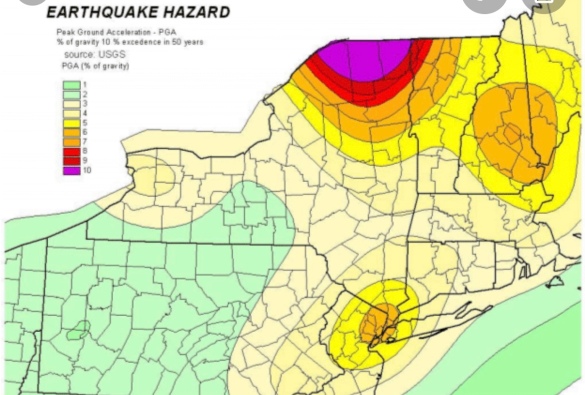
Some strike even closer to home. In April 2017, a 1.3 tremor occurred around two and half miles west of Pawling. In early 2016, an even smaller quake happened near Port Chester and Greenwich, CT. In the summer of 2019, a quake struck off the New Jersey coast.
Listen to Middays With Hopkins weekdays from 10AM to 2PM on 101.5 WPDH. Stream us live through the website, Alexa-enabled device, Google Home or the WPDH mobile app.
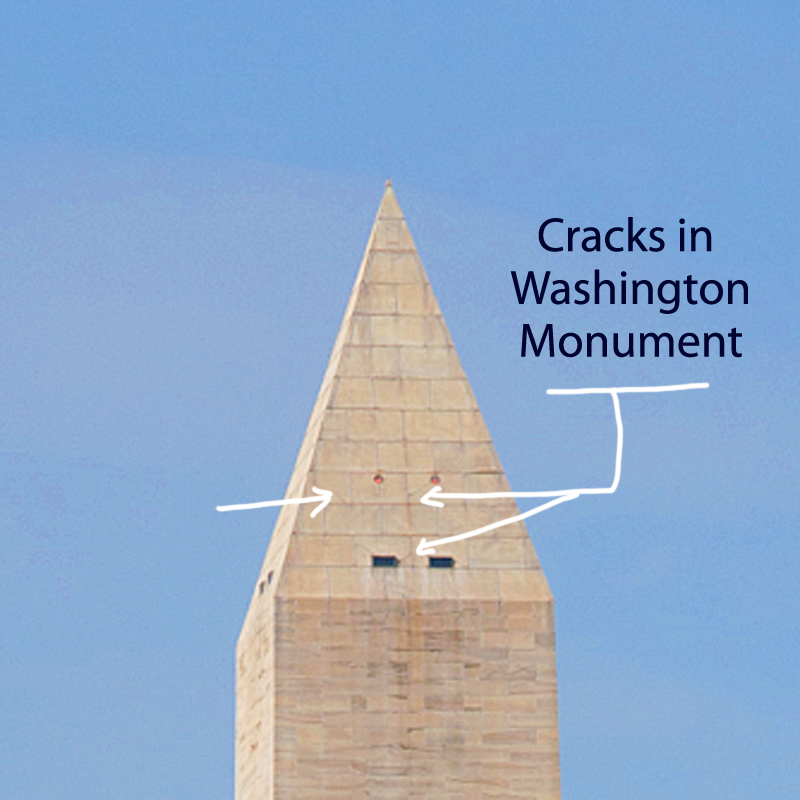
East Coast Earthquake Preparedness By By BEN NUCKOLS Posted: 08/25/2011 8:43 am EDT WASHINGTON — There were cracks in the Washington Monument and broken capstones at the National Cathedral. In the District of Columbia suburbs, some people stayed in shelters because of structural concerns at their apartment buildings. A day after the East Coast’s strongest earthquake in 67 years, inspectors assessed the damage and found that most problems were minor. But the shaking raised questions about whether this part of the country, with its older architecture and inexperience with seismic activity, is prepared for a truly powerful quake. The 5.8 magnitude quake felt from Georgia north to Canada prompted swift inspections of many structures Wednesday, including bridges and nuclear plants. An accurate damage estimate could take weeks, if not longer. And many people will not be covered by insurance. In a small Virginia city near the epicenter, the entire downtown business district was closed. School was canceled for two weeks to give engineers time to check out cracks in several buildings. At the 555-foot Washington Monument, inspectors found several cracks in the pyramidion – the section at the top of the obelisk where it begins narrowing to a point. A 4-foot crack was discovered Tuesday during a visual inspection by helicopter. It cannot be seen from the ground. Late Wednesday, the National Park Service announced that structural engineers had found several additional cracks inside the top of the monument. Carol Johnson, a park service spokeswoman, could not say how many cracks were found but said three or four of them were “significant.” Two structural engineering firms that specialize in assessing earthquake damage were being brought in to conduct a more thorough inspection on Thursday. The monument, by far the tallest structure in the nation’s capital, was to remain closed indefinitely, and Johnson said the additional cracks mean repairs are likely to take longer. It has never been damaged by a natural disaster, including earthquakes in Virginia in 1897 and New York in 1944. Tourists arrived at the monument Wednesday morning only to find out they couldn’t get near it. A temporary fence was erected in a wide circle about 120 feet from the flags that surround its base. Walkways were blocked by metal barriers manned by security guards. “Is it really closed?” a man asked the clerk at the site’s bookstore. “It’s really closed,” said the clerk, Erin Nolan. Advance tickets were available for purchase, but she cautioned against buying them because it’s not clear when the monument will open. “This is pretty much all I’m going to be doing today,” Nolan said. Tuesday’s quake was centered about 40 miles northwest of Richmond, 90 miles south of Washington and 3.7 miles underground. In the nearby town of Mineral, Va., Michael Leman knew his Main Street Plumbing & Electrical Supply business would need – at best – serious and expensive repairs. At worst, it could be condemned. The facade had become detached from the rest of the building, and daylight was visible through a 4- to 6-inch gap that opened between the front wall and ceiling. “We’re definitely going to open back up,” Leman said. “I’ve got people’s jobs to look out for.” Leman said he is insured, but some property owners might not be so lucky. The Insurance Information Institute said earthquakes are not covered under standard U.S. homeowners or business insurance policies, although supplemental coverage is usually available. The institute says coverage for other damage that may result from earthquakes, such as fire and water damage from burst gas or water pipes, is provided by standard homeowners and business insurance policies in most states. Cars and other vehicles with comprehensive insurance would also be protected. The U.S. Geological Survey classified the quake as Alert Level Orange, the second-most serious category on its four-level scale. Earthquakes in that range lead to estimated losses between $100 million and $1 billion. In Culpeper, Va., about 35 miles from the epicenter, walls had buckled at the old sanctuary at St. Stephen’s Episcopal Church, which was constructed in 1821 and drew worshippers including Confederate Gens. Robert E. Lee and J.E.B. Stuart. Heavy stone ornaments atop a pillar at the gate were shaken to the ground. A chimney from the old Culpeper Baptist Church built in 1894 also tumbled down. At the Washington National Cathedral, spokesman Richard Weinberg said the building’s overall structure remains sound and damage was limited to “decorative elements.” Massive stones atop three of the four spires on the building’s central tower broke off, crashing onto the roof. At least one of the spires is teetering badly, and cracks have appeared in some flying buttresses. Repairs were expected to cost millions of dollars – an expense not covered by insurance. “Every single portion of the exterior is carved by hand, so everything broken off is a piece of art,” Weinberg said. “It’s not just the labor, but the artistry of replicating what was once there.” The building will remain closed as a precaution. Services to dedicate the memorial honoring Rev. Martin Luther King Jr. were moved. Other major cities along the East Coast that felt the shaking tried to gauge the risk from another quake. A few hours after briefly evacuating New York City Hall, Mayor Michael Bloomberg said the city’s newer buildings could withstand a more serious earthquake. But, he added, questions remain about the older buildings that are common in a metropolis founded hundreds of years ago. “We think that the design standards of today are sufficient against any eventuality,” he said. But “there are questions always about some very old buildings. … Fortunately those tend to be low buildings, so there’s not great danger.” An earthquake similar to the one in Virginia could do billions of dollars of damage if it were centered in New York, said Barbara Nadel, an architect who specializes in securing buildings against natural disasters and terrorism. The city’s 49-page seismic code requires builders to prepare for significant shifting of the earth. High-rises must be built with certain kinds of bracing, and they must be able to safely sway at least somewhat to accommodate for wind and even shaking from the ground, Nadel said. Buildings constructed in Boston in recent decades had to follow stringent codes comparable to anything in California, said Vernon Woodworth, an architect and faculty member at the Boston Architectural College. New construction on older structures also must meet tough standards to withstand severe tremors, he said. It’s a different story with the city’s older buildings. The 18th- and 19th-century structures in Boston’s Back Bay, for instance, were often built on fill, which can liquefy in a strong quake, Woodworth said. Still, there just aren’t many strong quakes in New England. The last time the Boston area saw a quake as powerful as the one that hit Virginia on Tuesday was in 1755, off Cape Ann, to the north. A repeat of that quake would likely cause deaths, Woodworth said. Still, the quakes are so infrequent that it’s difficult to weigh the risks versus the costs of enacting tougher building standards regionally, he said. People in several of the affected states won’t have much time to reflect before confronting another potential emergency. Hurricane Irene is approaching the East Coast and could skirt the Mid-Atlantic region by the weekend and make landfall in New England after that. In North Carolina, officials were inspecting an aging bridge that is a vital evacuation route for people escaping the coastal barrier islands as the storm approaches. Speaking at an earthquake briefing Wednesday, Washington Mayor Vincent Gray inadvertently mixed up his disasters. “Everyone knows, obviously, that we had a hurricane,” he said before realizing his mistake. “Hurricane,” he repeated sheepishly as reporters and staffers burst into laughter. “I’m getting ahead of myself!” ___ Associated Press writers Sam Hananel in Washington; Alex Dominguez in Baltimore; Bob Lewis in Mineral, Va.; Samantha Gross in New York City; and Jay Lindsay in Boston contributed to this report.
The envoy said Russia would only use nuclear weapons “in response to weapons of mass destruction or a conventional weapons attack that threatened the existence of the Russian state”.
“Such a move would be able to trigger one of the two emergency scenarios described in our doctrine,” Mr Trofimov added. “We obviously stand for preventing this, but if western countries try to test our resolve, Russia will not back down.”
The diplomat also accused the US of “direct involvement” in the Ukraine war, which Russia calls a “military operation”.
Meanwhile, US president Joe Biden on Monday said he was ready to pursue a new nuclear arms deal with Russia and urged Moscow to “act in good faith”.
Mr Putin had in turn, said the world was “edging towards catastrophe” and said there would be “no winners in a nuclear war”.
The conference was supposed to take place in 2020 but was delayed due to the pandemic.
On Monday, UN Secretary-General Antonio Guterres said the conference was taking place “at a time of nuclear danger not seen since the height of the Cold War”.
“Humanity is just one misunderstanding, one miscalculation away from nuclear annihilation,” warned the UN chief.
Russian President Vladimir Putin said on Monday there could be no winners in a nuclear war and no such war should ever be started.
Putin made the comment in a letter to participants of a conference on the nuclear non-proliferation treaty (NPT), more than five months into his war on Ukraine.
“We proceed from the fact that there can be no winners in a nuclear war and it should never be unleashed, and we stand for equal and indivisible security for all members of the world community,” he said.
International concern about the risk of a nuclear confrontation has heightened since Russia invaded Ukraine on Feb. 24. In a speech at the time, Putin pointedly referred to Russia’s nuclear arsenal and warned outside powers against any attempt to interfere.
“Now I am become Death, the destroyer of worlds” was J. Robert Oppenheimer’s infamous response to seeing the first atomic bomb test detonation in 1945. This single event ushered in the so-called “Atomic Age” that saw the beginning of the age of harnessing of the power of the atom, for good and bad.
While no nuclear weapons have been used in anger since WW2, there are now thousands of nuclear warheads whose combined power would probably cause the collapse of all human civilization if ever unleashed en masse.
Let’s take a closer look at these most destructive of human inventions.
What are the differences between a hydrogen bomb and an atomic bomb?
Nuclear weapons come in a variety of forms, but atom and hydrogen bombs, while related, are about as similar as chalk and cheese. Both chalk and cheese have calcium in them, but they are very different things.
In essence, a hydrogen bomb employs fission to fuel a fusion process, whereas an atomic bomb is solely a fission-based weapon. In other words, a hydrogen bomb is set off by an atomic bomb.
To better understand this, it is probably worth giving a quick overview of each.
An atomic bomb, or A-bomb for short, is a form of nuclear weapon that detonates as a result of the tremendous energy unleashed by nuclear fission. Because of this, this kind of bomb is also often referred to as a fission bomb.
A material capable of fission (fissile material) is given supercritical mass, which is the point at which fission occurs — the nuclear breaks apart. This can be done by either firing one portion of a sub-critical mass into another or by compressing the sub-critical material with conventional explosives.
This material usually consists of either enriched plutonium or enriched uranium. The fission reaction is incredibly powerful. Atomic bombs are measured in kilotons, with each unit equal to the explosive force of 1,000 tons of TNT. The atomic weapon which leveled Hiroshima in 1945 had a yield of around 15 kilotons; or the explosive power of 15,000 tons of TNT.
A single atomic bomb can produce between around a ton and 500 kilotons of the explosive TNT. Additionally, radioactive fission fragments are released by the bomb as a result of the heavier nuclei splitting into smaller ones.
When detonated, fission fragments make up the majority of nuclear fallout.
Hydrogen bombs, or H-bombs for short, are also a type of nuclear weapon, which detonate as a result of the enormous energy produced by nuclear fusion. This is usually achieved through the use of deuterium and tritium (two hydrogen isotopes) that fuse to provide energy.
In a hydrogen bomb, the energy created during a fission reaction is used to heat and compress the hydrogen in order to start a fusion reaction, which can then lead to more fission reactions. About half of the output of a big thermonuclear device is produced by the fission of depleted uranium.
Although the fusion reaction doesn’t actually contribute to fallout, H-bombs produce at least as much of it as atomic bombs do since the process is started by fission and leads to more fission. In comparison to atomic bombs, hydrogen bombs have a far larger yield that is comparable to megatons of TNT. The greatest nuclear explosion ever created by humans, the 50 megaton yield Tsar Bomba, was an example of a hydrogen bomb (1 megaton has the energy equivalent of 1 million tons of TNT).
Both types of nuclear bombs emit radioactive fallout and unleash enormous amounts of energy from a relatively small amount of material.
But, while the yield of the hydrogen bomb is much larger, building one is a lot trickier. This is impressive enough, but these are not the only kinds of nuclear bombs that exist.
Who dropped the first atomic bomb and when?
Mercifully, to date, the only nation to ever use an atomic weapon in war is the United States of America. They unleashed not one, but two, atomic weapons on two cities in Japan at the end of World War II.
The first of these two unlucky targets was the Japanese city of Hiroshima, which was bombed on August 6, 1945, by an American B-29 bomber. An estimated 80,000 people perished in the explosion directly, while tens of thousands more perished from radioactive exposure. An additional A-bomb was detonated on Nagasaki three days later by a second B-29, killing an estimated 40,000 people.
In a radio address on August 15, Japan’s Emperor Hirohito declared Japan’s surrender and cited the devastating impact of “a new and most merciless/cruel bomb.”
But what was the rationale for unleashing the power of the atom on these cities?
To fully understand this, it is necessary to understand the state of affairs leading up to the dropping of the two bombs.
In 1945, by the time of the Trinity test as part of the Manhattan Project, the Allied powers had already vanquished Germany (the Trinity test took place on July 16, and Germany had surrendered on May 7).
Despite obvious signs (as early as 1944) that they had little prospect of prevailing, Japan had signalled that they were willing to fight to the final end in the Pacific. In fact, between mid-April 1945 (when President Harry Truman assumed office) and mid-July, Allied deaths in the Pacific Theater totalled almost half of all those sustained in three full years of fighting, demonstrating that Japan was not slowing its attacks, even while facing defeat.
The Potsdam Declaration, calling for Japan’s unconditional surrender and threatened the Japanese with “prompt and utter devastation” if they refused to surrender, was rejected by Japan’s militarist leadership in late July.
Top military leaders, including General Douglas MacArthur, advocated extending the current conventional bombardment of Japan and then launching a large invasion known as “Operation Downfall.” However, they warned Truman that such an invasion may result in up to 1 million American casualties if the Japanese decided to fight city-by-city and house-to-house.
Over the moral objections of Secretary of War Henry Stimson, General Dwight Eisenhower, and a number of the Manhattan Project scientists, Truman decided to deploy the atomic bomb in an effort to hasten the conclusion of the war. The reasoning was that the bomb would ultimately lead to fewer casualties than prolonging the war for several more months or years.
James Byrnes, Truman’s secretary of state, and other A-bomb proponents also reasoned that the weapon’s catastrophic force would not only end the war but also place the United States in a dominant position to shape the postwar world. Part of this reasoning was that the bombs would serve as a warning to the Soviet Union, an ally during WWII, but already turning into an enemy.
How many atomic bombs are in the world?
According to some sources, there are thought to be somewhere in the order of 12,705 nuclear weapons in existence right now. Although this number is considerably lower than either the United States or Russia had at the height of the Cold War, it is noteworthy that there are now more nuclear-armed nations than there were 30–40 years ago.
With an estimated 6,257 total warheads, Russia has the most nuclear weapons in existence to date. The New START treaty currently limits both the United States and Russia to a total of 1,550 weapons deployed on ICBMs, SLBMs, and heavy bombers. Of these, somewhere around 1,458 are thought to be currently deployed, around 3,039 are dormant but might be activated, and approximately 1,760 are retired and awaiting dismantlement. With about 5,428 nuclear weapons in total— including around 1,708 warheads, of which about 1,744 are deployed, approximately 1,964 are held in reserve and around 1,720 are retired and scheduled for destruction—the United States is not far behind Russia in terms of the nuclear stockpile.
At present, there are 9 nuclear-armed nations. These are: –
Facts about the atomic bomb
So, you should now have a good grounding as to what an atomic bomb (and other nuclear weapons) are. But, if you are hungry for more information, here are some interesting facts about these incredibly potent weapons.
1. The first atomic bomb(s) were developed by a diverse team
The “Father of the Atomic Bomb,” theoretical physicist J. Robert Oppenheimer, oversaw much of the work on the Manhattan Project in Los Alamos, New Mexico. The Trinity Test, the first atomic bomb to be successfully detonated, took place on July 16, 1945, in a remote desert location close to Alamogordo, New Mexico. It brought about the Atomic Age and produced a massive mushroom cloud that reached a height of 40,000 feet.
Many refugees joined the Manhattan Project in England and America. Among the scientists who fled Europe at the outset of the war, or just before, and contributed to the development of the bomb were Albert Einstein, Hans Bethe, John von Neumann, Leo Szilard, James Franck, Edward Teller, Rudolf Peierls, and Klaus Fuchs.
2. Nagasaki was an unfortunate victim of circumstance
While Nagasakiwas made famous for the unfortunate events of the Second World War, it was never initially selected as a potential target.
The initial list of potential targets included Kokura (present-day Kitakyushu), Hiroshima, Yokohama, Niigata, and Kyoto. According to legend, Kyoto was spared by US Secretary of War Henry Stimson, who argued that the city’s vast cultural heritage should be spared destruction. When the military insisted on the city’s inclusion, Stimson pled with Truman, and pointed out that destroying Kyoto would lead to lasting bitterness that could lead the Japanese to turn towards the Soviets.
On the morning of August 9, 1945, the B-29 carrying the “Fat Man” bomb took off for Kokura, home to a large Japanese arsenal. However, on finding Kokura obscured by cloud cover, the bomber’s crew decided to head to their secondary target, Nagasaki.
3. The bombs that were dropped on Nagasaki and Hiroshima were very different designs
The first, “Little Boy”, that was dropped on Hiroshima was made of highly enriched uranium-235 and was a kind known as a gun-type assembly. While the second, “Fat Man”, that was dropped on Nagasaki was made of plutonium and was an implosion assembly type of atomic bomb.
Of the two, “Fat Man” was regarded as a more complex design.
4. Despite their power, the atomic bombings of Japan were not the most destructive of the war
While the destructive power of nuclear weapons is without question, their use was not the most destructive bombing event of the war. Far from it, in fact.
The European Theatre had some very serious bombing campaigns, with some events, like the Blitz or bombing of Dresden, now burned (literally and figuratively) into the memories of those nations. However, there was a far more devastating bombing event in the Japanese Theatre; “Operation Meetinghouse”.
The US firebombing of Tokyo on March 9, 1945, known as “Operation Meetinghouse“, is widely regarded as the worst bombing raid in history. “Meetinghouse” was a napalm strike by 334 B-29 aircraft that claimed well over 100,000 lives, left 1,000,000 people homeless, and destroyed more than a quarter million buildings and homes.
5. There have been a few “close calls” since WW2
Since World War II, there have been several situations where nuclear weapons could have been used again. But, of these, the two “closest calls” were as follows.
In October 1962, it seemed as though a nuclear war was about to break out. Only 90 miles from the coast of the United States, the Soviet Union had placed nuclear-armed missiles on Cuba. This led to the Cuban Missile Crisis, a 13-day military, and political standoff.
In order to defuse the perceived danger, President John F. Kennedy imposed a naval blockade around Cuba and made it apparent that the US was ready to use force if necessary.
When the United States accepted Nikita Khrushchev’s offer to withdraw the Cuban missiles in exchange for a commitment from the United States not to invade Cuba (and to remove the US nuclear missiles from Turkey), disaster was averted.
The second, less well-known event, occurred in the September of 1983. Several weeks after the downing of Korean Air Lines Flight 007 over Soviet airspace, a satellite early-warning system near Moscow reported the launch of one American Minuteman ICBM.
It announced shortly after that five missiles had been fired. Lieutenant Colonel Stanislav Petrovof the Air Defense Forces refused to report the threat or acknowledge it as legitimate and persisted in persuading his superiors that it was a false alarm until this could be verified by ground radar, because he believed a true American offensive would involve many more missiles. In fact, the system had mistaken the sun’s reflection off clouds for the missiles.
This act, in effect, saved millions of innocent lives!
4. There are enough warheads to destroy every city on Earth
Each of these cities would only need between one and three nuclear warheads to be destroyed, so we can probably safely say that there are enough warheads to completely decimate every major city on Earth (assuming they reach their targets without being intercepted).
The energy of this many warheads is comparable to several billion tons of TNT and many times that of the Krakatoa volcano, which erupted with the greatest amount of force ever recorded.
If all these bombs were concentrated in one place, the combined explosion would produce a blaze that was 50 km across and a blast wave that would destroy anything within a 3,000 km radius. The pressure wave that followed the explosion traveled the globe for several weeks and could be heard everywhere.
The mushroom cloud would reach close to space and would extend to the farthest reaches of the Earth’s atmosphere. An explosion in the Amazon Rainforest of South America would start a fire that would destroy almost the entire continent.
Everything in the blast radius would die from radiation, and the area surrounding it for hundreds of kilometers would be uninhabitable. The world’s ecosystem would be very radioactive and the Amazon Rainforest be entirely destroyed, and it would likely eradicate humanity.
What a lovely thought.
5. While only two have ever been used in combat, thousands more have been detonated
Although there have only ever been two instances of nuclear weapons being used in hostilities, there have been over 2,000 nuclear tests over the interim decades since. Many of them released enormous amounts of radiation into the atmosphere and have rendered some areas of the world uninhabitable for many years to come.
6. Modern weapons are orders of magnitude more powerful than “Fat Man” or “Little Boy”
Around 5 square miles (13 square kilometers) of the Japanese city of Hiroshima were destroyed by the 15 kiloton bomb that was unleashed on it in 1945. Several million degrees Celsius were achieved at the explosion’s center. Around 70% of the city’s structures were destroyed or damaged, and everyone within half a mile of the blast’s epicenter died.
Approximately 75,000 people died right away, but many more perished from radiation sickness. The number of fatalities reached 200,000 by the end of the 1950s.
Three days later, 40,000 people were killed by the Nagasaki bomb, and by 1950, 140,000 had perished from the effects.
Horrifying.
But, nuclear weapons today are significantly more powerful than those used to attack Japan. The combined populations of Britain, Canada, Australia, Aotearoa/NZ, and Germany, totaling 200 million people, could all be killed by just 50 modestly-sized warheads.
7. There is no proven defense against nuclear attack, as yet
Despite numerous attempts over the years, there is no real defense against a nuclear assault. Instead, states use a strategy called “Mutually Assured Destruction,” or MAD, which effectively threatens an apocalypse that would wipe out everyone, and thus serves as a deterrent.
While some argue the merits of this stance, it may be the main reason that no nuclear warheads have been used in anger since the Second World War. Various initiatives have been experimented with in the past to intercept incoming nuclear weapons, but, to date, none have proved fruitful.
However, advances in space-based weapons and hypersonic missiles may provide some hope if way can be found to scrapping all nuclear arsenals. Although hypersonic missiles can, of course, be extremely destructive as well.
And that, atomic bomb addicts, is your lot for today.
The invention, and initial use, of the atomic bomb, has, undoubtedly, significantly changed the history of our species. For better or worse, these weapons now exist and can be deployed at any time.
Depending on your point of view, this has either made the world a more dangerous or a safer place.
The warning comes as the U.S. and our allies are facing threats from Russia, North Korea and China.
It is believed North Korean leader Kim Jong-un is preparing a seventh nuclear test and has been ramping up anti-U.S. rhetoric in recent weeks.
At a Korean War anniversary event, the North Korean dictator insisted his nation was prepared to mobilize a nuclear arsenal as a deterrent to American and South Korean “aggression.”
North Korea is not the only concern.
As he wages war in Ukraine and faces backlash from the international community, Russian President Vladimir Putin continues to issue threats pertaining to his nuclear arsenal.
His latest threat was issued on June 17. Putin was attending the St. Petersburg International Economic Forum when he warned Russia “will use such weapons to defend its sovereignty.”
Former Russian President Dmitry Medvedev has vowed “the horsemen of the apocalypse” are on their way.
Since the early days of the war in Ukraine, Putin had put Russia’s nuclear forces on high alert.
China also possesses nuclear warheads. France, India, Israel, Pakistan and the United Kingdom are also nuclear states, but are either allies with the United States or on friendly terms.
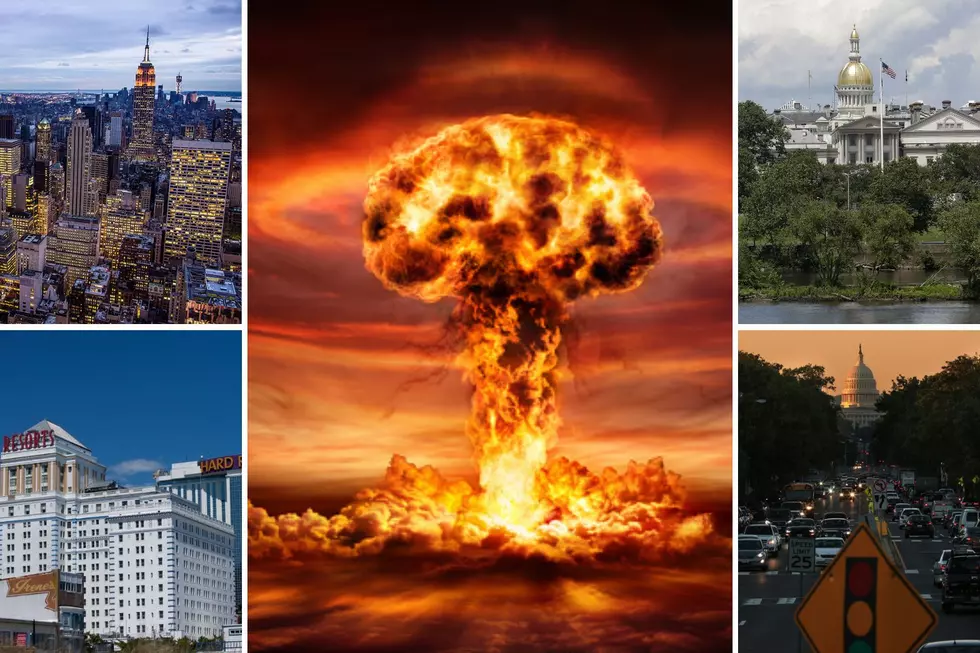
What if the unthinkable did happen? What would the impact of a nuclear attack be on New Jersey?
The most likely targets would be cities like New York, Los Angeles, Philadelphia or Washington, DC. New Jersey’s proximity to three of those primary targets could be devastating for the Garden State.
Using data from what is known of Russia’s nuclear arsenal and missile capable of hitting the U.S., we simulated the potential impact of a nuclear blast on New York, Philadelphia and Washington, D.C., as well as targets in New Jersey in the event that a missile went astray.
The biggest factor in terms of casualties, damage and nuclear fallout: An aerial detonation as opposed to ground impact (which results in nuclear fallout contamination spreading downwind), and the direction of atmospheric winds. For these simulations, we used a default Northeast wind direction.
Scroll through the gallery below to see the simulated impact of a nuclear blast.
The models show what would happen in aerial detonation, meaning the bomb would be set off in the sky, causing considerable damage to structures and people below; or what would happen in a ground detonation, which would have the alarming result of nuclear fallout. The models do not take into account the number of casualties that would result from fallout.
President Vladimir Putin has put Russia’s nuclear deterrent forces on high alert amid escalating tensions with the West over his unprovoked invasion of Ukraine.
Speaking at a meeting with senior officials, Putin said on February 27 that leading NATO powers had made “aggressive statements” along with Western countries imposing crippling financial sanctions against Russia, including the president himself.
Putin ordered Russia’s defense minister and the chief of the military’s General Staff to put the nuclear deterrent forces in a “special regime of combat duty,” meaning the country’s nuclear weapons would be in an increased state of readiness to launch.
The order immediately raised concerns that the tensions with the West could lead to the use of nuclear weapons.
White House press secretary Jen Psaki said the alert is part of a pattern of Moscow manufacturing threats to justify aggression.
“We’ve seen him do this time and time again. At no point has Russia been under threat from NATO, has Russia been under threat from Ukraine. This is all a pattern from President Putin and we’re going to stand up to it. We have the ability to defend ourselves, but we also need to call out what we’re seeing here from President Putin,” Psaki said in comments to ABC.
“It means that President Putin is continuing to escalate this war in a manner that is totally unacceptable and we have to continue to stem his actions in the strongest possible way,” Thomas-Greenfield said in interview with CBS.
NATO Secretary-General Jens Stoltenberg expressed alarm, saying it shows how serious the standoff over Russia’s invasion of Ukraine is.
On February 26, a group of Western countries agreed to to block access for “selected” Russian banks to the SWIFT financial system and impose “restrictive” measures against Russia’s central bank over Putin’s unprovoked aggression against Ukraine.
The moves are expected to severely harm Russia’s economy and the ruble
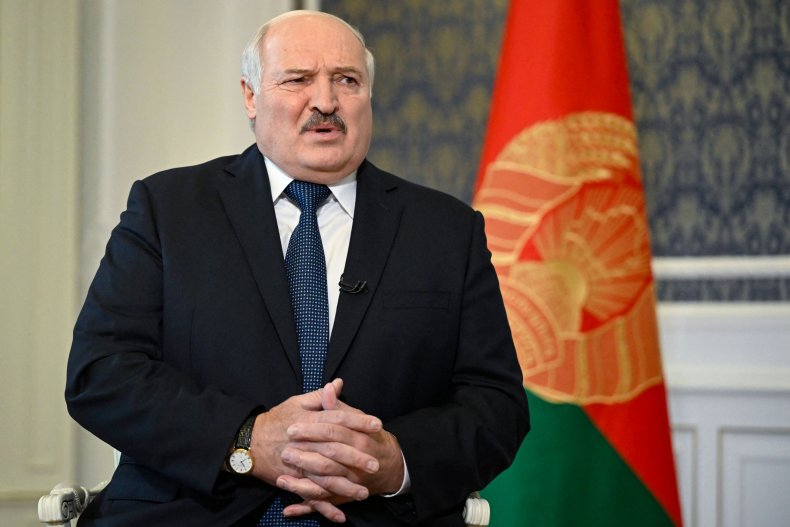
Belarusian President Alexander Lukashenko speaks to Agence France-Presse at his residence in the capital city Minsk on July 21, 2022. He warned that the war in Ukraine could spill over into nuclear conflict.ALEXANDER NEMENOV/GETTY IMAGES
Belarusian President Alexander Lukashenko has warned of dire consequences should there be a prolonged war in Ukraine.
Agence France-Presse tweeted that Lukashenko told the news agency on Thursday that the conflict must end to avoid the “abyss of nuclear war.”
The Kremlin has repeatedly denied it would resort to nuclear weapons but the prospect of an escalation towards the use of non-conventional arms has been a regular topic on Russian state television.
According to Global Security Review, Russia’s military doctrine allows the battlefield use of nuclear weapons in response to any non-nuclear assault on Russian territory. The ISW said Putin may use this as a justification to defend Russia’s newly annexed areas with nuclear arms.
“We must stop, reach an agreement, end this mess, operation and war in Ukraine,” Lukashenko told Agence France-Presse.
“Let’s stop and then we will figure out how to go on living,” he said. “There’s no need to go further. Further lies the abyss of nuclear war. There’s no need to go there.”
The agency tweeted that Lukashenko believed Kyiv could end the conflict—which started on February 24, by restarting talks with Moscow and accepting its demands. He also told the agency that the West had “fomented the war and are continuing it.”
Lukashenko has had a testy relationship with Putin over the years but now he relies heavily on the Russian president to stay in power.
Belarus hosted mobilization training exercises earlier in July, which prompted Ukrainian officials to say Moscow wants to bring Belarus into the war in Ukraine to make up for dwindling numbers of Russian military personnel.
Lukashenko also said in the interview that Belarus was an authoritarian country but it had no political prisoners. This is at odds with an assessment by the rights group Vesna-96 which said there were around 1,300 political prisoners in the country, many of whom had been jailed in a crackdown following disputed elections in 2020.
This month, a Belarusian court sentenced Katsiaryna Andreyeva, 28, who works as a journalist with Polish broadcaster Belsat TV, to eight years in jail for treason for her reports on protests in 2020.
An unarmed Minuteman III intercontinental ballistic missile launches during an operational test April 26, 2017, from Vandenberg Air Force Base, Calif. The Minuteman system has been in service for 60 years. Through continuous upgrades, including new production versions, improved targeting systems, and enhanced accuracy, today’s Minuteman system remains state of the art and is capable of meeting all modern challenges. (U.S. Air Force photo/Senior Airman Ian Dudley)
An unarmed Minuteman III intercontinental ballistic missile launches during an operational test April 26, 2017, from Vandenberg Air Force Base, Calif. The Minuteman system has been in service for 60 years. Through continuous upgrades, including new production versions, improved targeting systems, and enhanced accuracy, today’s Minuteman system remains state of the art and is capable of meeting all modern challenges. (U.S. Air Force photo/Senior Airman Ian Dudley)
By Dr. Manpreet Sethi*
A re-run of the nuclear arms race is staring us in the face. And, it is taking place in new circumstances. Today’s nuclear reality is starkly different from what the well-known nuclear strategist Thomas Schelling had described in 2009. He wrote, “There is no sign that any kind of nuclear arms race is in the offing—not, anyway, among the current nuclear powers. Prospects are good for substantial reduction of nuclear arms among the two largest arsenals, Russian and American. That should contribute to nuclear quiescence… Except for some ‘rogue’ threats, there is little that could disturb the quiet nuclear relations among the recognized nuclear nations.”
The nuclear landscape has changed dramatically in just a little more than a decade. What is the contemporary nuclear reality that is driving this new nuclear arms race? Can the trend be arrested? And when and where could such attempts best be made?
Meanwhile, another prominent feature of today’s nuclear arms race is that it is being run on the twin track of offensive and defensive systems. This is something that the 1972 anti-ballistic missile (ABM) Treaty had tried to arrest by stopping the unchecked deployment of defensive systems and anchoring deterrence in the idea of mutual vulnerability. But the abandonment of the ABM Treaty in 2002 resulted in an offence-defence tussle. Advances in US ballistic missile defence (BMD) technology and deployments has led Russia to repeatedly declare its intention to develop “invincible weapons.” The Avangard and Poseidon are examples of those efforts. China too seems to have decided to move towards a rapid expansion of its nuclear warhead numbers, as well as significant improvements in the penetrability, accuracy, and mobility of its delivery systems. There are also reports that it could adopt launch-on-warning postures to signal a higher degree of readiness. These developments race ahead in an environment bereft of all arms control measures, except for New START. No new agreements are on the anvil. Rather, the military industrial complex appears to be driving the arms race. And the P-5 seem to be drawing apart, driven by hyper-nationalist domestic politics.
One more disconcerting new reality that might emerge in the wake of the Russia-Ukraine conflict is a breakup of the long-held consensus on non-proliferation. Some non-nuclear weapon states (NNWS) have expressed disquiet at the manner in which a nuclear Russia invaded a non-nuclear Ukraine. NNWS that face a hostile relationship with a nuclear weapon state (NWS) could begin to believe that their security, too, demands the possession of nuclear weapons.
Overall, the perception of the value of nuclear weapons appears to be on the ascendant. And, the prospects for both vertical and horizontal proliferation could grow. This, then, would further exacerbate the risk of nuclear use. The growing popularity of strategies that favour low-yield nuclear weapons to fight a ‘limited nuclear war’ could result in the deployment of tactical nuclear weapons (TNWs) with delegated command and control. This could raise the risk of accidental use due to miscalculation amidst the fog of war. These worrisome and challenging issues dot today’s security environment.
Unfortunately, the possibilities of arresting the nuclear arms race appear dim. A P-5 statement at the start of 2022 that reaffirmed that a “nuclear war cannot be won and should not be fought” has sunk without a trace. Instead, it exhibited the superficiality of the five NWS’ projected unity.
The starting point for any change, however, can only be through dialogue. Direct, straight talks can help clear misperceptions. But the possibility of these taking place looks near impossible given the differences amongst the P-5. These are being further widened through the release of documents that tend to describe the other in adversarial tones. For instance, the US National Defense Strategy issued earlier this year, as well as the recently released NATO Strategic Concept, paint Russia and China as enemies. NATO has vowed to undertake the “biggest overhaul of our collective defense deterrence since the end of the Cold War,” as described by its Secretary General. It is likely that the delayed US Nuclear Posture Review will echo similar thoughts. So most likely will China’s White Paper on National Defence, whenever its next iteration is released.
The problem with this situation is that when documents talk to each other, rather than individuals, the language can be particularly harsh. When two people dialogue looking each other in the eye, there is scope for rapprochement. This goes missing in the case of documents, since they also pander to domestic constituencies, and hence can be more combative.
For dialogue to take place, one also needs the ‘right’ kind of leadership. National leaders with a more-than national vision, who are cognisant of the dangers of nuclear weapons and the risks of inadvertent use from adopting risky postures and policies, can be exhorted towards statesmanship on nuclear arms control. But no such leaders appear on the horizon as of now. Realistically speaking, for the arms race to be arrested, visionary leaders must speak to each other, share their sense of nuclear risks, and find it mutually beneficial to take the necessary steps.
Possible Opportunities
The nearest meaningful opportunity that could be used to make a difference will be the NPT Review Conference (NPT RevCon) in August 2022. Five NWS and nearly 190 NNWS will come together to mark 52 years of the NPT. If the states parties wish to remain invested in this Treaty, then the NWS must provide reassurance to their own counterparts as well as to the NNWS by adopting strategies that tend to reduce the value of nuclear weapons. Mutual assurances accompanied by tangible measures could temper the nuclear arms race. A positive note struck at the RevCon could change the mood and be leveraged in other forums such as the Conference on Disarmament. It would also be useful if the leaders of the US uand China initiated a bilateral nuclear dialogue. Meaningful outcomes at that level would have an effect on nuclear issues around the world.
The nuclear arms race needs to be arrested right away for the sake of the entire world. Some countries may be able to financially afford running and even winning this race. But the dangers that accompany this exercise would make everyone a loser—including even the winner of the race.
Dr. Manpreet Sethi is Distinguished Fellow, Centre for Air Power Studies (CAPS), New Delhi.