The prophecy is more than seeing into the future. For the prophecy sees without the element of time. For the prophecy sees things as they were, as they are, and as they always shall be.
Tuesday, February 10, 2026
History Warns New York Is The Sixth Seal on 3/3/26 (Revelation 6:12)
A Lack Of Vigilance Before The Sixth Seal of NYC On 3/3/26 (Revelation 6:12)
Faults Underlying Exercise Vigilant Guard
Story by: (Author NameStaff Sgt. Raymond Drumsta – 138th Public Affairs Detachment
Dated: Thu, Nov 5, 2009
This map illustrates the earthquake fault lines in Western New York. An earthquake in the region is a likely event, says University of Buffalo Professor Dr. Robert Jacobi.
TONAWANDA, NY — An earthquake in western New York, the scenario that Exercise Vigilant Guard is built around, is not that far-fetched, according to University of Buffalo geology professor Dr. Robert Jacobi.
When asked about earthquakes in the area, Jacobi pulls out a computer-generated state map, cross-hatched with diagonal lines representing geological faults.
The faults show that past earthquakes in the state were not random, and could occur again on the same fault systems, he said.
“In western New York, 6.5 magnitude earthquakes are possible,” he said.
This possibility underlies Exercise Vigilant Guard, a joint training opportunity for National Guard and emergency response organizations to build relationships with local, state, regional and federal partners against a variety of different homeland security threats including natural disasters and potential terrorist attacks.
The exercise was based on an earthquake scenario, and a rubble pile at the Spaulding Fibre site here was used to simulate a collapsed building. The scenario was chosen as a result of extensive consultations with the earthquake experts at the University of Buffalo’s Multidisciplinary Center for Earthquake Engineering Research (MCEER), said Brig. Gen. Mike Swezey, commander of 53rd Troop Command, who visited the site on Monday.
Earthquakes of up to 7 magnitude have occurred in the Northeastern part of the continent, and this scenario was calibrated on the magnitude 5.9 earthquake which occurred in Saguenay, Quebec in 1988, said Jacobi and Professor Andre Filiatrault, MCEER director.
“A 5.9 magnitude earthquake in this area is not an unrealistic scenario,” said Filiatrault.
Closer to home, a 1.9 magnitude earthquake occurred about 2.5 miles from the Spaulding Fibre site within the last decade, Jacobi said. He and other earthquake experts impaneled by the Atomic Energy Control Board of Canada in 1997 found that there’s a 40 percent chance of 6.5 magnitude earthquake occurring along the Clareden-Linden fault system, which lies about halfway between Buffalo and Rochester, Jacobi added.
Jacobi and Filiatrault said the soft soil of western New York, especially in part of downtown Buffalo, would amplify tremors, causing more damage.
“It’s like jello in a bowl,” said Jacobi.
The area’s old infrastructure is vulnerable because it was built without reinforcing steel, said Filiatrault. Damage to industrial areas could release hazardous materials, he added.
“You’ll have significant damage,” Filiatrault said.
Exercise Vigilant Guard involved an earthquake’s aftermath, including infrastructure damage, injuries, deaths, displaced citizens and hazardous material incidents. All this week, more than 1,300 National Guard troops and hundreds of local and regional emergency response professionals have been training at several sites in western New York to respond these types of incidents.
Jacobi called Exercise Vigilant Guard “important and illuminating.”
“I’m proud of the National Guard for organizing and carrying out such an excellent exercise,” he said.
Training concluded Thursday.
Monday, February 9, 2026
New York Subways at the Sixth Seal (Revelation 6)
New York City is full of peculiar phenomena—rickety fire escapes; 100-year-old subway tunnels; air conditioners propped perilously into window frames—that can strike fear into the heart of even the toughest city denizen. But should they? Every month, writer Ashley Fetters will be exploring—and debunking—these New York-specific fears, letting you know what you should actually worry about, and what anxieties you can simply let slip away.
The 25-minute subway commute from Crown Heights to the Financial District on the 2/3 line is, in my experience, a surprisingly peaceful start to the workday—save for one 3,100-foot stretch between the Clark Street and Wall Street stations, where for three minutes I sit wondering what the probability is that I will soon die a torturous, claustrophobic drowning death right here in this subway car.
The Clark Street Tunnel, opened in 1916, is one of approximately a dozen tunnels that escort MTA passengers from one borough to the next underwater—and just about all of them, with the exception of the 1989 addition of the 63rd Street F train tunnel, were constructed between 1900 and 1936.
Each day, thousands of New Yorkers venture across the East River and back again through these tubes buried deep in the riverbed, some of which are nearing or even past their 100th birthdays. Are they wrong to ponder their own mortality while picturing one of these watery catacombs suddenly springing a leak?
Mostly yes, they are, says Michael Horodniceanu, the former president of MTA Capital Construction and current principal of Urban Advisory Group. First, it’s important to remember that the subway tunnel is built under the riverbed, not just in the river—so what immediately surrounds the tunnel isn’t water but some 25 feet of soil. “There’s a lot of dirt on top of it,” Horodniceanu says. “It’s well into the bed of the bottom of the channel.”
And second, as Angus Kress Gillespie, author of Crossing Under the Hudson: The Story of the Holland and Lincoln Tunnels, points out, New York’s underwater subway tunnels are designed to withstand some leaking. And withstand it they do: Pumps placed below the floor of the tunnel, he says, are always running, always diverting water seepage into the sewers. (Horodniceanu says the amount of water these pumps divert into the sewer system each day numbers in the thousands of gallons.)
Additionally, MTA crews routinely repair the grouting and caulking, and often inject a substance into the walls that creates a waterproof membrane outside the tunnel—which keeps water out of the tunnel and relieves any water pressure acting on its walls. New tunnels, Horodniceanu points out, are even built with an outside waterproofing membrane that works like an umbrella: Water goes around it, it falls to the sides, and then it gets channeled into a pumping station and pumped out.
Of course, the classic New York nightmare scenario isn’t just a cute little trickle finding its way in. The anxiety daydream usually involves something sinister, or seismic. The good news, however, is that while an earthquake or explosion would indeed be bad for many reasons, it likely wouldn’t result in the frantic flooding horror scene that plays out in some commuters’ imaginations.
The Montague Tube, which sustained severe damage during Hurricane Sandy.
MTA New York City Transit / Marc A. Hermann
Horodniceanu assures me that tunnels built more recently are “built to withstand a seismic event.” The older tunnels, however—like, um, the Clark Street Tunnel—“were not seismically retrofitted, let me put it that way,” Horodniceanu says. “But the way they were built is in such a way that I do not believe an earthquake would affect them.” They aren’t deep enough in the ground, anyway, he says, to be too intensely affected by a seismic event. (The MTA did not respond to a request for comment.)
One of the only real threats to tunnel infrastructure, Horodniceanu adds, is extreme weather. Hurricane Sandy, for example, caused flooding in the tunnels, which “created problems with the infrastructure.” He continues, “The tunnels have to be rebuilt as a result of saltwater corroding the infrastructure.”
Still, he points out, hurricanes don’t exactly happen with no warning. So while Hurricane Sandy did cause major trauma to the tunnels, train traffic could be stopped with ample time to keep passengers out of harm’s way. In 2012, Governor Andrew Cuomo directed all the MTA’s mass transit services to shut down at 7 p.m. the night before Hurricane Sandy was expected to hit New York City.
And Gillespie, for his part, doubts even an explosion would result in sudden, dangerous flooding. A subway tunnel is not a closed system, he points out; it’s like a pipe that’s open at both ends. “The force of a blast would go forwards and backwards out the exit,” he says.
So the subway-train version of that terrifying Holland Tunnel flood scene in Sylvester Stallone’s Daylight is … unrealistic, right?
“Yeah,” Gillespie laughs. “Yeah. It is.”
Got a weird New York anxiety that you want explored? E-mail tips@curbed.com, and we may include it in a future column.
Sunday, February 8, 2026
The Year of the Sixth Seal is 2026 (Revelation 6:12)
Sloshing of Earth’s core may spike major earthquakes
The number of major earthquakes, like the magnitude-7 one that devastated Haiti in 2010, seems to be correlated with minute fluctuations in day length.
SEATTLE—The world doesn’t stop spinning. But every so often, it slows down. For decades, scientists have charted tiny fluctuations in the length of Earth’s day: Gain a millisecond here, lose a millisecond there. Last week at the annual meeting of the Geological Society of America here, two geophysicists argued that these minute changes could be enough to influence the timing of major earthquakes—and potentially help forecast them.
During the past 100 years, Earth’s slowdowns have correlated surprisingly well with periods with a global increase in magnitude-7 and larger earthquakes, according to Roger Bilham of the University of Colorado (CU) in Boulder and Rebecca Bendick at the University of Montana in Missoula. Usefully, the spike, which adds two to five more quakes than typical, happens well after the slow-down begins. “The Earth offers us a 5-years heads up on future earthquakes, which is remarkable,” says Bilham, who presented the work.
Most seismologists agree that earthquake prediction is a minefield. And so far, Bilham and Bendick have only fuzzy, hard-to-test ideas about what might cause the pattern they found. But the finding is too provocative to ignore, other researchers say. “The correlation they’ve found is remarkable, and deserves investigation,” says Peter Molnar, a geologist also at CU.
The research started as a search for synchrony in earthquake timing. Individual oscillators, be they fireflies, heart muscles, or metronomes, can end up vibrating in synchrony as a result of some kind of cross-talk—or some common influence. To Bendick, it didn’t seem a far jump to consider the faults that cause earthquakes, with their cyclical buildup of strain and violent discharge, as “really noisy, really crummy oscillators,” she says. She and Bilham dove into the data, using the only complete earthquake catalog for the past 100 years: magnitude-7 and larger earthquakes.
In work published in August in Geophysical Research Letters they reported two patterns: First, major quakes appeared to cluster in time
—although not in space. And second, the number of large earthquakes seemed to peak at 32-year intervals. The earthquakes could be somehow talking to each other, or an external force could be nudging the earth into rupture.
Exploring such global forces, the researchers eventually discovered the match with the length of day. Although weather patterns such as El Nino can drive day length to vary back and forth by a millisecond over a year or more, a periodic, decades-long fluctuation of several milliseconds—in particular, its point of peak slow down about every three decades or so—lined up with the quake trend perfectly. "Of course that seems sort of crazy," Bendick says. But maybe it isn’t. When day length changes over decades, Earth’s magnetic field also develops a temporary ripple. Researchers think slight changes in the flow of the molten iron of the outer core may be responsible for both effects. Just what happens is uncertain—perhaps a bit of the molten outer core sticks to the mantle above. That might change the flow of the liquid metal, altering the magnetic field, and transfer enough momentum between the mantle and the core to affect day length.
Seismologists aren’t used to thinking about the planet’s core, buried 2900 kilometers beneath the crust where quakes happen. But they should, Bilham said during his talk here. The core is “quite close to us. It’s closer than New York from here,” he said.
At the equator, Earth spins 460 meters per second. Given this high velocity, it’s not absurd to think that a slight mismatch in speed between the solid crust and mantle and the liquid core could translate into a force somehow nudging quakes into synchrony, Molnar says. Of course, he adds, “It might be nonsense.” But the evidence for some kind of link is compelling, says geophysicist Michael Manga of the University of California, Berkeley. “I’ve worked on earthquakes triggered by seasonal variation, melting snow. His correlation is much better than what I’m used to seeing.”
One way or another, says James Dolan, a geologist at the University of Southern California in Los Angeles, “we’re going to know in 5 years.” That’s because Earth’s rotation began a periodic slow-down 4-plus years ago. Beginning next year, Earth should expect five more major earthquakes a year than average—between 17 to 20 quakes, compared with the anomalously low four so far this year. If the pattern holds, it will put a new spin on earthquake forecasting.
doi:10.1126/science.aar3598
Saturday, February 7, 2026
The Next Major Quake: The Sixth Seal of NYC 3/3/26
New York is OVERDUE an earthquake from a ‚brittle grid‘ of faults under the city, expert warns
- New York City last experienced a M5 or higher earthquake in 1884, experts say
- It’s thought that these earthquakes occur on a roughly 150-year periodicity
- Based on this, some say the city could be overdue for the next major quake
THE ‚CONEY ISLAND EARTHQUAKE‘
Friday, February 6, 2026
Quakeland: On the Road to America’s Next Devastating Earthquake on 3/3/26: Revelation 6

Here is the Sixth Seal Zone in NYC on 3/3/26 (Revelation 6:12)
Thursday, February 5, 2026
The Sixth Seal in NYC on March 3, 2026 (Revelation 6:12)
Updated | An earthquake is long overdue to hit New York and America isn’t prepared, author and environmental theorist Kathryn Miles told Trevor Noah on Tuesday’s Daily Show.
Miles is the author of a new book, Quakeland, which investigates how imminently an earthquake is expected in the U.S. and how well-prepared the country is to handle it. The answer to those questions: Very soon and not very well.
“We know it will, that’s inevitable, but we don’t know when,” said Miles when asked when to expect another earthquake in the U.S.
She warned that New York is in serious danger of being the site of the next one, surprising considering that the West Coast sits along the San Andreas fault line.
“New York is 40 years overdue for a significant earthquake...Memphis, Seattle, Washington D.C.—it’s a national problem,” said Miles.
Miles told Noah that though the U.S. is “really good at responding to natural disasters,” like the rapid response to the hurricanes in Texas and Florida, the country and its government is, in fact, lagging behind in its ability to safeguard citizens before an earthquake hits.
“We’re really bad at the preparedness side,” Miles responded when Noah asked how the infrastructure in the U.S. compares to Mexico’s national warning system, for example.
“Whether it’s the literal infrastructure, like our roads and bridges, or the metaphoric infrastructure, like forecasting, prediction, early warning systems. Historically, we’ve underfunded those and as a result we’re way behind even developing nations on those fronts.”
Part of the problem, Miles says, is that President Donald Trump and his White House are not concerned with warning systems that could prevent the devastation of natural disasters.
“We can invest in an early warning system. That’s one thing we can definitely do. We can invest in better infrastructures, so that when the quake happens, the damage is less,” said the author.
“The scientists, the emergency managers, they have great plans in place. We have the technology for an early warning system, we have the technology for tsunami monitoring. But we don’t have a president that is currently interested in funding that, and that’s a problem.”
This article has been updated to reflect that Miles said New York is the possible site of an upcoming earthquake, and not the likeliest place to be next hit by one.
Real Risk, Few Precautions for the Sixth Seal in NYC (Revelation 6:12)
By WILLIAM K. STEVENS
Published: October 24, 1989
AN EARTHQUAKE as powerful as the one that struck northern California last week could occur almost anywhere along the East Coast, experts say. And if it did, it would probably cause far more destruction than the West Coast quake.
The chances of such an occurrence are much less in the East than on the West Coast. Geologic stresses in the East build up only a hundredth to a thousandth as fast as in California, and this means that big Eastern quakes are far less frequent. Scientists do not really know what the interval between them might be, nor are the deeper-lying geologic faults that cause them as accessible to study. So seismologists are at a loss to predict when or where they will strike.
But they do know that a temblor with a magnitude estimated at 7 on the Richter scale – about the same magnitude as last week’s California quake – devastated Charleston, S.C., in 1886. And after more than a decade of study, they also know that geologic structures similar to those that caused the Charleston quake exist all along the Eastern Seaboard.
For this reason, ”we can’t preclude that a Charleston-sized earthquake might occur anywhere along the East Coast,” said David Russ, the assistant chief geologist of the United States Geological Survey in Reston, Va. ”It could occur in Washington. It could occur in New York.”
If that happens, many experts agree, the impact will probably be much greater than in California.Easterners, unlike Californians, have paid very little attention to making buildings and other structures earthquake-proof or earthquake-resistant. ”We don’t have that mentality here on the East Coast,” said Robert Silman, a New York structural engineer whose firm has worked on 3,800 buildings in the metropolitan area.
Moreover, buildings, highways, bridges, water and sewer systems and communications networks in the East are all older than in the West and consequently more vulnerable to damage. Even under normal conditions, for instance, water mains routinely rupture in New York City.
The result, said Dr. John Ebel, a geophysicist who is the assistant director of Boston College’s Weston Observatory, is that damage in the East would probably be more widespread, more people could be hurt and killed, depending on circumstances like time of day, and ”it would probably take a lot longer to get these cities back to useful operating levels.”
On top of this, scientists say, an earthquake in the East can shake an area 100 times larger than a quake of the same magnitude in California. This is because the earth’s crust is older, colder and more brittle in the East and tends to transmit seismic energy more efficiently. ”If you had a magnitude 7 earthquake and you put it halfway between New York City and Boston,” Dr. Ebel said, ”you would have the potential of doing damage in both places,” not to mention cities like Hartford and Providence.
Few studies have been done of Eastern cities’ vulnerability to earthquakes. But one, published last June in The Annals of the New York Academy of Sciences, calculated the effects on New York City of a magnitude 6 earthquake. That is one-tenth the magnitude of last week’s California quake, but about the same as the Whittier, Calif., quake two years ago.
The study found that such an earthquake centered 17 miles southeast of City Hall, off Rockaway Beach, would cause $11 billion in damage to buildings and start 130 fires. By comparison, preliminary estimates place the damage in last week’s California disaster at $4 billion to $10 billion. If the quake’s epicenter were 11 miles southeast of City Hall, the study found, there would be about $18 billion in damage; if 5 miles, about $25 billion.
No estimates on injuries or loss of life were made. But a magnitude 6 earthquake ”would probably be a disaster unparalleled in New York history,” wrote the authors of the study, Charles Scawthorn and Stephen K. Harris of EQE Engineering in San Francisco.
The study was financed by the National Center for Earthquake Engineering Research at the State University of New York at Buffalo. The research and education center, supported by the National Science Foundation and New York State, was established in 1986 to help reduce damage and loss of life from earthquakes.
The study’s postulated epicenter of 17 miles southeast of City Hall was the location of the strongest quake to strike New York since it has been settled, a magnitude 5 temblor on Aug. 10, 1884. That 1884 quake rattled bottles and crockery in Manhattan and frightened New Yorkers, but caused little damage. Seismologists say a quake of that order is likely to occur within 50 miles of New York City every 300 years. Quakes of magnitude 5 are not rare in the East. The major earthquake zone in the eastern half of the country is the central Mississippi Valley, where a huge underground rift causes frequent geologic dislocations and small temblors. The most powerful quake ever known to strike the United States occurred at New Madrid, Mo., in 1812. It was later estimated at magnitude 8.7 and was one of three quakes to strike that area in 1811-12, all of them stronger than magnitude 8. They were felt as far away as Washington, where they rattled chandeliers, Boston and Quebec.
Because the New Madrid rift is so active, it has been well studied, and scientists have been able to come up with predictions for the central Mississippi valley, which includes St. Louis and Memphis. According to Dr. Russ, there is a 40 to 63 percent chance that a quake of magnitude 6 will strike that area between now and the year 2000, and an 86 to 97 percent chance that it will do so by 2035. The Federal geologists say there is a 1 percent chance or less of a quake greater than magnitude 7 by 2000, and a 4 percent chance or less by 2035.
Elsewhere in the East, scientists are limited in their knowledge of probabilities partly because faults that could cause big earthquakes are buried deeper in the earth’s crust. In contrast to California, where the boundary between two major tectonic plates creates the San Andreas and related faults, the eastern United States lies in the middle of a major tectonic plate. Its faults are far less obvious, their activity far more subtle, and their slippage far slower.
Any large earthquake would be ”vastly more serious” in the older cities of the East than in California, said Dr. Tsu T. Soong, a professor of civil engineering at the State University of New York at Buffalo who is a researcher in earthquake-mitigation technology at the National Center for Earthquake Engineering Research. First, he said, many buildings are simply older, and therefore weaker and more vulnerable to collapse. Second, there is no seismic construction code in most of the East as there is in California, where such codes have been in place for decades.
The vulnerability is evident in many ways. ”I’m sitting here looking out my window,” said Mr. Silman, the structural engineer in New York, ”and I see a bunch of water tanks all over the place” on rooftops. ”They are not anchored down at all, and it’s very possible they would fall in an earthquake.”
Many brownstones, he said, constructed as they are of unreinforced masonry walls with wood joists between, ”would just go like a house of cards.” Unreinforced masonry, in fact, is the single most vulnerable structure, engineers say. Such buildings are abundant, even predominant, in many older cities. The Scawthorn-Harris study reviewed inventories of all buildings in Manhattan as of 1972 and found that 28,884, or more than half, were built of unreinforced masonry. Of those, 23,064 were three to five stories high.
Buildings of reinforced masonry, reinforced concrete and steel would hold up much better, engineers say, and wooden structures are considered intrinsically tough in ordinary circumstances. The best performers, they say, would probably be skyscrapers built in the last 20 years. As Mr. Silman explained, they have been built to withstand high winds, and the same structural features that enable them to do so also help them resist an earthquake’s force. But even these new towers have not been provided with the seismic protections required in California and so are more vulnerable than similar structures on the West Coast.
Buildings in New York are not generally constructed with such seismic protections as base-isolated structures, in which the building is allowed to shift with the ground movement; or with flexible frames that absorb and distribute energy through columns and beams so that floors can flex from side to side, or with reinforced frames that help resist distortion.
”If you’re trying to make a building ductile – able to absorb energy – we’re not geared to think that way,” said Mr. Silman.
New York buildings also contain a lot of decorative stonework, which can be dislodged and turned into lethal missiles by an earthquake. In California, building codes strictly regulate such architectural details.
Manhattan does, however, have at least one mitigating factor: ”We are blessed with this bedrock island,” said Mr. Silman. ”That should work to our benefit; we don’t have shifting soils. But there are plenty of places that are problem areas, particularly the shoreline areas,” where landfills make the ground soft and unstable.
As scientists have learned more about geologic faults in the Northeast, the nation’s uniform building code – the basic, minimum code followed throughout the country – has been revised accordingly. Until recently, the code required newly constructed buildings in New York City to withstand at least 19 percent of the side-to-side seismic force that a comparable building in the seismically active areas of California must handle. Now the threshold has been raised to 25 percent.
New York City, for the first time, is moving to adopt seismic standards as part of its own building code. Local and state building codes can and do go beyond the national code. Charles M. Smith Jr., the city Building Commissioner, last spring formed a committee of scientists, engineers, architects and government officials to recommend the changes.
”They all agree that New York City should anticipate an earthquake,” Mr. Smith said. As to how big an earthquake, ”I don’t think anybody would bet on a magnitude greater than 6.5,” he said. ”I don’t know,” he added, ”that our committee will go so far as to acknowledge” the damage levels in the Scawthorn-Harris study, characterizing it as ”not without controversy.”
For the most part, neither New York nor any other Eastern city has done a detailed survey of just how individual buildings and other structures would be affected, and how or whether to modify them.
”The thing I think is needed in the East is a program to investigate all the bridges” to see how they would stand up to various magnitudes of earthquake,” said Bill Geyer, the executive vice president of the New York engineering firm of Steinman, Boynton, Gronquist and Birdsall, which is rehabilitating the cable on the Williamsburg Bridge. ”No one has gone through and done any analysis of the existing bridges.”
In general, he said, the large suspension bridges, by their nature, ”are not susceptible to the magnitude of earthquake you’d expect in the East.” But the approaches and side spans of some of them might be, he said, and only a bridge-by-bridge analysis would tell. Nor, experts say, are some elevated highways in New York designed with the flexibility and ability to accommodate motion that would enable them to withstand a big temblor.
Tunnels Vulnerable
The underground tunnels that carry travelers under the rivers into Manhattan, those that contain the subways and those that carry water, sewers and natural gas would all be vulnerable to rupture, engineers say. The Lincoln, Holland, PATH and Amtrak tunnels, for instance, go from bedrock in Manhattan to soft soil under the Hudson River to bedrock again in New Jersey, said Mark Carter, a partner in Raamot Associates, geotechnical engineers specializing in soils and foundations.
Likewise, he said, subway tunnels between Manhattan and Queens go from hard rock to soft soil to hard rock on Roosevelt Island, to soft soil again and back to rock. The boundaries between soft soil and rock are points of weakness, he said.
”These structures are old,” he said, ”and as far as I know they have not been designed for earthquake loadings.”
Even if it is possible to survey all major buildings and facilities to determine what corrections can be made, cities like New York would then face a major decision: Is it worth spending the money to modify buildings and other structures to cope with a quake that might or might not come in 100, or 200 300 years or more?
”That is a classical problem” in risk-benefit analysis, said Dr. George Lee, the acting director of the Earthquake Engineering Research Center in Buffalo. As more is learned about Eastern earthquakes, he said, it should become ”possible to talk about decision-making.” But for now, he said, ”I think it’s premature for us to consider that question.”
Wednesday, February 4, 2026
Indian Point Pipeline is NOT Safe for NYC (Revelation 6:12)


History Says Expect The Sixth Seal In New York (Revelation 6:12)

History Says New York Is Earthquake Prone
Tuesday, February 3, 2026
East Coast Still Unprepared For The Sixth Seal (Revelation 6:12)

East Coast Earthquake Preparedness
By By BEN NUCKOLS
Posted: 08/25/2011 8:43 am EDT
WASHINGTON — There were cracks in the Washington Monument and broken capstones at the National Cathedral. In the District of Columbia suburbs, some people stayed in shelters because of structural concerns at their apartment buildings.
A day after the East Coast’s strongest earthquake in 67 years, inspectors assessed the damage and found that most problems were minor. But the shaking raised questions about whether this part of the country, with its older architecture and inexperience with seismic activity, is prepared for a truly powerful quake.
The 5.8 magnitude quake felt from Georgia north to Canada prompted swift inspections of many structures Wednesday, including bridges and nuclear plants. An accurate damage estimate could take weeks, if not longer. And many people will not be covered by insurance.
In a small Virginia city near the epicenter, the entire downtown business district was closed. School was canceled for two weeks to give engineers time to check out cracks in several buildings.
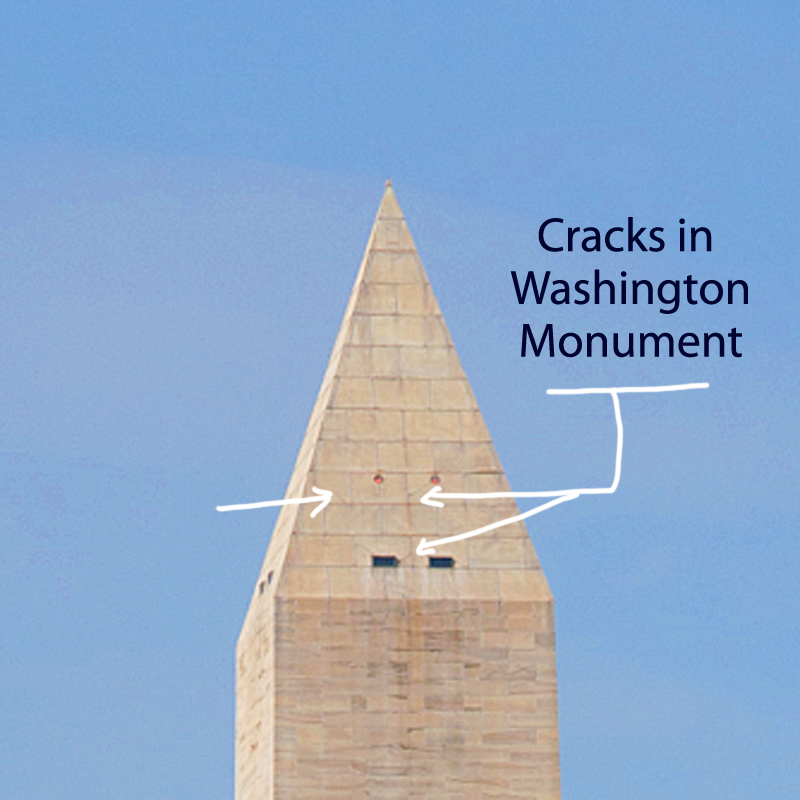
At the 555-foot Washington Monument, inspectors found several cracks in the pyramidion – the section at the top of the obelisk where it begins narrowing to a point.
A 4-foot crack was discovered Tuesday during a visual inspection by helicopter. It cannot be seen from the ground. Late Wednesday, the National Park Service announced that structural engineers had found several additional cracks inside the top of the monument.
Carol Johnson, a park service spokeswoman, could not say how many cracks were found but said three or four of them were “significant.” Two structural engineering firms that specialize in assessing earthquake damage were being brought in to conduct a more thorough inspection on Thursday.
The monument, by far the tallest structure in the nation’s capital, was to remain closed indefinitely, and Johnson said the additional cracks mean repairs are likely to take longer. It has never been damaged by a natural disaster, including earthquakes in Virginia in 1897 and New York in 1944.
Tourists arrived at the monument Wednesday morning only to find out they couldn’t get near it. A temporary fence was erected in a wide circle about 120 feet from the flags that surround its base. Walkways were blocked by metal barriers manned by security guards.
“Is it really closed?” a man asked the clerk at the site’s bookstore.
“It’s really closed,” said the clerk, Erin Nolan. Advance tickets were available for purchase, but she cautioned against buying them because it’s not clear when the monument will open.
“This is pretty much all I’m going to be doing today,” Nolan said.
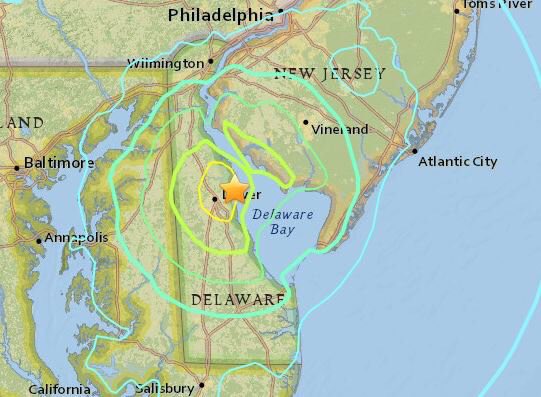
Tuesday’s quake was centered about 40 miles northwest of Richmond, 90 miles south of Washington and 3.7 miles underground. In the nearby town of Mineral, Va., Michael Leman knew his Main Street Plumbing & Electrical Supply business would need – at best – serious and expensive repairs.
At worst, it could be condemned. The facade had become detached from the rest of the building, and daylight was visible through a 4- to 6-inch gap that opened between the front wall and ceiling.
“We’re definitely going to open back up,” Leman said. “I’ve got people’s jobs to look out for.”
Leman said he is insured, but some property owners might not be so lucky.
The Insurance Information Institute said earthquakes are not covered under standard U.S. homeowners or business insurance policies, although supplemental coverage is usually available.
The institute says coverage for other damage that may result from earthquakes, such as fire and water damage from burst gas or water pipes, is provided by standard homeowners and business insurance policies in most states. Cars and other vehicles with comprehensive insurance would also be protected.
The U.S. Geological Survey classified the quake as Alert Level Orange, the second-most serious category on its four-level scale. Earthquakes in that range lead to estimated losses between $100 million and $1 billion.
In Culpeper, Va., about 35 miles from the epicenter, walls had buckled at the old sanctuary at St. Stephen’s Episcopal Church, which was constructed in 1821 and drew worshippers including Confederate Gens. Robert E. Lee and J.E.B. Stuart. Heavy stone ornaments atop a pillar at the gate were shaken to the ground. A chimney from the old Culpeper Baptist Church built in 1894 also tumbled down.
At the Washington National Cathedral, spokesman Richard Weinberg said the building’s overall structure remains sound and damage was limited to “decorative elements.”
Massive stones atop three of the four spires on the building’s central tower broke off, crashing onto the roof. At least one of the spires is teetering badly, and cracks have appeared in some flying buttresses.
Repairs were expected to cost millions of dollars – an expense not covered by insurance.
“Every single portion of the exterior is carved by hand, so everything broken off is a piece of art,” Weinberg said. “It’s not just the labor, but the artistry of replicating what was once there.”
The building will remain closed as a precaution. Services to dedicate the memorial honoring Rev. Martin Luther King Jr. were moved.
Other major cities along the East Coast that felt the shaking tried to gauge the risk from another quake.
A few hours after briefly evacuating New York City Hall, Mayor Michael Bloomberg said the city’s newer buildings could withstand a more serious earthquake. But, he added, questions remain about the older buildings that are common in a metropolis founded hundreds of years ago.
“We think that the design standards of today are sufficient against any eventuality,” he said. But “there are questions always about some very old buildings. … Fortunately those tend to be low buildings, so there’s not great danger.”
An earthquake similar to the one in Virginia could do billions of dollars of damage if it were centered in New York, said Barbara Nadel, an architect who specializes in securing buildings against natural disasters and terrorism.
The city’s 49-page seismic code requires builders to prepare for significant shifting of the earth. High-rises must be built with certain kinds of bracing, and they must be able to safely sway at least somewhat to accommodate for wind and even shaking from the ground, Nadel said.
Buildings constructed in Boston in recent decades had to follow stringent codes comparable to anything in California, said Vernon Woodworth, an architect and faculty member at the Boston Architectural College. New construction on older structures also must meet tough standards to withstand severe tremors, he said.
It’s a different story with the city’s older buildings. The 18th- and 19th-century structures in Boston’s Back Bay, for instance, were often built on fill, which can liquefy in a strong quake, Woodworth said. Still, there just aren’t many strong quakes in New England.
The last time the Boston area saw a quake as powerful as the one that hit Virginia on Tuesday was in 1755, off Cape Ann, to the north. A repeat of that quake would likely cause deaths, Woodworth said. Still, the quakes are so infrequent that it’s difficult to weigh the risks versus the costs of enacting tougher building standards regionally, he said.
People in several of the affected states won’t have much time to reflect before confronting another potential emergency. Hurricane Irene is approaching the East Coast and could skirt the Mid-Atlantic region by the weekend and make landfall in New England after that.
In North Carolina, officials were inspecting an aging bridge that is a vital evacuation route for people escaping the coastal barrier islands as the storm approaches.
Speaking at an earthquake briefing Wednesday, Washington Mayor Vincent Gray inadvertently mixed up his disasters.
“Everyone knows, obviously, that we had a hurricane,” he said before realizing his mistake.
“Hurricane,” he repeated sheepishly as reporters and staffers burst into laughter. “I’m getting ahead of myself!”
___
Associated Press writers Sam Hananel in Washington; Alex Dominguez in Baltimore; Bob Lewis in Mineral, Va.; Samantha Gross in New York City; and Jay Lindsay in Boston contributed to this report.
Monday, February 2, 2026
The Main Cause of the Sixth Seal in NY (Revelation 6:12)