Showing posts with label temple. Show all posts

Monday, March 18, 2019

The Paradox Outside the Temple Walls (Revelation 11)


The Gaza paradox: Palestinians are fed up with Hamas, Israel is worried – Palestinians – Haaretz.com
Zvi Bar’el18.03.2019 | 00:58
At any other time, Gazan discontent with Hamas would be good news for Israel. But on election eve, Israel needs a stable enemy
The slogan, “We want to live” isn’t just a catchphrase yelled by the Gaza residents demonstrating in the Strip last week against Hamas, it’s also the name of a Facebook page that has thousands of followers and on which there are dozens of very harsh anti-Hamas posts.
“At a time when the [popular] movement went out to demonstrate, suddenly Qassam [Iz al-Din al-Qassam, Hamas’ military wing] comes out to march. By God, the ones giving them these damned ideas are the Jews,” wrote Mohammed al-Masri, who accused Hamas’ military wing of deliberately undermining the public’s right to demonstrate.
“How can it be that the young people of Iz al-Din al-Qassam be satisfied with the poverty they’re in while their leaders are the greatest money launderers, collecting millions by begging all around the world?” asked Nael Khader.
Amjad al-Arabid, a journalist who writes for several media outlets, has an especially active Facebook page, on which Ahmad Walid posted the following:
“I was innocently driving to bring my wife and children home from my in-laws. Suddenly a police jeep appeared behind me and started to honk incessantly for me to clear the way. There was a car in front of me and I couldn’t move. Near the junction the road opened up a little and the jeep could have passed me. It indeed passed me then stopped in front of me, near the Al-Omda restaurant. Two masked men got out of the jeep and started beating and cursing me. They threw me to the ground, took my car keys and forced me into the jeep, which already had around 10 young men who had been beaten and cursed, and they brought all of us to the police station. Only then did soldiers [Hamas men] come in and reprimand the policemen for hitting civilians. Enough with these humiliations and mafia behavior.”
A short search on the Facebook page reveals a video clip in which a Gaza woman is incensed over the death of a young demonstrator shot by Hamas fire. “Why does the 20-year-old son of a senior Hamas figure have everything he wants, a house and a jeep and a car, and he can get married, while the ordinary people have nothing, not even a piece of bread?” The woman, from Dir al-Balah, is directing her anger at a Hamas commander, who asks her if she saw who fired, and if he wore a police or army uniform. “He wasn’t in uniform, but I can assure you that he was a member of Iz al-Din al-Qassam,” she said.
An hour earlier, Al-Arabid reported that Hamas had turned the Al-Hashimiya school in Gaza City’s Shujaiyeh neighborhood into a detention center. “They have inherited Israel’s policy of oppression,” he wrote. On another Facebook page, by Muhammad Firwana, he justifies the struggle of the “We Want to Live” movement. “Everyone has the right to stand up against anyone who punishes and tortures them. Every person has the right to say ‘we’re tired of this.’ But who is responsible? Who is refusing to allow an electric line into Gaza? Who is blocking the clerks’ salaries? Who has not allowed the transfer of medical aid into Gaza? Who is preventing the treatment of cancer patients? Whom are you fighting against? Against your brethren who are locked in the same closure as you are? The compass is off. The one who’s imposing a closure on us is [Palestinian Authority chairman] Mahmoud Abbas, the one denying us life is Mahmoud Abbas, not Hamas. We are all under siege, including Hamas.”
The mass protests in Jabalya, Dir al-Balah and Khan Yunis are not the first time that Gaza residents have protested against the economic crisis in the Strip. It’s also not the first time that posts critical of Hamas have appeared on social networks. Two years ago there were videos that showed how associates of Ismail Haniyeh, the former Hamas prime minister, enjoyed luxuries and revealed how Hamas men brutally dispersed demonstrations. But it seems that this time the protests are more sweeping and intense, and the public response to how the demonstrations in Jabalya were broken up are pushing the envelope.
The nature of the protest is evidence that fear of the Hamas regime has deepening cracks, and that awe of its power is gradually fading. The cancellation of the demonstrations along the border this past weekend may have been attributed to Hamas’ response to Egyptian intervention and its insistence that the rockets fired at Tel Aviv last Thursday were a “mistake.” Hamas also issued warnings against any violations of its orders – and this time the orders were to maintain quiet.
But it’s possible that Hamas itself isn’t totally certain that after the tough dispersal of the demonstrations, which included shooting, it will be able to once again enlist the masses to rush the border fence to protest Gaza’s closure. The website of Islamic Jihad, which sends its young people to the fence protests, issued an official condemnation on Thursday against the violence used against demonstrators and demanded the release of all those imprisoned. “This is a violation of the right to demonstrate, which is part of the right of every citizen to express his opinion,” wrote the organization, which is not usually known for its concern for civil rights.
The paradox is that under other circumstances, Israel would be pleased with the public protest in Gaza and see it as proof of the success of the closure policy, which it believes could lead to Hamas’ downfall. But the turmoil Hamas is experiencing worries Israel too. It needs a partner to take responsibility for running the Strip, stop a disintegration that could lead to a large-scale armed conflict on the eve of the election, and serve as an address for mediation. Suddenly it turns out that the confrontations at the fence are a marginal threat, if at all, compared to the risk of instability of the Hamas government.

Sunday, March 17, 2019

Israel Pounds Gaza Outside the Temple Walls (Revelation 11)


15 March 2019
A Gaza City site struck by Israel the previous night, 15 March. Ashraf Amra APA images
The occupied Gaza Strip was subjected to some 100 Israeli strikes overnight Friday after two rockets were fired from Gaza toward central Israel, sounding off sirens in Tel Aviv.
One of the rockets fired from Gaza landed in the Tel Aviv suburb of Holon. No injuries were reported as a result of the two rockets.
Gaza’s health ministry reported four injuries due to the “Israeli escalation,” after which four rockets were fired from Gaza toward southern Israel, according to Israeli media.
The bombing frequency is much higher than usual. We have had at least five or six blasts just in our area. Huge orange flashes can be seen from the window
Egyptian mediators stated that a ceasefire was declared at 8am Friday morning, and both the Hamas leadership in Gaza and the Israeli military appeared keen to avoid a prolonged escalation.
Both the Hamas and Islamic Jihad factions in Gaza, the organizations most likely to possess mid-range rockets that could reach Tel Aviv, quickly denied responsibility, with Hamas saying that it would discipline those responsible for acting outside the national consensus.
Israel: rockets launched by mistake
Hamas officials were meeting with Egyptian mediators at the time the two rockets were launched. The Egyptian delegation, which has been conducting indirect negotiations between Hamas and Israel for several months, was told to leave by Israel later that night before the bombardment of the Strip.
On Friday, the Israeli military told media that the rockets were likely launched by mistake during maintenance work.
Meanwhile the Great March of Return organizing committee announced that it would postpone demonstrations along Gaza’s eastern boundaries that day, the first cancelation of the weekly protests since their launch on 30 March last year.
The committee obliquely referenced the overnight escalation and called on Palestinians to prepare for a massive mobilization on the one-year anniversary of the protests.
A United Nations independent commission of inquiry recently published its preliminaryreport stating that it had collected evidence of war crimes and crimes against humanity by Israel, which has used lethal military force against unarmed protesters in Gaza.
The commission called on Israel to immediately lift its blockade on Gaza – one of the key demands of the Great March of Return – and to investigate “every protest-related killing and injury, promptly, impartially and independently.”
Israeli media reported this week that military police have been instructed to investigate eight additional protest deaths, bringing to 11 the number of fatalities purportedly under review.
B’Tselem, a leading human rights group in Israel, has previously described the Israelimilitary’s internal probes as a whitewashing mechanism that “serves as a fig leaf for the occupation.”
Israel keeps up the appearance of a robust internal investigative apparatus to ward off accountability in international courts.
The commission of inquiry’s confidential file containing dossiers of alleged perpetrators of international crimes related to the Great March of Return will be handed over to the UN High Commissioner for Human Rights so that it can be transferred to the International Criminal Court.
The situation in the occupied West Bank and Gaza Strip has been under preliminary examination by the International Criminal Court since 2015. Its chief prosecutor issued an unprecedented warning to Israeli leaders last year that they may face trial for the killings of unarmed protesters in Gaza.
Judges in The Hague have also ordered the International Criminal Court to reach out to victims of war crimes in Palestine.
Israel refused to cooperate with the UN commission of inquiry and denied entry to investigators, as it meanwhile seeks the deportation of the director of Human Rights Watch’s Jerusalem office.
But while publicly attacking the International Criminal Court, Israel is secretly cooperating with the court’s investigation into its 51-day military offensive on the Gaza Strip in 2014.
“There is concern in the political and military echelons that the court will open a criminal investigation into Israel’s actions in the Strip, a process that could lead to a wave of lawsuits against those involved and even to their arrest abroad,” the Israeli newspaper Haaretz reported in November.
More than 2,250 Palestinians in Gaza, including 1,462 civilians, among them at least 551 children, were killed during the summer 2014 onslaught, according to an independent investigation commissioned by the UN Human Rights Council.
Six civilians died in Israel and more than 60 Israeli soldiers died in fighting with the Palestinian resistance.
One of the commanders of that attack, former Israeli army chief Benny Gantz, seeks to unseat Benjamin Netanyahu, who was prime minister during the 2014 assault, in Israel’s general election on 9 April.
Gantz and another top Israeli officer are currently being sued for war crimes in the Netherlands by Ismail Ziada, a Palestinian-Dutch citizen whose mother and five other family members were killed in the Israeli bombing of their home in Gaza during the 2014 assault.
US threatens ICC
On Friday, the US announced that it would revoke or deny visas to “individuals directly responsible for any [International Criminal Court] investigation of US personnel,” in addition to those investigating Israel.
In November 2017 the chief prosecutor of the International Criminal Court initiated an investigation into alleged war crimes and crimes against humanity in Afghanistan since May 2003.
“If you are responsible for the proposed ICC investigation of US personnel in connection with the situation in Afghanistan, you should not assume that you still have or will get a visa or will be permitted to enter the United States,” US Secretary of State Mike Pompeo said on Friday.
Associated Press reporter Matthew Lee notedthat Pompeo’s comment “suggested that action may have already been taken against the ICC prosecutor.”

Saturday, March 16, 2019

Israel Strikes Back Outside the Temple Walls (Revelation 11)


Israel says it struck 100 targets in Gaza after two rockets were fired at Tel Aviv
March 15, 2019 at 4:47 AM
JERUSALEM — The Israeli military said that it struck more than 100 targets in Gaza overnight Friday after two rockets were fired toward Tel Aviv, escalating tension less than a month before Prime Minister Benjamin Netanyahu faces reelection. 
Residents reported hearing explosions, but there were no reports of injuries or damage. The military said neither rocket was intercepted by Israel’s Iron Dome military defense system, though warning systems had operated as required.  
The Israeli military said it believed Hamas was responsible. Israeli media reported that their initial assessment was that the group launched the rockets by mistake.
One rocket probably fell into the sea, Tel Aviv Mayor Ron Huldai told Israeli television. He said he had instructed the city to open all bomb shelters, but life appeared to be returning to normal shortly after the incident. 
While rocket launches from Gaza are not unusual, it was the first time in more than four years that they have targeted the major city of Tel Aviv. Israel and Hamas fought a 50-day conflict in the summer of 2014. 
Netanyahu called an emergency meeting with top security officials, after which Israel mounted its response. 
In the early hours of Friday morning the Israeli military said it was targeting “terror sites” in the Gaza Strip, striking around 100 military sites belonging to Hamas, including the main site used to manufacture standard grade rockets. 
Seven more rocket launches followed, six of which were intercepted by the Iron Dome. 
The escalation on Thursday followed a day of unrest in Gaza, where Hamas, the militant group that controls the Palestinian enclave, had forcibly put down demonstrations against deteriorating living conditions. Some analysts speculated that Hamas might have been trying to cause a distraction. 
Others pointed the finger at Islamic Jihad, the second largest militant organization in Gaza, saying the group may have been trying to disrupt efforts by Egypt to broker a truce between Hamas and Israel. An Egyptian delegation had arrived in Gaza on Thursday evening.  
No group immediately claimed responsibility. Islamic Jihad denied that it was behind the attack. Hamas also denied responsibility, pointing out the attack took place at the same time the group’s leaders were meeting with Egyptian officials to discuss the cease-fire. It said it would find the perpetrators and called off its weekly Friday demonstration at the fence with Israel. 
Netanyahu last year was criticized by members of his own government coalition for being soft on Hamas by agreeing to a cease-fire with that group after a spate of rocket attacks from Gaza toward communities in southern Israel. His political opponents have also criticized Netanyahu’s decision to allow Qatar to deliver $15 million a month into Gaza to pay salaries of Hamas civil servants. 
Yaakov Amidror, a retired major general and former national security adviser, said he believed Netanyahu was “experienced and sober enough” that electoral pressure would not be a factor in determining his response. “There is no real argument in the Jewish community about the need to react,” he said on a conference call with journalists. 
Israel normally holds Hamas responsible for any violence emanating from Gaza, regardless of which group perpetrated the attack.  
President Trump’s special envoy to the Middle East, Jason Greenblatt, reacted on Twitter, saying, “Hamas violently suppresses its own people demonstrating against Hamas’ rule & failures today and NOW fires rockets at cities in Israel. OUTRAGEOUS!”
Hazem Balousha in Gaza City contributed to this report. 

Friday, March 15, 2019

Two Rockets Fired From Outside the Temple Walls (Revelation 11)


After a failed rocket attack on the major city, conflict between Israel and Gaza could get worse.
Alex WardMar 14, 2019, 4:55pm EDT
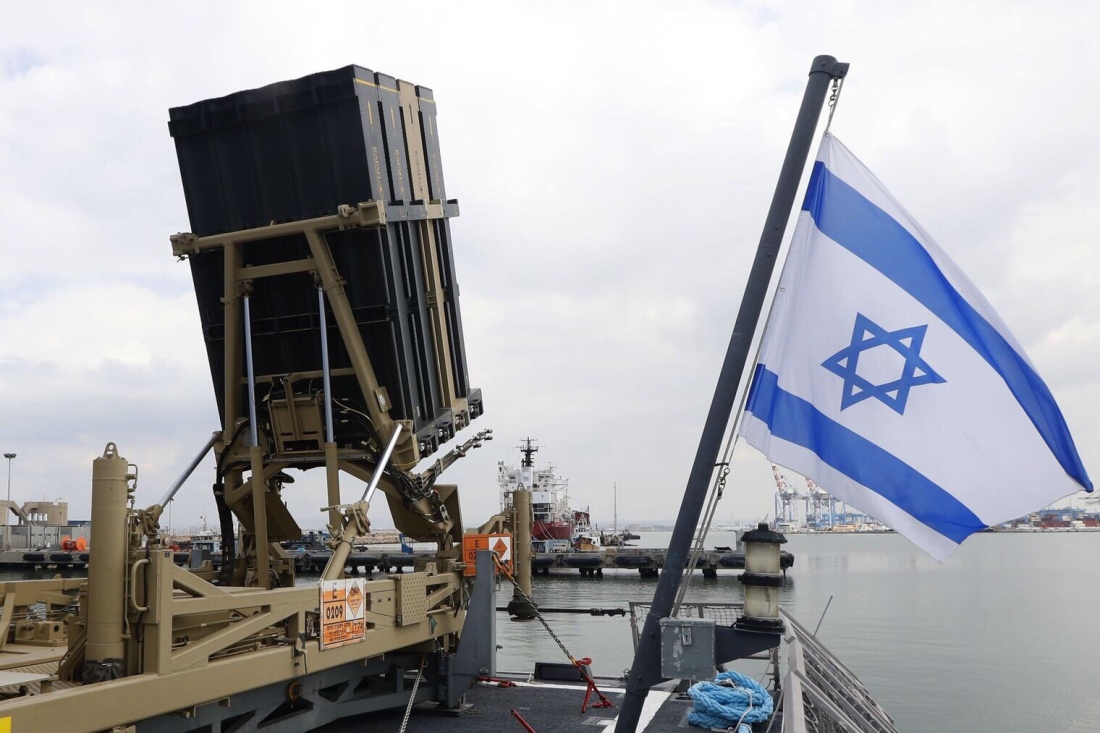
A photo taken on February 12, 2019, shows an Israeli naval Iron Dome defense system installed on an Israeli ship.
Jack Guez/AFP/Getty Images
Tensions between Israel and Gaza — already extremely high — may grow even higher in the coming hours.
On Thursday, two long-range rockets fired from Gaza streaked toward Tel Aviv, one of Israel’s largest cities. And although no casualties or property damage have been reported so far, Israel is likely to respond forcefully.
Which means an already roiling crisis in the Middle East is likely to deepen.
Red alert sirens indicating incoming rockets sounded in Tel Aviv indicating the first time that the city was a target since 2014. That year, Israel and Gaza engaged in brutal, weeks-long fighting. The Israeli military said its missile defense system, Iron Dome, was launched to intercept the rockets, although it’s unclear if an interception actually took place. The videobelow shows Iron Dome interceptors flying through the night sky over Tel Aviv, but they self-destructed because an interception was unnecessary.
One Israeli journalist tweeted that he was sitting in his living room when “suddenly” there were sirens and “sounds of explosion.” Tel Aviv has opened bomb shelters for citizens to use overnight.
The question now is what happens next. The answer, depressingly, seems pretty clear: retaliation.
Israel will surely hit back — hard
It’s unclear who, exactly, was behind the rocket attack. But since it came from Gaza, the territory will be in Israel’s crosshairs over the coming hours.
Israel has conducted airstrikes in Gaza in recent months because Hamas — a Palestinian Islamist political organization and militant group that has waged war on Israel since the group’s 1987 founding and ruled Gaza since 2007 — keeps shooting short-range rockets into the nation’s south.
Last November, the two sides engaged in days of fighting that saw fighters and civilians on both sides die.
But a long-range rocket attack on Tel Aviv is a serious escalation, which means groups in Gaza — like Hamas — may be trying to send a message, according to Neri Zilber, a Middle East expert at the Washington Institute for Near East Policy think tank.
He told me that militants in Gaza may have decided to launch the rockets to deflect popular anger directed at Hamas leaders in Gaza as well as to regain the attention of international actors, including Israel, to work on potential reconciliation.
Peace, though, seems very, very far away right now. Instead, Israeli Prime Minister Benjamin Netanyahu — who faces a tough reelection battle in April — only has incentives to strike back.
“Netanyahu will respond, but will likely respond within reason,” Zilber said. That means the prime minister may still authorize dozens or more airstrikes, but the Israeli military will likely strike important but largely empty targets like command centers, headquarters, and training grounds for militants in Gaza.
Should Israel end up killing scores of Palestinians or hit occupied buildings, it could signal a new phase in Israel’s response to rocket attacks. And if that’s the case, we may see more intensive fighting between the two sides over the next few days.

Thursday, March 14, 2019

Babylon the Great Measures the Holy City (Revelation 11:1)


Image result for golan  heights militaryIn first, U.S. drops ‘occupied’ from report on West Bank, Gaza and Golan Heights

Amir Tibon and Noa Landau (Washington) Mar 13, 2019 5:35 PM


WASHINGTON – The U.S. State Department referred to the Golan Heights as “Israeli-controlled territory” in its annual human rights report for 2018. This is a change compared to the language used by previous administrations, which referred to the area as “occupied territory.”A separate section on the West Bank and Gaza Strip, areas that Israel captured along with the Golan Heights during the Six-Day War in 1967, also did not refer to those territories as being “occupied” or under “occupation.” In last year’s State Department report on human rights, the administration dropped the term “occupied territories” from the headline, but referred to the Golan Heights and the West Bank as “occupied” inside the text itself. The main change in this year’s report is the scrubbing of the word “occupied” from the text itself.
U.S. Palestinian mission in Jerusalem shuts down
Video Player is loading
A State Department source said on Wednesday that, “Our policy on Golan has not changed. We retitled the HRR to refer to the commonly used geographic names of the area the report covers.”
Israel effectively annexed the Golan Heights, which is populated largely by Druze communities, after capturing it in 1967. The international community does not recognize Israeli sovereignty over the area, but the ongoing conflict in Syria has complicated the matter of ownership. Assad-aligned forces, including Hezbollah and Iran-backed militias, regularly clash with rebel forces on the Syrian side of the de-facto border. The United Nations Disengagement Observer Force oversees the cease-fire line.
On Monday, Republican Senator Lindsey Graham visited the Golan Heights alongside Prime Minister Benjamin Netanyahu and U.S. Ambassador to Israel David Friedman and revealed plans to work toward American recognition of the Golan Heights as part of Israel.
“Working with Senator [Ted] Cruz, I will start an effort to recognize the Golan as part of the State of Israel now and forever,” Graham said.
“Israel occupied this territory by fighting for its survival,” the senator added. This territory was taken by military force because it was used as a launching point to attack the State of Israel. This territory has a rich Jewish history.”
Graham also asked to whom the stretch of territory would be returned if Israel were to give it up. “Who do you give it back to, Assad?” Senator Graham said, noting that Iran and Russia are deeply invested in the territory. “Russia? I believe not.”
Graham said he would speak to President Donald Trump on the matter of recognizing the territory as Israeli.
Reuters contributed to this report. 

Babylon the Great Fails to Recognize the War Outside the Temple (Revelation 11)


Image result for gaza war


Since when did Fox News start carrying water for terror groups in the Gaza Strip?
It’s a strange question that must be asked in light of the short segment broadcast by the network on March 5, 2019. In the segment,Fox News correspondent Trey Yingst relays warnings from unnamed security analysts that a war could soon break out between Israel and “factions” in Gaza Strip. The narrative that he offers to explain why war might happen places all the blame for the potential conflict on Israel. Yingst covers the story as if the “factions” in question — Hamas and Palestinian Islamic Jihad — bear no responsibility for the tensions along the boundary between Israel and the Gaza Strip.
He does this in a number of ways.
First, he reports that, “Each week, thousands of Palestinians gather at the Israel-Gaza border to protest the Israeli blockade of the Gaza Strip,” and that Israel has responded to these “protests” with “tear gas and live ammunition.” The way Yingst reports the story, it sounds and looks like Israel is arbitrarily gunning down peace protesters who pose no threat to Israeli security.
Yingst fails to report that these protesters don’t just “protest” the blockade, but have sought to break through the security barrier between Israel and the Gaza Strip. He also fails to note that Hamas leaders have called on participants to invade Israel and murder civilians who live nearby.
The protests are part of what Hamas has called the “March of Return.” That’s not about protesting a “blockade,” but a call to invade Israel. And that’s what the rioters at the boundary between Israel and the Gaza Strip have done. Yingst’s “protesters” have placed explosives on the fence and have entered into Israel territory. The rioters have also shot at Israeli soldiers with rifles. Clearly, their intentions are not good. Hamas leader Yahya Sinwar declared in April 2018, soon after riots started: “We will tear down the border and we will tear out their hearts from their bodies.”
All of this helps explain why Israeli soldiers have used “tear gas and live ammunition” against the Palestinians who are indeed trying to “tear down the border.”
Yingst also relays complaints from Khaled Al-Batsh, a leader from Palestinian Islamic Jihad, about Israel killing “civilians” involved in the “protests.” Through an interpreter, Al-Batsh is quoted as saying, “The continuous killing of Palestinian civilians by Israeli snipers on the fence. This may cause a reaction from individuals, relatives of the killed people and this could escalate the clash and the fighting.”
In relaying Al-Batsh’s accusation that Israel is engaged in “continuous killing of Palestinian civilians,” the report fails to acknowledge that many of the Palestinians killed during the assaults on the security barrier have been members of Hamas and other terror organizations in the Gaza Strip. Last April, the Meir Amit Intelligence Center reported that most of the casualties associated with the March of Return were terrorist operatives or members of terror organizations. The report states:
The ITIC’s interim findings clearly show that terrorist operatives (especially Hamas operatives), or Palestinians affiliated with terrorist organizations, play a key role in the front lines of the “great return march” demonstrations near the fence. They are primarily involved in violent clashes with the IDF and on occasion carry out terrorist attacks. Conspicuous is the small number of civilian activists and ordinary civilians, who were involved in organizing the march, involved in rioting with the IDF. They were left behind when the violence began.
In a report published by NBC last May Hamas admitted that most of those killed were its members. This clearly undermines the Al-Batsh’s suggestion that Israel is sniping at innocent civilians. Why did Fox News allow Al-Batsh’s suggestion to go unchallenged?
This is simply irresponsible.
The report also relays, without challenge, Palestinian complaints about shortages of water and electricity in the Gaza Strip, which are implicitly blamed on Israel. “Gaza is in need of consistent electricity and clean water,” Yingst reports, without acknowledging the role Palestinian leaders have played in causing these shortages. In 2017, Avi Issacharoff reported that the lack of electricity in the Gaza Strip is the result of Hamas’s refusal to pay for the fuel necessary to run the power plants in the area. Issacharoff reported that the electricity crisis in the Gaza Strip “is the outcome of a long-running disagreement between the Palestinian Authority and Hamas over the payment of excise taxes for the fuel that is used in the power station in Gaza.” Because Hamas has refused pay the excise tax, “the Gaza Strip has seen drastic swings in the electricity supply,” Issacharoff reported in The Times of Israel in 2017.
Qatar has paid for the cost of the diesel fuel to increase the output of the electrical plant in the Gaza Strip in an effort to alleviate the suffering (and to decrease tensions between Israel and Hamas). To this end, Qatar has paid $10 million a month in fuel costs since late last year, which has resulted in people enjoying eight hours of electricity a day instead of the previous four hours.
Leaders in Doha have reportedly grown tired of footing the bill in the face of Hamas’s failure to improve its infrastructure. The Times of Israel reported on Feb. 19, 2019 that Qatar is frustrated “with Hamas’s foot-dragging on several large projects in the Strip, including a long-delayed high-voltage power line from Israel that could double the Strip’s power.”
Despite all this, Yingst allowed Palestinian leaders to use a shortage of electricity in the Gaza Strip — which is their fault — as a pretext for more violence against Israel.
Moreover, Yingst’s report also omitted any reference to the incendiary balloon attacks emanating from the Gaza Strip. These attacks, which had stopped for a while, started up again two days before Fox News aired its report. These attacks have caused massive damage to Israel’s natural and agricultural resources.
In May, 2018, Hamas leader, Mahmoud Al-Zahar declared that when Hamas talks “about ‘peaceful resistance,’ we are deceiving the public.”
Why is Yingst assisting in Hamas’s efforts to deceive the world about the purposes of the March of Return? And why is Fox News letting him?

Wednesday, March 13, 2019

The World will NOT Listen to the Truth Outside the Temple Walls (Revelation 11)


The truth is out about Israel’s lethal actions in Gaza. Will the world listen?
The UN’s damning verdict on the 2018 Gaza protests should prompt the international community into ending Israeli occupation
Tue 12 Mar 2019 08.42 EDT
UN investigation into the 2018 Gaza protests has concluded that Israeli officers and their leaders may have committed war crimes or crimes against humanity. The human rights council’s commission of inquiry found that soldiers intentionally used live ammunition against civilians, who included children, women, journalists, health workers and people with disabilities.
The figures are telling: more than 6,000 people injured by Israeli bullets, with 183 killed. Renowned human rights organisations such as Human Rights Watch, B’Tselem and Al-Haq had already denounced this policy, with B’Tselem calling on Israeli soldiers not to follow orders to shoot civilians. The people of Palestine still wonder whether such findings will be used by the international community to implement policy aimed at ending the Israeli occupation, or whether it will be business as usual.
The killing of Palestinian civilians during 2018 is part of a long list of ongoing Israeli crimes and violations. Israel, the occupying power, often denounces any reporting on its treatment of the people of Palestine – going as far as pushing for the expulsion of the representative of Human Rights Watch and refusing UN commissions of inquiry or special rapporteurs access to the occupied territories.
Israel has long been targeting Palestinian civil society organisations and human rights activists for exposing its ongoing policies of colonisation that deny the right of the Palestinian people to be free. Sadly, if members of the international community don’t act, the results of this commission of inquiry will eventually be added to other investigations – including the recently released EU report on Israeli settlement construction – and Israel will continue to violate international law and UN resolutions through the complicity of a number of UN member states..youtube.com/watch?v=YOi343S1
The EU, Israel’s main trade partner, has a consistent position for ending Israel’s occupation of Palestine – reaffirmed in a statement from the Arab-EU summit at Sharm el-Sheikh last month. But Israel also knows that, among its main trade partners, and particularly within the EU, products coming from illegal colonial settlements in the occupied territory are not being labelled, let alone banned. And while Israeli settlers enjoy the benefit of visa-free entry to Europe, Palestinians living only a few metres away still require them. Indeed, none of the countries who claim to be concerned about “fairness” have taken any significant step towards holding Israel accountable for its decades-long crimes and violations.
What we see on the ground reflects a deep culture of impunity. We see international companies working in Israeli settlements; countries continuing to sell arms to Israel despite its repeated violations of international humanitarian law; an increase in settler tourism, which contributes to the illegal colonial-settlement enterprise. Alongside this, Israel’s theft of natural resources and effective control over all aspects of Palestinian life, including the population registry, clearly show how the Palestinian right to self-determination is violated on a daily basis.
There is a legal and a moral responsibility for the international community to take decisive action towards respecting international law, UN resolutions and human rights in Palestine. This is most important now, while the Trump administration in the US is escalating its policies against our people. Among other steps, and in accordance with resolution 31/36, we have reiterated our call for the UN human rights commissioner to release the database of companies involved in the Israeli occupation.
There is now an opportunity to send the right message about the Israeli occupation in the upcoming human rights council discussions – and to take long-overdue steps towards a just and lasting peace by affirming the inalienable rights of the Palestinian people.
• Dr Saeb Erekat is secretary general of the Palestine Liberation Organisation

Tuesday, March 12, 2019

IDF strikes Gaza outside the Temple Walls (Revelation 11)


IDF strikes Gaza in response to rocket fired into Israel


By ANNA AHRONHEIM
The IDF struck several targets in GazaSaturday night after a rocket was shot at Israel several hours before, triggering sirens in surrounding Israel communities.
The IDF fighter jets struck in several locations, including terrorist targets in a military compound in the northern Gaza Strip and two vessels belonging to Hamas, the IDF spokesperson confirmed.
“The IDF views with great severity any attempt to harm Israeli civilians and will continue to act vigorously against these terrorist acts,” the IDF added, blaming Hamas for “everything that happens in and out of the Gaza Strip.”
The strikes came in response to a tumultuous weekend.
A projectile landed in open territory into the Eshkol Regional Council on Saturday night shortly after a red alert incoming rocket siren was activated. 
The rocket fire came hours after Israeli aircraft attacked several Hamas military targets in the Gaza Strip on Friday night, hours after a projectile was fired toward southern Israel, the IDF said.
Top Stories
The IDF Spokesperson’s Office said that IDF fighter planes and aircraft attacked a number of terrorist targets in the military compound of the Hamas terrorist organization in the southern Gaza Strip, as well as underground infrastructures in the northern Gaza Strip.
The army said jets struck a Hamas military compound in southern Gaza and underground infrastructure in the north. According to reports, the targets included a naval facility near Sudaniya, a naval facility in Khan Yunis, and two other sites in Zeytoun and Tuffah in Gaza City.
There were no reports of casualties.
The strike was “carried out in response to the launching of a rocket into Israel earlier this evening, as well as the terrorist attacks from the Gaza Strip, including [the launching of] balloons and attempts to damage security infrastructures in recent days,” the military said in a statement.
“The IDF views with great severity any attempt to harm Israeli civilians and will continue to act vigorously against these terrorist acts,” the statement continued adding that Hamas “bears responsibility for everything that is happening in and out of the Gaza Strip.”
The rocket launch and retaliatory strike came after a day of intense clashes between IDF forces and some roughly 8,000 Palestinian protesters, marking the 50th week of the “March of Return” protests.
The protests began on March 30, 2018, and have seen hundreds of thousands of Gazans violently demonstrating along the security fence with Israel, demanding an end to the 12-year-long grinding blockade of the coastal enclave.  
The Palestinian Ministry of Health said that one Palestinian, 23-year-old Tamer Khaled Mustafa Arfat was killed and 48 others were injured by IDF fire, including two women and 15 youths. Another four paramedics and two journalists were also injured.
During the protests, two Palestinians infiltrated into Israel from the northern Gaza Strip leading the military to close several local roads and deploy troops to communities who were put on alert. The two men were later arrested by troops and were found to be armed with a knife and grenade, the military said.
On Friday, three clusters of explosive balloons carrying large objects were discovered in open fields within the council’s area. One cluster carried a scarecrow while another carried a toy drone.
In the month leading up to the anniversary, there has been a marked increase of Hamas-led violence along the border, during the day and at night, with explosive balloons and improvised explosive devices hurled at troops or placed on the fence.
During violent riots on Wednesday night, an incoming rocket siren was activated in communities in the Sha’ar Hanegev Regional Council bordering the Gaza Strip, after rioters attempted to throw explosive devices at troops stationed along the border. 
There were no injuries or damage.
Around an hour later, additional incoming rocket sirens were activated after a mortar was fired toward communities in the Eshkol Regional Council.
In response, Israeli warplanes carried out intensive airstrikes in the southern Gaza Strip, which according to Palestinian media destroyed a Hamas naval commando base and damaged several nearby homes. There were no injuries reported.

Islamic Jihad from Outside the Temple Walls (Revelation 11)


Islamic Jihad is the real threat from Gaza


On Tuesday morning, a delegation of Egyptian intelligence officers arrived at Ben-Gurion Airport, headed by the chief of the “Palestine Department,” General Omar Halfi. The group of Israeli officers waiting for them drove them directly to the Defense Ministry’s Tel Aviv headquarters for talks with the upper echelons of the defense establishment, in an attempt to find a way to reduce the growing tensions in the Gaza Strip, ahead of an explosion of violence.
The Egyptians came up with a list of Israeli commitments to improve living conditions in Gaza: water, electricity, expanding fishing areas, increasing the amount of goods coming from Israel, and so on. But the following day, when the Egyptians went to Gaza with the Israeli proposals in hand, it became clear that they were insufficient.
And so Qatar’s envoy to the region, Mohammed al-Emadi, found himself summoned to the region on Wednesday because Hamas demanded an increase in Gaza’s monthly Qatari stipend from $15 million to $20 million. It also emerged that the planned work that the United Nations was supposed to organize in the Gaza Strip had yet to begin.
And so the Egyptians went to Gaza on Wednesday with a partial package. Last week, they tried to do their bit to ease tensions by releasing eight Hamas prisoners, but contrary to expectations, Hamas did not use this release to hold mass celebrations that would highlight the achievements of the organization’s leadership. What Hamas wants is water and power, and it wants them now. It is demanding the immediate activation of Israel’s Electric Corporation’s plan to supply electricity to Gaza.
The impact of the last round of Egyptian mediation efforts will be seen in the weekend protests at the Israel-Gaza border fence: If the violence escalates, Gaza will not accept the Israeli-Egyptian proposal to calm the situation. If the tensions remain at their current levels, there is still room for compromise. At the moment, both sides are one step away from the abyss. One small trigger, and we will find ourselves in a real conflict.
This fragile situation also has another major factor that could up-end the entire table: It appears that for now Israel and Hamas in Gaza have a common enemy: Palestinian Islamic Jihad.
Islamic Jihad was responsible for most of the rocket, anti-tank missiles and sniper attacks carried out in recent months against Israel. Its leaders, who are hiding in the Dahiya neighborhood of Beirut under the leadership of deputy secretary-general Ziad al-Nahla, have decided to renew military activity from the Gaza Strip. The organization’s representatives in Gaza also stopped coordinating their military activities with Hamas, as part of a joint war room set up by all the terrorist organizations in the Strip.
And so Hamas today finds itself facing off against an intransigent organization that acts in contravention to its agenda. Islamic Jihad is making sure to carry out its military provocations on the days when Hamas is conducting some sort of dialogue with Israel or with Egypt regarding arrangements in the Strip – and when they attack, Israel retaliates with attacks on Hamas installations.
One can make the fair assumption that if there are any signs of any constructive progress between Israel and Hamas towards the end of the week, Islamic Jihad will try to sabotage it. It is enough for one mercenary sniper to hit one Israeli for Gaza to burn. But when Israel does not deal with the Islamic Jihad threat, it encourages increased anarchy in Gaza, which will ultimately lead to a ground invasion by the IDF.
Hamas, for its part, is waging an ineffective battle against the renegade organization. Several days ago, for example, Hamas’s internal security apparatus arrested Hashem Salem, an Islamic Jihad member who converted from Sunni to Shiite Islam, and established a pro-Iranian organization in the Gaza Strip. That’s how it starts: Today it’s a small charity, funded by Iran, which supports widows and orphans, but if we do not pay attention, tomorrow that charity will be yet another Iranian military organization in Gaza.
Hamas understands the danger inherent in the pro-Iranian organizations, but in Israel, Islamic Jihad is only regarded as a secondary enemy. While Hamas is a political movement, Islamic Jihad is a military one. It does not recognize the PLO as a representative of the Palestinian people, and it sees itself as a fighting elite unit with the aim of liberating Palestine, and now has more rockets in the Gaza Strip than Hamas. And this is what will set the Israel-Gaza border aflame.

Monday, March 11, 2019

Palestinian Protester Shot Outside the Temple Walls (Revelation 11)


Palestinian protester shot in the head near Gaza border: ministry
Tamer Arafat, 23, died from his wounds after being shot in the head during Friday’s protest, Gaza health ministry says.
08 Mar 2019 GMT+3
Israeli forces have shot and killed a Palestinian man and wounded more than 40 as thousands protested near the Gaza Strip‘s perimeter fence, the enclave’s health ministry has said.
Tamer Arafat, 23, died from his wounds on Friday during the 50th week of demonstrations, said Ashraf al-Qidra, the spokesman for the ministry.
Qidra also said that 48 Palestinians had been wounded by Israeli gunfire, including four medics, two women and 15 children.
The Israeli military said over 8,000 Palestinians took part in the demonstration, throwing rocks and explosives towards soldiers, and that some tried to breach the fence into Israel.
A spokesman for the military said Israeli forces “responded with riot dispersal means and fired in accordance with standard operating procedures”.
Palestinians have staged weekly protests near the border with Israel as part of the Great March of Return protests, which began in March last year.
The demonstrators are calling for the lifting of an Israeli-Egyptian blockade imposed on Gaza since 2007 and for the right to return to their ancestral homes in Israel, as stipulated in UN Resolution 194.
Egypt tries to restore calm
Cross-border violence has increased in recent days with Israel’s military saying it had carried out air raids on a compound belonging to Hamas after explosives attached to balloons were launched from the coastal enclave towards Israel.
Egyptian officials, who have frequently brokered ceasefires between Israel and Hamas, have been shuttling between the sides to try to restore calm, a Palestinian official told Reuters.
According to the Al Mezan Center for Human Rights, 267 Palestinians have been killed in the Gaza Strip since March 30.
Of them, 190 were killed during demonstrations, including 40 children, two women, two journalists, three paramedics and eight disabled people.
Another 14,673 have been injured, including 3,128 children.
Most of the Palestinians killed during the demonstrations were shot in weekly clashes, but some have been hit by Israeli tank fire or air raids.
Israel has accused Hamas of using the demonstrations as cover for infiltrations and attacks, but rights groups and Palestinians say the protesters have posed little threat.
Last month, UN investigators said there was evidence pointing to crimes against humanity by Israeli security forces.
However, Israeli Prime Minister Benjamin Netanyahu rejected the report’s findings, saying it was “setting new records of hypocrisy and lies, out of an obsessive hatred of Israel, the only democracy in the Middle East”.

Sunday, March 10, 2019

Mortar shell fired from outside the Temple Walls (Revelation 11)


Mortar shell fired at southern Israel from Gaza for second time in two days


No reports of injury or damage as projectile hits Eshkol region field near Gaza; attack continues violent weekend as mediators seek to soothe tensions
9 Mar 2019, 9:03 pm
Palestinian terrorists in the Gaza Strip fired a mortar shell at the Eshkol region of southern Israel on Saturday night, amid an uptick in violence along the Gaza border.
The mortar shell struck an open field, causing neither injuries nor damage, the local government said. The launch triggered air raid sirens in the region, sending thousands of residents to bomb shelters.
“Residents of the Gaza periphery have been living under a continuous state of emergency for many months. If the children of the Gaza periphery aren’t sleeping at night because of the situation, it must also wake the policy-makers and those responsible for the security of the citizens of the State of Israel,” Eshkol Mayor Gadi Yarkoni said in a statement.
Earlier in the day, police sappers were called to the Israel-Gaza border area after a cluster of balloons suspected of carrying an explosive device landed in Israeli territory.
From images of the device, the balloons appeared to be carrying the warhead of an anti-tank missile.
The balloon-borne device was located in the Sdot Negev Regional Council. Police instructed hikers to keep away from the area as they carried out a controlled explosion.
A screenshot from a Channel 13 report on March 9, 2019 showing a police officer at the spot where a controlled explosion of a cluster of balloons carrying a missile warhead took place.
On Friday, a mortar shell from Gaza struck an open field in the Eshkol region, causing no injuries or damage. In response, the Israel Air Force carried out several strikes in the Strip, hitting a Hamas military base in the south of the territory and underground infrastructure in the north.
Friday also saw thousands of Palestinians take part in violent protests along the border, and two men, whom the IDF said were carrying a knife and a hand grenade, were arrested after crossing into Israel from the northern Strip. The two infiltrators broke through the security fence and evaded capture for approximately half an hour, forcing the IDF to bring additional troops to the area, as well as local communities to go on high alert and call up their volunteer security forces.
In light of the increasing violence between Israel and Hamas, Egypt and other mediators have been working intensively in recent weeks to broker a cease fire agreement between the two sides, but thus far to no avail.
Friday’s protests were part of what Palestinians call the “March of Return,” a series of regular demonstrations and violent riots along the border fence that have been held since March 30, 2018.
Israel says the demonstrations are orchestrated by Hamas, which vocally supports them, sending free buses to the border and providing food and internet to participants — as well as money for those injured in them — in order to provide a cover for the organization’s nefarious activities along the security fence, including infiltration attempts, the planting of explosives and attacks on Israeli soldiers.
Their organizers have said the protests aim to achieve the “return” of Palestinian refugees and their descendants to lands that are now part of Israel, and pressure the Jewish state to lift its restrictions on the movement of people and goods into and out of the coastal enclave.
Israeli officials hold that the return of Palestinian refugees and their descendants would destroy Israel’s Jewish character. They also maintain that the restrictions on movement are in place to prevent Hamas and other terrorist groups from smuggling weapons into the Strip.
The flying of kites and balloons carrying burning objects and explosives had been a main element of the weekly clashes on the Gaza border, ravaging forests and farmland in southern Israel and posing a threat to local residents.
Israeli troops respond to an infiltration by two Palestinian men from the northern Gaza Strip on March 8, 2019. (Yediot Mehashetah)
On Thursday, Prime Minister Benjamin Netanyahu warned Hamas that Israel would respond harshly to any further violence emanating from the Strip.
Egyptian mediators were in Gaza this week as Cairo launched a new round of mediation between Israel and Hamas in a bid to secure a lasting ceasefire deal.