Showing posts with label football. Show all posts

Wednesday, June 20, 2018

The Growing Chinese Nuclear Horn (Daniel 7)


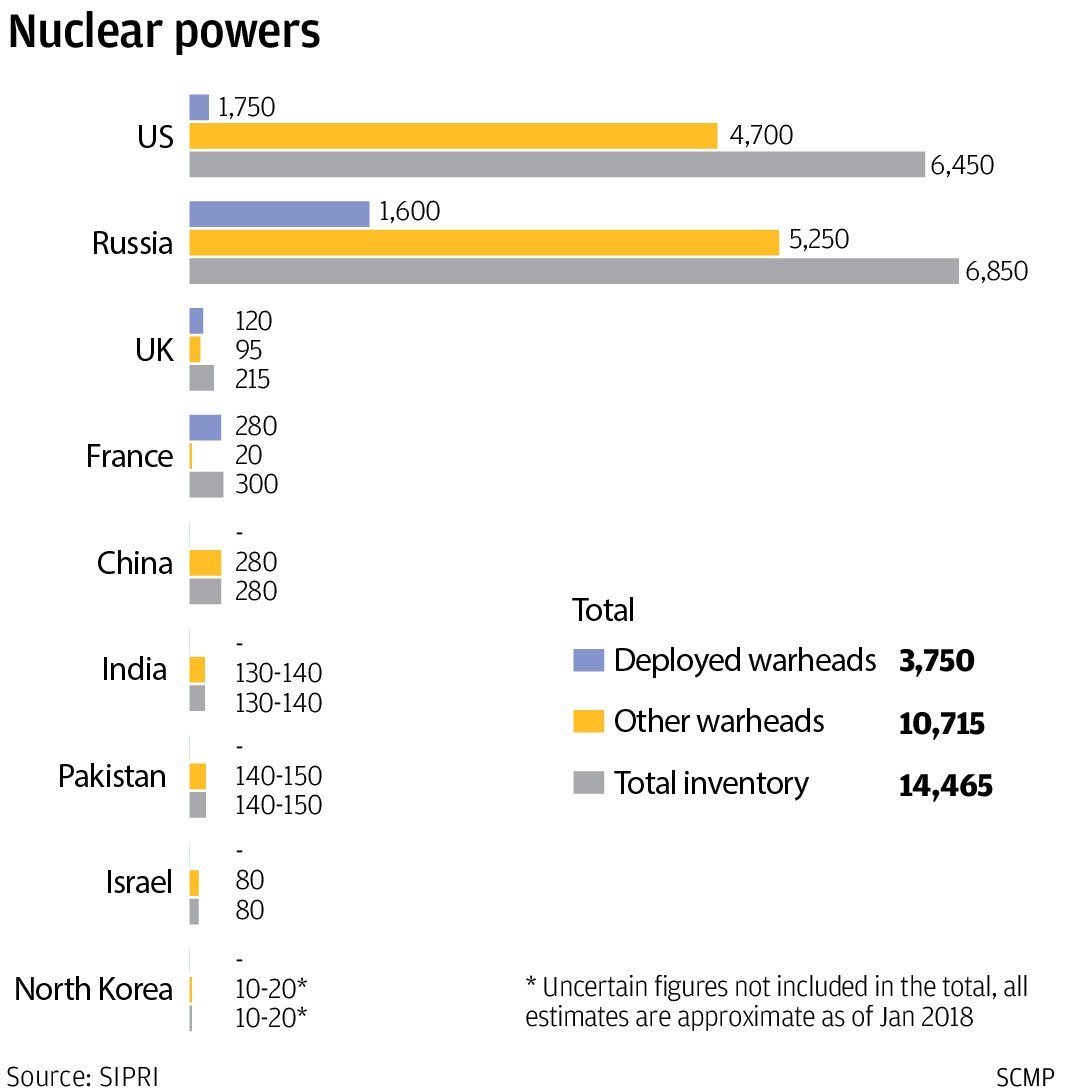
The number of nuclear weapons worldwide dipped slightly in 2017, with the world’s nine nuclear powers collectively downsizing by 500 weapons.
The United States and Russia entered 2018 with fewer weapons, while China, India, and Pakistan gave their modest arsenals a slight boost. The world’s newest nuclear power, North Korea, is still a mystery with an unknown quantity of nuclear weapons.
The nonprofit Stockholm International Peace Research Institute tracks the arms trade, current conflicts, and the number of worldwide nuclear weapons through its annual yearbook. The 2018 yearbook, just released, has some interesting figures on the state of nukes.
The United States decreased its nuclear arsenal from 6,800 in 2017 to 6,450 in January 2018. That’s a decrease of 350 nukes, or about a warhead a day. Those numbers are deceiving, however, as the U.S. deployed only 1,700 warheads during this period (meaning the weapons that are loaded on submarines, intercontinental ballistic missiles, and standing by at air bases). The rest of the arsenal is in reserve or awaiting destruction. Russia also declined, but not by as much, dropping from 7,000 weapons to 6,850. Russia had 1,600 deployed nukes during the same period.
 
 
The United States and Russia are reducing their arsenals to comply with the New START arms control treaty, which mandates no more than 1,550 deployed nukes on either side. Both sides met the February 2018 deadline, with Russia reporting 1,444 nukes on February 5 and the United States 1,350 warheads. The number of nukes each country deploys rises and falls slightly on a regular basis, as submarines—which alone have hundreds of warheads—leave or return from patrols, land-based missiles are taken offline for maintenance, and so on.
Despite increasing tensions between the two countries, both appear committed to adhering to New START. This runs counter to President Donald Trump’s expressed desire to boost the American nuclear arsenal to new post-Cold War heights, deploying ten times as many nuclear weapons as before.
 
 
Meanwhile, China, India, and Pakistan all saw rising nuclear arsenals. India’s arsenal increased by an estimated ten warheads, from 120-130 to 130-140. Rival Pakistan also increased its arsenal from 130-140 to 140-150. SIPRI believes both countries will continue to increase the size of their arsenals. Pakistan's conventional armed forces are smaller than India’s, so the country is apparently trying to make up for it in nuclear weapons.
China’s boost to its nuclear arsenal is the most interesting development, with Beijing adding 10 nukes between 2017 and 2018. China keeps its nuclear arsenal small, reasoning that so long as it can credibly deliver enough of a counterstrike to deter attackers, the intricacies of nuclear warfare and the extreme costs of an arms race are irrelevant. This is a policy known as “assured retaliation.
It’s unknown if China will continue to grow its nuclear arsenal. The country has a relatively small amount of fissile material, keeping its warhead numbers low. Producing more nuclear fuel would be a major undertaking on Beijing’s part. That said, China is said to be concerned about the American ballistic missile shield. Although the American defense doesn't provide much of an impediment to a Chinese nuclear strike, the Chinese are concerned it could be scaled up by the addition of more missile interceptors.
 
Holding steady: the United Kingdom (215 warheads), France (300), and Israel (80) all maintained the same size nuclear arsenals over the past year. North Korea, whose numbers are unknown but thought to be between 10 and 20 weapons, might as well be in the category as well.
Overall, it’s a mixed picture for nuclear weapons worldwide. The good news is that the two main nuclear powers, each of which could roll back human civilization by thousands of years in a matter of hours, appear committed to existing arms control treaties. Tensions between the two countries likely mean we won’t see any new treaties any time soon though. On the other hand, the India-Pakistan arms race is a worrying development. China’s numbers remain low for a superpower, but the big question is: Will they stay low, and is there anything that can be done about it?

Tuesday, June 19, 2018

China Nuclear Horn Modernizes Its Nukes


China adds to nuclear arsenal amid military modernisation drive
Country now has 280 warheads, according to think tank, which calls nuclear states’ renewed focus on deterrence and capacity ‘a very worrying trend’
Lee Jeong-ho
Monday, 18 Jun 2018, 10:18PM
China is pushing ahead with modernising its nuclear weapon delivery systems and has added to its arsenal as it boosts military expenditure, according to a report released by an independent think tank on Monday.
As of January, the country had 280 warheads, up from 270 a year earlier, the Stockholm International Peace Research Institute (SIPRI) said in an annual report.
But it said none of the nuclear warheads were deployed on missiles or located on bases with operational forces. They were instead classified as “other warheads” – meaning they are being stored or have been retired.
China is the world’s second biggest spender on military, allocating US$228 billion for defence last year – up 5.6 per cent from 2016. That was its lowest increase in military spending since 2010, but was in line with gross domestic product growth and inflation.
It was a long way off the US$610 billion military spend of the United States, which again topped the list last year.
Meanwhile, India and Pakistan also expanded their nuclear weapon stockpiles and accelerated development of new missile delivery systems for land, sea and air, according to the report.
Both countries had added about 10 warheads as of January, with India’s total at 130 to 140, and Pakistan’s at 140 to 150, the think tank said. None of those warheads were deployed on missiles.
North Korea also advanced its nuclear weapon capabilities, including testing a thermonuclear weapon in September.
“Despite the clear international interest in nuclear disarmament reflected in the conclusion of the Prohibition of Nuclear Weapons Treaty in 2017, the modernisation programmes under development in states possessing nuclear weapons indicate that genuine progress towards nuclear disarmament will remain a distant goal,” said Shannon Kile, a senior researcher with the SIPRI disarmament, arms control and non-proliferation programme.

Other nuclear-armed states either reduced the total number of warheads or did not add to their arsenals.
The US cut its nuclear warheads to 6,480 as of January from 6,800 a year earlier, while Russia went from 7,000 to 6,850 this year, the report said.
There was no change from last year for the United Kingdom at 215 warheads, France at 300, Israel at 80, and North Korea with 10 to 20.
But although they reduced their arsenals, the US and Russia accounted for nearly 92 per cent of all nuclear weapons in the world.
“Despite making limited reductions to their nuclear forces, both Russia and the USA have long-term programmes under way to replace and modernise their nuclear warheads, missile and aircraft delivery systems, and nuclear weapon production facilities,” the report said.
Jan Eliasson, chairman of the SIPRI Governing Board, said: “The renewed focus on the strategic importance of nuclear deterrence and capacity is a very worrying trend.
“The world needs a clear commitment from the nuclear weapon states to an effective, legally binding process towards nuclear disarmament.”
Nine countries – the US, Russia, the UK, France, China, India, Pakistan, Israel and North Korea – now have some 14,465 nuclear weapons between them, down from a total of 14,935 last year.
The SIPRI was set up in Sweden in 1966 to carry out research into conflict, armaments, arms control and disarmament.

Thursday, May 31, 2018

The Growing Chinese Nuclear Horn (Daniel 7:7)

See the source imageUS, report says

Wade Bennett

China continues to rapidly advance its nuclear weapons program in a growing arms race with the U.S. and Russia, with Beijing now conducting as many as five simulated nuclear tests per month. The U.S. averages less than one test per month.
In a document released by the China Academy of Engineering Physics, the institute said that between September 2014 and December 2017, China conducted around 200 laboratory experiments simulating the extreme physics of a nuclear blast.
The purpose of the tests, according to Pentagon officials, is to develop an arsenal of next-generation weapons in response to the U.S.’ own capabilities, the South China Morning Post reported on Monday.
“The use of small warheads will lead to the use of bigger ones,” Beijing-based naval expert Li Jie stated. “If other countries use nuclear weapons on us, we have to retaliate. This is probably why there is research to develop new weapons.”
Because of an international ban, China’s experiments are not full-fledged nuclear weapons tests. Instead, the tests are carried out using high-powered gas guns that fire projectiles at weapons-grade materials in labs.
The tests occur in tunnels deep under the mountains in Mianyang, where China’s main nuclear design facilities are based.
However, China has conducted just a fraction of the total number of live nuclear tests compared to the U.S., which has detonated more than 1,000 nuclear warheads since 1945, Professor Wang Chuanbin at Wuhan University of Technology pointed out.
Still, China’s growing nuclear efforts signal a new nuclear arms race that shows no signs of slowing down. What’s more concerning is that public opinion on such an arms race has yet to catch up with the reality, according to James Lewis at the Center for Strategic and International Studies.
In response to the growing threat of a nuclear arms race, the White House is considering a $1.2 trillion nuclear stockpile revitalization plan.
The Pentagon also announced its intention to develop new low-yield nuclear weapons for cruise missiles and submarines.
But these developments were a response to Moscow and not Beijing, Lewis said.
The U.S.’ own interest in revamping its nuclear program seems to have indirectly motivated China, he pointed out.
“After some debate, the U.S. decided it needed to think about warheads, without the need for actual tests,” Lewis said. “It wouldn’t surprise me if China saw all this and decided that it had better get in the game.”
China’s various territorial disputes in the South China Sea have also been an outlet for the country to justify its expanding military efforts.
Jie pointed out that that Beijing has pledged to never be the first to initiate nuclear arms, regardless of the circumstances.

Sunday, May 20, 2018

China Extends Her Nuclear Horn (Daniel 7:7)

China’s air force has landed bombers on islands and reefs in the South China Sea as part of a training exercise in the disputed region, it said in a statement.
Several bombers of various types – including the long-range, nuclear strike-capable H-6K – carried out landing and take off drills at an unidentified island airfield after carrying out simulated strike training on targets at sea, the Chinese airforce said.
“A division of the People’s Liberation Army Air Force (PLAAF) recently organised multiple bombers such as the H-6K to conduct take-off and landing training on islands and reefs in the South China Sea in order to improve our ability to ‘reach all territory, conduct strikes at any time and strike in all directions’,” it said.
The statement said the pilot of the H-6K bomber conducted assault training on a designated sea target and then carried out take-offs and landings at an airport in the area, describing the exercise as preparation for “the west Pacific and the battle for the South China Sea”.
The notice, published on the PLAAF’s Weibo microblogging account, did not provide the precise location of the exercise.
The US has dispatched warships to disputed areas of the South China Sea in a bid to challenge China’s extensive sovereignty claims in the territory, which is also subject to claims by Vietnam, the Philippines, Taiwan, Brunei and Malaysia. The waters are vital global shipping routes and contain what are believed to be significant oil and natural gas deposits.
“The United States remains committed to a free and open Indo-Pacific,” Pentagon spokesman Lt Col Christopher Logan said.
“We have seen these same reports and China’s continued militarisation of disputed features in the South China Sea only serves to raise tensions and destabilise the region.”
Wang Mingliang, a defence expert cited in the Chinese statement, said the takeoff and landing exercises will help the air force “strengthen its combat capability to deal with maritime security threats”.
The move comes weeks after US network CNBC reported that China had installed anti-ship and air-to-air defences on outposts in the Spratly Islands that are also claimed by Vietnam and the Philippines, citing sources close to US intelligence.
Washington warned Beijing would face unspecified “consequences” over its militarisation of the South China Sea, and said it had raised the issue with China.
In an analysis published on its website, CSIS said the location of the runway was believed to be Woody Island, China’s largest base in the Paracel Islands, which is also claimed by Vietnam and Taiwan.
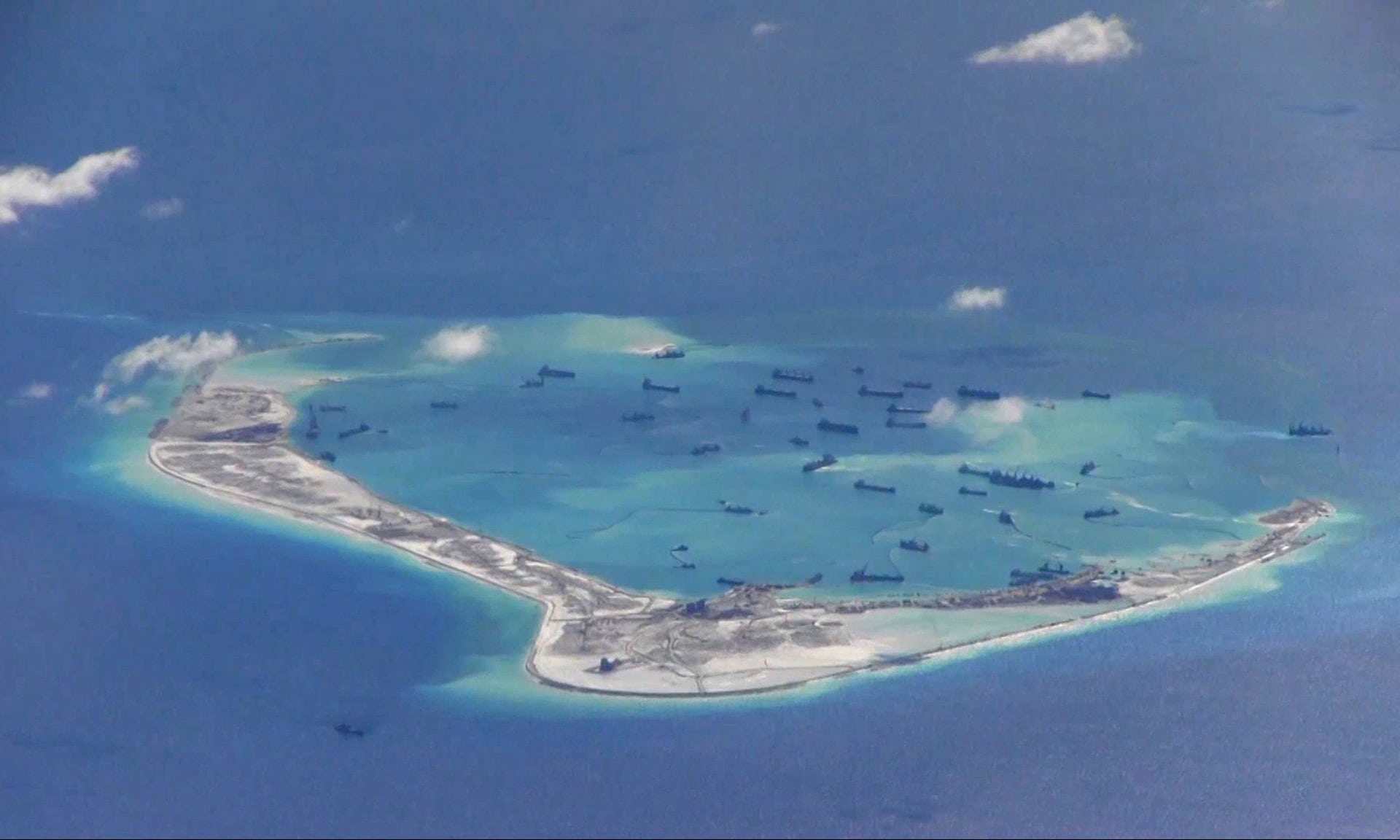
China has engaged in years of land-reclamation efforts on reefs it controls in the region and built both civilian and military facilities in the contested area.
Chinese military facilities include air bases, radar and communications systems, naval facilities and defensive weaponry including landing strips able to accommodate military planes.
Reuters and Agence France-Presse contributed to this report

Tuesday, February 20, 2018

Nuclear Tensions with China

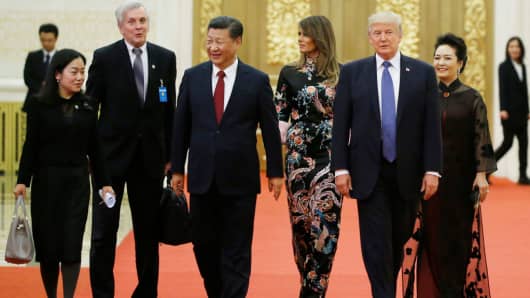
The military aide carrying the nuclear football (second from left) with U.S. President Donald Trump and China's President Xi Jinping at Beijing's Great Hall of the People.
Things got physical between U.S. and Chinese officials over the nuclear "football" during President Donald Trump's visit to Beijing last year, Axios reported Sunday.
A military aide carrying the "football" — a briefcase with contents for the president to authorize a nuclear strike — was blocked by Chinese security officials at Beijing's Great Hall of the People in November 2017, according to the report, which cited five sources "familiar with the events."
The briefcase is supposed to be close to the president at all times. Chief of Staff John Kelly, after hearing about the incident, rushed over and told U.S. officials to keep walking, Axios said. That resulted in a commotion between the Americans and the Chinese.
"A Chinese security official grabbed Kelly, and Kelly shoved the man's hand off of his body. Then a U.S. Secret Service agent grabbed the Chinese security official and tackled him to the ground," according to the report.
The news outlet reported the scuffle was over "in a flash" and the Chinese never touched the briefcase. The chief of the Beijing security detail apologized, Axios said.
The White House did not immediately respond to a request for comment sent outside of normal business hours.