Sunday, April 12, 2026

Columbia University Warns Of Sixth Seal (Revelation 6:12)


Earthquakes May Endanger New York More Than Thought, Says Study
A study by a group of prominent seismologists suggests that a pattern of subtle but active faults makes the risk of earthquakes to the New York City area substantially greater than formerly believed. Among other things, they say that the controversial Indian Point nuclear power plants, 24 miles north of the city, sit astride the previously unidentified intersection of two active seismic zones. The paper appears in the current issue of the Bulletin of the Seismological Society of America.
Many faults and a few mostly modest quakes have long been known around New York City, but the research casts them in a new light. The scientists say the insight comes from sophisticated analysis of past quakes, plus 34 years of new data on tremors, most of them perceptible only by modern seismic instruments. The evidence charts unseen but potentially powerful structures whose layout and dynamics are only now coming clearer, say the scientists. All are based at Columbia University’s Lamont-Doherty Earth Observatory, which runs the network of seismometers that monitors most of the northeastern United States.
Lead author Lynn R. Sykes said the data show that large quakes are infrequent around New Yorkcompared to more active areas like California and Japan, but that the risk is high, because of the overwhelming concentration of people and infrastructure. “The research raises the perception both of how common these events are, and, specifically, where they may occur,” he said. “It’s an extremely populated area with very large assets.” Sykes, who has studied the region for four decades, is known for his early role in establishing the global theory of plate tectonics.
The authors compiled a catalog of all 383 known earthquakes from 1677 to 2007 in a 15,000-square-mile area around New York City. Coauthor John Armbruster estimated sizes and locations of dozens of events before 1930 by combing newspaper accounts and other records. The researchers say magnitude 5 quakes—strong enough to cause damage–occurred in 1737, 1783 and 1884. There was little settlement around to be hurt by the first two quakes, whose locations are vague due to a lack of good accounts; but the last, thought to be centered under the seabed somewhere between Brooklyn and Sandy Hook, toppled chimneys across the city and New Jersey, and panicked bathers at Coney Island. Based on this, the researchers say such quakes should be routinely expected, on average, about every 100 years. “Today, with so many more buildings and people, a magnitude 5 centered below the city would be extremely attention-getting,” said Armbruster. “We’d see billions in damage, with some brick buildings falling. People would probably be killed.”
Starting in the early 1970s Lamont began collecting data on quakes from dozens of newly deployed seismometers; these have revealed further potential, including distinct zones where earthquakes concentrate, and where larger ones could come. The Lamont network, now led by coauthor Won-Young Kim, has located hundreds of small events, including a magnitude 3 every few years, which can be felt by people at the surface, but is unlikely to cause damage. These small quakes tend to cluster along a series of small, old faults in harder rocks across the region. Many of the faults were discovered decades ago when subways, water tunnels and other excavations intersected them, but conventional wisdom said they were inactive remnants of continental collisions and rifting hundreds of millions of years ago. The results clearly show that they are active, and quite capable of generating damaging quakes, said Sykes.
One major previously known feature, the Ramapo Seismic Zone, runs from eastern Pennsylvania to the mid-Hudson Valley, passing within a mile or two northwest of Indian Point. The researchers found that this system is not so much a single fracture as a braid of smaller ones, where quakes emanate from a set of still ill-defined faults. East and south of the Ramapo zone—and possibly more significant in terms of hazard–is a set of nearly parallel northwest-southeast faults. These include Manhattan’s 125th Street fault, which seems to have generated two small 1981 quakes, and could have been the source of the big 1737 quake; the Dyckman Street fault, which carried a magnitude 2 in 1989; the Mosholu Parkway fault; and the Dobbs Ferry fault in suburban Westchester, which generated the largest recent shock, a surprising magnitude 4.1, in 1985. Fortunately, it did no damage. Given the pattern, Sykes says the big 1884 quake may have hit on a yet-undetected member of this parallel family further south.
The researchers say that frequent small quakes occur in predictable ratios to larger ones, and so can be used to project a rough time scale for damaging events. Based on the lengths of the faults, the detected tremors, and calculations of how stresses build in the crust, the researchers say that magnitude 6 quakes, or even 7—respectively 10 and 100 times bigger than magnitude 5–are quite possible on the active faults they describe. They calculate that magnitude 6 quakes take place in the area about every 670 years, and sevens, every 3,400 years. The corresponding probabilities of occurrence in any 50-year period would be 7% and 1.5%. After less specific hints of these possibilities appeared in previous research, a 2003 analysis by The New York City Area Consortium for Earthquake Loss Mitigation put the cost of quakes this size in the metro New York area at $39 billion to $197 billion. A separate 2001 analysis for northern New Jersey’s Bergen County estimates that a magnitude 7 would destroy 14,000 buildings and damage 180,000 in that area alone. The researchers point out that no one knows when the last such events occurred, and say no one can predict when they next might come.
“We need to step backward from the simple old model, where you worry about one large, obvious fault, like they do in California,” said coauthor Leonardo Seeber. “The problem here comes from many subtle faults. We now see there is earthquake activity on them. Each one is small, but when you add them up, they are probably more dangerous than we thought. We need to take a very close look.” Seeber says that because the faults are mostly invisible at the surface and move infrequently, a big quake could easily hit one not yet identified. “The probability is not zero, and the damage could be great,” he said. “It could be like something out of a Greek myth.”
The researchers found concrete evidence for one significant previously unknown structure: an active seismic zone running at least 25 miles from Stamford, Conn., to the Hudson Valley town of Peekskill, N.Y., where it passes less than a mile north of the Indian Point nuclear power plant. The Stamford-Peekskill line stands out sharply on the researchers’ earthquake map, with small events clustered along its length, and to its immediate southwest. Just to the north, there are no quakes, indicating that it represents some kind of underground boundary. It is parallel to the other faults beginning at 125th Street, so the researchers believe it is a fault in the same family. Like the others, they say it is probably capable of producing at least a magnitude 6 quake. Furthermore, a mile or so on, it intersects the Ramapo seismic zone.
Sykes said the existence of the Stamford-Peekskill line had been suggested before, because the Hudson takes a sudden unexplained bend just ot the north of Indian Point, and definite traces of an old fault can be along the north side of the bend. The seismic evidence confirms it, he said. “Indian Point is situated at the intersection of the two most striking linear features marking the seismicity and also in the midst of a large population that is at risk in case of an accident,” says the paper. “This is clearly one of the least favorable sites in our study area from an earthquake hazard and risk perspective.”
The findings comes at a time when Entergy, the owner of Indian Point, is trying to relicense the two operating plants for an additional 20 years—a move being fought by surrounding communities and the New York State Attorney General. Last fall the attorney general, alerted to the then-unpublished Lamont data, told a Nuclear Regulatory Commission panel in a filing: “New data developed in the last 20 years disclose a substantially higher likelihood of significant earthquake activity in the vicinity of [Indian Point] that could exceed the earthquake design for the facility.” The state alleges that Entergy has not presented new data on earthquakes past 1979. However, in a little-noticed decision this July 31, the panel rejected the argument on procedural grounds. A source at the attorney general’s office said the state is considering its options.
The characteristics of New York’s geology and human footprint may increase the problem. Unlike in California, many New York quakes occur near the surface—in the upper mile or so—and they occur not in the broken-up, more malleable formations common where quakes are frequent, but rather in the extremely hard, rigid rocks underlying Manhattan and much of the lower Hudson Valley. Such rocks can build large stresses, then suddenly and efficiently transmit energy over long distances. “It’s like putting a hard rock in a vise,” said Seeber. “Nothing happens for a while. Then it goes with a bang.” Earthquake-resistant building codes were not introduced to New York City until 1995, and are not in effect at all in many other communities. Sinuous skyscrapers and bridges might get by with minimal damage, said Sykes, but many older, unreinforced three- to six-story brick buildings could crumble.
Art Lerner-Lam, associate director of Lamont for seismology, geology and tectonophysics, pointed out that the region’s major highways including the New York State Thruway, commuter and long-distance rail lines, and the main gas, oil and power transmission lines all cross the parallel active faults, making them particularly vulnerable to being cut. Lerner-Lam, who was not involved in the research, said that the identification of the seismic line near Indian Point “is a major substantiation of a feature that bears on the long-term earthquake risk of the northeastern United States.” He called for policymakers to develop more information on the region’s vulnerability, to take a closer look at land use and development, and to make investments to strengthen critical infrastructure.
“This is a landmark study in many ways,” said Lerner-Lam. “It gives us the best possible evidence that we have an earthquake hazard here that should be a factor in any planning decision. It crystallizes the argument that this hazard is not random. There is a structure to the location and timing of the earthquakes. This enables us to contemplate risk in an entirely different way. And since we are able to do that, we should be required to do that.”
New York Earthquake Briefs and Quotes:
Existing U.S. Geological Survey seismic hazard maps show New York City as facing more hazard than many other eastern U.S. areas. Three areas are somewhat more active—northernmost New York State, New Hampshire and South Carolina—but they have much lower populations and fewer structures. The wider forces at work include pressure exerted from continuing expansion of the mid-Atlantic Ridge thousands of miles to the east; slow westward migration of the North American continent; and the area’s intricate labyrinth of old faults, sutures and zones of weakness caused by past collisions and rifting.
Due to New York’s past history, population density and fragile, interdependent infrastructure, a 2001 analysis by the Federal Emergency Management Agency ranks it the 11th most at-risk U.S. city for earthquake damage. Among those ahead: Los Angeles, San Francisco, Seattle and Portland. Behind: Salt Lake City, Sacramento, Anchorage.
New York’s first seismic station was set up at Fordham University in the 1920s. Lamont-Doherty Earth Observatory, in Palisades, N.Y., has operated stations since 1949, and now coordinates a network of about 40.
Dozens of small quakes have been felt in the New York area. A Jan. 17, 2001 magnitude 2.4, centered  in the Upper East Side—the first ever detected in Manhattan itself–may have originated on the 125th Street fault. Some people thought it was an explosion, but no one was harmed.
The most recent felt quake, a magnitude 2.1 on July 28, 2008, was centered near Milford, N.J. Houses shook and a woman at St. Edward’s Church said she felt the building rise up under her feet—but no damage was done.
Questions about the seismic safety of the Indian Point nuclear power plant, which lies amid a metropolitan area of more than 20 million people, were raised in previous scientific papers in 1978 and 1985.
Because the hard rocks under much of New York can build up a lot strain before breaking, researchers believe that modest faults as short as 1 to 10 kilometers can cause magnitude 5 or 6 quakes.
In general, magnitude 3 quakes occur about 10 times more often than magnitude fours; 100 times more than magnitude fives; and so on. This principle is called the Gutenberg-Richter relationship.

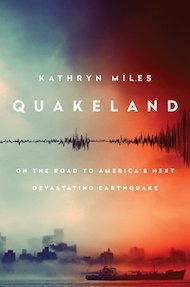
Quakeland: On the Road to America’s Next Devastating Earthquake: Revelation 6


Quakeland: On the Road to America’s Next Devastating Earthquake
Roger BilhamQuakeland: New York and the Sixth Seal (Revelation 6:12)
Given recent seismic activity — political as well as geological — it’s perhaps unsurprising that two books on earthquakes have arrived this season. One is as elegant as the score of a Beethoven symphony; the other resembles a diary of conversations overheard during a rock concert. Both are interesting, and both relate recent history to a shaky future.
Journalist Kathryn Miles’s Quakeland is a litany of bad things that happen when you provoke Earth to release its invisible but ubiquitous store of seismic-strain energy, either by removing fluids (oil, water, gas) or by adding them in copious quantities (when extracting shale gas in hydraulic fracturing, also known as fracking, or when injecting contaminated water or building reservoirs). To complete the picture, she describes at length the bad things that happen during unprovoked natural earthquakes. As its subtitle hints, the book takes the form of a road trip to visit seismic disasters both past and potential, and seismologists and earthquake engineers who have first-hand knowledge of them. Their colourful personalities, opinions and prejudices tell a story of scientific discovery and engineering remedy.
Miles poses some important societal questions. Aside from human intervention potentially triggering a really damaging earthquake, what is it actually like to live in neighbourhoods jolted daily by magnitude 1–3 earthquakes, or the occasional magnitude 5? Are these bumps in the night acceptable? And how can industries that perturb the highly stressed rocks beneath our feet deny obvious cause and effect? In 2015, the Oklahoma Geological Survey conceded that a quadrupling of the rate of magnitude-3 or more earthquakes in recent years, coinciding with a rise in fracking, was unlikely to represent a natural process. Miles does not take sides, but it’s difficult for the reader not to.
She visits New York City, marvelling at subway tunnels and unreinforced masonry almost certainly scheduled for destruction by the next moderate earthquake in the vicinity. She considers the perils of nuclear-waste storage in Nevada and Texas, and ponders the risks to Idaho miners of rock bursts — spontaneous fracture of the working face when the restraints of many million years of confinement are mined away. She contemplates the ups and downs of the Yellowstone Caldera — North America’s very own mid-continent supervolcano — and its magnificently uncertain future. Miles also touches on geothermal power plants in southern California’s Salton Sea and elsewhere; the vast US network of crumbling bridges, dams and oil-storage farms; and the magnitude 7–9 earthquakes that could hit California and the Cascadia coastline of Oregon and Washington state this century. Amid all this doom, a new elementary school on the coast near Westport, Washington, vulnerable to inbound tsunamis, is offered as a note of optimism. With foresight and much persuasion from its head teacher, it was engineered to become an elevated safe haven.
Miles briefly discusses earthquake prediction and the perils of getting it wrong (embarrassment in New Madrid, Missouri, where a quake was predicted but never materialized; prison in L’Aquila, Italy, where scientists failed to foresee a devastating seismic event) and the successes of early-warning systems, with which electronic alerts can be issued ahead of damaging seismic waves. Yes, it’s a lot to digest, but most of the book obeys the laws of physics, and it is a engaging read. One just can’t help wishing that Miles’s road trips had taken her somewhere that wasn’t a disaster waiting to happen.
Catastrophic damage in Anchorage, Alaska, in 1964, caused by the second-largest earthquake in the global instrumental record.
In The Great Quake, journalist Henry Fountain provides us with a forthright and timely reminder of the startling historical consequences of North America’s largest known earthquake, which more than half a century ago devastated southern Alaska. With its epicentre in Prince William Sound, the 1964 quake reached magnitude 9.2, the second largest in the global instrumental record. It released more energy than either the 2004 Sumatra–Andaman earthquake or the 2011 Tohoku earthquake off Japan; and it generated almost as many pages of scientific commentary and description as aftershocks. Yet it has been forgotten by many.
The quake was scientifically important because it occurred at a time when plate tectonics was in transition from hypothesis to theory. Fountain expertly traces the theory’s historical development, and how the Alaska earthquake was pivotal in nailing down one of the most important predictions. The earthquake caused a fjordland region larger than England to subside, and a similarly huge region of islands offshore to rise by many metres; but its scientific implications were not obvious at the time. Eminent seismologists thought that a vertical fault had slipped, drowning forests and coastlines to its north and raising beaches and islands to its south. But this kind of fault should have reached the surface, and extended deep into Earth’s mantle. There was no geological evidence of a monster surface fault separating these two regions, nor any evidence for excessively deep aftershocks. The landslides and liquefied soils that collapsed houses, and the tsunami that severely damaged ports and infrastructure, offered no clues to the cause.
“Previous earthquakes provide clear guidance about present-day vulnerability.” The hero of The Great Quake is the geologist George Plafker, who painstakingly mapped the height reached by barnacles lifted out of the intertidal zone along shorelines raised by the earthquake, and documented the depths of drowned forests. He deduced that the region of subsidence was the surface manifestation of previously compressed rocks springing apart, driving parts of Alaska up and southwards over the Pacific Plate. His finding confirmed a prediction of plate tectonics, that the leading edge of the Pacific Plate plunged beneath the southern edge of Alaska along a gently dipping thrust fault. That observation, once fully appreciated, was applauded by the geophysics community.
Fountain tells this story through the testimony of survivors, engineers and scientists, interweaving it with the fascinating history of Alaska, from early discovery by Europeans to purchase from Russia by the United States in 1867, and its recent development. Were the quake to occur now, it is not difficult to envisage that with increased infrastructure and larger populations, the death toll and price tag would be two orders of magnitude larger than the 139 fatalities and US$300-million economic cost recorded in 1964.
What is clear from these two books is that seismicity on the North American continent is guaranteed to deliver surprises, along with unprecedented economic and human losses. Previous earthquakes provide clear guidance about the present-day vulnerability of US infrastructure and populations. Engineers and seismologists know how to mitigate the effects of future earthquakes (and, in mid-continent, would advise against the reckless injection of waste fluids known to trigger earthquakes). It is merely a matter of persuading city planners and politicians that if they are tempted to ignore the certainty of the continent’s seismic past, they should err on the side of caution when considering its seismic future.

Saturday, April 11, 2026

New York Subways at the Sixth Seal (Revelation 6)

                     How vulnerable are NYC’s underwater subway tunnels to flooding?

Ashley Fetters
New York City is full of peculiar phenomena—rickety fire escapes; 100-year-old subway tunnelsair conditioners propped perilously into window frames—that can strike fear into the heart of even the toughest city denizen


ew York-specific fears, letting you know what you should actually worry about, and what anxieties you can simply let slip away.
The 25-minute subway commute from Crown Heights to the Financial District on the 2/3 line is, in my experience, a surprisingly peaceful start to the workday—save for one 3,100-foot stretch between the Clark Street and Wall Street stations, where for three minutes I sit wondering what the probability is that I will soon die a torturous, claustrophobic drowning death right here in this subway car.
The Clark Street Tunnel, opened in 1916, is one of approximately a dozen tunnels that escort MTA passengers from one borough to the next underwater—and just about all of them, with the exception of the 1989 addition of the 63rd Street F train tunnel, were constructed between 1900 and 1936.
Each day, thousands of New Yorkers venture across the East River and back again through these tubes buried deep in the riverbed, some of which are nearing or even past their 100th birthdays. Are they wrong to ponder their own mortality while picturing one of these watery catacombs suddenly springing a leak?
Mostly yes, they are, says Michael Horodniceanu, the former president of MTA Capital Construction and current principal of Urban Advisory Group. First, it’s important to remember that the subway tunnel is built under the riverbed, not just in the river—so what immediately surrounds the tunnel isn’t water but some 25 feet of soil. “There’s a lot of dirt on top of it,” Horodniceanu says. “It’s well into the bed of the bottom of the channel.”
And second, as Angus Kress Gillespie, author of Crossing Under the Hudson: The Story of the Holland and Lincoln Tunnels, points out, New York’s underwater subway tunnels are designed to withstand some leaking. And withstand it they do: Pumps placed below the floor of the tunnel, he says, are always running, always diverting water seepage into the sewers. (Horodniceanu says the amount of water these pumps divert into the sewer system each day numbers in the thousands of gallons.)
Additionally, MTA crews routinely repair the grouting and caulking, and often inject a substance into the walls that creates a waterproof membrane outside the tunnel—which keeps water out of the tunnel and relieves any water pressure acting on its walls. New tunnels, Horodniceanu points out, are even built with an outside waterproofing membrane that works like an umbrella: Water goes around it, it falls to the sides, and then it gets channeled into a pumping station and pumped out.
Of course, the classic New York nightmare scenario isn’t just a cute little trickle finding its way in. The anxiety daydream usually involves something sinister, or seismic. The good news, however, is that while an earthquake or explosion would indeed be bad for many reasons, it likely wouldn’t result in the frantic flooding horror scene that plays out in some commuters’ imaginations.
The Montague Tube, which sustained severe damage during Hurricane Sandy.
MTA New York City Transit / Marc A. Hermann
Horodniceanu assures me that tunnels built more recently are “built to withstand a seismic event.” The older tunnels, however—like, um, the Clark Street Tunnel—“were not seismically retrofitted, let me put it that way,” Horodniceanu says. “But the way they were built is in such a way that I do not believe an earthquake would affect them.” They aren’t deep enough in the ground, anyway, he says, to be too intensely affected by a seismic event. (The MTA did not respond to a request for comment.)
One of the only real threats to tunnel infrastructure, Horodniceanu adds, is extreme weather. Hurricane Sandy, for example, caused flooding in the tunnels, which “created problems with the infrastructure.” He continues, “The tunnels have to be rebuilt as a result of saltwater corroding the infrastructure.”
Still, he points out, hurricanes don’t exactly happen with no warning. So while Hurricane Sandy did cause major trauma to the tunnels, train traffic could be stopped with ample time to keep passengers out of harm’s way. In 2012, Governor Andrew Cuomo directed all the MTA’s mass transit services to shut down at 7 p.m. the night before Hurricane Sandy was expected to hit New York City.
And Gillespie, for his part, doubts even an explosion would result in sudden, dangerous flooding. A subway tunnel is not a closed system, he points out; it’s like a pipe that’s open at both ends. “The force of a blast would go forwards and backwards out the exit,” he says.
So the subway-train version of that terrifying Holland Tunnel flood scene in Sylvester Stallone’s Daylight is … unrealistic, right?
“Yeah,” Gillespie laughs. “Yeah. It is.”
Got a weird New York anxiety that you want explored? E-mail tips@curbed.com, and we may include it in a future column.

Here is the Sixth Seal Zone (Revelation 6:12)


April 13, 20204 Min Read
Let’s get able to (probably) rumble.
A report this week from the Los Angeles Instances took a have a look at what a devastating earthquake may do to Los Angeles — and the classes to be discovered from the calamitous 6.three magnitude quake in 2011 that every one however flattened Christchurch, New Zealand.
However whereas People are conscious of the San Andreas fault and the seismic exercise in California, which has wreaked havoc in San Francisco and Los Angeles, there are different, lesser-known fault traces in the United States that fly dangerously underneath the radar. These cracks in the crust have prompted appreciable harm in the previous — and scientists say will achieve this once more.
Virginia Seismic Zone
Richmond, VirginiaShutterstock
In 2011, New Yorkers had been jolted by a 5.eight magnitude earthquake that shook the East Coast from New Hampshire all the approach down by means of Chapel Hill, North Carolina. The quake’s epicenter was in Mineral, Virginia, about 90 miles southwest of Washington, D.C., and was so highly effective that Union Station, the Pentagon and the Capitol Constructing had been all evacuated.
The quake woke lots of people in the northeast as much as the Virginia Seismic Zone (VSZ) under the Mason Dixon — and the consequential results it may have on main cities alongside the East Coast. The final time the VSZ prompted a lot chaos was in 1867 when it launched an earthquake of 5.6-magnitude — the strongest in Virginia’s historical past.
Ramapo Fault Zone
Shutterstock
It’s not simply the Virginia Seismic Zone New Yorkers have to fret about. Nearer to house is the Ramapo Fault Zone, which stretches from New York by means of New Jersey to Pennsylvania and was most energetic tens of millions of years in the past throughout the formation of the Appalachian Mountains. It’s answerable for a number of of the fault traces that run by means of New York Metropolis, together with one underneath 125th Avenue. In line with a New York Publish report in 2017, “On common, the area has witnessed a reasonable quake (about a 5.zero on the Richter scale) each hundred years. The final one was in 1884. Seismologists say we will anticipate the subsequent one any day now.” Enjoyable occasions!
The New Madrid Seismic Zone
This 150 mile-long sequence of faults stretches underneath 5 states: Illinois, Missouri, Arkansas, Tennessee and Kentucky, and is answerable for 4 of the largest earthquakes in the historical past of the United States, which befell over three months from December 1811 and February 1812. The quakes had been so robust the mighty Mississippi River flowed backward for 3 days. Fortunately, the space was not as populated as it’s now, so the harm was restricted. Nonetheless, a FEMA report launched in 2008 warned {that a} quake now could be catastrophic and end in “the highest financial losses as a consequence of a pure catastrophe in the United States.”
The Northern Sangre de Cristo Fault
Downtown Trinidad, Colorado Shutterstock
In 2011, a magnitude 5.three quake hit Trinidad, Colorado, one other space that has seen little seismic exercise on such a big scale. In line with the Colorado Division of Homeland Safety and Emergency Administration, The Sangre de Cristo Fault, which lies at the base of the Sangre de Cristo Mountains alongside the japanese fringe of the San Luis Valley, and the Sawatch Fault, which runs alongside the japanese fringe of the Sawatch Vary, are “two of the most distinguished probably energetic faults in Colorado” and that “Seismologists predict that Colorado will once more expertise a magnitude 6.5 earthquake at some unknown level in the future.”
The Cascadia Subduction Zone
One in every of the most probably harmful fault traces lies north of California, stretching between Oregon and Washington. Main cities like Portland, Seattle and Vancouver lie alongside the Cascadia Subduction Zone, which scientists say has the functionality of a 9.zero or 10 magnitude earthquake — 16 occasions extra highly effective than the 1906 quake which ravaged San Francisco. A quake of this magnitude would have devastating penalties on infrastructure and will probably set off large tsunamis. The risk is so nice, the BBC even did a nifty video on the potential MegaQuake risk.

Friday, April 10, 2026

Why We Are In Trouble At The Sixth Seal (Revelation 6:12)


Dave Lochbaum
This is the second in a series of commentaries about the vital role nuclear safety inspections conducted by the Nuclear Regulatory Commission (NRC) play in protecting the public. The initial commentary described how NRC inspectors discovered that limits on the maximum allowable control room air temperature at the Columbia Generating Station in Washington had been improperly relaxed by the plant’s owner. This commentary describes a more recent finding by NRC inspectors about animproper safety assessment of a leaking cooling water system pipe on Entergy’s Unit 3 reactor at Indian Point outside New York City.
Indian Point Unit 3: Leak Before Break
On February 3, 2017, the NRC issued Indian Point a Green finding for a violation of Appendix B to 10 CFR Part 50. Specifically, the owner failed to perform an adequate operability review per its procedures after workers discovered water leaking from a service water system pipe.
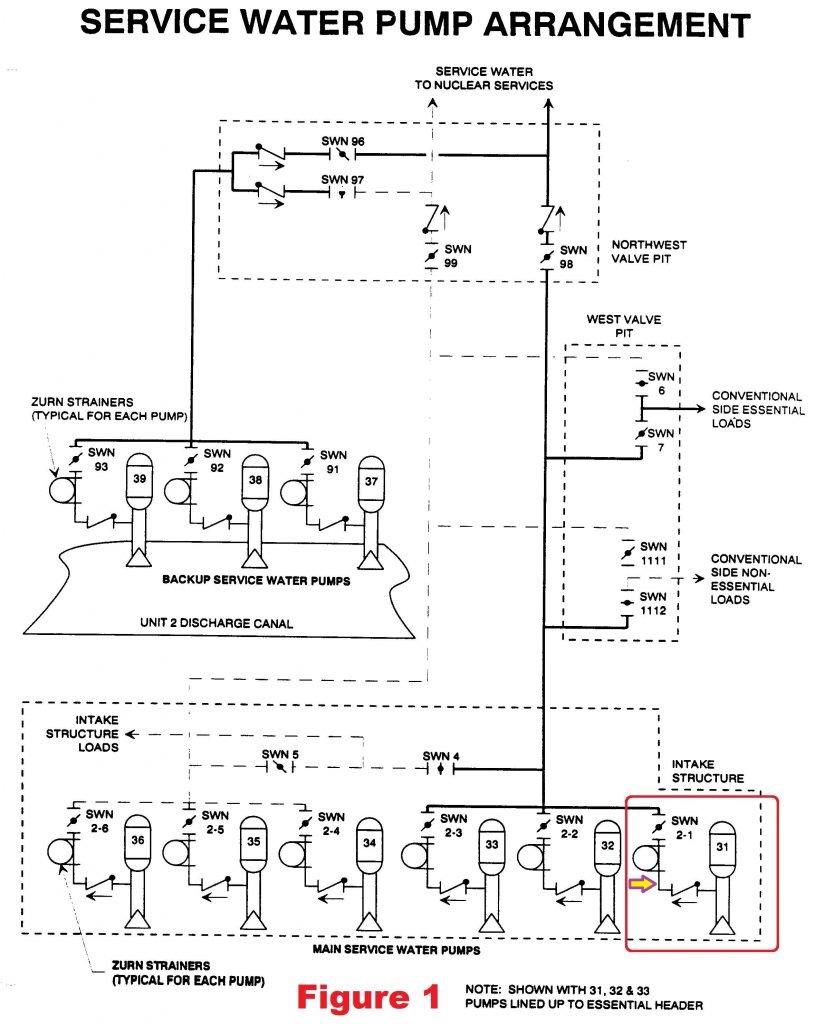
On April 27, 2016, workers found water leaking from the pipe downstream of the strainer for service water (SW) pump 31. As shown in Figure 1, SW pump 31 is one of six service water pumps located within the intake structure alongside the Hudson River. The six SW pumps are arranged in two sets of three pumps. Figure 1 shows SW pumps 31, 32, and 33 aligned to provide water drawn from the Hudson River to essential (i.e, safety and emergency) components within Unit 3. SW pumps 34, 35, and 36 are aligned to provide cooling water to non-essential equipment within Unit 3.
Fig. 1 (Source: Nuclear Regulatory Commission Plant Information Book) (click to enlarge)
Each SW pump is designed to deliver 6,000 gallons of flow. During normal operation, one SW pump can handle the essential loads while two SW pumps are needed for the non-essential loads. Under accident conditions, two SW pumps are needed to cool the essential equipment. The onsite emergency diesel generators can power either of the sets of three pumps, but not both simultaneously. If the set of SW pumps aligned to the essential equipment aren’t getting the job done, workers can open/close valves and electrical breakers to reconfigure the second set of three SW pumps to the essential equipment loops.
Because river water can have stuff in it that could clog some of the coolers for essential equipment, each SW pump has a strainer that attempts to remove as much debris as possible from the water. The leak discovered on April 27, 2016, was in the piping between the discharge check valve for SW pump 31 and its strainer. An arrow points to this piping section in Figure 1. The strainers were installed in openings called pits in the thick concrete floor of the intake structure. Water from the leaking pipe flowed into the pit housing the strainer for SW pump 31.
The initial leak rate was modest—estimated to be about one-eighth of a gallon per minute. The leak was similar to other pinhole leaks that had occurred in the concrete-lined, carbon steel SW pipes. The owner began daily checks on the leakage and prepared an operability determination. Basically, “operability determinations” are used within the nuclear industry when safety equipment is found to be impaired or degraded. The operability determination for the service water pipe leak concluded that the impairment did not prevent the SW pumps from fulfilling their required safety function. The operability determination relied on a sump pump located at the bottom of the strainer pit transferring the leaking water out of the pit before the water flooded and submerged safety components.
The daily checks instituted by the owner included workers recording the leak rate and assessing whether it had significantly increased. But the checks were against the previous day’s leak rate rather than the initial leak rate. By September 18, 2016, the leakage had steadily increased by a factor of 64 to 8 gallons per minute. But the daily incremental increases were small enough that they kept workers from finding the overall increase to be significant.
The daily check on October 15, 2016, found the pump room flooded to a depth of several inches. The leak rate was now estimated to be 20 gallons per minute. And the floor drain in the strainer pit was clogged (ironic, huh?) impairing the ability of its sump pump to remove the water. Workers placed temporary sump pumps in the room to remove the flood water and cope with the insignificantly higher leak rate. On October 17, workers installed a clamp on the pipe that reduced the leakage to less than one gallon per minute.
The operability determination was revised in response to concerns expressed by the NRC inspectors. The NRC inspectors were not satisfied by the revised operability determination. It continued to rely on the strainer pit sump pump removing the leaking water. But that sump pump was not powered from the emergency diesel generator and thus would not remove water should offsite power become unavailable. Step 5.6.4 of procedure EN-OP-14, “Operability Determination Process,” stated “If the Operability is based on the use or availability of other equipment, it must be verified that the equipment is capable of performing the function utilized in the evaluation.”
The operability determination explicitly stated that no compensatory measures or operator manual actions were needed to handle the leak, but the situation clearly required both compensatory measures and operator manual actions.
The NRC inspectors found additional deficiencies in the revised operability determination. The NRC inspectors calculated that a 20 gallon per minute leak rate coupled with an unavailable strainer pit sump pump would flood the room to a depth of three feet in three hours. There are no flood alarms in the room and the daily checks might not detect flooding until the level rose to three feet. At that level, water would submerge and potentially disable the vacuum breakers for the SW pumps. Proper vacuum breaker operation could be needed to successfully restart the SW pumps.
The NRC inspectors calculated that the 20 gallon per minute leak rate without remediation would flood the room to the level of the control cabinets for the strainers in 10 hours. The submerged control cabinets could disable the strainers, leading to blocked cooling water flow to essential equipment.
The NRC inspects calculated that the 20 gallon per minute leak rate without remediation would completely fill the room in about 29 hours, or only slightly longer than the daily check interval.
Flooding to depths of 3 feet, 10 feet, and the room’s ceiling affected all six SW pumps. Thus, the flooding represented a common mode threat that could disable the entire service water system. In turn, all safety equipment shown in Figure 2 no longer cooled by the disabled service water system could also be disabled. The NRC estimated that the flooding risk was about 5×10⁻⁶ per reactor year, solidly in the Green finding band.
Fig. 2 (Source: Nuclear Regulatory Commission Plant Information Book) (click to enlarge)
UCS Perspective
“Leak before break” is a longstanding nuclear safety philosophy. Books have been written about it (well, at least one report has been written and may even have been read.)  The NRC’s approval of a leak before break analysis can allow the owner of an existing nuclear power reactor to remove pipe whip restraints and jet impingement barriers. Such hardware guarded against the sudden rupture of a pipe filled with high pressure fluid from damaging safety equipment in the area. The leak before break analyses can provide the NRC with sufficient confidence that piping degradation will be detected by observed leakage with remedial actions taken before the pipe fails catastrophically. More than a decade ago, the NRC issued a Knowledge Management document on the leak before break philosophy and acceptable methods of analyzing, monitoring, and responding to piping degradation.
This incident at Indian Point illustrated an equally longstanding nuclear safety practice of “leak before break.” In this case, the leak was indeed followed by a break. But the break was not the failure of the piping but failure of the owner to comply with federal safety regulations. Pipe breaks are bad. Regulation breaks are bad. Deciding which is worse is like trying to decide which eye one wants to be poked in. None is far better than either.
As with the prior Columbia Generating Station case study, this Indian Point case study illustrates the vital role that NRC’s enforcement efforts plays in nuclear safety. Even after NRC inspectors voiced clear concerns about the improperly evaluated service water system pipe leak, Entergy failed to properly evaluate the situation, thus violating federal safety regulations. To be fair to Entergy, the company was probably doing its best, but in recent years, Entergy’s best has been far below nuclear industry average performance levels.
The NRC’s ROP is the public’s best protection against hazards caused by aging nuclear power reactors, shrinking maintenance budgets, emerging sabotage threats, and Entergy.Replacing the NRC’s engineering inspections with self-assessments by Entergy would lessen the effectiveness of that protective shield.
The NRC must continue to protect the public to the best of its ability. Delegating safety checks to owners like Entergy is inconsistent with that important mission.
Support from UCS members make work like this possible. Will you join us? Help UCS advance independent science for a healthy environment and a safer world.he Hudson River. The six SW pumps are arranged in two sets of three pumps. Figure 1 shows SW pumps 31, 32, and 33 aligned to provide water drawn from the Hudson River to essential (i.e, safety and emergency) components within Unit 3. SW pumps 34, 35, and 36 are aligned to provide cooling water to non-essential equipment within Unit 3. Fig. 1 (Source: Nuclear Regulatory Commission Plant Information Book) (click to enlarge) Each SW pump is designed to deliver 6,000 gallons of flow. During normal operation, one SW pump can handle the essential loads while two SW pumps are needed for the non-essential loads. Under accident conditions, two SW pumps are needed to cool the essential equipment. The onsite emergency diesel generators can power either of the sets of three pumps, but not both simultaneously. If the set of SW pumps aligned to the essential equipment aren’t getting the job done, workers can open/close valves and electrical breakers to reconfigure the second set of three SW pumps to the essential equipment loops. Because river water can have stuff in it that could clog some of the coolers for essential equipment, each SW pump has a strainer that attempts to remove as much debris as possible from the water. The leak discovered on April 27, 2016, was in the piping between the discharge check valve for SW pump 31 and its strainer. An arrow points to this piping section in Figure 1. The strainers were installed in openings called pits in the thick concrete floor of the intake structure. Water from the leaking pipe flowed into the pit housing the strainer for SW pump 31. The initial leak rate was modest—estimated to be about one-eighth of a gallon per minute. The leak was similar to other pinhole leaks that had occurred in the concrete-lined, carbon steel SW pipes. The owner began daily checks on the leakage and prepared an operability determination. Basically, “operability determinations” are used within the nuclear industry when safety equipment is found to be impaired or degraded. The operability determination for the service water pipe leak concluded that the impairment did not prevent the SW pumps from fulfilling their required safety function. The operability determination relied on a sump pump located at the bottom of the strainer pit transferring the leaking water out of the pit before the water flooded and submerged safety components. The daily checks instituted by the owner included workers recording the leak rate and assessing whether it had significantly increased. But the checks were against the previous day’s leak rate rather than the initial leak rate. By September 18, 2016, the leakage had steadily increased by a factor of 64 to 8 gallons per minute. But the daily incremental increases were small enough that they kept workers from finding the overall increase to be significant. The daily check on October 15, 2016, found the pump room flooded to a depth of several inches. The leak rate was now estimated to be 20 gallons per minute. And the floor drain in the strainer pit was clogged (ironic, huh?) impairing the ability of its sump pump to remove the water. Workers placed temporary sump pumps in the room to remove the flood water and cope with the insignificantly higher leak rate. On October 17, workers installed a clamp on the pipe that reduced the leakage to less than one gallon per minute. The operability determination was revised in response to concerns expressed by the NRC inspectors. The NRC inspectors were not satisfied by the revised operability determination. It continued to rely on the strainer pit sump pump removing the leaking water. But that sump pump was not powered from the emergency diesel generator and thus would not remove water should offsite power become unavailable. Step 5.6.4 of procedure EN-OP-14, “Operability Determination Process,” stated “If the Operability is based on the use or availability of other equipment, it must be verified that the equipment is capable of performing the function utilized in the evaluation.” The operability determination explicitly stated that no compensatory measures or operator manual actions were needed to handle the leak, but the situation clearly required both compensatory measures and operator manual actions. The NRC inspectors found additional deficiencies in the revised operability determination. The NRC inspectors calculated that a 20 gallon per minute leak rate coupled with an unavailable strainer pit sump pump would flood the room to a depth of three feet in three hours. There are no flood alarms in the room and the daily checks might not detect flooding until the level rose to three feet. At that level, water would submerge and potentially disable the vacuum breakers for the SW pumps. Proper vacuum breaker operation could be needed to successfully restart the SW pumps. The NRC inspectors calculated that the 20 gallon per minute leak rate without remediation would flood the room to the level of the control cabinets for the strainers in 10 hours. The submerged control cabinets could disable the strainers, leading to blocked cooling water flow to essential equipment. The NRC inspects calculated that the 20 gallon per minute leak rate without remediation would completely fill the room in about 29 hours, or only slightly longer than the daily check interval. Flooding to depths of 3 feet, 10 feet, and the room’s ceiling affected all six SW pumps. Thus, the flooding represented a common mode threat that could disable the entire service water system. In turn, all safety equipment shown in Figure 2 no longer cooled by the disabled service water system could also be disabled. The NRC estimated that the flooding risk was about 5×10⁻⁶ per reactor year, solidly in the Green finding band. Fig. 2 (Source: Nuclear Regulatory Commission Plant Information Book) (click to enlarge) UCS Perspective “Leak before break” is a longstanding nuclear safety philosophy. Books have been written about it (well, at least one report has been written and may even have been read.) The NRC’s approval of a leak before break analysis can allow the owner of an existing nuclear power reactor to remove pipe whip restraints and jet impingement barriers. Such hardware guarded against the sudden rupture of a pipe filled with high pressure fluid from damaging safety equipment in the area. The leak before break analyses can provide the NRC with sufficient confidence that piping degradation will be detected by observed leakage with remedial actions taken before the pipe fails catastrophically. More than a decade ago, the NRC issued a Knowledge Management document on the leak before break philosophy and acceptable methods of analyzing, monitoring, and responding to piping degradation. This incident at Indian Point illustrated an equally longstanding nuclear safety practice of “leak before break.” In this case, the leak was indeed followed by a break. But the break was not the failure of the piping but failure of the owner to comply with federal safety regulations. Pipe breaks are bad. Regulation breaks are bad. Deciding which is worse is like trying to decide which eye one wants to be poked in. None is far better than either. As with the prior Columbia Generating Station case study, this Indian Point case study illustrates the vital role that NRC’s enforcement efforts plays in nuclear safety. Even after NRC inspectors voiced clear concerns about the improperly evaluated service water system pipe leak, Entergy failed to properly evaluate the situation, thus violating federal safety regulations. To be fair to Entergy, the company was probably doing its best, but in recent years, Entergy’s best has been far below nuclear industry average performance levels. The NRC’s ROP is the public’s best protection against hazards caused by aging nuclear power reactors, shrinking maintenance budgets, emerging sabotage threats, and Entergy.Replacing the NRC’s engineering inspections with self-assessments by Entergy would lessen the effectiveness of that protective shield. The NRC must continue to protect the public to the best of its ability. Delegating safety checks to owners like Entergy is inconsistent with that important mission. Support from UCS members make work like this possible. Will you join us? Help UCS advance independent science for a healthy environment and a safer world.

History Warns New York Is The Sixth Seal (3/3/26)

 New York Earthquake 1884
Friday, 18 March 2011 – 9:23pm IST | Place: NEW YORK | Agency: ANI
If the past is any indication, New York can be hit by an earthquake, claims John Armbruster, a seismologist at Columbia University’s Lamont-Doherty Earth Observatory.
According to the New York Daily News, Lynn Skyes, lead author of a recent study by seismologists at the Lamont-Doherty Earth Observatory adds that a magnitude-6 quake hits the area about every 670 years, and magnitude-7 every 3,400 years.
A 5.2-magnitude quake shook New York City in 1737 and another of the same severity hit in 1884.
Tremors were felt from Maine to Virginia.
„The problem here comes from many subtle faults,“ explained Skyes after the study was published.
He adds: „We now see there is earthquake activity on them. Each one is small, but when you add them up, they are probably more dangerous than we thought.“
Armbruster says a 5.0-magnitude earthquake today likely would result in casualties and hundreds of millions of dollars in damage.
„I would expect some people to be killed,“ he notes.

Monday, April 6, 2026

We really are due for the sixth seal: Revelation 6:12


Opinion/Al Southwick: Could an earthquake really rock New England? We are 265 years overdue

On Nov. 8, a 3.6 magnitude earthquake struck Buzzard’s Bay off the coast of New Bedford. Reverberations were felt up to 100 miles away, across Massachusetts, Rhode Island, and parts of Connecticut and New York. News outlets scrambled to interview local residents who felt the ground shake their homes. Seismologists explained that New England earthquakes, while uncommon and usually minor, are by no means unheard of.

The last bad one we had took place on Nov. 18, 1755, a date long remembered.

It’s sometimes called the Boston Earthquake and sometimes the Cape Ann Earthquake. Its epicenter is thought to have been in the Atlantic Ocean about 25 miles east of Gloucester. Estimates say that it would have registered between 6.0 and 6.3 on the modern Richter scale. It was an occasion to remember as chronicled by John E. Ebel, director of the Weston observatory of Boston College:

“At about 4:30 in the morning on 18 November, 1755, a strong earthquake rocked the New England area. Observers reported damage to chimneys, brick buildings and stone walls in coastal communities from Portland, Maine to south of Boston … Chimneys were also damaged as far away as Springfield, Massachusetts, and New Haven, Connecticut. The earthquake was felt at Halifax, Nova Scotia to the northeast, Lake Champlain to the northwest, and Winyah, South Carolina to the southwest. The crew of a ship in deep water about 70 leagues east of Boston thought it had run aground and only realized it had felt an earthquake after it arrived at Boston later that same day.

“The 1755 earthquake rocked Boston, with the shaking lasting more than a minute. According to contemporary reports, as many as 1,500 chimneys were shattered or thrown down in part, the gable ends of about 15 brick buildings were broken out, and some church steeples ended up tilted due to the shaking. Falling chimney bricks created holes in the roofs of some houses. Some streets, particularly those on manmade ground along the water, were so covered with bricks and debris that passage by horse-drawn carriage was impossible. Many homes lost china and glassware that was thrown from shelves and shattered. A distiller’s cistern filled with liquor broke apart and lost its contents.”

We don’t have many details of the earthquake’s impact here, there being no newspaper in Worcester County at that time. We do know that one man, Christian Angel, working in a “silver” mine in Sterling, was buried alive when the ground shook. He is the only known fatality in these parts. We can assume that, if the quake shook down chimneys in Springfield and New Haven, it did even more damage hereabouts. We can imagine the cries of alarm and the feeling of panic as trees swayed violently, fields and meadows trembled underfoot and pottery fell off shelves and crashed below.

The Boston Earthquake was an aftershock from the gigantic Lisbon Earthquake that had leveled Lisbon, Portugal, a few days before. That cataclysm, estimated as an 8 or 9 on the modern Richter scale, was the most devastating natural catastrophe to hit western Europe since Roman times. The first shock struck on Nov. 1, at about 9 in the morning.

According to one account: ”Suddenly the city began to shudder violently, its tall medieval spires waving like a cornfield in the breeze … In the ancient cathedral, the Basilica de Santa Maria, the nave rocked and the massive chandeliers began swinging crazily. . . . Then came a second, even more powerful shock. And with it, the ornate façade of every great building in the square … broke away and cascaded forward.”

Until that moment, Lisbon had been one of the leading cities in western Europe, right up there with London and Paris. With 250,000 people, it was a center of culture, financial activity and exploration. Within minutes it was reduced to smoky, dusty rubble punctuated by human groans and screams. An estimated 60,000 to 100,000 lost their lives.

Since then, New England has been mildly shaken by quakes from time to time. One series of tremors on March 1, 1925, was felt throughout Worcester County, from Fitchburg to Worcester, and caused a lot of speculation.

What if another quake like that in 1755 hit New England today? What would happen? That question was studied 15 years ago by the Massachusetts Civil Defense Agency. Its report is sobering:

“The occurrence of a Richter magnitude 6.25 earthquake off Cape Ann, Massachusetts … would cause damage in the range of 2 to 10 billion dollars … in the Boston metropolitan area (within Route 128) due to ground shaking, with significant additional losses due to secondary effects such as soil liquefaction failures, fires and economic interruptions. Hundreds of deaths and thousands of major and minor injuries would be expected … Thousands of people could be displaced from their homes … Additional damage may also be experienced outside the 128 area, especially closer to the earthquake epicenter.”

So even if we don’t worry much about volcanoes, we know that hurricanes and tornadoes are always possible. As for earthquakes, they may not happen in this century or even in this millennium, but it is sobering to think that if the tectonic plates under Boston and Gloucester shift again, we could see a repeat of 1755.

The Main Cause of the Sixth Seal (Revelation 6:12)


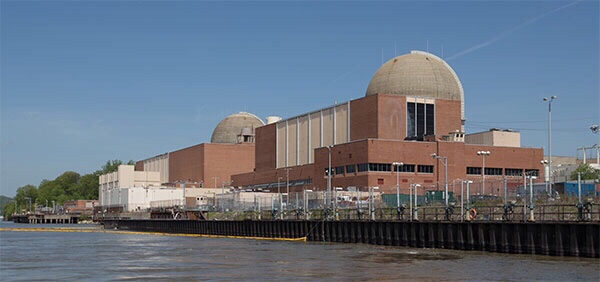
Nuclear power plant in Buchanan, New York
Indian Point Energy Center (IPEC) is a three-unit nuclear power plant station located in Buchanan, New York, just south of Peekskill. It sits on the east bank of the Hudson River, about 36 miles (58 km) north of Midtown Manhattan. The plant generates over 2,000 megawatts (MWe) of electrical power. For reference, the record peak energy consumption of New York City and Westchester County (the ConEdison Service Territory) was set during a seven-day heat wave on July 19, 2013, at 13,322 megawatts.[3] Electrical energy consumption varies greatly with time of day and season.[4]
Quick Facts: Country, Location …
The plant is owned and operated by Entergy Nuclear Northeast, a subsidiary of Entergy Corporation, and includes two operating Westinghouse pressurized water reactors—designated “Indian Point 2” and “Indian Point 3″—which Entergy bought from Consolidated Edison and the New York Power Authority respectively. The facility also contains the permanently shut-down Indian Point Unit 1 reactor. As of 2015, the number of permanent jobs at the Buchanan plant is approximately 1,000.
The original 40-year operating licenses for units 2 and 3 expired in September 2013 and December 2015, respectively. Entergy had applied for license extensions and the Nuclear Regulatory Commission (NRC) was moving toward granting a twenty-year extension for each reactor. However, after pressure from local environmental groups and New York governor Andrew Cuomo, it was announced that the plant is scheduled to be shut down by 2021.[5] Local groups had cited increasingly frequent issues with the aging units, ongoing environmental releases, and the proximity of the plant to New York City.[6]
Reactors
History and design
The reactors are built on land that originally housed the Indian Point Amusement Park, but was acquired by Consolidated Edison (ConEdison) on October 14, 1954.[7] Indian Point 1, built by ConEdison, was a 275-megawatt Babcock & Wilcox supplied [8] pressurized water reactor that was issued an operating license on March 26, 1962 and began operations on September 16, 1962.[9] The first core used a thorium-based fuel with stainless steel cladding, but this fuel did not live up to expectations for core life.[10] The plant was operated with uranium dioxide fuel for the remainder of its life. The reactor was shut down on October 31, 1974, because the emergency core cooling system did not meet regulatory requirements. All spent fuel was removed from the reactor vessel by January 1976, but the reactor still stands.[11] The licensee, Entergy, plans to decommission Unit 1 when Unit 2 is decommissioned.[12]
The two additional reactors, Indian Point 2 and 3, are four-loop Westinghouse pressurized water reactors both of similar design. Units 2 and 3 were completed in 1974 and 1976, respectively. Unit 2 has a generating capacity of 1,032 MW, and Unit 3 has a generating capacity of 1,051 MW. Both reactors use uranium dioxide fuel of no more than 4.8% U-235 enrichment. The reactors at Indian Point are protected by containment domes made of steel-reinforced concrete that is 40 inches thick, with a carbon steel liner.[13]
Nuclear capacity in New York state
Units 2 and 3 are two of six operating nuclear energy sources in New York State. New York is one of the five largest states in terms of nuclear capacity and generation, accounting for approximately 5% of the national totals. Indian Point provides 39% of the state’s nuclear capacity. Nuclear power produces 34.2% of the state’s electricity, higher than the U.S. average of 20.6%. In 2017, Indian Point generated approximately 10% of the state’s electricity needs, and 25% of the electricity used in New York City and Westchester County.[14] Its contract with Consolidated Edison is for just 560 megawatts. The New York Power Authority, which built Unit 3, stopped buying electricity from Indian Point in 2012. NYPA supplies the subways, airports, and public schools and housing in NYC and Westchester County. Entergy sells the rest of Indian Point’s output into the NYISO administered electric wholesale markets and elsewhere in New England.[15][16][17][18] In 2013, New York had the fourth highest average electricity prices in the United States. Half of New York’s power demand is in the New York City region; about two-fifths of generation originates there.[19][20]
Refueling
The currently operating Units 2 and 3 are each refueled on a two-year cycle. At the end of each fuel cycle, one unit is brought offline for refueling and maintenance activities. On March 2, 2015, Indian Point 3 was taken offline for 23 days to perform its refueling operations. Entergy invested $50 million in the refueling and other related projects for Unit 3, of which $30 million went to employee salaries. The unit was brought back online on March 25, 2015.[21]
Effects
Economic impact
A June 2015 report by a lobby group called Nuclear Energy Institute found that the operation of Indian Point generates $1.3 billion of annual economic output in local counties, $1.6 billion statewide, and $2.5 billion across the United States. In 2014, Entergy paid $30 million in state and local property taxes. The total tax revenue (direct and secondary) was nearly $340 million to local, state, and federal governments.[15] According to the Village of Buchanan budget for 2016–2017, a payment in lieu of taxes in the amount of $2.62 million was received in 2015-2016, and was projected to be $2.62 million in 2016–2017 – the majority of which can be assumed to come from the Indian Point Energy Center.[22]
Over the last decade, the station has maintained a capacity factor of greater than 93 percent. This is consistently higher than the nuclear industry average and than other forms of generation. The reliability helps offset the severe price volatility of other energy sources (e.g., natural gas) and the indeterminacy of renewable electricity sources (e.g., solar, wind).[15]
Indian Point directly employs about 1,000 full-time workers. This employment creates another 2,800 jobs in the five-county region, and 1,600 in other industries in New York, for a total of 5,400 in-state jobs. Additionally, another 5,300 indirect jobs are created out of state, creating a sum total of 10,700 jobs throughout the United States.[15]
Environmental concerns
Environmentalists have expressed concern about increased carbon emissions with the impending shutdown of Indian Point (generating electricity with nuclear energy creates no carbon emissions). A study undertaken by Environmental Progress found that closure of the plant would cause power emissions to jump 29% in New York, equivalent to the emissions from 1.4 million additional cars on New York roads.[23]
Some environmental groups have expressed concerns about the operation of Indian Point, including radiation pollution and endangerment of wildlife, but whether Indian Point has ever posed a significant danger to wildlife or the public remains controversial. Though anti-nuclear group Riverkeeper notes “Radioactive leakage from the plant containing several radioactive isotopes, such as strontium-90, cesium-137, cobalt-60, nickel-63 and tritium, a rarely-occurring isotope of hydrogen, has flowed into groundwater that eventually enters the Hudson River in the past[24], there is no evidence radiation from the plant has ever posed a significant hazard to local residents or wildlife. In the last year[when?], nine tritium leaks have occurred, however, even at their highest levels the leaks have never exceeded one-tenth of one percent of US Nuclear Regulatory Commission limits.
In February 2016, New York State Governor Andrew Cuomo called for a full investigation by state environment[25] and health officials and is partnering with organizations like Sierra Club, Riverkeepers, Hudson River Sloop Clearwater, Indian Point Safe Energy Coalition, Scenic Hudson and Physicians for Social Responsibility in seeking the permanent closure of the plant.[citation needed] However, Cuomo’s motivation for closing the plant was called into question after it was revealed two top former aides, under federal prosecution for influence-peddling, had lobbied on behalf of natural gas company Competitive Power Ventures (CPV) to kill Indian Point. In his indictment, US attorney Preet Bharara wrote “the importance of the plant [CPV’s proposed Valley Energy Center, a plant powered by natural gas] to the State depended at least in part, on whether [Indian Point] was going to be shut down.”[26]
In April 2016 climate scientist James Hansen took issue with calls to shut the plant down, including those from presidential candidate Bernie Sanders. “The last few weeks have seen an orchestrated campaign to mislead the people of New York about the essential safety and importance of Indian Point nuclear plant to address climate change,” wrote Hansen, adding “Sanders has offered no evidence that NRC [U.S. Nuclear Regulatory Commission] has failed to do its job, and he has no expertise in over-riding NRC’s judgement. For the sake of future generations who could be harmed by irreversible climate change, I urge New Yorkers to reject this fear mongering and uphold science against ideology.”[27]
Indian Point removes water from the nearby Hudson River. Despite the use of fish screens, the cooling system kills over a billion fish eggs and larvae annually.[28] According to one NRC report from 2010, as few as 38% of alewives survive the screens.[29] On September 14, 2015, a state hearing began in regards to the deaths of fish in the river, and possibly implementing a shutdown period from May to August. An Indian Point spokesman stated that such a period would be unnecessary, as Indian Point “is fully protective of life in the Hudson River and $75 million has been spent over the last 30 years on scientific studies demonstrating that the plant has no harmful impact to adult fish.” The hearings lasted three weeks.[30] Concerns were also raised over the planned building of new cooling towers, which would cut down forest land that is suspected to be used as breeding ground by muskrat and mink. At the time of the report, no minks or muskrats were spotted there.[29]
Safety
Indian Point Energy Center has been given an incredible amount of scrutiny from the media and politicians and is regulated more heavily than various other power plants in the state of New York (i.e., by the NRC in addition to FERC, the NYSPSC, the NYISO, the NYSDEC, and the EPA). On a forced outage basis – incidents related to electrical equipment failure that force a plant stoppage – it provides a much more reliable operating history than most other power plants in New York.[31][32] Beginning at the end of 2015, Governor Cuomo began to ramp up political action against the Indian Point facility, opening an investigation with the state public utility commission, the department of health, and the department of environmental conservation.[33][34][35][30][36][37] To put the public service commission investigation in perspective: most electric outage investigations conducted by the commission are in response to outages with a known number of affected retail electric customers.[38] By November 17, 2017, the NYISO accepted Indian Point’s retirement notice.[39]
In 1997, Indian Point Unit 3 was removed from the NRC’s list of plants that receive increased attention from the regulator. An engineer for the NRC noted that the plant had been experiencing increasingly fewer problems during inspections.[40] On March 10, 2009 the Indian Point Power Plant was awarded the fifth consecutive top safety rating for annual operations by the Federal regulators. According to the Hudson Valley Journal News, the plant had shown substantial improvement in its safety culture in the previous two years.[41] A 2003 report commissioned by then-Governor George Pataki concluded that the “current radiological response system and capabilities are not adequate to…protect the people from an unacceptable dose of radiation in the event of a release from Indian Point”.[42] More recently, in December 2012 Entergy commissioned a 400-page report on the estimates of evacuation times. This report, performed by emergency planning company KLD Engineering, concluded that the existing traffic management plans provided by Orange, Putnam, Rockland, and Westchester Counties are adequate and require no changes.[43] According to one list that ranks U.S. nuclear power plants by their likelihood of having a major natural disaster related incident, Indian Point is the most likely to be hit by a natural disaster, mainly an earthquake.[44][45][46][47] Despite this, the owners of the plant still say that safety is a selling point for the nuclear power plant.[48]
▪ In 1973, five months after Indian Point 2 opened, the plant was shut down when engineers discovered buckling in the steel liner of the concrete dome in which the nuclear reactor is housed.[49]
▪ On October 17, 1980,[50] 100,000 gallons of Hudson River water leaked into the Indian Point 2 containment building from the fan cooling unit, undetected by a safety device designed to detect hot water. The flooding, covering the first nine feet of the reactor vessel, was discovered when technicians entered the building. Two pumps that should have removed the water were found to be inoperative. NRC proposed a $2,100,000 fine for the incident.
▪ In February 2000, Unit 2 experienced a Steam Generator Tube Rupture (SGTR), which allowed primary water to leak into the secondary system through one of the steam generators.[51] All four steam generators were subsequently replaced.[citation needed]
▪ In 2005, Entergy workers while digging discovered a small leak in a spent fuel pool. Water containing tritium and strontium-90 was leaking through a crack in the pool building and then finding its way into the nearby Hudson River. Workers were able to keep the spent fuel rods safely covered despite the leak.[52] On March 22, 2006 The New York Times also reported finding radioactive nickel-63 and strontium in groundwater on site.[53]
▪ In 2007, a transformer at Unit 3 caught fire, and the Nuclear Regulatory Commission raised its level of inspections, because the plant had experienced many unplanned shutdowns. According to The New York Times, Indian Point “has a history of transformer problems”.[54]
▪ On April 23, 2007, the Nuclear Regulatory Commission fined the owner of the Indian Point nuclear plant $130,000 for failing to meet a deadline for a new emergency siren plan. The 150 sirens at the plant are meant to alert residents within 10 miles to a plant emergency.[55]
▪ On January 7, 2010, NRC inspectors reported that an estimated 600,000 gallons of mildly radioactive steam was intentionally vented to the atmosphere after an automatic shutdown of Unit 2. After the vent, one of the vent valves unintentionally remained slightly open for two days. The levels of tritium in the steam were within the allowable safety limits defined in NRC standards.[56]
▪ On November 7, 2010, an explosion occurred in a main transformer for Indian Point 2, spilling oil into the Hudson River.[57] Entergy later agreed to pay a $1.2 million penalty for the transformer explosion.[54]
▪ July 2013, a former supervisor, who worked at the Indian Point nuclear power plant for twenty-nine years, was arrested for falsifying the amount of particulate in the diesel fuel for the plant’s backup generators.[58]
▪ On May 9, 2015, a transformer failed at Indian Point 3, causing the automated shutdown of reactor 3. A fire that resulted from the failure was extinguished, and the reactor was placed in a safe and stable condition.[59] The failed transformer contained about 24,000 gallons of dielectric fluid, which is used as an insulator and coolant when the transformer is energized. The U.S. Coast Guard estimates that about 3,000 gallons of dielectric fluid entered the river following the failure.[60]
▪ In June 2015, a mylar balloon floated into a switchyard, causing an electrical problem resulting in the shutdown of Reactor 3.[61]
▪ In July 2015, Reactor 3 was shut down after a water pump failure.[citation needed]
▪ On December 5, 2015, Indian Point 2 was shut down after several control rods lost power.[62]
▪ On February 6, 2016, Governor Andrew Cuomo informed the public that radioactive tritium-contaminated water leaked into the groundwater at the Indian Point Nuclear facility.[25]
Spent fuel
Indian Point stores used fuel rods in two spent fuel pools at the facility.[52] The spent fuel pools at Indian Point are not stored under a containment dome like the reactor, but rather they are contained within an indoor 40-foot-deep pool and submerged under 27 feet of water. Water is a natural and effective barrier to radiation. The spent fuel pools at Indian Point are set in bedrock and are constructed of concrete walls that are four to six feet wide, with a quarter-inch thick stainless steel inner liner. The pools each have multiple redundant backup cooling systems.[52][63]
Indian Point began dry cask storage of spent fuel rods in 2008, which is a safe and environmentally sound option according to the Nuclear Regulatory Commission.[64] Some rods have already been moved to casks from the spent fuel pools. The pools will be kept nearly full of spent fuel, leaving enough space to allow emptying the reactor completely.[65] Dry cask storage systems are designed to resist floods, tornadoes, projectiles, temperature extremes, and other unusual scenarios. The NRC requires the spent fuel to be cooled and stored in the spent fuel pool for at least five years before being transferred to dry casks.[66]
Earthquake risk
In 2008, researchers from Columbia University’s Lamont-Doherty Earth Observatory located a previously unknown active seismic zone running from Stamford, Connecticut, to the Hudson Valley town of Peekskill, New York—the intersection of the Stamford-Peekskill line with the well-known Ramapo Fault—which passes less than a mile north of the Indian Point nuclear power plant.[67] The Ramapo Fault is the longest fault in the Northeast, but scientists dispute how active this roughly 200-million-year-old fault really is. Many earthquakes in the state’s surprisingly varied seismic history are believed to have occurred on or near it. Visible at ground level, the fault line likely extends as deep as nine miles below the surface.[68]
In July 2013, Entergy engineers reassessed the risk of seismic damage to Unit 3 and submitted their findings in a report to the NRC. It was found that risk leading to reactor core damage is 1 in 106,000 reactor years using U.S. Geological Survey data; and 1 in 141,000 reactor years using Electric Power Research Institute data. Unit 3’s previous owner, the New York Power Authority, had conducted a more limited analysis in the 1990s than Unit 2’s previous owner, Con Edison, leading to the impression that Unit 3 had fewer seismic protections than Unit 2. Neither submission of data from the previous owners was incorrect.[69]
According to a company spokesman, Indian Point was built to withstand an earthquake of 6.1 on the Richter scale.[70] Entergy executives have also noted “that Indian Point had been designed to withstand an earthquake much stronger than any on record in the region, though not one as powerful as the quake that rocked Japan.”[71]
The Nuclear Regulatory Commission’s estimate of the risk each year of an earthquake intense enough to cause core damage to the reactor at Indian Point was Reactor 2: 1 in 30,303; Reactor 3: 1 in 10,000, according to an NRC study published in August 2010. Msnbc.com reported based on the NRC data that “Indian Point nuclear reactor No. 3 has the highest risk of earthquake damage in the country, according to new NRC risk estimates provided to msnbc.com.” According to the report, the reason is that plants in known earthquake zones like California were designed to be more quake-resistant than those in less affected areas like New York.[72][73] The NRC did not dispute the numbers but responded in a release that “The NRC results to date should not be interpreted as definitive estimates of seismic risk,” because the NRC does not rank plants by seismic risk.[74]
IPEC Units 2 and 3 both operated at 100% full power before, during, and after the Virginia earthquake on August 23, 2011. A thorough inspection of both units by plant personnel immediately following this event verified no significant damage occurred at either unit.
Emergency planning
The Nuclear Regulatory Commission defines two emergency planning zones around nuclear power plants: a plume exposure pathway zone with a radius of 10 miles (16 km), concerned primarily with exposure to, and inhalation of, airborne radioactive contamination, and an ingestion pathway zone of about 50 miles (80 km), concerned primarily with ingestion of food and liquid contaminated by radioactivity.[75]
According to an analysis of U.S. Census data for MSNBC, the 2010 U.S. population within 10 miles (16 km) of Indian Point was 272,539, an increase of 17.6 percent during the previous ten years. The 2010 U.S. population within 50 miles (80 km) was 17,220,895, an increase of 5.1 percent since 2000. Cities within 50 miles include New York (41 miles to city center); Bridgeport, Conn. (40 miles); Newark, N.J. (39 miles); and Stamford, Conn. (24 miles).[76]
In the wake of the 2011 Fukushima incident in Japan, the State Department recommended that any Americans in Japan stay beyond fifty miles from the area.[citation needed] Columnist Peter Applebome, writing in The New York Times, noted that such an area around Indian Point would include “almost all of New York City except for Staten Island; almost all of Nassau County and much of Suffolk County; all of Bergen County, N.J.; all of Fairfield, Conn.” He quotes Purdue University professor Daniel Aldrich as saying “Many scholars have already argued that any evacuation plans shouldn’t be called plans, but rather “fantasy documents””.[42]
The current 10-mile plume-exposure pathway Emergency Planning Zone (EPZ) is one of two EPZs intended to facilitate a strategy for protective action during an emergency and comply with NRC regulations. “The exact size and shape of each EPZ is a result of detailed planning which includes consideration of the specific conditions at each site, unique geographical features of the area, and demographic information. This preplanned strategy for an EPZ provides a substantial basis to support activity beyond the planning zone in the extremely unlikely event it would be needed.”[77]
In an interview, Entergy executives said they doubt that the evacuation zone would be expanded to reach as far as New York City.[71]
Indian Point is protected by federal, state, and local law enforcement agencies, including a National Guard base within a mile of the facility, as well as by private off-site security forces.[78]
During the September 11 attacks, American Airlines Flight 11 flew near the Indian Point Energy Center en route to the World Trade Center. Mohamed Atta, one of the 9/11 hijackers/plotters, had considered nuclear facilities for targeting in a terrorist attack.[79] Entergy says it is prepared for a terrorist attack, and asserts that a large airliner crash into the containment building would not cause reactor damage.[80] Following 9/11 the NRC required operators of nuclear facilities in the U.S. to examine the effects of terrorist events and provide planned responses.[81] In September 2006, the Indian Point Security Department successfully completed mock assault exercises required by the Nuclear Regulatory Commission.[citation needed] However, according to environmental group Riverkeeper, these NRC exercises are inadequate because they do not envision a sufficiently large group of attackers.[citation needed]
According to The New York Times, fuel stored in dry casks is less vulnerable to terrorist attack than fuel in the storage pools.[65]
Recertification
Units 2 and 3 were both originally licensed by the NRC for 40 years of operation. The NRC limits commercial power reactor licenses to an initial 40 years, but also permits such licenses to be renewed. This original 40-year term for reactor licenses was based on economic and antitrust considerations, not on limitations of nuclear technology. Due to this selected period, however, some structures and components may have been engineered on the basis of an expected 40-year service life.[82] The original federal license for Unit Two expired on September 28, 2013,[83][84] and the license for Unit Three was due to expire in December 2015.[85] On April 30, 2007, Entergy submitted an application for a 20-year renewal of the licenses for both units. On May 2, 2007, the NRC announced that this application is available for public review.[86] Because the owner submitted license renewal applications at least five years prior to the original expiration date, the units are allowed to continue operation past this date while the NRC considers the renewal application.
On September 23, 2007, the antinuclear group Friends United for Sustainable Energy (FUSE) filed legal papers with the NRC opposing the relicensing of the Indian Point 2 reactor. The group contended that the NRC improperly held Indian Point to less stringent design requirements. The NRC responded that the newer requirements were put in place after the plant was complete.[87]
On December 1, 2007, Westchester County Executive Andrew J. Spano, New York Attorney General Andrew Cuomo, and New York Governor Eliot Spitzer called a press conference with the participation of environmental advocacy groups Clearwater and Riverkeeper to announce their united opposition to the re-licensing of the Indian Point nuclear power plants. The New York State Department of Environmental Conservation and the Office of the Attorney General requested a hearing as part of the process put forth by the Nuclear Regulatory Commission.[citation needed] In September 2007 The New York Times reported on the rigorous legal opposition Entergy faces in its request for a 20-year licensing extension for Indian Point Nuclear Reactor 2.[87]
A water quality certificate is a prerequisite for a twenty-year renewal by the NRC.[citation needed] On April 3, 2010, the New York State Department of Environmental Conservation ruled that Indian Point violates the federal Clean Water Act,[88] because “the power plant’s water-intake system kills nearly a billion aquatic organisms a year, including the shortnose sturgeon, an endangered species.”[citation needed] The state is demanding that Entergy constructs new closed-cycle cooling towers at a cost of over $1 billion, a decision that will effectively close the plant for nearly a year. Regulators denied Entergy’s request to install fish screens that they said would improve fish mortality more than new cooling towers. Anti-nuclear groups and environmentalists have in the past tried to close the plant,[citation needed] which is in a more densely populated area than any of the 66 other nuclear plant sites in the US.[citation needed] Opposition to the plant[from whom?] increased after the September 2001 terror attacks,[citation needed] when one of the hijacked jets flew close to the plant on its way to the World Trade Center.[citation needed] Public worries also increased after the 2011 Japanese Fukushima Daiichi nuclear disaster and after a report highlighting the Indian Point plant’s proximity to the Ramapo Fault.[citation needed]
Advocates of recertifying Indian Point include former New York City mayors Michael Bloomberg and Rudolph W. Giuliani. Bloomberg says that “Indian Point is critical to the city’s economic viability”.[89] The New York Independent System Operator maintains that in the absence of Indian Point, grid voltages would degrade, which would limit the ability to transfer power from upstate New York resources through the Hudson Valley to New York City.[90]
As the current governor, Andrew Cuomo continues to call for closure of Indian Point.[91] In late June 2011, a Cuomo advisor in a meeting with Entergy executives informed them for the first time directly of the Governor’s intention to close the plant, while the legislature approved a bill to streamline the process of siting replacement plants.[92]
Nuclear energy industry figures and analysts responded to Cuomo’s initiative by questioning whether replacement electrical plants could be certified and built rapidly enough to replace Indian Point, given New York state’s “cumbersome regulation process”, and also noted that replacement power from out of state sources will be hard to obtain because New York has weak ties to generation capacity in other states.[citation needed] They said that possible consequences of closure will be a sharp increase in the cost of electricity for downstate users and even “rotating black-outs”.[93]
Several members of the House of Representatives representing districts near the plant have also opposed recertification, including Democrats Nita Lowey, Maurice Hinchey, and Eliot Engel and then Republican member Sue Kelly.[94]
In November 2016 the New York Court of Appeals ruled that the application to renew the NRC operating licences must be reviewed against the state’s coastal management program, which The New York State Department of State had already decided was inconsistent with coastal management requirements. Entergy has filed a lawsuit regarding the validity of Department of State’s decision.[95]
Closure
Beginning at the end of 2015, Governor Cuomo began to ramp up political action against the Indian Point facility, opening investigations with the state public utility commission, the department of health and the department of environmental conservation.[33][34][35][30][36][37] To put the public service commission investigation in perspective, most electric outage investigations conducted by the commission are in response to outages with a known number of affected retail electric customers.[38] By November 17, 2017, the NYISO accepted Indian Point’s retirement notice.[39]
In January 2017, the governor’s office announced closure by 2020-21.[96] The closure, along with pollution control, challenges New York’s ability to be supplied.[citation needed] Among the solution proposals are storage, renewables (solar and wind), a new transmission cables from Canada [97][98] and a 650MW natural gas plant located in Wawayanda, New York.[99] There was also a 1,000 MW merchant HVDC transmission line proposed in 2013 to the public service commission that would have interconnected at Athens, New York and Buchanan, New York, however this project was indefinitely stalled when its proposed southern converter station site was bought by the Town of Cortlandt in a land auction administered by Con Edison.[100][101][102] As of October 1, 2018, the 650 MW plant built in Wawayanda, New York, by CPV Valley, is operating commercially.[103] The CPV Valley plant has been associated with Governor Cuomo’s close aid, Joe Percoco, and the associated corruption trial.[104] Another plant being built, Cricket Valley Energy Center, rated at 1,100 MW, is on schedule to provide energy by 2020 in Dover, New York.[105] An Indian Point contingency plan, initiated in 2012 by the NYSPSC under the administration of Cuomo, solicited energy solutions from which a Transmission Owner Transmission Solutions (TOTS) plan was selected. The TOTS projects provide 450 MW[106] of additional transfer capability across a NYISO defined electric transmission corridor in the form of three projects: series compensation at a station in Marcy, New York, reconductoring a transmission line, adding an additional transmission line, and “unbottling” Staten Island capacity. These projects, with the exception of part of the Staten Island “unbottling” were in service by mid-2016. The cost of the TOTS projects are distributed among various utilities in their rate cases before the public service commission and the cost allocation amongst themselves was approved by FERC. NYPA and LIPA are also receiving a portion. The cost of the TOTS projects has been estimated in the range of $27 million to $228 million.[107][108][109][110][111] An energy highway initiative was also prompted by this order (generally speaking, additional lines on the Edic-Pleasant Valley and the Oakdale-Fraser transmission corridors) which is still going through the regulatory process in both the NYISO and NYSPSC.

Under the current plan, one reactor is scheduled to be shut down in April 2020 and the second by April 2021.[112] A report by the New York Building Congress, a construction industry association, has said that NYC will need additional natural gas pipelines to accommodate the city’s increasing demand for energy. Environmentalists have argued that the power provided by Indian point can be replaced by renewable energy, combined with conservation measures and improvements to the efficiency of the electrical grid.[113]