Wednesday, August 27, 2025

The Sixth Seal Will be in New York (Revelation 6:12)


By Simon Worrall
PUBLISHED AUGUST 26, 2017
Half a million earthquakes occur worldwide each year, according to an estimate by the U.S. Geological Survey (USGS). Most are too small to rattle your teacup. But some, like the 2011 quake off the coast of Japan or last year’s disaster in Italy, can level high-rise buildings, knock out power, water and communications, and leave a lifelong legacy of trauma for those unlucky enough to be caught in them.
In the U.S., the focus is on California’s San Andreas fault, which geologists suggest has a nearly one-in-five chance of causing a major earthquake in the next three decades. But it’s not just the faults we know about that should concern us, says Kathryn Miles, author of Quakeland: On the Road to America’s Next Devastating Earthquake. As she explained when National Geographic caught up with her at her home in Portland, Maine, there’s a much larger number of faults we don’t know about—and fracking is only adding to the risks.
When it comes to earthquakes, there is really only one question everyone wants to know: When will the big one hit California?
That’s the question seismologists wish they could answer, too! One of the most shocking and surprising things for me is just how little is actually known about this natural phenomenon. The geophysicists, seismologists, aThe Sixth Seal Will be in New York (Revelation 6:12)nd emergency managers that I spoke with are the first to say, “We just don’t know!”
What we can say is that it is relatively certain that a major earthquake will happen in California in our lifetime. We don’t know where or when. An earthquake happening east of San Diego out in the desert is going to have hugely different effects than that same earthquake happening in, say, Los Angeles. They’re both possible, both likely, but we just don’t know.
One of the things that’s important to understand about San Andreas is that it’s a fault zone. As laypeople we tend to think about it as this single crack that runs through California and if it cracks enough it’s going to dump the state into the ocean. But that’s not what’s happening here. San Andreas is a huge fault zone, which goes through very different types of geological features. As a result, very different types of earthquakes can happen in different places.
As Charles Richter, inventor of the Richter Scale, famously said, “Only fools, liars and charlatans predict earthquakes.” Why are earthquakes so hard to predict? After all, we have sent rockets into space and plumbed the depths of the ocean.
You’re right: We know far more about distant galaxies than we do about the inner workings of our planet. The problem is that seismologists can’t study an earthquake because they don’t know when or where it’s going to happen. It could happen six miles underground or six miles under the ocean, in which case they can’t even witness it. They can go back and do forensic, post-mortem work. But we still don’t know where most faults lie. We only know where a fault is after an earthquake has occurred. If you look at the last 100 years of major earthquakes in the U.S., they’ve all happened on faults we didn’t even know existed.
Earthquakes 101
Earthquakes are unpredictable and can strike with enough force to bring buildings down. Find out what causes earthquakes, why they’re so deadly, and what’s being done to help buildings sustain their hits.
Fracking is a relatively new industry. Many people believe that it can cause what are known as induced earthquakes. What’s the scientific consensus?
The scientific consensus is that a practice known as wastewater injection undeniably causes earthquakes when the geological features are conducive. In the fracking process, water and lubricants are injected into the earth to split open the rock, so oil and natural gas can be retrieved. As this happens, wastewater is also retrieved and brought back to the surface.
You Might Also Like
Different states deal with this in different ways. Some states, like Pennsylvania, favor letting the wastewater settle in aboveground pools, which can cause run-off contamination of drinking supplies. Other states, like Oklahoma, have chosen to re-inject the water into the ground. And what we’re seeing in Oklahoma is that this injection is enough to shift the pressure inside the earth’s core, so that daily earthquakes are happening in communities like Stillwater. As our technology improves, and both our ability and need to extract more resources from the earth increases, our risk of causing earthquakes will also rise exponentially.
After Fukushima, the idea of storing nuclear waste underground cannot be guaranteed to be safe. Yet President Trump has recently green-lighted new funds for the Yucca Mountain site in Nevada. Is that wise?
The issue with Fukushima was not about underground nuclear storage but it is relevant. The Tohoku earthquake, off the coast of Japan, was a massive, 9.0 earthquake—so big that it shifted the axis of the earth and moved the entire island of Japan some eight centimeters! It also created a series of tsunamis, which swamped the Fukushima nuclear power plant to a degree the designers did not believe was possible.
Here in the U.S., we have nuclear plants that are also potentially vulnerable to earthquakes and tsunamis, above all on the East Coast, like Pilgrim Nuclear, south of Boston, or Indian Point, north of New York City. Both of these have been deemed by the USGS to have an unacceptable level of seismic risk. [Both are scheduled to close in the next few years.]
Yucca Mountain is meant to address our need to store the huge amounts of nuclear waste that have been accumulating for more than 40 years. Problem number one is getting it out of these plants. We are going to have to somehow truck or train these spent fuel rods from, say, Boston, to a place like Yucca Mountain, in Nevada. On the way it will have to go through multiple earthquake zones, including New Madrid, which is widely considered to be one of the country’s most dangerous earthquake zones.
Yucca Mountain itself has had seismic activity. Ultimately, there’s no great place to put nuclear waste—and there’s no guarantee that where we do put it is going to be safe.
The psychological and emotional effects of an earthquake are especially harrowing. Why is that?
This is a fascinating and newly emerging subfield within psychology, which looks at the effects of natural disasters on both our individual and collective psyches. Whenever you experience significant trauma, you’re going to see a huge increase in PTSD, anxiety, depression, suicide, and even violent behaviors.
What seems to make earthquakes particularly pernicious is the surprise factor. A tornado will usually give people a few minutes, if not longer, to prepare; same thing with hurricanes. But that doesn’t happen with an earthquake. There is nothing but profound surprise. And the idea that the bedrock we walk and sleep upon can somehow become liquid and mobile seems to be really difficult for us to get our heads around.
Psychologists think that there are two things happening. One is a PTSD-type loop where our brain replays the trauma again and again, manifesting itself in dreams or panic attacks during the day. But there also appears to be a physiological effect as well as a psychological one. If your readers have ever been at sea for some time and then get off the ship and try to walk on dry land, they know they will look like drunkards. [Laughs] The reason for this is that the inner ear has habituated itself to the motion of the ship. We think the inner ear does something similar in the case of earthquakes, in an attempt to make sense of this strange, jarring movement.
After the Abruzzo quake in Italy, seven seismologists were actually tried and sentenced to six years in jail for failing to predict the disaster. Wouldn’t a similar threat help improve the prediction skills of American seismologists?
[Laughs] The scientific community was uniform in denouncing that action by the Italian government because, right now, earthquakes are impossible to predict. But the question of culpability is an important one. To what degree do we want to hold anyone responsible? Do we want to hold the local meteorologist responsible if he gets the weather forecast wrong? [Laughs]
What scientists say—and I don’t think this is a dodge on their parts—is, “Predicting earthquakes is the Holy Grail; it’s not going to happen in our lifetime. It may never happen.” What we can do is work on early warning systems, where we can at least give people 30 or 90 seconds to make a few quick decisive moves that could well save your life. We have failed to do that. But Mexico has had one in place for years!
There is some evidence that animals can predict earthquakes. Is there any truth to these theories?
All we know right now is anecdotal information because this is so hard to test for. We don’t know where the next earthquake is going to be so we can’t necessarily set up cameras and observe the animals there. So we have to rely on these anecdotal reports, say, of reptiles coming out of the ground prior to a quake. The one thing that was recorded here in the U.S. recently was that in the seconds before an earthquake in Oklahoma huge flocks of birds took flight. Was that coincidence? Related? We can’t draw that correlation yet.
One of the fascinating new approaches to prediction is the MyQuake app. Tell us how it works—and why it could be an especially good solution for Third World countries.
The USGS desperately wants to have it funded. The reluctance appears to be from Congress. A consortium of universities, in conjunction with the USGS, has been working on some fascinating tools. One is a dense network of seismographs that feed into a mainframe computer, which can take all the information and within nanoseconds understand that an earthquake is starting.
MyQuake is an app where you can get up to date information on what’s happening around the world. What’s fascinating is that our phones can also serve as seismographs. The same technology that knows which way your phone is facing, and whether it should show us an image in portrait or landscape, registers other kinds of movement. Scientists at UC Berkeley are looking to see if they can crowd source that information so that in places where we don’t have a lot of seismographs or measuring instruments, like New York City or Chicago or developing countries like Nepal, we can use smart phones both to record quakes and to send out early warning notices to people.
You traveled all over the U.S. for your research. Did you return home feeling safer?
I do not feel safer in the sense that I had no idea just how much risk regions of this country face on a daily basis when it comes to seismic hazards. We tend to think of this as a West Coast problem but it’s not! It’s a New York, Memphis, Seattle, or Phoenix problem. Nearly every major urban center in this country is at risk of a measurable earthquake.
What I do feel safer about is knowing what I can do as an individual. I hope that is a major take-home message for people who read the book. There are so many things we should be doing as individuals, family members, or communities to minimize this risk: simple things from having a go-bag and an emergency plan amongst the family to larger things like building codes.
We know that a major earthquake is going to happen. It’s probably going to knock out our communications lines. Phones aren’t going to work, Wi-Fi is going to go down, first responders are not going to be able to get to people for quite some time. So it is beholden on all of us to make sure we can survive until help can get to us.
This interview was edited for length and clarity.

Tuesday, August 26, 2025

History Warns New York Is The Sixth Seal (Revelation 6:12)


New York Earthquake 1884
Friday, 18 March 2011 – 9:23pm IST | Place: NEW YORK | Agency: ANI
If the past is any indication, New York can be hit by an earthquake, claims John Armbruster, a seismologist at Columbia University’s Lamont-Doherty Earth Observatory.Based on historical precedent, Armbruster says the New York City metro area is susceptible to an earthquake of at least a magnitude of 5.0 once a century.According to the New York Daily News, Lynn Skyes, lead author of a recent study by seismologists at the Lamont-Doherty Earth Observatory adds that a magnitude-6 quake hits the area about every 670 years, and magnitude-7 every 3,400 years.A 5.2-magnitude quake shook New York City in 1737 and another of the same severity hit in 1884.
Tremors were felt from Maine to Virginia.
“The problem here comes from many subtle faults,” explained Skyes after the study was published.
He adds: “We now see there is earthquake activity on them. Each one is small, but when you add them up, they are probably more dangerous than we thought.”
Armbruster says a 5.0-magnitude earthquake today likely would result in casualties and hundreds of millions of dollars in damage.
“I would expect some people to be killed,” he notes.
The scope and scale of damage would multiply exponentially with each additional tick on the Richter scale.

Monday, August 18, 2025

East Coast Still Unprepared For The Sixth Seal (Revelation 6:12)


East Coast Earthquake Preparedness
By By BEN NUCKOLS
Posted: 08/25/2011 8:43 am EDT
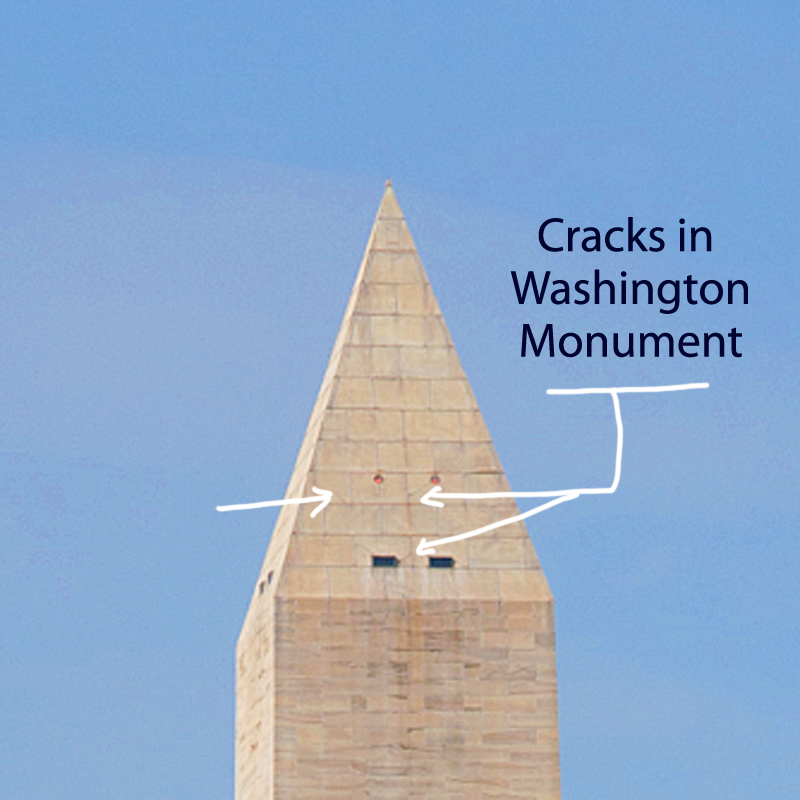
WASHINGTON — There were cracks in the Washington Monument and broken capstones at the National Cathedral. In the District of Columbia suburbs, some people stayed in shelters because of structural concerns at their apartment buildings.
A day after the East Coast’s strongest earthquake in 67 years, inspectors assessed the damage and found that most problems were minor. But the shaking raised questions about whether this part of the country, with its older architecture and inexperience with seismic activity, is prepared for a truly powerful quake.
The 5.8 magnitude quake felt from Georgia north to Canada prompted swift inspections of many structures Wednesday, including bridges and nuclear plants. An accurate damage estimate could take weeks, if not longer. And many people will not be covered by insurance.
In a small Virginia city near the epicenter, the entire downtown business district was closed. School was canceled for two weeks to give engineers time to check out cracks in several buildings.
At the 555-foot Washington Monument, inspectors found several cracks in the pyramidion – the section at the top of the obelisk where it begins narrowing to a point.
A 4-foot crack was discovered Tuesday during a visual inspection by helicopter. It cannot be seen from the ground. Late Wednesday, the National Park Service announced that structural engineers had found several additional cracks inside the top of the monument.
Carol Johnson, a park service spokeswoman, could not say how many cracks were found but said three or four of them were “significant.” Two structural engineering firms that specialize in assessing earthquake damage were being brought in to conduct a more thorough inspection on Thursday.
The monument, by far the tallest structure in the nation’s capital, was to remain closed indefinitely, and Johnson said the additional cracks mean repairs are likely to take longer. It has never been damaged by a natural disaster, including earthquakes in Virginia in 1897 and New York in 1944.
Tourists arrived at the monument Wednesday morning only to find out they couldn’t get near it. A temporary fence was erected in a wide circle about 120 feet from the flags that surround its base. Walkways were blocked by metal barriers manned by security guards.
“Is it really closed?” a man asked the clerk at the site’s bookstore.
“It’s really closed,” said the clerk, Erin Nolan. Advance tickets were available for purchase, but she cautioned against buying them because it’s not clear when the monument will open.
“This is pretty much all I’m going to be doing today,” Nolan said.
Tuesday’s quake was centered about 40 miles northwest of Richmond, 90 miles south of Washington and 3.7 miles underground. In the nearby town of Mineral, Va., Michael Leman knew his Main Street Plumbing & Electrical Supply business would need – at best – serious and expensive repairs.
At worst, it could be condemned. The facade had become detached from the rest of the building, and daylight was visible through a 4- to 6-inch gap that opened between the front wall and ceiling.
“We’re definitely going to open back up,” Leman said. “I’ve got people’s jobs to look out for.”
Leman said he is insured, but some property owners might not be so lucky.
The Insurance Information Institute said earthquakes are not covered under standard U.S. homeowners or business insurance policies, although supplemental coverage is usually available.
The institute says coverage for other damage that may result from earthquakes, such as fire and water damage from burst gas or water pipes, is provided by standard homeowners and business insurance policies in most states. Cars and other vehicles with comprehensive insurance would also be protected.
The U.S. Geological Survey classified the quake as Alert Level Orange, the second-most serious category on its four-level scale. Earthquakes in that range lead to estimated losses between $100 million and $1 billion.
In Culpeper, Va., about 35 miles from the epicenter, walls had buckled at the old sanctuary at St. Stephen’s Episcopal Church, which was constructed in 1821 and drew worshippers including Confederate Gens. Robert E. Lee and J.E.B. Stuart. Heavy stone ornaments atop a pillar at the gate were shaken to the ground. A chimney from the old Culpeper Baptist Church built in 1894 also tumbled down.
At the Washington National Cathedral, spokesman Richard Weinberg said the building’s overall structure remains sound and damage was limited to “decorative elements.”
Massive stones atop three of the four spires on the building’s central tower broke off, crashing onto the roof. At least one of the spires is teetering badly, and cracks have appeared in some flying buttresses.
Repairs were expected to cost millions of dollars – an expense not covered by insurance.
“Every single portion of the exterior is carved by hand, so everything broken off is a piece of art,” Weinberg said. “It’s not just the labor, but the artistry of replicating what was once there.”
The building will remain closed as a precaution. Services to dedicate the memorial honoring Rev. Martin Luther King Jr. were moved.
Other major cities along the East Coast that felt the shaking tried to gauge the risk from another quake.
A few hours after briefly evacuating New York City Hall, Mayor Michael Bloomberg said the city’s newer buildings could withstand a more serious earthquake. But, he added, questions remain about the older buildings that are common in a metropolis founded hundreds of years ago.
“We think that the design standards of today are sufficient against any eventuality,” he said. But “there are questions always about some very old buildings. … Fortunately those tend to be low buildings, so there’s not great danger.”
An earthquake similar to the one in Virginia could do billions of dollars of damage if it were centered in New York, said Barbara Nadel, an architect who specializes in securing buildings against natural disasters and terrorism.
The city’s 49-page seismic code requires builders to prepare for significant shifting of the earth. High-rises must be built with certain kinds of bracing, and they must be able to safely sway at least somewhat to accommodate for wind and even shaking from the ground, Nadel said.
Buildings constructed in Boston in recent decades had to follow stringent codes comparable to anything in California, said Vernon Woodworth, an architect and faculty member at the Boston Architectural College. New construction on older structures also must meet tough standards to withstand severe tremors, he said.
It’s a different story with the city’s older buildings. The 18th- and 19th-century structures in Boston’s Back Bay, for instance, were often built on fill, which can liquefy in a strong quake, Woodworth said. Still, there just aren’t many strong quakes in New England.
The last time the Boston area saw a quake as powerful as the one that hit Virginia on Tuesday was in 1755, off Cape Ann, to the north. A repeat of that quake would likely cause deaths, Woodworth said. Still, the quakes are so infrequent that it’s difficult to weigh the risks versus the costs of enacting tougher building standards regionally, he said.
People in several of the affected states won’t have much time to reflect before confronting another potential emergency. Hurricane Irene is approaching the East Coast and could skirt the Mid-Atlantic region by the weekend and make landfall in New England after that.
In North Carolina, officials were inspecting an aging bridge that is a vital evacuation route for people escaping the coastal barrier islands as the storm approaches.
Speaking at an earthquake briefing Wednesday, Washington Mayor Vincent Gray inadvertently mixed up his disasters.
“Everyone knows, obviously, that we had a hurricane,” he said before realizing his mistake.
“Hurricane,” he repeated sheepishly as reporters and staffers burst into laughter. “I’m getting ahead of myself!”
___
Associated Press writers Sam Hananel in Washington; Alex Dominguez in Baltimore; Bob Lewis in Mineral, Va.; Samantha Gross in New York City; and Jay Lindsay in Boston contributed to this report.

Tuesday, August 5, 2025

The Sixth Seal Long Overdue (Revelation 6)

ON THE MAP; Exploring the Fault Where the Next Big One May Be Waiting


The Big One Awaits
By MARGO NASH
Published: March 25, 2001
Alexander Gates, a geology professor at Rutgers-Newark, is co-author of ”The Encyclopedia of Earthquakes and Volcanoes,” which will be published by Facts on File in July. He has been leading a four-year effort to remap an area known as the Sloatsburg Quadrangle, a 5-by-7-mile tract near Mahwah that crosses into New York State. The Ramapo Fault, which runs through it, was responsible for a big earthquake in 1884, and Dr. Gates warns that a recurrence is overdue. He recently talked about his findings.
Q. What have you found?
A. We’re basically looking at a lot more rock, and we’re looking at the fracturing and jointing in the bedrock and putting it on the maps. Any break in the rock is a fracture. If it has movement, then it’s a fault. There are a lot of faults that are offshoots of the Ramapo. Basically when there are faults, it means you had an earthquake that made it. So there was a lot of earthquake activity to produce these features. We are basically not in a period of earthquake activity along the Ramapo Fault now, but we can see that about six or seven times in history, about 250 million years ago, it had major earthquake activity. And because it’s such a fundamental zone of weakness, anytime anything happens, the Ramapo Fault goes.
Q. Where is the Ramapo Fault?
A. The fault line is in western New Jersey and goes through a good chunk of the state, all the way down to Flemington. It goes right along where they put in the new 287. It continues northeast across the Hudson River right under the Indian Point power plant up into Westchester County. There are a lot of earthquakes rumbling around it every year, but not a big one for a while.
Q. Did you find anything that surprised you?
A. I found a lot of faults, splays that offshoot from the Ramapo that go 5 to 10 miles away from the fault. I have looked at the Ramapo Fault in other places too. I have seen splays 5 to 10 miles up into the Hudson Highlands. And you can see them right along the roadsides on 287. There’s been a lot of damage to those rocks, and obviously it was produced by fault activities. All of these faults have earthquake potential.
Q. Describe the 1884 earthquake.
A. It was in the northern part of the state near the Sloatsburg area. They didn’t have precise ways of describing the location then. There was lots of damage. Chimneys toppled over. But in 1884, it was a farming community, and there were not many people to be injured. Nobody appears to have written an account of the numbers who were injured.
Q. What lessons we can learn from previous earthquakes?
A. In 1960, the city of Agadir in Morocco had a 6.2 earthquake that killed 12,000 people, a third of the population, and injured a third more. I think it was because the city was unprepared.There had been an earthquake in the area 200 years before. But people discounted the possibility of a recurrence. Here in New Jersey, we should not make the same mistake. We should not forget that we had a 5.4 earthquake 117 years ago. The recurrence interval for an earthquake of that magnitude is every 50 years, and we are overdue. The Agadir was a 6.2, and a 5.4 to a 6.2 isn’t that big a jump.
Q. What are the dangers of a quake that size?
A. When you’re in a flat area in a wooden house it’s obviously not as dangerous, although it could cut off a gas line that could explode. There’s a real problem with infrastructure that is crumbling, like the bridges with crumbling cement. There’s a real danger we could wind up with our water supplies and electricity cut off if a sizable earthquake goes off. The best thing is to have regular upkeep and keep up new building codes. The new buildings will be O.K. But there is a sense of complacency.
MARGO NASH
Photo: Alexander Gates, a Rutgers geologist, is mapping a part of the Ramapo Fault, site of previous earthquakes. (John W. Wheeler for The New York Times)